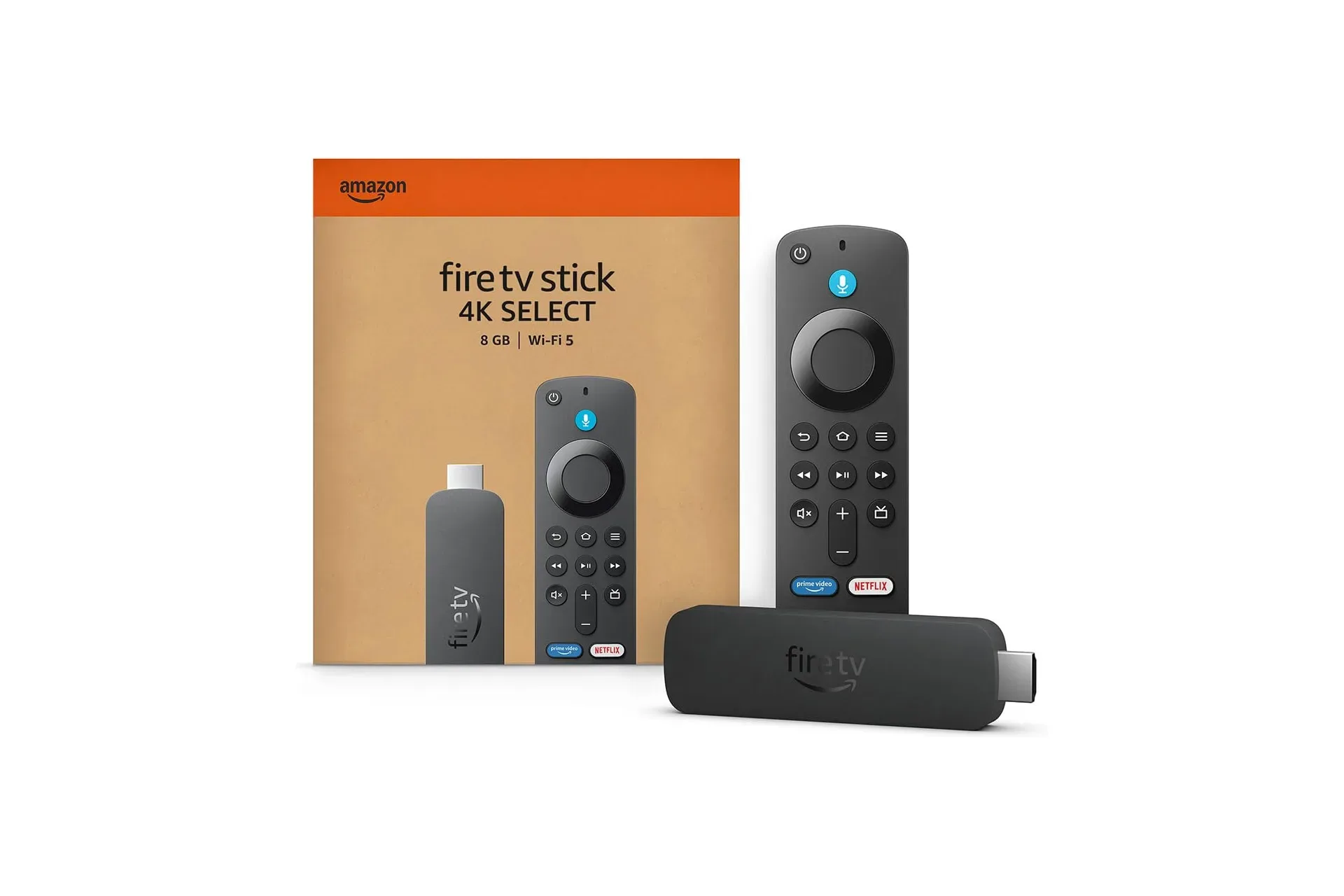
Amazon has cut the Fire TV Stick 4K Select to $18 as part of its early Black Friday promotions, a $32 reduction from its stated $50 regular price. That is a 64% discount, and it puts a 4K-capable streaming device into the kind of price bracket usually reserved for a simple replacement remote, a suspiciously expensive HDMI cable, or three snacks that somehow seemed sensible at the checkout.
The deal is described as limited-time, so the useful fact is not that the stick is suddenly a no-questions-asked premium streaming solution. It is that buyers who need an inexpensive way to add Amazon’s Fire TV interface to a television can get the core 4K streaming function for substantially less than the listed price—provided its deliberate omissions fit their setup.
That distinction matters. The Fire TV Stick 4K Select is Amazon’s budget-minded 4K option, not a version that has every feature offered by the higher-end Fire TV Stick 4K Plus. It can play 4K-resolution and HDR content, but it does not support Wi-Fi 6, Dolby Vision, or Dolby Atmos. It uses Wi-Fi 5 and includes 1GB of RAM; the Fire TV Stick 4K Plus has twice that memory.
For $18, those compromises may be perfectly reasonable. But a Black Friday percentage is not a magical spell that makes every missing feature vanish into a puff of festive retail smoke. The smart question is whether the Select’s baseline feature set matches the television, network and streaming services already in a home.
What the deal includes—and what it does not
A streaming stick is a compact media player that connects to a television through an HDMI port. In this case, it provides the Fire TV interface: a central menu for finding and opening supported streaming apps. The device is powered over USB, either from a television’s USB port where available or from another USB power source.
That basic arrangement can be useful for a television that lacks a preferred smart-TV interface, has limited app options, or simply needs a separate streaming front end. The Fire TV Stick 4K Select supports services including Netflix, HBO Max, Hulu, Apple TV, Disney Plus and Prime Video. It also supports more specialized services such as Dropout, Crunchyroll and Shudder.
App availability does not mean every service is included with the hardware. Many of those platforms require their own subscriptions. The Fire TV ecosystem also offers free, ad-supported movies, shows and live TV options, while YouTube remains another broad source of video. In short, the stick is the route to the apps and services; it is not a bundle containing every show people may want to watch.
For households where Crunchyroll is part of the routine, support for that app is one of the device’s more relevant entertainment credentials. That is a streaming convenience, however, rather than a gaming feature. The supplied specifications do not establish game-streaming capability, controller support, cloud-gaming performance, or any other game-focused function, so prospective buyers should not treat this offer as an all-purpose console substitute.
Understanding 4K and HDR without the alphabet soup
4K refers to a high-resolution video format. The headline value of the Fire TV Stick 4K Select is that it can deliver 4K streamed content on compatible equipment. That is the core feature Amazon has retained at the lower price point.
HDR, short for high dynamic range, concerns how a picture handles brightness and color range. The Fire TV Stick 4K Select supports HDR content, which is important because resolution and image presentation are separate considerations. A device can be 4K-capable while its support for particular HDR formats differs from another model.
Here, the major missing format is Dolby Vision. The Select supports HDR but omits Dolby Vision support. That does not erase its 4K and HDR capabilities; it simply means buyers looking specifically for Dolby Vision should recognize that the lower-cost model is not presented as the right fit for that requirement.
The other notable exclusion is Dolby Atmos, an audio format not supported by the 4K Select. Buyers who specifically want that format should not assume a “4K” label covers it. Video resolution, HDR formats and audio formats are related parts of an entertainment setup, but they are not interchangeable checkboxes.
The practical takeaway is uncomplicated: someone who wants a low-cost way to stream in 4K and HDR may find the Select’s feature set sufficient. Someone building around Dolby Vision and Dolby Atmos should pay attention to the model name rather than letting the sale banner do all the thinking.
Wi-Fi 5, Wi-Fi 6 and the memory gap
Networking is another dividing line between the 4K Select and the Fire TV Stick 4K Plus. The Select uses Wi-Fi 5 and does not include Wi-Fi 6 support. Wi-Fi 6 is a newer Wi-Fi standard, but its absence is not automatically a deal-breaker for every home. The provided information does not make a performance promise about either model in a particular network, and real-world streaming conditions can depend on the existing connection and equipment.
What can be said plainly is that buyers who specifically prioritize Wi-Fi 6 compatibility will not get it from the Select. If that is an essential part of the household setup, a larger discount does not alter the specification.
Memory is the other stated hardware difference. The Fire TV Stick 4K Select has 1GB of RAM, while the Fire TV Stick 4K Plus has double that amount. RAM is short-term working memory used while a device runs software and shifts among active tasks. The source material identifies the capacity difference but does not quantify what it means for app-loading speed, multitasking or responsiveness in any particular scenario. It is best treated as a meaningful product-tier distinction, not as a license to invent a benchmark chart in one’s head.
That restraint is especially useful during holiday sales. A lower-priced model is often designed around a clear trade: retain a few essential functions, trim higher-tier specifications, and reduce the cost. In this case, the essentials Amazon highlights are 4K streaming, HDR, HDMI connection and access to the Fire TV app ecosystem. The trims are Wi-Fi 6, Dolby Vision, Dolby Atmos and the additional RAM found in the Plus model.
A simple setup may be the strongest selling point
The Fire TV Stick 4K Select’s physical setup is straightforward. It plugs into a television through HDMI and draws power through USB. Some televisions have a USB port that can provide that power, potentially avoiding the need to use a spare wall outlet. Whether that option is available depends on the television, so it is worth checking the ports before buying rather than discovering the answer while balancing behind a media cabinet at an angle no human spine was designed to attempt.
The uncomplicated installation is meaningful for a secondary television, a guest-room screen, or a display that needs access to a wider familiar set of streaming apps. It also means the $18 price is not paired, in the provided details, with a requirement for a separate hub or major installation project.
Still, prospective buyers should take inventory of the non-negotiables first: an available HDMI input, a USB power option or another way to supply USB power, and an internet setup appropriate for the services they plan to use. Subscribers should also confirm that the apps they rely on are available in their own circumstances; the device’s app list is not the same thing as an active subscription library.
Who this sale makes sense for
The 4K Select is easiest to recommend on the evidence available when the goal is simple: get Fire TV access and 4K/HDR streaming at the lowest possible upfront cost. At $18, its stated discount is large enough that the model’s role as a value-oriented option is unusually clear.
- Good fit: viewers who want a low-cost Fire TV stick with 4K and HDR support.
- Good fit: homes using streaming services such as Netflix, HBO Max, Hulu, Apple TV, Disney Plus, Prime Video, Crunchyroll, Dropout or Shudder, assuming the relevant subscriptions are in place.
- Good fit: televisions with HDMI and a workable USB-power arrangement.
- Consider a different model: buyers who require Wi-Fi 6, Dolby Vision, Dolby Atmos or the 2GB RAM configuration identified for the Fire TV Stick 4K Plus.
- Do not assume: that the hardware purchase includes paid streaming subscriptions or that it has unlisted gaming capabilities.
It is also a useful reminder that holiday-device deals should be assessed by the feature that actually solves a problem, not by the size of the percentage printed beside it. A similar logic applies to other discounted tech, including this Galaxy S26 FE price cut: the price matters, but the specifications determine whether the item belongs in a particular setup.
For the Fire TV Stick 4K Select, the equation is unusually clean. The price has fallen from $50 to $18. It retains 4K and HDR streaming plus the Fire TV app catalog. In exchange, it leaves out Wi-Fi 6, Dolby Vision, Dolby Atmos and the Plus model’s larger RAM allocation. Buyers content with that balance have a notably inexpensive option ahead of Black Friday; buyers who need those omitted features have a clear reason not to mistake “cheap” for “complete.”
Shop the products
Check current price, model and availability at the retailer.