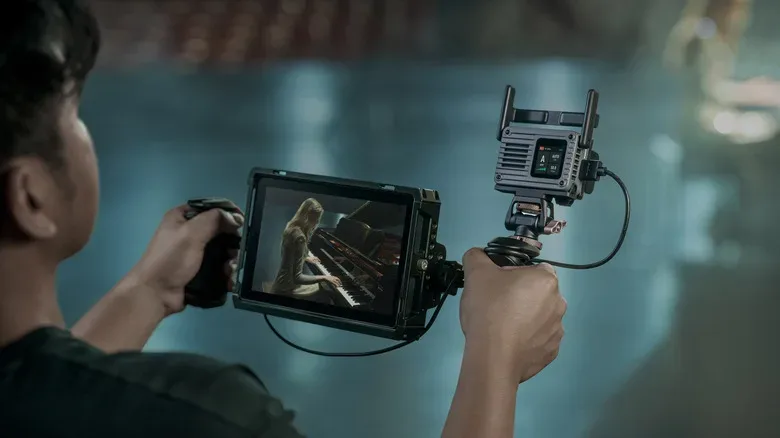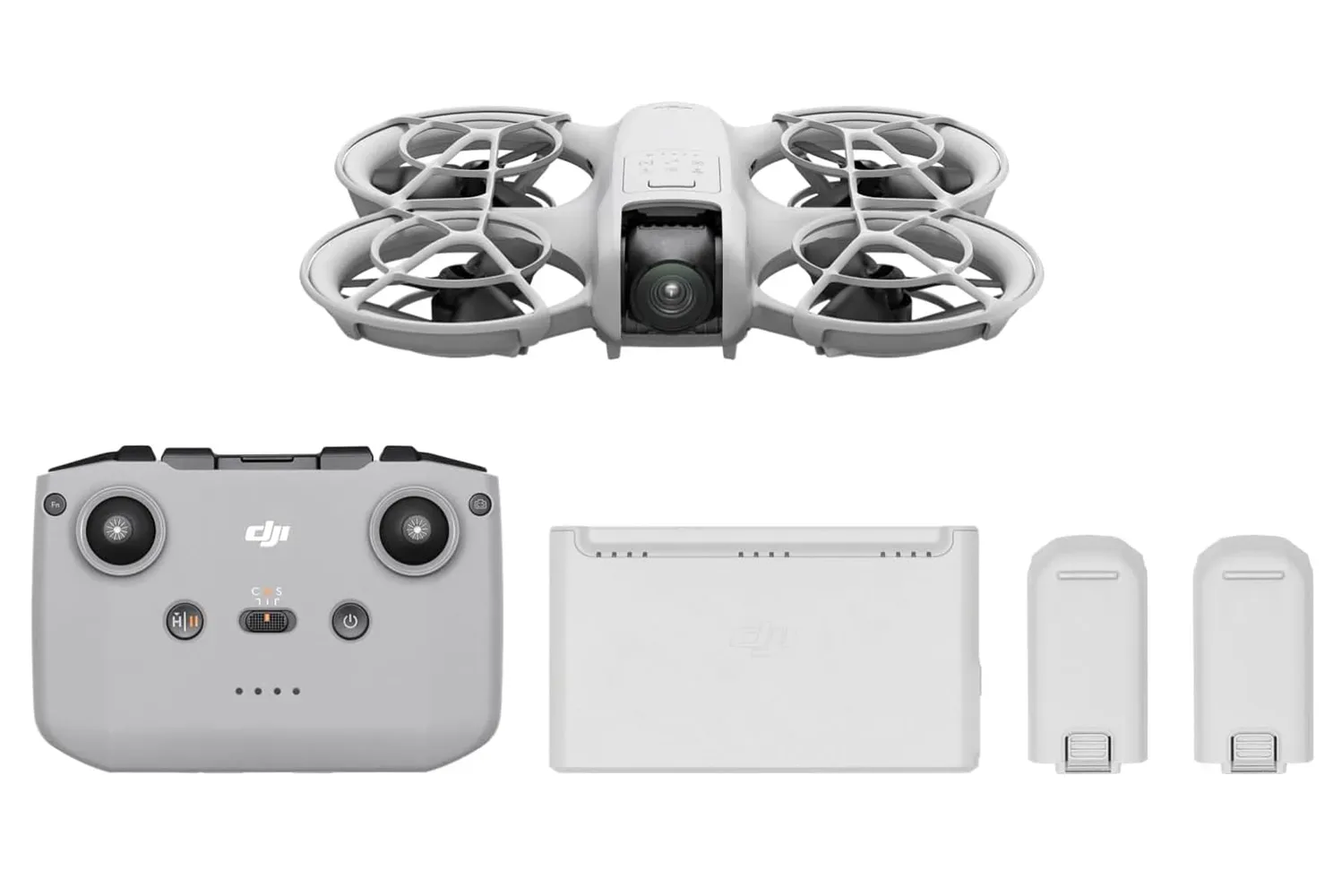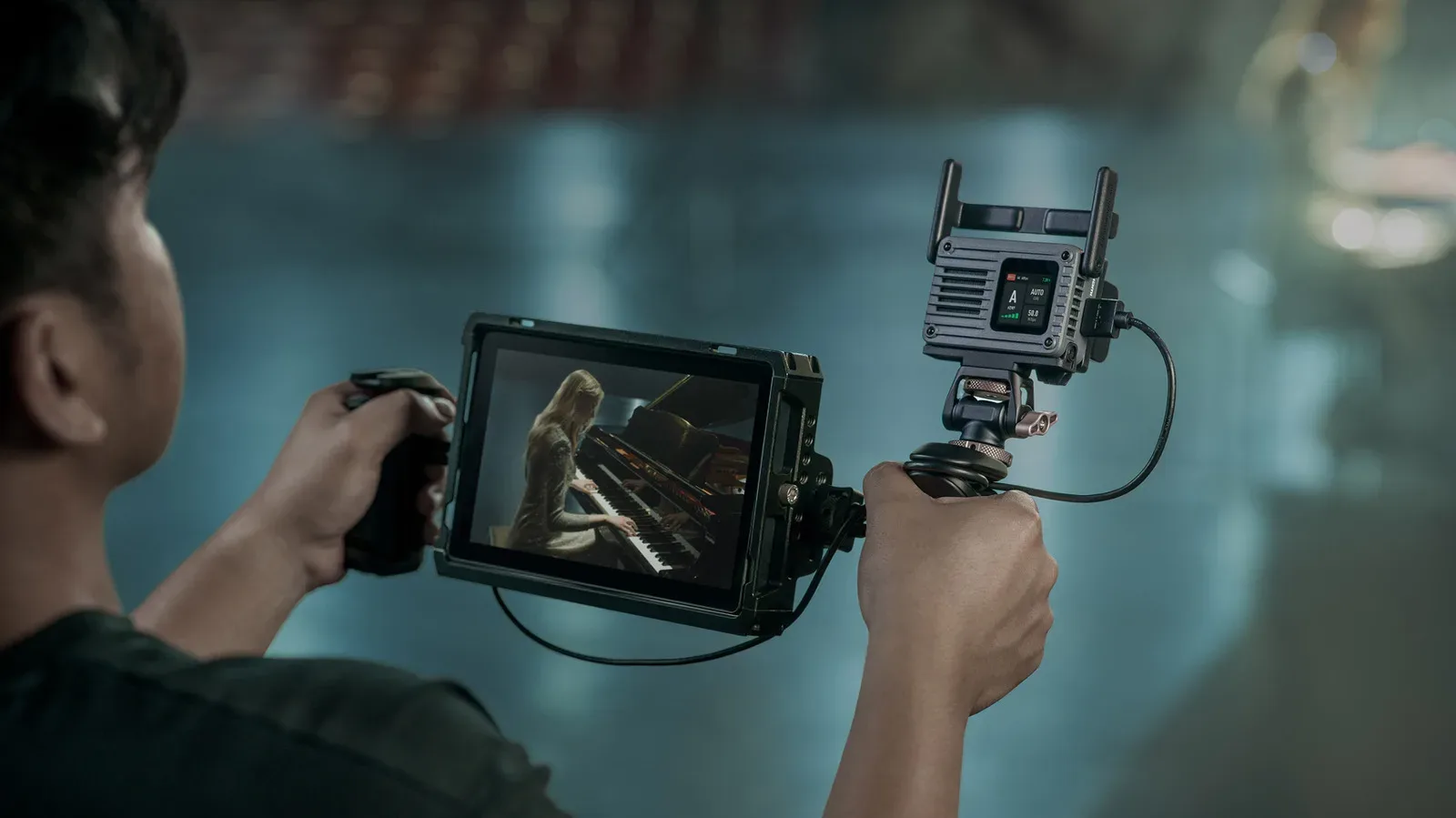
DJI has introduced SDR Transmission II, a wireless video system aimed squarely at production crews that need to see and control cameras from a distance. Its headline upgrade is substantial: the new transmitter can send 4K video at 60 frames per second with HDR at a stated 50Mbps bitrate, reaching receiving transceivers as far as 2.5 miles (4 km) away.
That is a notable step up from the original SDR Transmission system, which was specified for 1080p video at 20Mbps and a range of 1.8 miles (3 km). The newer system is not merely about putting a sharper picture on a monitor. DJI is positioning it as a coordination tool for demanding multi-camera work, where a director, producer, camera assistant or focus puller may need a usable image and responsive control without standing beside the camera.
Its potential applications include open stadiums, forested locations, vehicle-to-vehicle work and FPV drone shots. In each case, the practical problem is similar: the camera may be moving, inaccessible or far enough away that running a conventional video cable is impractical. A wireless link does not remove every production complication, but it can give the crew a way to monitor a shot and react while it is happening.
What SDR means here — and what the new specifications mean
In this product name, SDR stands for software-defined radio, not standard dynamic range. A software-defined radio is a radio system whose behavior is substantially managed through software rather than being fixed entirely in dedicated hardware. In a video-transmission product, that foundation is relevant because reliable wireless video requires the system to manage a radio link while sending a great deal of data.
The visual specification is more straightforward. 4K refers to a high-resolution video format, while 60 fps means 60 frames per second. Higher frame rates can be especially useful for rapidly changing movement, whether that is action on a field, a moving vehicle or an FPV camera navigating a tight route. HDR, or high dynamic range, refers to video designed to retain a broader range of bright and dark image detail than conventional SDR imagery, provided the rest of the workflow supports it.
DJI lists a 50Mbps bitrate for SDR Transmission II. Bitrate is the quantity of video data sent each second; it is not a complete measure of image quality on its own, but it is central to the trade-off a wireless video system has to manage. More resolution, more frames and HDR all raise the demands on the link. The move from the original model’s 1080p/20Mbps specification to 4K/60 HDR at 50Mbps is therefore the core of this generation’s proposition.
Range deserves a similarly careful reading. DJI states up to 2.5 miles, or 4 km, between a transmitter and receiving transceiver. That is a maximum claimed figure, not a promise that every working location will behave identically. A stadium, a mountain forest, a car rig and an FPV flight each present different obstacles. The important production-facing claim is that the system is designed for those varied environments, not that distance alone determines whether a shoot has a dependable signal.
Built for monitoring, control and multi-camera coordination
A transceiver can operate as a transmitter or receiver, depending on its mode. In TX mode, SDR Transmission II sends the camera feed; in RX mode, it receives that feed for monitoring. DJI says one transceiver can connect to as many as eight others, with remote control supported at each connected unit.
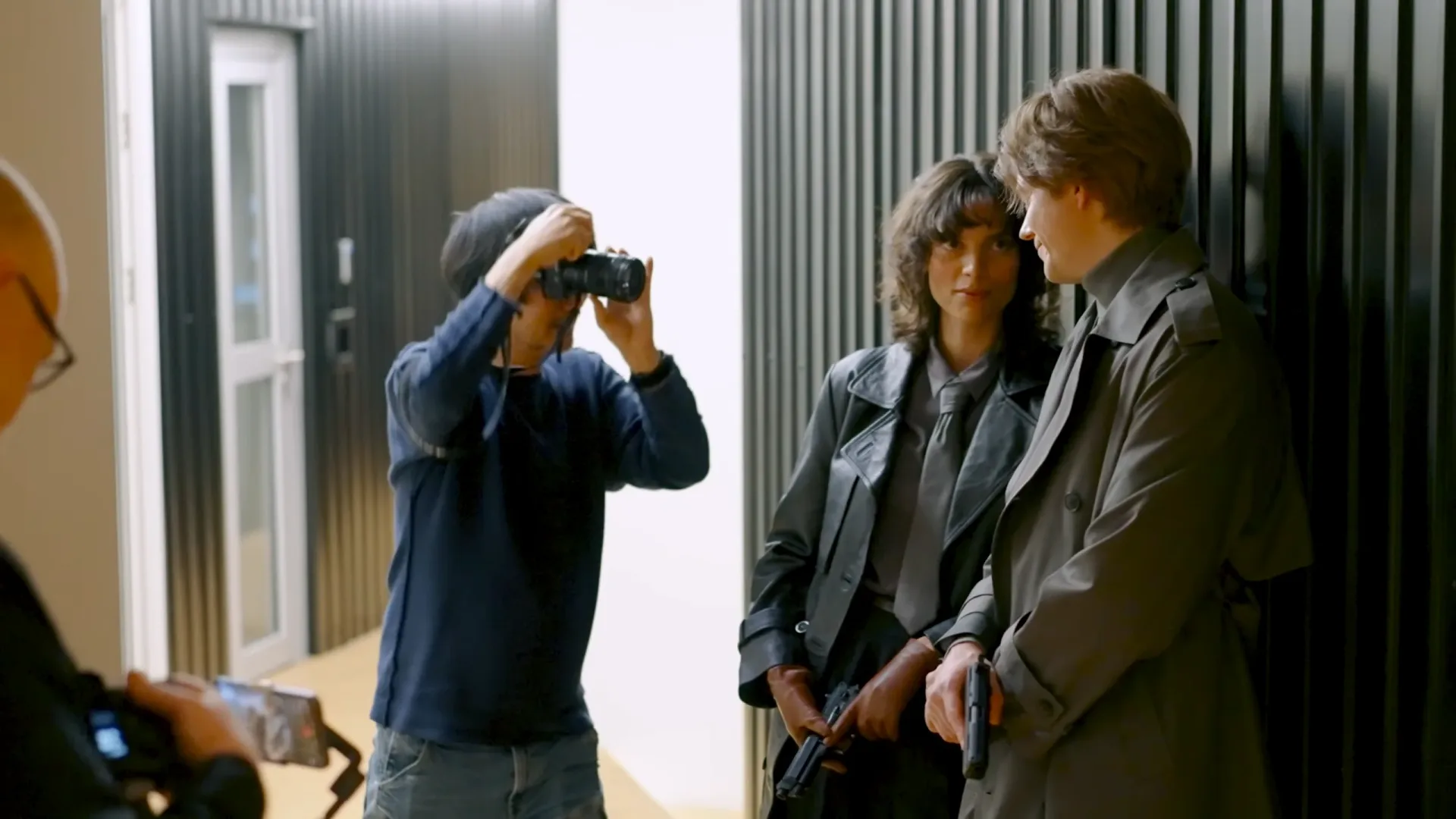
That arrangement matters because camera feeds are useful to more people than the operator holding the camera. A director may be following composition and performance. A producer may be watching coverage. A focus puller may be watching sharpness and adjusting focus remotely. DJI says the system supports remote camera adjustment and control for camera operators and focus pullers, in addition to monitoring for personnel around the set.
For bigger shoots, DJI specifies support for up to five transmitters and 40 receivers operating at once. Put plainly, that is intended for a production with multiple active cameras and multiple people who need access to those pictures. It makes the system more relevant to a sports, concert, live-event or action-production workflow than to a solo creator who only needs a simple camera-to-monitor connection.
Sports coverage is a natural example of why multi-camera monitoring has value. A crew may need to follow activity from several angles while keeping an eye on moving camera positions. The visual culture surrounding sport also increasingly crosses between competition, fashion and media production, as seen in coverage of Stefon Diggs’ Air Jordan 17 Low “Lightning” cleats. SDR Transmission II is not a consumer sports accessory, but it is the kind of behind-the-scenes equipment designed to help professional crews keep complex moving images organized.
35ms latency and why it matters
DJI lists latency as low as 35 milliseconds. Latency is the delay between an event at the camera and the corresponding image or response at the receiving end. In a production setting, the concern is not just whether a picture eventually arrives; it is whether the delay is short enough for a crew member to make useful decisions while a shot is still in progress.
A low-latency feed can matter for focus pulling, where an assistant adjusts focus to keep a subject sharp as the distance between camera and subject changes. It can also matter for gimbal movement and other remote commands. A delayed view makes timing harder, particularly when a camera, vehicle or subject is moving quickly. DJI’s 35ms figure is therefore one of the product’s more consequential specifications, though it is described as an “as low as” measurement rather than a universal result for every setup and location.
The system also adds a tap-based way to switch between camera feeds without the usual process of rebooting, disconnecting and searching for the desired link. On a multi-camera set, reducing that interruption could be as useful as increasing raw range. A crew member who needs to check another angle wants the change to be immediate and orderly, rather than turning monitoring into an equipment-management task.
Monitoring tools go beyond simply seeing the feed
SDR Transmission II supports smartphone monitoring and several image-assist tools: LUTs, focus peaking and waveforms. These terms are familiar to camera departments, but they are worth unpacking because they describe what turns a wireless feed into a working reference rather than a casual preview.
- LUTs, or look-up tables, are used to apply a chosen viewing transformation to an image. They can help a crew monitor a particular intended look without changing the underlying purpose of the camera feed.
- Focus peaking highlights areas that appear to be in focus. It is an assistive visual guide, particularly helpful when judging sharpness from a monitor rather than through a camera viewfinder.
- Waveforms provide a visual representation of image signal levels. They can help users evaluate exposure-related information in a more technical form than a picture alone offers.
DJI also says the system supports PTP control on compatible cameras. The supported controls include capture, aperture, shutter speed and ISO. Aperture controls how open the lens is; shutter speed affects the time each frame is exposed; and ISO is the camera’s sensitivity setting. These are core image-making controls, so the value of remote operation is clear when the camera cannot be conveniently reached.
Compatibility is the operative word. The supplied details identify those controls as available on compatible cameras, but do not provide a complete supported-camera list. Buyers and production managers will need to verify that their particular camera and desired remote-control functions are supported before treating the system as a replacement for hands-on adjustment.
A professional transmission system, not a drone-recording substitute
DJI says SDR Transmission II uses the same foundational wireless technology as its OcuSync drone system. That connection may invite a simple question: does this mean DJI drone video links now deliver 4K/60 HDR in the same way? The available information does not say that. SDR Transmission II is presented as a professionally oriented transmission product, while OcuSync is DJI’s established drone-link technology.
The distinction matters for aerial workflows. A live transmission feed and footage recorded to onboard drone storage serve different roles. The material supplied notes the appeal of a 4K/60p OcuSync upgrade as a possible backup when onboard memory is a concern, but no such OcuSync upgrade is announced here. SDR Transmission II should consequently be understood on its own stated terms: a dedicated pro-video transmission and control system, not confirmation of a new drone recording or downlink format.
Price, regional availability and the buying question
DJI lists SDR Transmission II transceivers from €349 or £309. A two-unit Combo is listed at €629 or £559. Since a transmission workflow commonly needs a sending side and a receiving side, the two-pack is the more immediately legible option for a basic link, while larger configurations would depend on the number of cameras and monitors required.
There is currently no US availability listed. The supplied information suggests this may be connected to a ban affecting certain DJI products, but does not establish a release date or a definitive reason for the absence. For prospective US buyers, the practical point is simply that availability has not been provided.
For crews working in the supported regions, SDR Transmission II’s appeal is the combination rather than any lone statistic: higher-resolution HDR monitoring, 60 fps video, a claimed 4 km maximum range, low stated latency, remote control functions and the ability to scale up to five transmitters and 40 receivers. Whether those specifications justify the system depends on the production’s camera count, locations, compatible gear and monitoring needs. But DJI’s update is plainly aimed at the jobs where a lost minute, an inaccessible camera or a sluggish wireless feed can disrupt much more than a single shot.