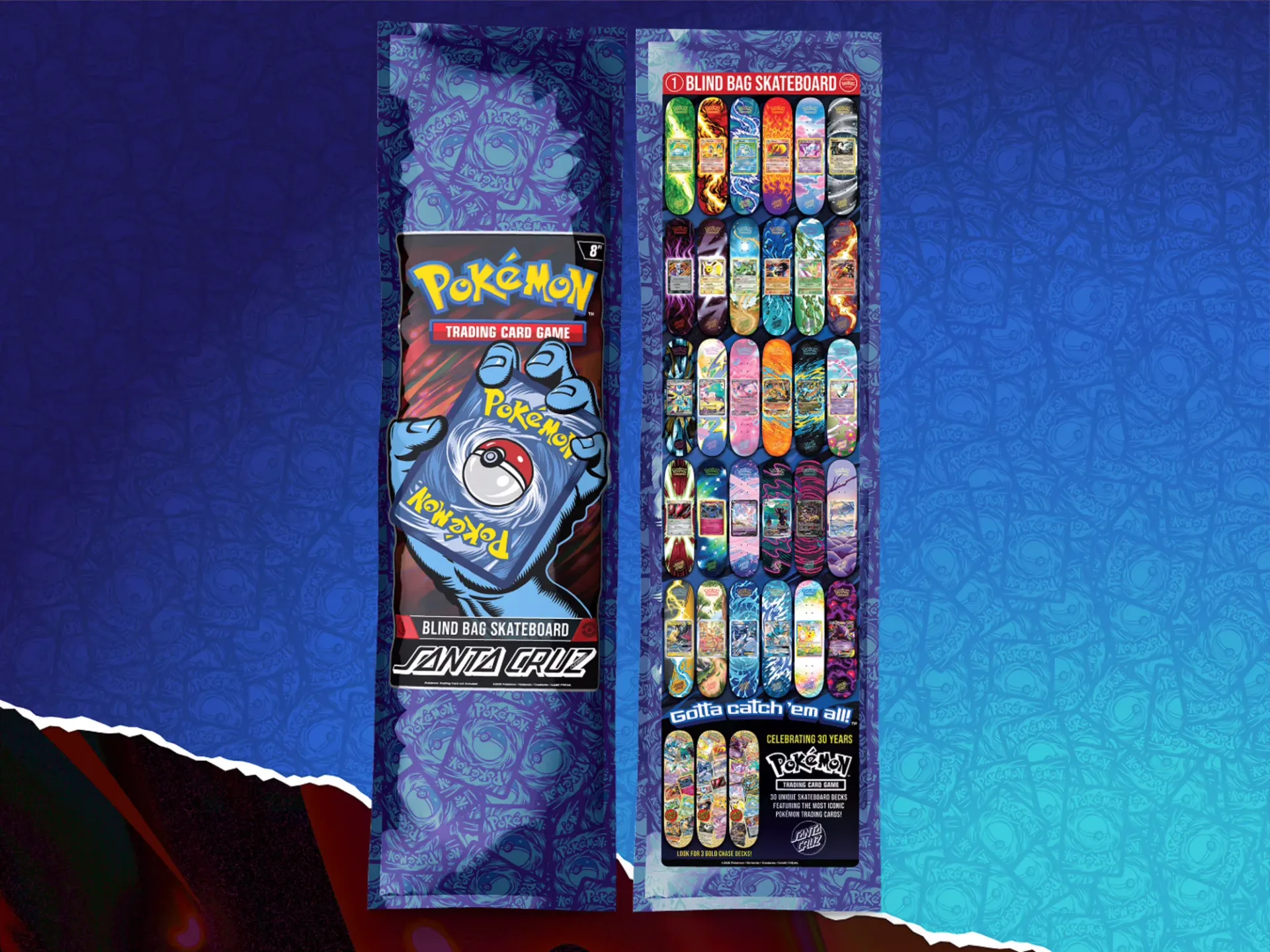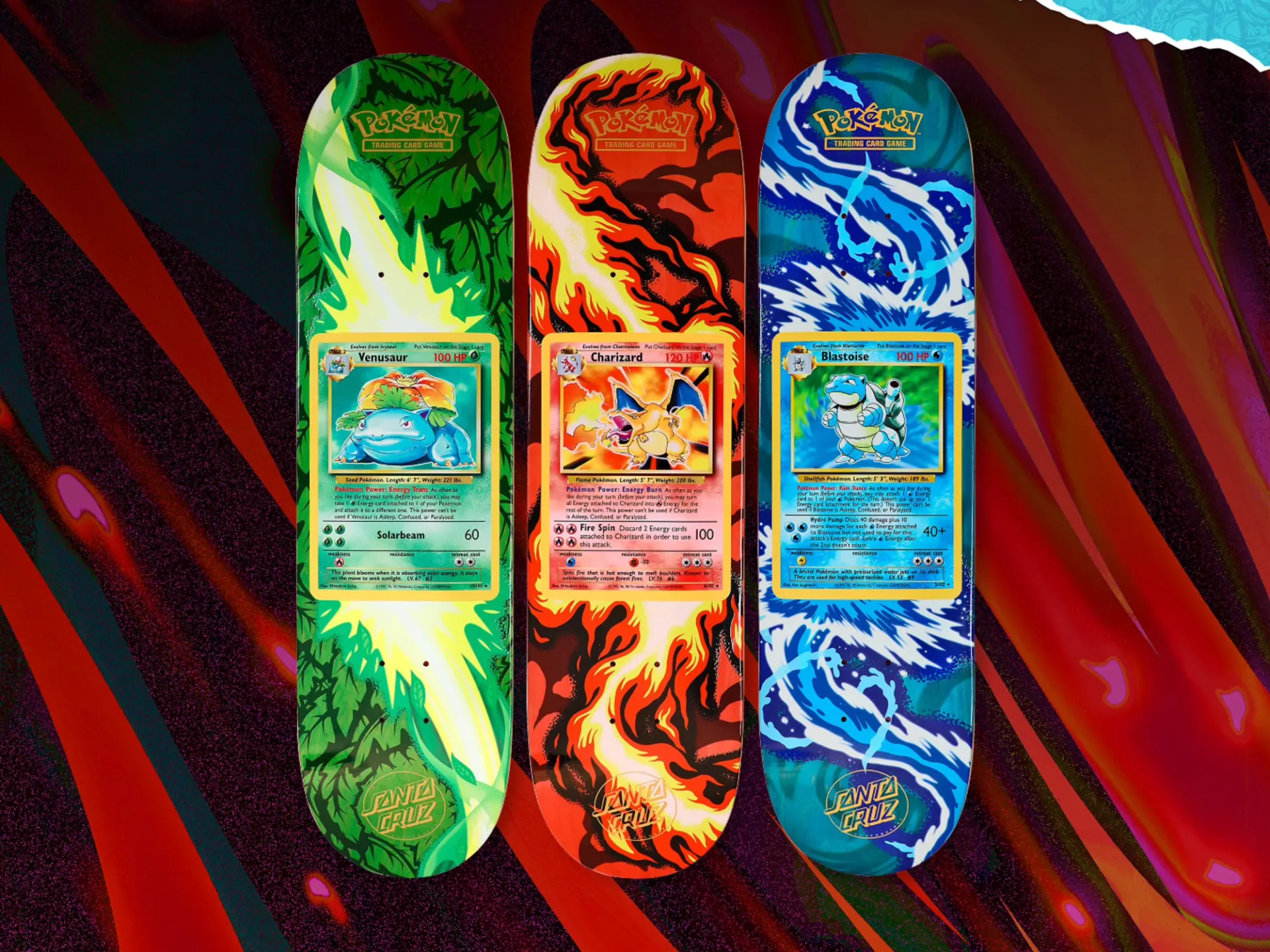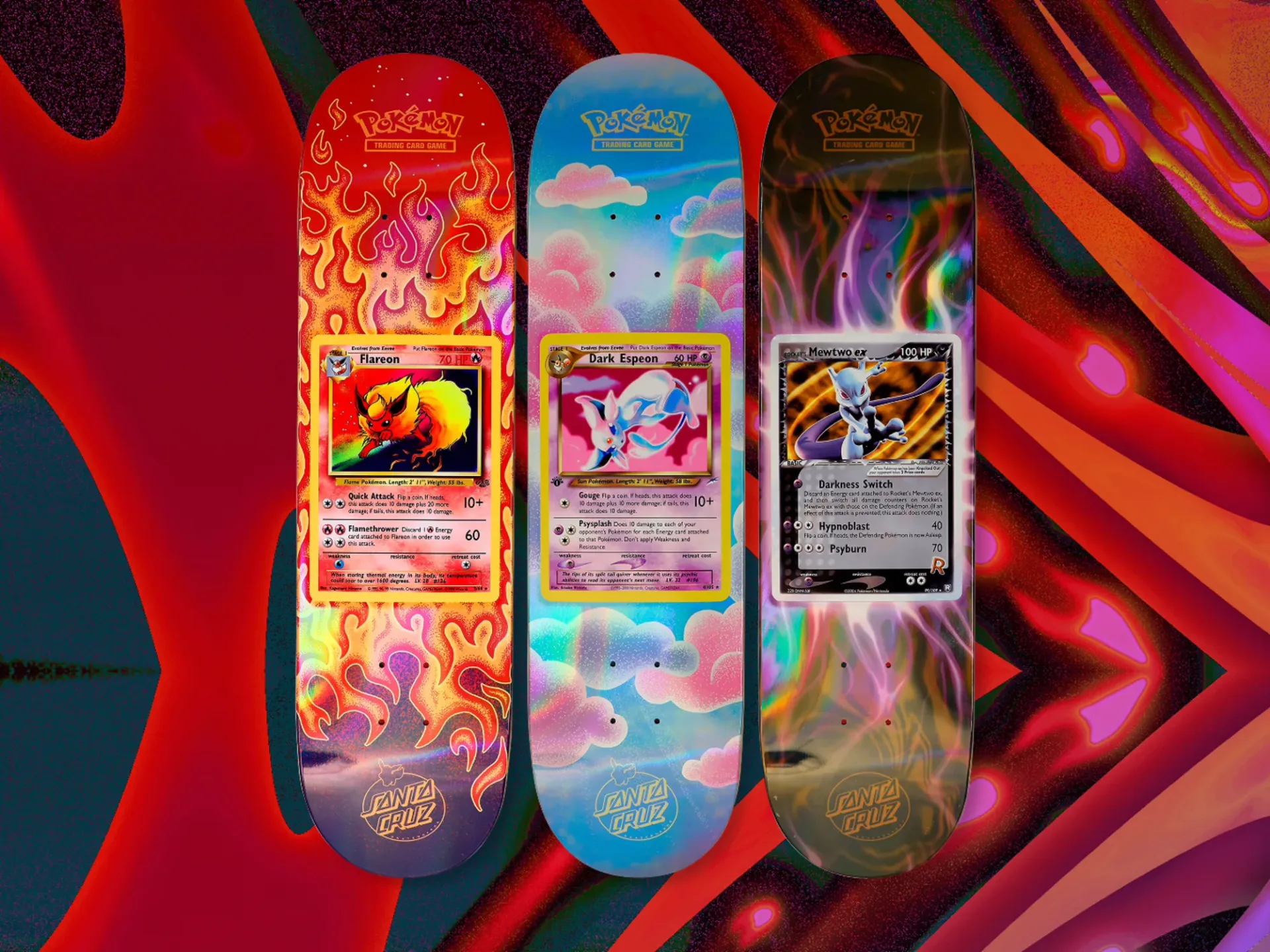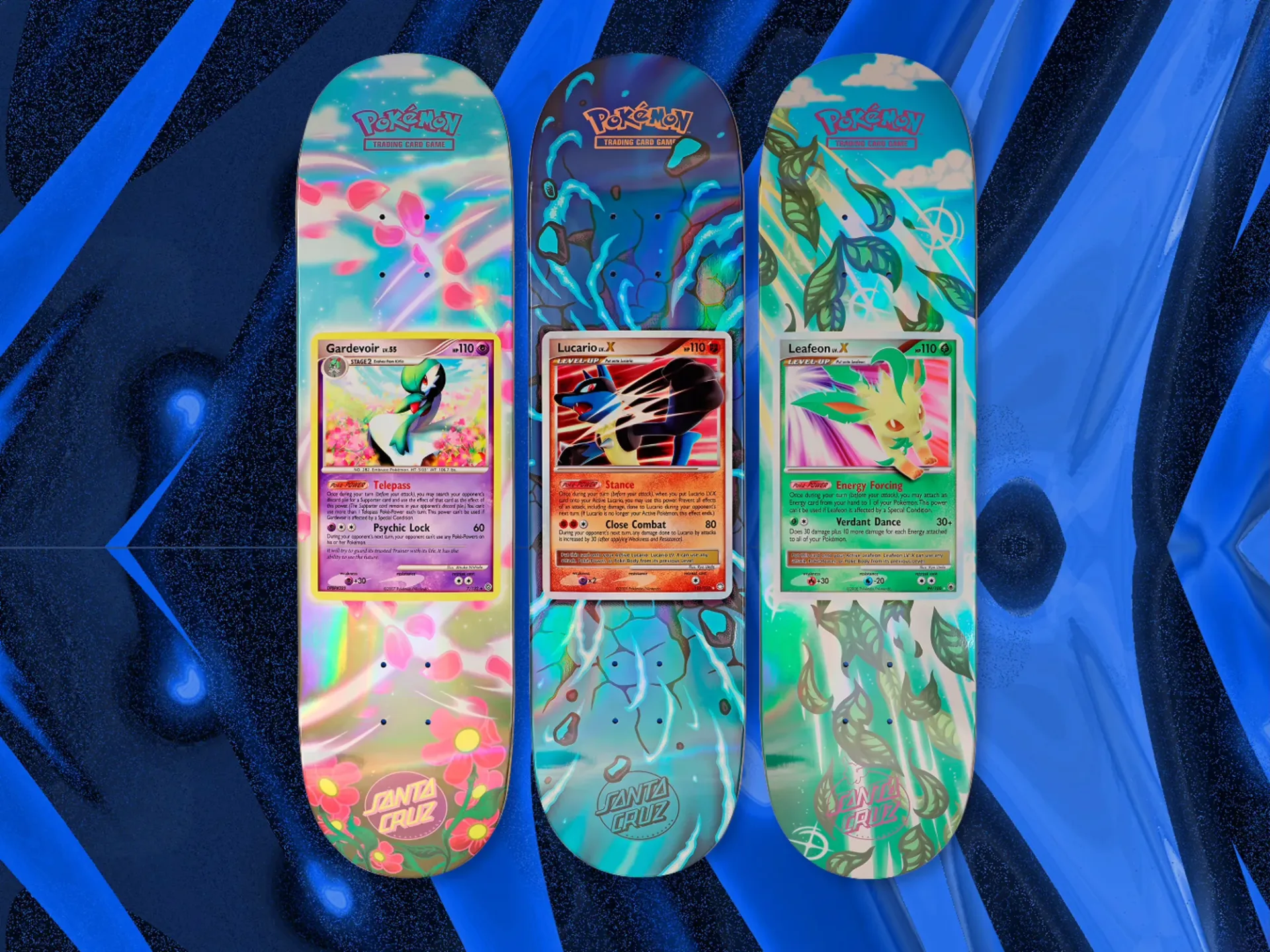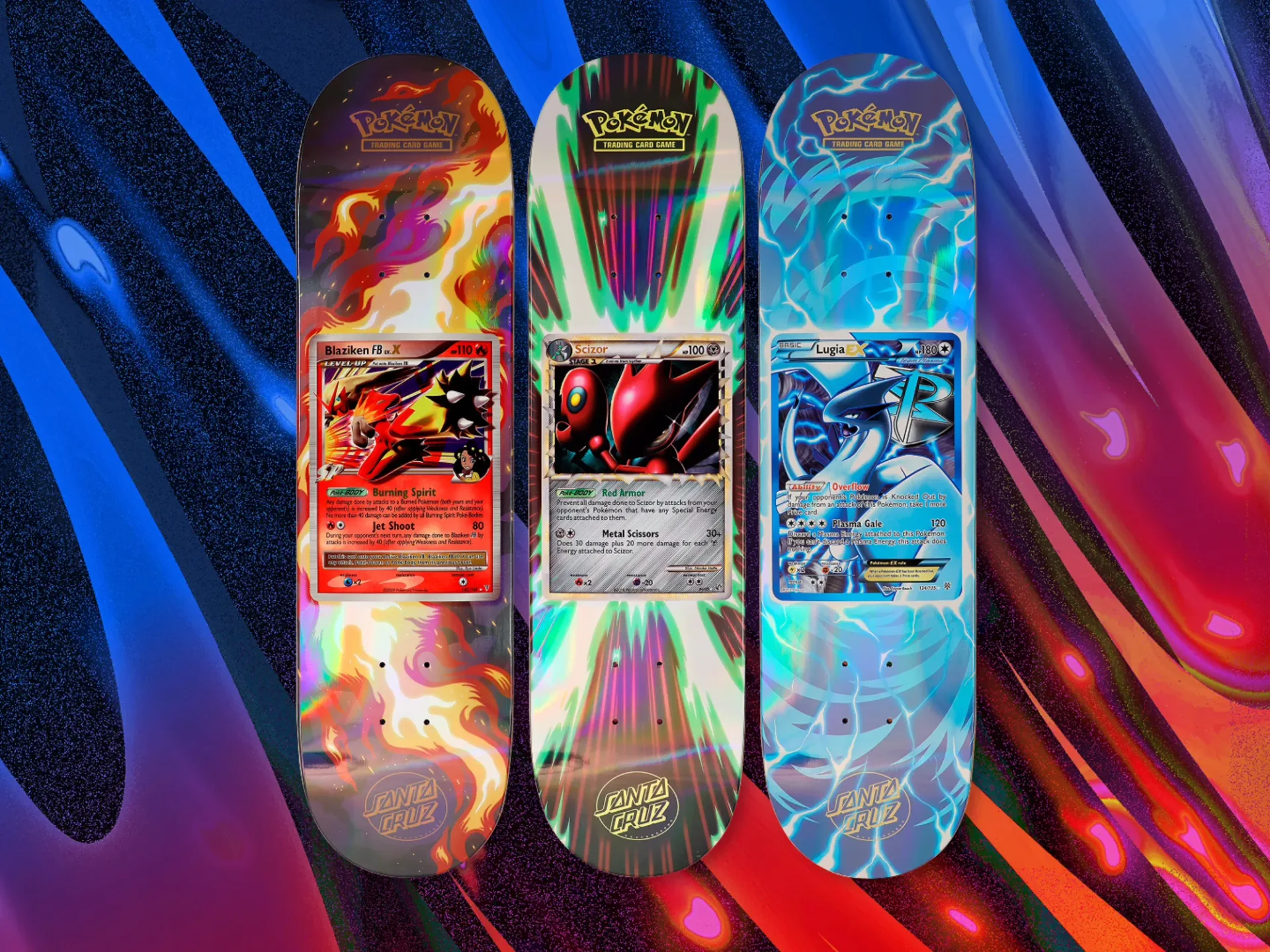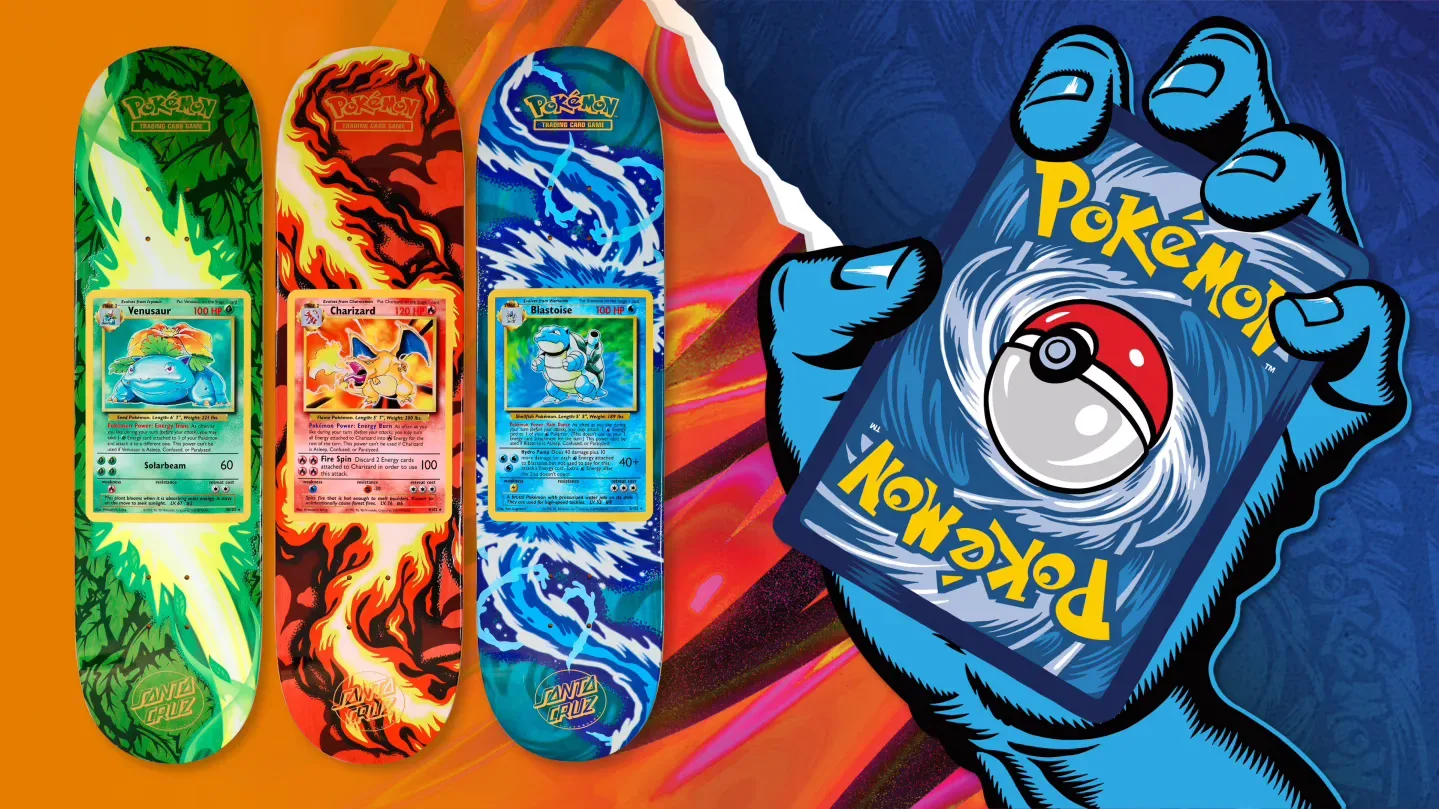
Pokémon’s 30th-anniversary celebrations now have grip tape-adjacent consequences. Pokémon and Santa Cruz Skateboards have released a new line of blind-bag skateboard decks built around artwork from the Pokémon Trading Card Game’s long history. The collection has 30 standard deck designs, each drawing on the illustration from a notable Pokémon card, alongside three glitter-gold variants made from collages of 10 cards apiece.
The decks are available through Pokémon Center, Santa Cruz Skateboards’ online store, and local skate shops. Every Variant Skateboard deck also comes with a booklet cataloguing the 30 deck designs and the gold variants, plus a collectible sticker.
It is a crossover that treats TCG illustration as more than packaging art. A card is normally a compact object: its art is framed by rules text, borders, symbols, rarity treatment, and the practical requirement to fit in a deck box. A skateboard deck gives that illustration an entirely different canvas. The image becomes wall-sized collectible design, whether its owner plans to ride it or display it.
Thirty designs, with card art as the main attraction
The central idea is simple but unusually specific: these are decks inspired by individual Pokémon TCG cards rather than merely decks decorated with broadly familiar Pokémon. That distinction matters to card collectors. The appeal is tied not just to which Pokémon appears, but to a particular piece of artwork and the card’s place in the game’s history.
Examples named for the line stretch across several TCG eras:
- Charizard, illustrated by Mitsuhiro Arita, from the original Base Set expansion.
- Lugia-EX, illustrated by Toyste Beach, from Black & White—Plasma Storm.
- Umbreon VMAX, illustrated by KEIICHIRO ITO, from Sword & Shield—Evolving Skies.
Those selections make the anniversary angle clearer. Rather than isolating one generation or one current product cycle, the collaboration pulls from multiple periods of the TCG. The result is a line aimed at people who recognize landmark card images as objects of fandom in their own right—whether their attachment began with early Pokémon card collecting, a later competitive era, or modern expansion art.
The three glitter-gold decks take a different approach. Instead of centering on one card illustration, each combines 10 Pokémon TCG cards into a collage. That makes the gold designs distinct entries in the range, not simply alternate treatments of the regular decks. For collectors trying to document the full project, the included booklet should be particularly useful: it provides a reference point for identifying the full standard lineup and the gold variants.
What “blind bag” means for skateboard collectors
“Blind bag” is the important practical term here. It means the specific deck design is concealed when purchased, so buyers discover which design they received after opening it. That turns an ordinary product selection into a randomized collectible experience.
Related coverage includes Pokémon TCG x Santa Cruz Blind Bag Decks Arrive With 30 Designs.
For fans who want one deck as a surprise, the format is part of the fun. For someone hoping for a specific card-art design, it introduces uncertainty. A buyer drawn specifically to the original Base Set Charizard image, for example, cannot simply treat a sealed blind-bag deck as a guaranteed route to that exact artwork.
This also separates the line from a standard piece of branded skate hardware. The board is still a skateboard deck, but the collecting format borrows an idea familiar to trading-card buyers: the reveal is part of the purchase. It is not a trading card product, and the decks should not be confused with playable Pokémon TCG cards, but the presentation deliberately places the experience close to card-collecting culture.
That overlap gives the collaboration two potential audiences. Skateboard collectors may be interested in the Santa Cruz format and the visual identity of the decks. Pokémon collectors may approach them as large-format commemorative objects based on card art. The best fit is likely the collector who sees the deck as both: a real piece of skateboard equipment and a displayable interpretation of a favorite TCG illustration.
Why the named cards matter
The three examples also show why artist and set information is worth preserving when discussing the decks. Charizard, Lugia-EX, and Umbreon VMAX are Pokémon names; the specific card versions provide the deeper point of reference. Each cited deck is connected to an illustration and an expansion, not just a character.
For Charizard, the reference is the original Base Set and Mitsuhiro Arita’s illustration. For Lugia-EX, it is the Plasma Storm version illustrated by Toyste Beach. For Umbreon VMAX, it is the Evolving Skies version illustrated by KEIICHIRO ITO. In a product line celebrating Pokémon’s 30 years, those precise callouts give the range an archival flavor. The decks are positioned as reminders of distinct chapters in the TCG rather than a generic greatest-hits reel.
That is also why the collection could work well as a display piece even for someone who does not skate. A framed or mounted deck can foreground an artwork at a scale a standard card cannot offer. Conversely, somebody who does intend to skate should remember the collecting premise: use can change the condition and appearance of a deck, while a display-first owner may care most about keeping the deck and its accompanying booklet together.
Buying and keeping the collection straight
With blind-bag items, a little organization can make a collection easier to track. The booklet included with every deck is the obvious starting point, since it covers the 30 standard designs and gold variants. Keeping the booklet alongside the deck and the included sticker helps retain the components supplied with that individual purchase.
Collectors may also want to record the card name, illustrator, and expansion represented by any deck they open. That is useful because the appeal of the line is rooted in specific TCG art. “Charizard deck” describes one part of the object; “the Base Set Charizard illustrated by Mitsuhiro Arita” documents the actual reference more accurately.
The collaboration is a reminder that physical game-adjacent collecting can take many forms beyond cards themselves. For a different kind of game-world object designed around display and hobby use, see our look at pre-painted Warhammer 40,000 terrain.
There is no need to overcomplicate the Santa Cruz project, though. Its premise is appealing precisely because it is direct: iconic Pokémon TCG art, enlarged onto a recognizable skateboard-deck format, with the particular design left unknown until the bag is opened. The 30 standard designs provide a broad card-art gallery, while the three glitter-gold collage decks give the line an additional visual category to discover.
For Pokémon fans, the most compelling question is likely the one built into the release: which card artwork will turn up? For collectors who already have a favorite card image in mind, the answer may determine whether they embrace the surprise or keep looking for a deck that puts their preferred piece of TCG history on the wall.