
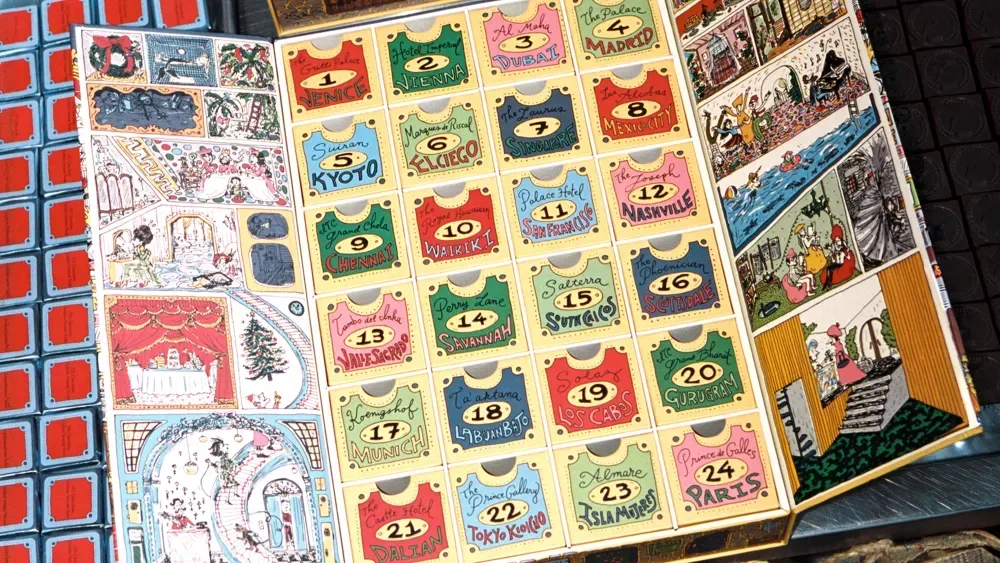
Advent calendars are designed around a simple ritual: open one small compartment at a time and let anticipation do the rest. A new limited-edition collaboration between Egyptian artist Laila Gohar and The Luxury Collection makes that ritual considerably more elaborate, turning 24 numbered drawers into a stylized tour of destinations across the hotel brand’s portfolio.
Priced at $218, the Laila Gohar x The Luxury Collection Advent Calendar is presented as an ornate grand-hotel façade. Every drawer contains a custom chocolate linked to one of 24 destinations. The project brings together Gohar, illustrator Joana Avillez and Mexican chocolatier Casa Bosques, with Casa Bosques founder Rafael Prieto collaborating with culinary teams from across the hotel portfolio on the flavors.
It is a holiday product, certainly, but it also treats packaging and presentation as central parts of the experience. Rather than using the calendar merely as a box for sweets, the collaboration makes the box itself a designed object: a miniature architectural front with its own sequence of drawers, discoveries and destination-specific details.
A 24-drawer itinerary in chocolate
The core idea is straightforward: each day reveals a chocolate inspired by a different place. The resulting flavor list is more specific than a standard assortment. Examples include saffron for Dubai, black sesame for Kyoto, toasted coconut for South Caicos, and banana with sea salt for Waikiki. Paris is represented by hazelnut praline, while Los Cabos is represented by smoked mesquite.
That does not mean the calendar claims to reproduce whole regional cuisines in miniature. Instead, the reported selections use individual flavors and ingredients as prompts for each destination. This is an important distinction. A flavor such as saffron can create an immediate point of recognition and a sense of place, but it is not a comprehensive culinary portrait of Dubai. The format is best understood as a series of edible references, arranged as a countdown.
Praline, for example, generally refers to a confection centered on nuts and sugar, and in chocolate contexts often points to a smooth nut-based filling. Black sesame brings a more savory, roasted profile than many conventional advent-calendar chocolates. Mesquite is associated here with a smoked note, positioning the Los Cabos drawer as a more unusual entry alongside sweeter flavors such as coconut or banana and sea salt. The range suggests that the 24 drawers are intended to vary in character rather than simply delivering repeated versions of a single chocolate.
Gohar described the appeal of an advent calendar as the anticipation created by opening it over the holidays. Her framing of each drawer as a small world captures the larger premise: the calendar is structured around gradual discovery, not immediate consumption of everything inside.
Why the design matters as much as the chocolates
Gohar World, Gohar’s homewares label, is known for surreal takes on traditional tabletop objects, while Gohar’s broader artistic practice has often transformed food into elaborate and fantastical installations. That background makes the grand-hotel presentation more than a decorative afterthought. It places the collaboration between food, hospitality, illustration and object design.
Avillez’s illustration is part of that equation, and the calendar’s exterior is designed to resemble the façade of a grand hotel. A façade is the outward-facing front of a building; in this case, the architectural idea supplies a visual framework for the 24 compartments. Opening drawers then becomes a domestic, tabletop-scale version of moving through rooms or spaces within the imagined hotel.
For physical-object collectors, that structure is likely to be a key practical consideration. The chocolates are consumable, while the illustrated drawer cabinet is the element that can remain after the calendar has been opened. However, the collaboration is described as limited edition without a stated production number. That makes it inappropriate to infer rarity, future value or resale potential from the information available. “Limited edition” establishes that the run is restricted; it does not, by itself, establish how scarce any individual calendar may be.
The $218 price also reflects a collaborative art-and-design presentation rather than the expectations set by a conventional chocolate countdown. Prospective buyers should view it as a premium seasonal object containing 24 chocolates, not as a simple price-per-piece confection purchase. The supplied details do not specify chocolate weights, ingredients beyond the named flavor references, dietary information, shipping terms or stock levels, so those are points worth checking directly before purchasing.
Pop-ups extend the drawer concept into hotel spaces
The collaboration also includes holiday pop-ups designed by Gohar. Their visual references are old-world Parisian chocolate shops and Milanese apothecaries, with theatrical display windows and drawer-lined interiors that echo the calendar.
An apothecary traditionally refers to a shop associated with medicinal preparations and ingredients. In this design context, the reference is aesthetic: an organized, cabinet-and-drawer environment in which objects and ingredients can be displayed with ceremony. That makes it a natural extension of the advent calendar’s own construction.
The pop-ups are set to run through the holiday season at Prince de Galles in Paris, The Joseph in Nashville, Solaz in Los Cabos and The Laurus in Singapore. At Prince de Galles, artist and set designer Alix Bortoli created custom vitrines incorporating raw ingredients used in the chocolates. A vitrine is a glass display case, so the Paris installation gives those flavor components a visible role in the broader presentation.
Select properties will also offer culinary and design programming connected to the project, though no individual events or schedules are specified. That limitation matters for travelers and local visitors: the presence of a pop-up does not automatically confirm a particular workshop, tasting or presentation at every location. Interested guests will need to confirm the programming at the relevant property.
A hospitality initiative built around seasonal culture
The project sits within The Luxury Collection’s World in Season initiative, which focuses on culinary and cultural traditions within the Marriott-owned brand’s properties. The brand’s portfolio is described as spanning more than 135 hotels and resorts in 41 countries and territories. Within that context, the calendar converts a wide geographic footprint into a single holiday object, using one flavor per drawer as the organizing device.
That approach also makes the calendar legible without requiring a stay at one of the properties. The buyer’s interaction is deliberately intimate and sequential: one drawer, one chocolate, one destination cue at a time. The hotel connection is present through the destinations and culinary teams, while the act of opening the calendar takes place at home.
The timing places the collaboration in a wider season of designed holiday ephemera, where temporary displays, food and pop-culture objects frequently overlap. For another seasonal angle, see the potential status of Mario, Pikachu and Pac-Man balloons at the Macy’s Thanksgiving Day Parade.
Where it will be sold
The Laila Gohar x The Luxury Collection Advent Calendar will be available through The Luxury Collection Boutique in the United States and through Gohar World in select international markets. It will also be sold online and at participating hotels. The stated retail price is $218.
Availability language remains qualified in two ways: Gohar World distribution is only specified for select international markets, and hotel sales are limited to participating properties. The information provided does not identify every participating hotel or list every international market. Buyers should therefore confirm local availability through the relevant retailer or hotel rather than assume that every Luxury Collection destination carrying the pop-up will also have stock.
As a collaboration, the calendar’s appeal rests on the combination of its contributors: Gohar’s playful, food-centered design sensibility; Avillez’s illustration; Prieto and Casa Bosques’ chocolate work; and a hotel group’s destination network. The 24 drawers are the connective tissue. They turn a holiday countdown into a deliberately paced collection of flavors, illustration and architecture-inspired presentation.