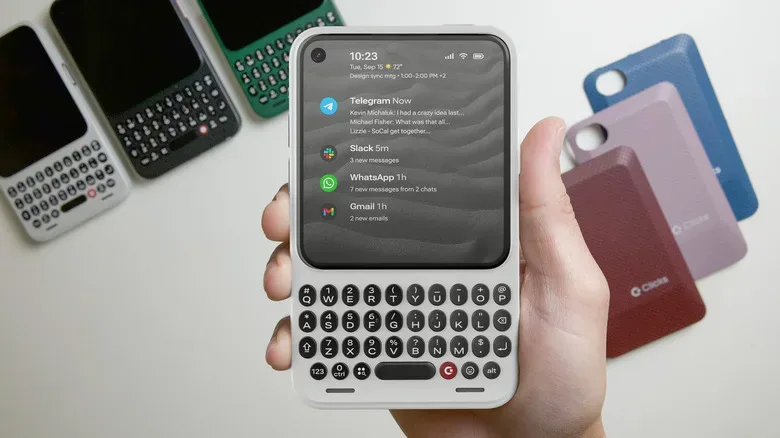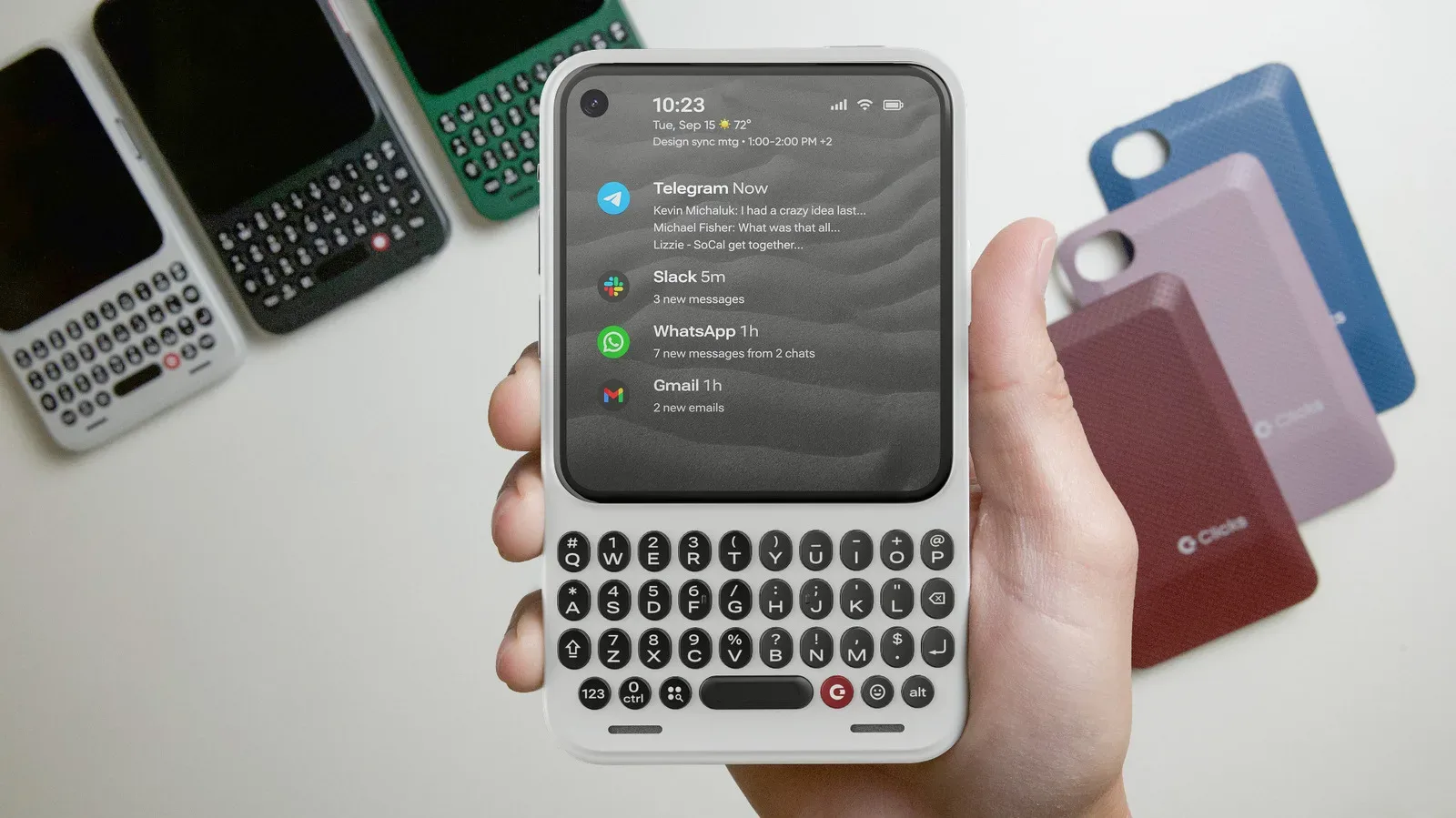
Clicks’ bid to bring the physical smartphone keyboard back into daily circulation is nearing its first major reality check. The company’s Clicks Communicator, a compact Android handset built around a BlackBerry-like portrait layout, is scheduled to begin shipping in December. The final hardware is arriving with more memory and a larger battery than initially outlined—but prospective owners have a limited window before its price climbs substantially.
Reservations can still be placed at the original $499 price. That changes on October 1, when the Communicator’s price is set to rise to $649. For a device Clicks is positioning primarily as a communications-focused companion phone rather than a conventional flagship challenger, the $150 difference is likely to be central to any buyer’s decision.
A deliberately different kind of Android phone
The Communicator is unusual not merely because it has physical keys, but because the keyboard is built into the phone’s fundamental shape. Beneath a 4.03-inch, 120Hz AMOLED display sits a hardware keyboard, giving the device a square-ish, vertically oriented profile that recalls earlier messaging-first smartphones.
That design makes Clicks’ priorities relatively clear. Modern mainstream phones tend to maximize screen area and treat typing as a software task. The Communicator gives up some display real estate to make text entry, navigation and shortcuts tactile. It is a purposeful trade-off, not an attempt to reproduce the standard slab-phone formula with a few retro decorations.
The company describes the handset as a “new kind of mobile communicator” and frames it as a second phone for calls and messages instead of a device designed to encourage endless scrolling. That does not mean it lacks normal smartphone foundations: it runs Android, supports expandable storage and includes contemporary biometric authentication. But its pitch is about changing the physical rhythm of phone use, not winning an all-out specifications contest.
There is a natural nostalgia element here, especially for people who remember thumb keyboards as a practical productivity feature rather than a museum piece. Still, the more important question is whether a keyboard-first Android device offers enough tangible everyday benefit to justify its compromises and its price. December shipments will put that proposition in buyers’ hands.
The final specification changes
Clicks has improved several headline specifications ahead of release. The Communicator will ship with 12GB of RAM, rather than the originally stated 8GB. RAM, or random-access memory, is the short-term working space used by the operating system and active apps. More of it can help a phone retain apps in memory and manage heavier multitasking, although it does not by itself determine how fast every task will feel.
Battery capacity has also increased from 4,000mAh to 4,350mAh. The mAh figure, short for milliamp-hours, measures battery capacity rather than a guaranteed number of hours between charges; screen use, signal conditions, apps and other variables all affect actual endurance. Clicks also says the battery is rated for more than 800 charge cycles. A charge cycle generally represents cumulative use equal to a full battery charge, even when that use comes from several partial charges.
Related coverage includes Clicks Communicator Ships in December With More RAM, Bigger Battery.
Software support is one of the most consequential parts of the package. The Communicator will launch with Android 17, with platform support planned through Android 20 and five years of security updates. Operating-system upgrades can bring newer Android capabilities and compatibility changes, while security updates address vulnerabilities. The two are related but distinct commitments, and the stated timeline is useful context for anyone considering the device as more than a novelty.
Under the hood, the phone uses a MediaTek Dimensity 8300 processor, along with 256GB of internal storage and microSD expansion. The chipset is not being presented as flagship-class hardware, and Clicks is not trying to disguise that. The Communicator is aimed at a specific interaction model, not at people shopping for the highest possible benchmark results or the most elaborate camera system.
The keyboard does more than type
Clicks is attempting to make the keyboard earn the space it occupies. Its surface is touch-sensitive, allowing users to swipe over the keys to scroll and navigate. In principle, that means the lower half of the device can function both as a tactile typing surface and as an alternative navigation area.
The spacebar also serves as a fingerprint sensor. That puts biometric unlocking directly into an area a user will frequently touch while holding the phone. Whether that feels especially convenient will be personal, but it is a more integrated approach than treating the keyboard as a separate, purely legacy-minded accessory.
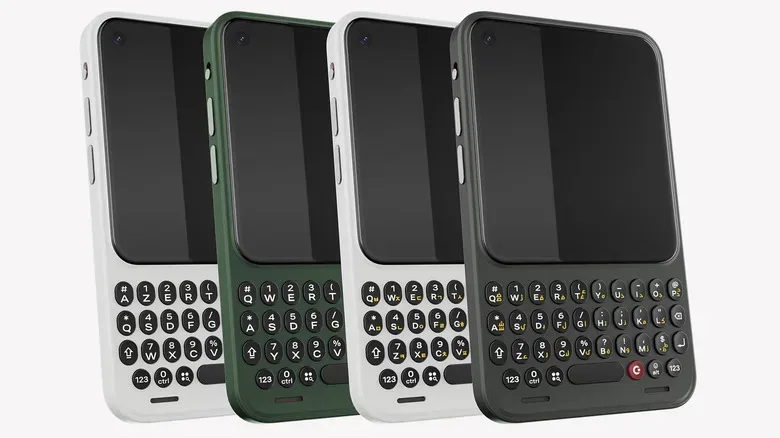
Keyboard availability extends beyond English QWERTY. Clicks plans French AZERTY, German QWERTZ, Korean and Arabic versions. Those names refer to the first sequence of letters along the top alphabetic row in different keyboard arrangements. Supporting multiple layouts matters on a product whose identity is so closely linked to physical keys: a fixed hardware layout is far less flexible than an on-screen keyboard that can be switched in software.
The Communicator also includes a 3.5mm headphone jack, another feature that has become uncommon on higher-profile phones. For wired-headphone users, it eliminates the need for a dongle or wireless pairing. It is a small inclusion, but it fits the larger theme: this is a handset built around direct, physical controls and connections.
Screen, cameras and the trade-offs behind the idea
The 4.03-inch AMOLED display offers a 120Hz refresh rate. AMOLED is a display technology in which pixels produce their own light, while 120Hz means the image can refresh up to 120 times per second. Higher refresh rates can make scrolling and animation appear smoother. On this phone, however, the display’s modest dimensions and unusual proportions are at least as defining as that number.
Clicks acknowledges that not every Android app will be ideal on the Communicator’s square-ish screen. That caveat is essential. Android’s broad app ecosystem was largely built around the tall touchscreens that dominate current phones. Apps may still function, but a nonstandard aspect ratio can alter layouts, reduce visible content or make some interfaces feel awkward. Anyone expecting a seamless substitute for a large-screen flagship should take that limitation seriously.
Photography is another area where the Communicator chooses restraint over escalation. It has a 50MP rear camera and a 24MP front-facing camera, rather than a multi-lens rear array. Megapixels describe image resolution, not the complete quality of a camera, so those figures alone cannot settle how photos will look. What they do establish is that Clicks is not positioning the phone around the usual flagship-camera arms race.
That approach is coherent with the second-phone pitch. A user could keep a conventional primary phone for sprawling apps, advanced cameras and larger-screen entertainment, while using the Communicator for focused messaging and calls. The complication, of course, is that $649 is no longer an incidental experiment. The nearer the price gets to that level, the more buyers will compare it not just with niche hardware but with capable full-service smartphones.
Price timing and configuration choices
The key date for interested buyers is October 1. Until then, a reservation remains available at $499; afterward, the listed price will be $649. The product is available to pre-order through Clicks’ website, and existing reservation holders can now configure their units.
Those configuration options include color, keyboard layout and charging cover choices. The ability to select a keyboard layout is especially meaningful given the device’s physical interface. Choosing it carefully is not cosmetic in the way a color might be—it affects the arrangement a person will use every time they type.
- Shipping schedule: December.
- Reservation price before October 1: $499.
- Price from October 1: $649.
- Memory: 12GB RAM.
- Battery: 4,350mAh, rated for more than 800 charge cycles.
- Software: Android 17 at launch, support through Android 20, plus five years of security updates.
- Storage: 256GB with microSD expansion.
Why this device may find an audience—and why it may not
The Communicator’s strongest argument is not that physical keyboards are universally superior. It is that certain people may prefer a phone that makes writing, calling and intentional navigation feel more deliberate. A tactile keyboard provides a physical reference point that a flat glass screen does not, and the touch-sensitive scrolling feature suggests Clicks is trying to adapt that old form factor rather than simply reproduce it.
Its limitations are equally part of the deal. The processor sits below flagship level, the camera setup is comparatively simple, and app layouts may not always suit the screen. The company’s own second-phone positioning helps set appropriate expectations, but it also raises a practical question: how much should a focused companion cost when it may share pocket time with another smartphone?
There is also a broader reason software support deserves attention in a niche hardware launch. A distinctive shape and keyboard can create initial interest, but long-term usefulness depends on the Android version and security-maintenance plan. The Communicator’s stated support through Android 20, plus five years of security updates, gives buyers a clearer support horizon than a nostalgia pitch alone could provide. It also lands at a time when device owners are paying closer attention to what their hardware contains, controls and maintains, as seen in wider consumer-tech privacy debates.
Clicks now has a sharply defined product: an Android 17 phone with a physical, touch-sensitive keyboard; a 4.03-inch 120Hz AMOLED screen; 12GB of RAM; a larger-than-announced battery; microSD support; and a headphone jack. It is not aiming to be everything for everyone. The next test is whether enough people see that selectiveness as a benefit worth paying for, particularly once the reservation price gives way to the higher $649 figure.