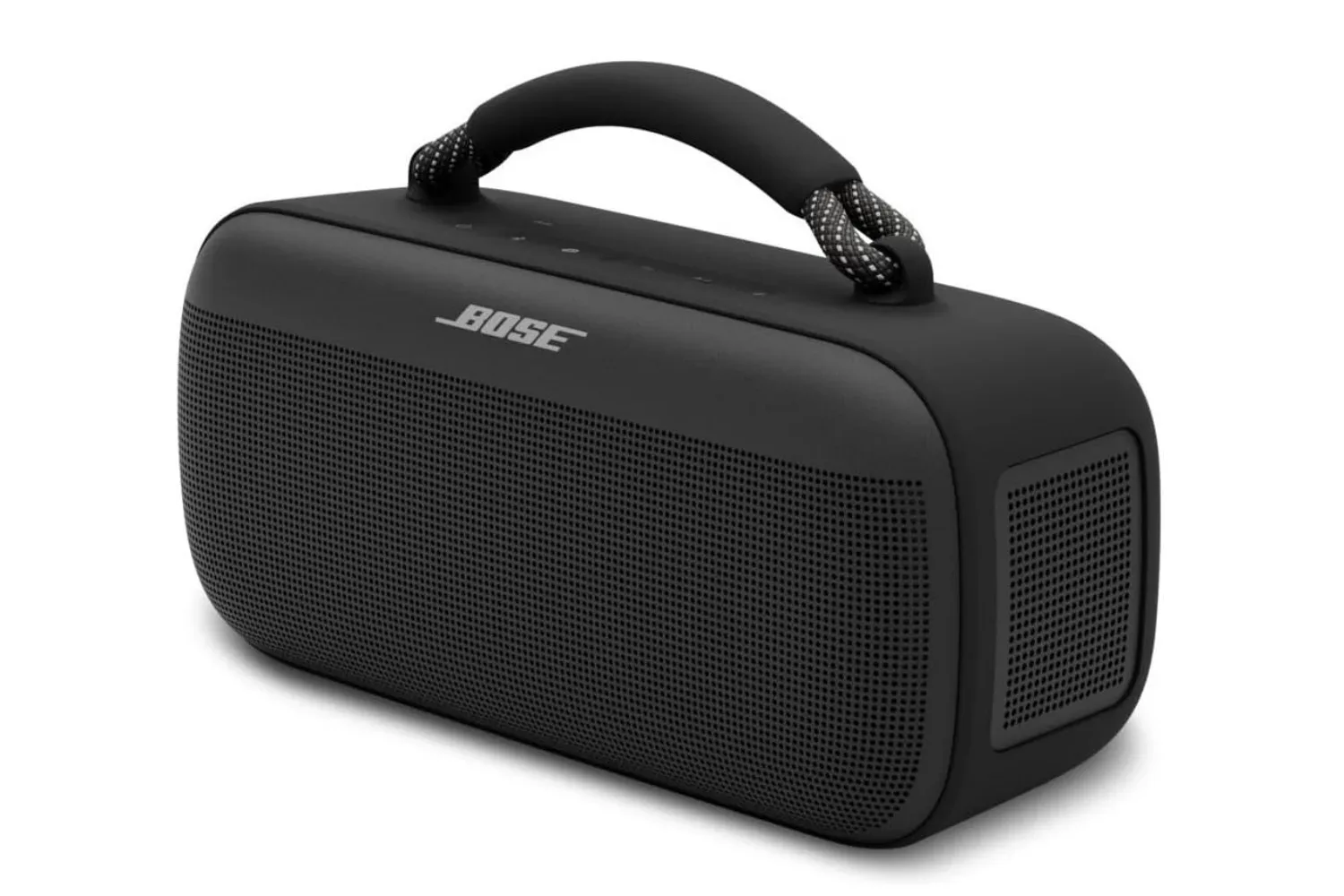
The Bose SoundLink Max portable Bluetooth speaker is listed at $279 during Prime Day, down from a stated regular price of $399. That is a $120 reduction, or roughly 30%, and the listed offer applies to both the Black and Blue Dusk color options.
For players, music listeners, and anyone tired of relying on a phone or laptop’s built-in speakers, the appeal is straightforward: this is a large portable speaker designed to bring fuller sound to places where a dedicated home audio setup is impractical. The SoundLink Max combines Bluetooth playback with a 3.5mm AUX input, a claimed battery life of up to 20 hours, and IP67-rated protection against dust and water.
The discount itself is the headline, but the feature mix is what determines whether the SoundLink Max fits a setup. It is aimed less at private, close-range listening than at bringing sound to a room, an outdoor hangout, or a travel bag without requiring a separate receiver or wired speaker system.
The Prime Day price and the important caveat
At $279, the SoundLink Max is $120 below the stated $399 regular price. Both listed colors are included, so buyers are not limited to a single finish to receive the reduction.
Promotional listings can change quickly, particularly during Prime Day. The relevant check before buying is the live price, the selected color, and whether any membership or account condition is shown on the retailer’s page. The supplied deal information identifies the $279 price and the two colors, but it does not establish how long the listing will remain available.
That $120 difference matters most for shoppers who were already looking for a portable speaker with an analog input and weather-resistant construction. A sale should not turn unused features into essentials, but it can make a higher-capability portable option more reasonable than it would be at full price.
What the SoundLink Max is built to do
The SoundLink Max is presented as a compact, carryable speaker with powerful, deep sound and clear playback. Its removable climbing-rope handle is a practical design detail: it is intended to make transporting the speaker easier, whether it is moving from room to room or heading out with the rest of a day’s gear.
“Portable” does not necessarily mean pocket-sized. In this context, it means the speaker is intended to travel and to operate away from a wall outlet for extended stretches. Buyers deciding between a portable speaker and smaller personal audio gear should think about the listening situation: filling a shared space is a different job from listening alone at a desk.
Related coverage includes Bose SoundLink Max Drops to $279 for Prime Day.
For gaming use, Bluetooth speakers are most naturally suited to background music, casual game audio, social spaces, and mobile devices. The available information does not make a latency claim, so it would be unwise to assume a specific response time for competitive play or precise rhythm-game timing. The 3.5mm AUX input provides a wired connection option for compatible devices, but the supplied details do not specify performance characteristics beyond the presence of that port.
Bluetooth and AUX make the speaker more flexible
Bluetooth is the wireless connection method used for phones, laptops, and other compatible devices. It is convenient because playback does not need a physical cable running to the speaker. That simplicity is useful for quick music sessions, video playback, or shifting a speaker around a room.
The SoundLink Max also includes a 3.5mm AUX input. AUX, short for auxiliary, is a common analog audio connection. It allows the speaker to be used with equipment such as a turntable, CD player, or MP3 player, rather than limiting it to wireless sources alone.
That input is especially useful for a mixed-device household. A Bluetooth-only speaker can be perfect for a phone but awkward when a source device needs or benefits from a cable. With AUX available, the SoundLink Max can sit between newer wireless hardware and older or more specialized audio devices. Compatibility still depends on the output available from the source device, so users should confirm that their turntable, player, console-related setup, or adapter can provide an appropriate 3.5mm connection.
The Bose app adds EQ adjustment. EQ, or equalization, means changing the balance of different portions of the audio range. The available controls cover bass, mid-range, and treble:
- Bass refers to low-frequency sound, including the weight of kick drums, bass lines, and many cinematic effects.
- Mid-range is a central portion of the sound spectrum and is important for much of the body of vocals and instruments.
- Treble refers to higher-frequency detail, such as cymbals and the crispness of some vocal and instrumental elements.
The practical benefit is adjustment rather than a promise that one setting suits every listener. Music, spoken audio, and game soundtracks can all place different demands on a speaker, while room size and placement can change how the output is perceived. The SoundLink Max’s app-based EQ gives owners a way to tailor those levels instead of being locked into a single presentation.
IP67, explained without the marketing fog
The SoundLink Max carries an IP67 rating for water and dust protection. IP ratings are a standardized shorthand for an enclosure’s resistance to ingress—outside material getting into the product.
In IP67, the first digit, 6, indicates dust protection. The second digit, 7, indicates water protection. In everyday terms, that makes the speaker better suited to environments where dust or water are realistic concerns, including outdoor use or areas near water, than a speaker with no such stated rating.
It is still best understood as protection, not invulnerability. An IP rating does not eliminate the need for ordinary care with electronics, connections, and charging. Anyone using the speaker around a beach, bathroom, or outdoor gathering should make sensible decisions about placement and should not treat water resistance as a reason to disregard the product’s operating guidance.
For buyers, the larger implication is flexibility. A portable speaker that is intended to handle both dust and water exposure can be easier to bring along when plans move beyond a desk or living room. That broadens the SoundLink Max’s role from an indoor playback device to something more adaptable for travel and casual outdoor use.
Battery life and USB-C power sharing
Bose states that the SoundLink Max can run for up to 20 hours on a single charge. “Up to” is important wording: it expresses a maximum claimed runtime rather than a guarantee for every use case. Actual endurance can vary with factors such as volume and playback habits, though no specific variation figures are provided here.
Even so, a 20-hour claim points to a speaker intended for long sessions without regular outlet access. That can be helpful for an extended gathering, a full day away from a charger, or simply avoiding the annoyance of frequent recharging between uses.
The rear USB-C port also serves a second function: it can top up another device, such as a phone. This is power-bank behavior, meaning the speaker’s stored battery power can be shared with another product when needed. It is a useful contingency feature, but it also creates a trade-off. Charging a phone from the speaker uses energy that would otherwise remain available for audio playback.
USB-C is the connector format used for that charging and power-sharing port. The availability of a USB-C port does not, by itself, state the charging speed of either the speaker or a connected device. Buyers who require a particular rapid-charging standard should avoid assuming it from the connector alone.
Who should consider the discounted speaker?
The SoundLink Max makes the clearest case for people who want one portable speaker to cover several roles: wireless playback from a phone or laptop, wired playback through 3.5mm AUX, carry-friendly use away from home, and occasional phone top-ups through USB-C.
It also has a practical advantage for listeners who want control over the sound balance. The Bose app’s bass, mid-range, and treble adjustments provide a route to personalize playback rather than expecting every recording or game soundtrack to work best with the same tuning.
Shoppers primarily interested in gaming should weigh their connection needs. For ambient listening or general entertainment, a portable Bluetooth speaker can be a convenient addition to a setup. For situations where timing is the overriding concern, the available facts do not provide a basis for making latency promises. A wired option exists through AUX, but device compatibility should be checked before treating that as a complete answer for any specific platform.
For more troubleshooting-focused console audio advice, see our guide to fixing distorted PS5 audio without replacing your setup.
What buyers can verify before checkout
- Confirm the live $279 price rather than relying on a promotional price displayed earlier.
- Select either Black or Blue Dusk and verify that the discount remains attached to that choice.
- Consider whether Bluetooth alone is enough, or whether the 3.5mm AUX input is a feature that will actually be used.
- Check the available output on any turntable, CD player, MP3 player, or other wired source planned for the speaker.
- Remember that using the USB-C port to charge a phone draws on the speaker battery.
- Treat the up-to-20-hour figure as a stated maximum, not a fixed runtime in every listening scenario.
At the listed Prime Day price, the Bose SoundLink Max offers a $120 reduction alongside a feature set centered on portability, weather-resistant construction, adjustable EQ, AUX support, and long claimed battery life. The strongest reason to consider it is not simply that it is discounted, but that those features match the way a buyer expects to listen.
Shop the products
Check current price, model and availability at the retailer.