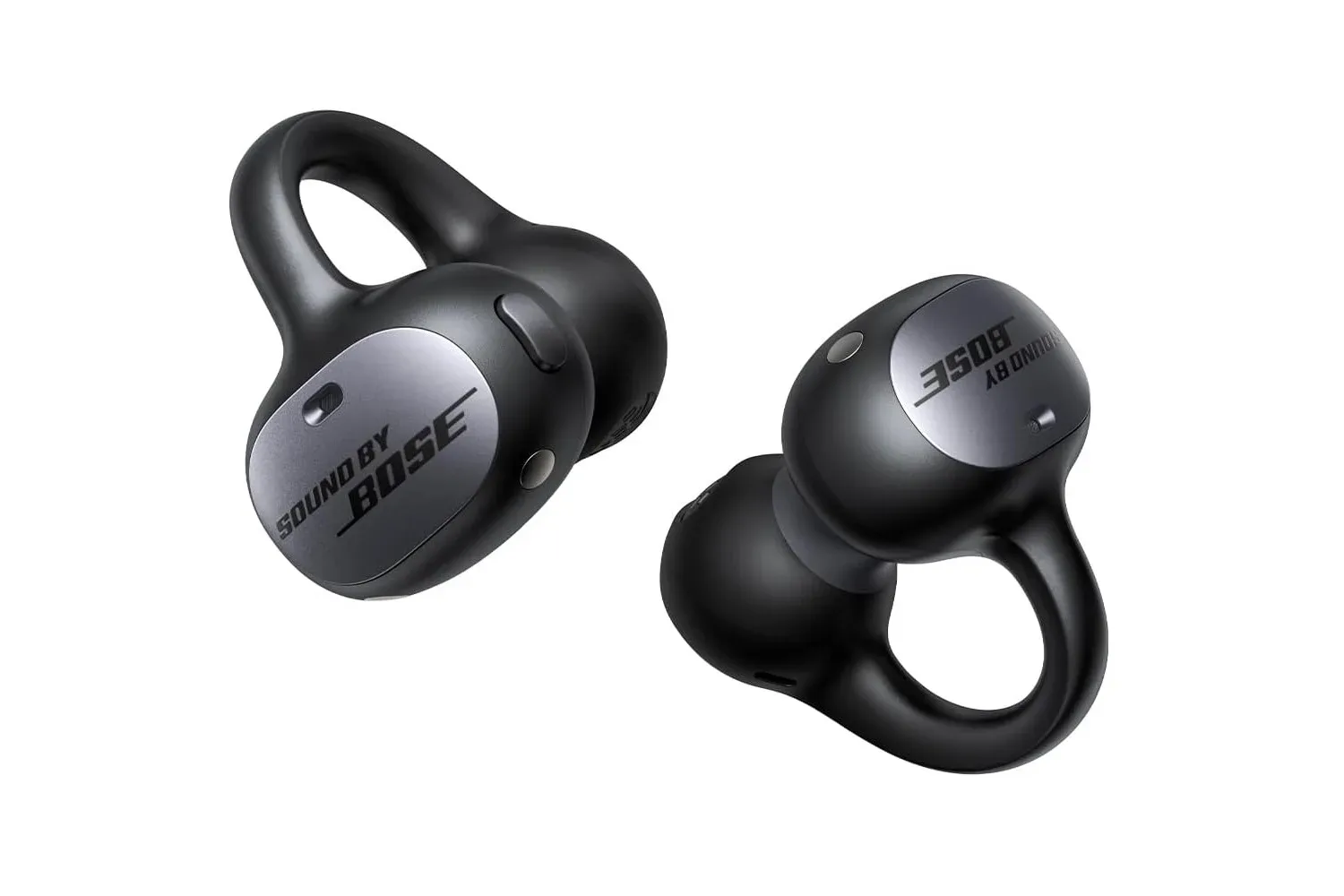
The Cosmic Black version of Baseus’ Inspire XC1 open-ear earbuds is currently listed for $99, a $30 reduction from its stated $130 retail price. Starlight Off-White and Titanium versions are also part of the range, but the reduction applies to Cosmic Black at the time of writing.
The headline price is simple, but the product itself occupies a more specific lane than a conventional sealed wireless earbud. The Inspire XC1 uses an open-ear design: rather than closing off the ear canal, the buds are intended to leave the wearer more aware of the environment. That makes the distinction important for anyone looking for a pair to use around the house, during exercise, or while playing games and still needing to hear a doorbell, a teammate in the room, or the generally alarming sound of a snack bag opening.
Baseus says Bose audio engineers helped tune the sound performance. Its hardware list includes a dynamic woofer for bass and a Knowles balanced-armature tweeter for high-frequency detail, alongside the company’s adaptive SuperBass 3.0 and SuperBalance 3.0 processing. The quoted battery specification is up to eight hours from the earbuds themselves and up to 40 hours in total with their charging case. The earbuds also carry an IP66 rating and use four microphones with AI voice pickup and wind-noise reduction for calls.
What the $99 deal covers
The price cut takes $30 off the stated $130 price, which works out to roughly 23% off. More importantly, it is tied to a particular finish rather than every color in the lineup. Anyone shopping primarily on price should verify that the selected listing is still the Cosmic Black model and still displays the reduced amount before checkout, rather than assuming an alternate color receives the same deal.
This is not a claim that every user will prefer an open-ear fit over a conventional in-ear seal. It is a different trade-off. A sealed bud is designed to sit in the ear canal and can naturally limit some outside sound. An open-ear design favors situational awareness instead. Neither approach automatically wins; the useful choice depends on where, and how, the earbuds will be worn.
For a player who wants private game audio at a desk, the open construction may be appealing if they also need to follow conversations or listen for activity elsewhere. For someone trying to isolate themselves from a loud environment, the same design goal may be less suitable. That is worth deciding before treating the feature list—or the discount—as the entire buying decision.
Audio hardware: what the terms mean
The Inspire XC1 combines two kinds of drivers. A dynamic woofer is the component assigned to lower-frequency output, including bass. A balanced-armature tweeter is a compact driver type used here for the higher end of the frequency range. In straightforward terms, Baseus is positioning the combination as a way to cover bass weight and treble clarity with components serving different parts of the sound.
Baseus also identifies SuperBass 3.0 and SuperBalance 3.0 as adaptive technologies that adjust output in real time. “Adaptive” in this context means the system is intended to modify the audio signal as it plays, rather than simply applying one fixed sound profile. The stated aim is balanced playback across different material. That can matter when moving among game soundtracks, chat, podcasts and music, whose mixes can place very different demands on bass, voices and higher-pitched effects.
The Bose-engineer involvement is notable context for the product’s audio positioning, but consumers should keep the claim in proportion: these remain Baseus earbuds, with Baseus’ named driver arrangement and audio processing. The supplied specifications establish the tuning collaboration and features; they do not establish that the XC1 will sound identical to a Bose product, nor that every listener will respond to its tuning in the same way.
Why open-ear audio changes expectations
Open-ear listening is best understood as a design decision centered on awareness and comfort rather than a promise of total acoustic separation. Because outside sound remains part of the experience, the real-world result can vary greatly with surroundings. A calm room is not the same listening environment as a roadside run or a busy shared space.
For game use, that means the Inspire XC1 could suit players who dislike the isolated feeling of sealed buds or who need to remain responsive to what is happening around them. It is less directly aimed at the person whose first priority is shutting out environmental distractions. Buyers should align the form factor with that preference first, then weigh the driver and processing specifications.
Calls, chat and the four-microphone setup
Baseus equips each set with a four-microphone array, AI voice pickup and wind-noise reduction. The intended function is clear: prioritize the wearer’s voice while reducing the impact of surrounding noise for the person on the other end of a call.
That is relevant beyond phone calls. Voice communication is a regular part of multiplayer games, remote work and group chats, and a headset’s microphone behavior can be as consequential as its music playback. The listed system is designed to address two common obstacles: general surrounding noise and wind. It should not be read as a guarantee that every loud environment becomes silent, but it does indicate that voice transmission is an explicit focus of the XC1’s feature set.
Players building out a home setup may also want to separate audio questions from network questions. Clear voice pickup does not solve connection stability, just as a faster cable does not improve a microphone. For the wired side of a home gaming setup, our guide to Cat6 versus Cat7 for home gaming explains why the bigger number is not automatically the better purchase.
Fit, exercise and the IP66 rating
Baseus describes the fit system with several terms: zero-sense air cushions, flexible ring joints and liquid silicone. The practical goal is an adaptive, secure fit that remains comfortable over extended wear and is less likely to require frequent adjustment. This is especially relevant to the open-ear category, where the buds need to stay in place without the conventional in-ear seal doing the work.
The IP66 rating is the other major everyday-use specification. The first 6 indicates dust protection, while the second 6 denotes protection against powerful water jets. Baseus presents the earbuds as protected from rain, sweat, dust and splashes. That makes the rating a meaningful reason to consider the pair for workouts and outdoor use.
However, IP ratings should be interpreted precisely. The supplied rating supports resistance to the listed exposure; it is not a basis for assuming that the earbuds are designed for every kind of water use. A rain- and sweat-ready product is not automatically a product to submerge. Keeping that distinction in mind helps preserve the value of a purchase that is being made largely because of its lower price.
Battery claims and quick charging
Baseus quotes approximately eight hours of listening from one charge of the earbuds, with up to 40 hours when the charging case is included. The case is therefore central to the overall endurance figure: the earbuds play for their single-charge span, then can be replenished from the case while away from an outlet.
A 10-minute charge is claimed to provide another 2.5 hours of listening. For someone who realizes before a commute, workout or gaming session that the case needs a boost, that specification may be more useful than the larger total figure. It describes a short top-up intended to get listening underway again rather than a full recharge.
Battery longevity always depends on how a device is used, so these should be treated as the manufacturer’s quoted figures rather than a universal promise for every volume level, call pattern or listening routine. Still, the combination of an eight-hour quoted per-charge figure, case-based total of up to 40 hours, and fast-charge claim gives prospective buyers concrete figures to compare against their own charging habits.
Who the Inspire XC1 looks best suited for
- People who prefer awareness: The open-ear approach is designed for listeners who want to hear more of their surroundings than they would with a sealed in-ear model.
- Workout users: The adaptive-fit elements, stated secure placement and IP66 protection make exercise one of the clearest intended use cases.
- Frequent callers and chat users: Four microphones, AI voice pickup and wind-noise reduction put attention on voice clarity as well as music playback.
- Listeners needing longer time away from a wall charger: Baseus quotes up to eight hours per earbud charge and up to 40 hours with the case.
- Shoppers comfortable with the Cosmic Black finish: That is the color connected to the $99 listing; the other listed finishes are not discounted at this time.
At $99, the Inspire XC1’s appeal rests on a specific combination rather than one isolated specification: open-ear awareness, a dual-driver arrangement, voice-focused microphone hardware, IP66 protection and a substantial quoted case total. Buyers who want isolation should recognize the open design as a potential mismatch, no matter how attractive the price is. For those who value staying aware while listening, though, the Cosmic Black reduction makes the model a more compelling option than it was at its stated $130 price.
Shop the products
Check current price, model and availability at the retailer.