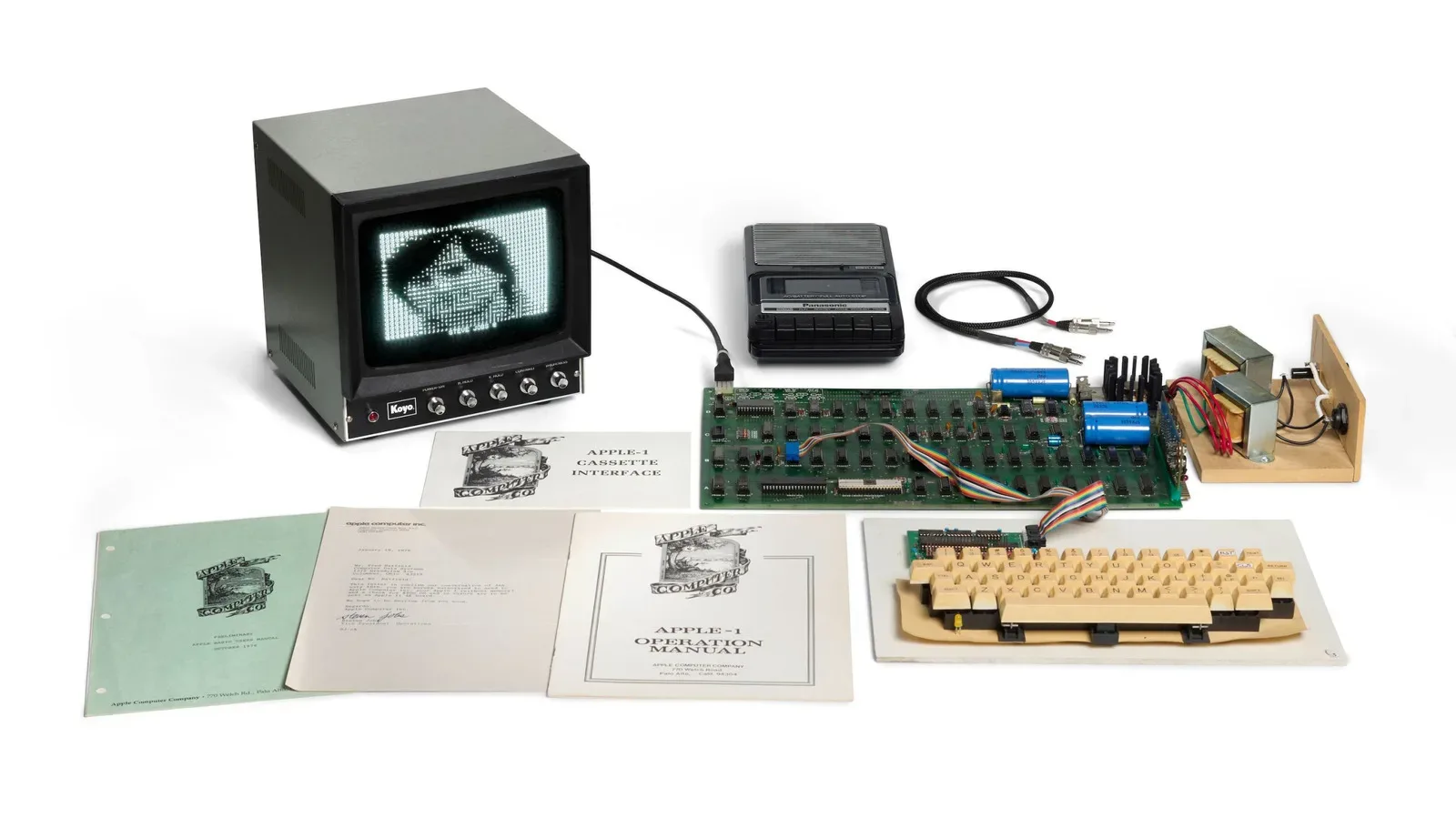
A 1976 Apple I known as the “Hatfield” machine has sold for $1,148,200 at auction, setting a new high for this particular computer after its previous 2013 sale of $671,400. The buyer has not been identified, but the final price surpassed the auction’s stated top estimate of $800,000 following bidding between two parties.
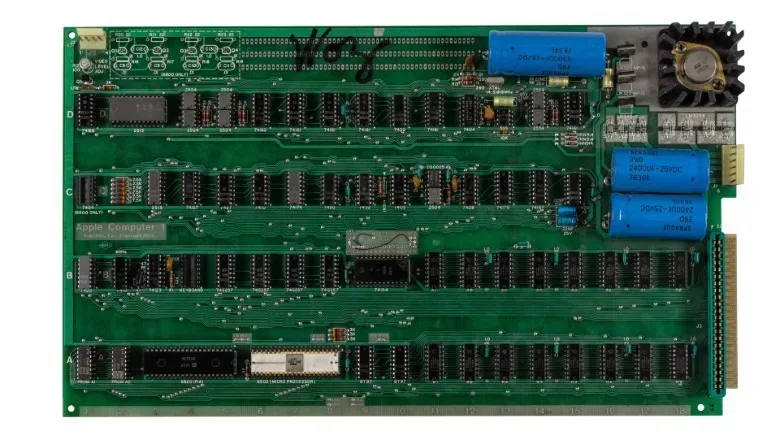
The result is not simply about an early circuit board with a famous logo attached. This Apple I combines several qualities collectors tend to value intensely: verified scarcity, operating condition, a documented owner history, a Steve Wozniak signature, and an unusually direct piece of correspondence from Steve Jobs. It was originally sold in 1976 to Fred Hatfield for $666.60 and is registry number 48 among 74 verified Apple I computers said to remain.
Why this Apple I is different
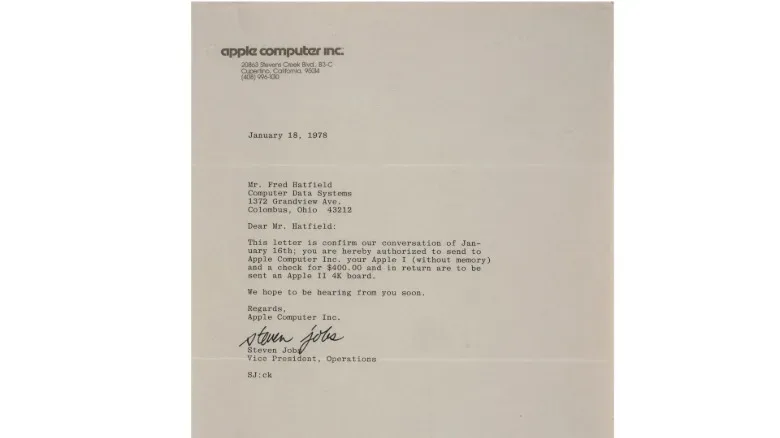
The machine’s defining document is a letter in which Jobs encouraged Hatfield to send in the motherboard for an upgrade to the Apple II. Hatfield did not take that offer, a decision that preserved this Apple I in a configuration that has become historically and financially significant.
That letter matters because it links the physical machine to a very specific moment in Apple’s early evolution. It is not merely an autograph or a loose promotional item. The correspondence concerns the exact owner and motherboard connected to the lot, turning an already scarce computer into an artifact with a clear, personal connection to the people running the young company.
There is a useful distinction here between provenance and condition. Provenance is the documented history of ownership and association: in this case, the original sale to Hatfield, the Jobs letter and the machine’s registry identification. Condition concerns the object itself, including whether it remains functional and how much original or period-appropriate equipment is present. The Hatfield Apple I has both a strong narrative trail and a reported working state, which is a difficult pairing for hardware from 1976.
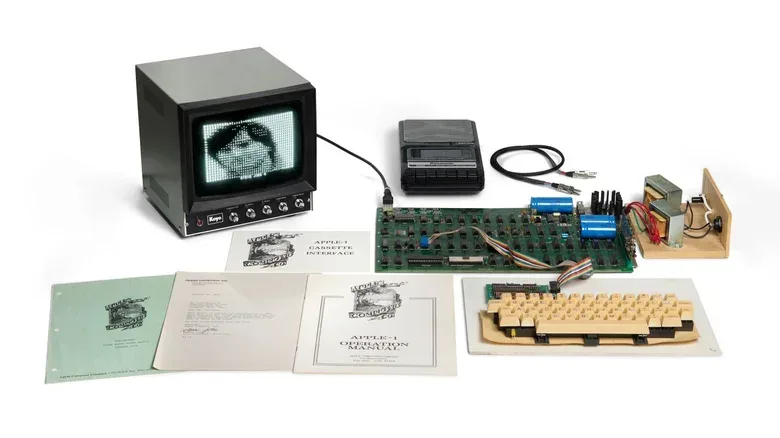
The lot also includes a signed element from Wozniak, Apple I operating documentation, a cassette operating manual, an Apple I Owners Club invitation, a custom power supply, and period monitor and keyboard hardware. Together, those components offer more context than a bare board could provide. They help show how the computer was intended to be operated at a time when personal computers demanded far more assembly and technical knowledge from their owners.
The Apple I was not a plug-and-play home computer
Modern readers may hear “Apple computer” and picture an all-in-one retail product ready to use immediately. The Apple I was a very different proposition. It did not ship with a power supply, keyboard or monitor. Those omissions meant an owner had to supply essential pieces of the overall setup before getting to the point of interacting with software.
The Hatfield system was sold with 8KB of RAM and a MOS Technology 6502 microprocessor. RAM, or random-access memory, is the short-term working memory a computer uses while running instructions and handling data. Eight kilobytes is extraordinarily small beside present-day devices, but it was sufficient for the machine’s intended tasks.
The 6502 was the processor at the heart of the system: the component that executes program instructions. On the Apple I, that processing power could run Apple Integer Basic and a limited selection of games through the optional Apple Cassette Interface. The cassette interface is another reminder of the era’s constraints. Rather than relying on the internal storage users now take for granted, it enabled programs and data to be handled through cassette media.
In practical terms, the Apple I was less like a sealed consumer appliance and more like the core of a computing project. Its value in 2026 is therefore not based on everyday usefulness. It comes from what it represents: an early Apple product that required owners to participate in creating a usable computer environment around the board.
That makes the accompanying power supply, monitor and keyboards meaningful beyond their visual appeal. They illustrate the difference between possessing an Apple I board and having the components needed for a period-style computing setup. For collectors, original paperwork and compatible-era accessories can help make the technical story of a machine legible, even when they do not make it equivalent to a factory-packaged modern PC.
From a $666.60 purchase to seven figures
Hatfield bought the computer for $666.60, then later sold it for $40,000. When the same machine came to auction in 2013, it achieved $671,400. Its new $1,148,200 result is an increase of $476,800 over that earlier auction price.
The sequence also underlines how the significance of early computing objects can change over time. Hatfield’s original purchase was of a current, highly technical product. The later $40,000 sale recognized it as a scarce remnant of personal-computing history. The two subsequent auction results reflect the added importance of detailed provenance, preserved materials and the expanding cultural interest in Apple’s origins.
Hatfield put the proceeds from his $40,000 sale toward dinners and nights out in New Orleans, rather than treating the transaction as the beginning of an investment strategy. That anecdote is a sharp contrast with the latest seven-figure figure, but it also demonstrates a fundamental point about collecting: future value is rarely clear when a person decides to sell an older piece of technology.
What the sale says about collectible technology
It would be a mistake to read this result as proof that every old computer is worth a fortune. The Hatfield Apple I is notable precisely because several rare attributes converge in one lot. There are only 74 verified Apple I examples remaining, it is one of the few reported to still work, it has an identified original purchaser, and it includes material associated with both Wozniak and Jobs.
For anyone assessing historic hardware, the lesson is not “old equals valuable.” It is that details determine the story and the value. A collector or family sorting old electronics should distinguish among the machine itself, documentation, peripheral hardware, modifications, serial or registry information, and any correspondence that connects an item to a specific person or event.
- Keep related materials together: Manuals, letters, invitations and accessories can provide essential context for an older computer.
- Document ownership carefully: A clear chain of custody can be as important as physical condition when an item is historically unusual.
- Avoid casual restoration: Replacing or discarding older parts may alter the object’s historical character. The supplied evidence does not establish which individual components of this lot are original, but it shows why associated materials are closely scrutinized.
- Separate functionality from completeness: A computer can be operational without being fully original, while an incomplete system may still have powerful historical importance. Both questions deserve careful documentation.
Why the Jobs letter carries unusual weight
The letter’s importance goes beyond celebrity association. Its substance reveals how directly involved Apple’s founders were with customers at the time. Jobs was offering a motherboard upgrade path to the Apple II, while Wozniak’s signature is attached to the Apple I itself. The two items connect product support, engineering history and the transition between Apple’s first two computers.
That transition is central to the object’s appeal. An offer to upgrade could easily have removed an Apple I from its original form. In this case, Hatfield’s decision not to proceed left behind evidence of the moment when the newer model was being positioned as the next step. The original computer and the upgrade invitation consequently tell complementary stories: one preserves the first product, while the other points toward its successor.
For broader Apple context, the company’s current hardware plans continue to attract attention, including reports surrounding a possible October media event for future Macs and iPad hardware. The contrast is considerable. Today’s Apple devices are finished, integrated consumer products; the Apple I was sold without even the power supply, display or input hardware needed for a complete setup.
A milestone object, not just an expensive board
The final auction number is attention-grabbing, but the stronger explanation for the price is the depth of the package. The Hatfield Apple I is a functioning surviving example of Apple’s first product, identified in the Apple I registry, tied to its first owner, signed by Wozniak, and accompanied by a Jobs letter connected to an Apple II upgrade. Its manuals, Owners Club invitation, custom power supply, period monitor and keyboards round out an unusually rich collection of supporting material.
Its journey—from a 1976 sale for $666.60, through a $40,000 private-era transaction, to auction results of $671,400 and now $1,148,200—shows why condition, documentation and provenance cannot be separated when historic technology reaches the high-end market. The physical hardware is essential, but the records around it are what transform it from an early computer into a specific, traceable piece of computing history.