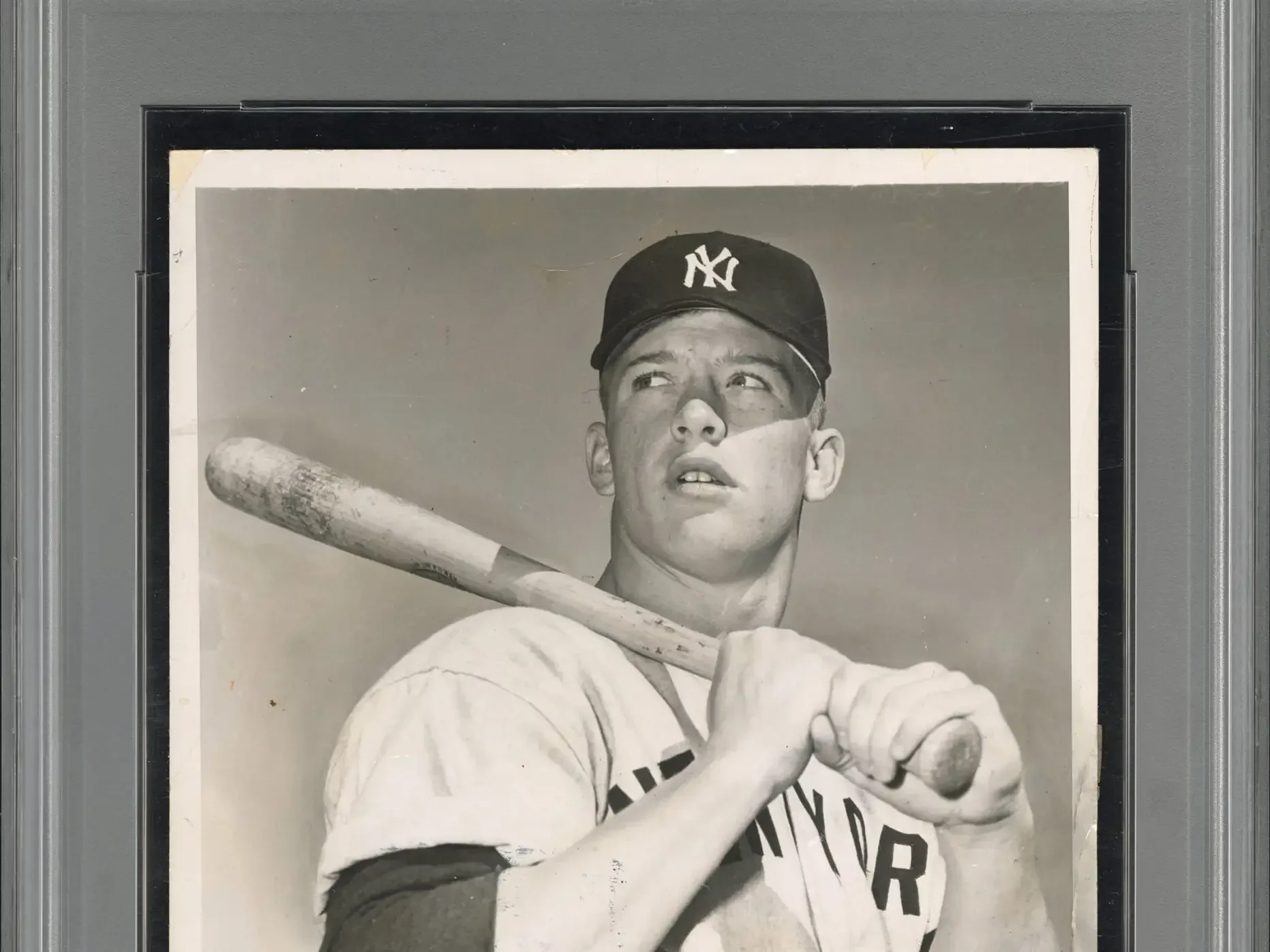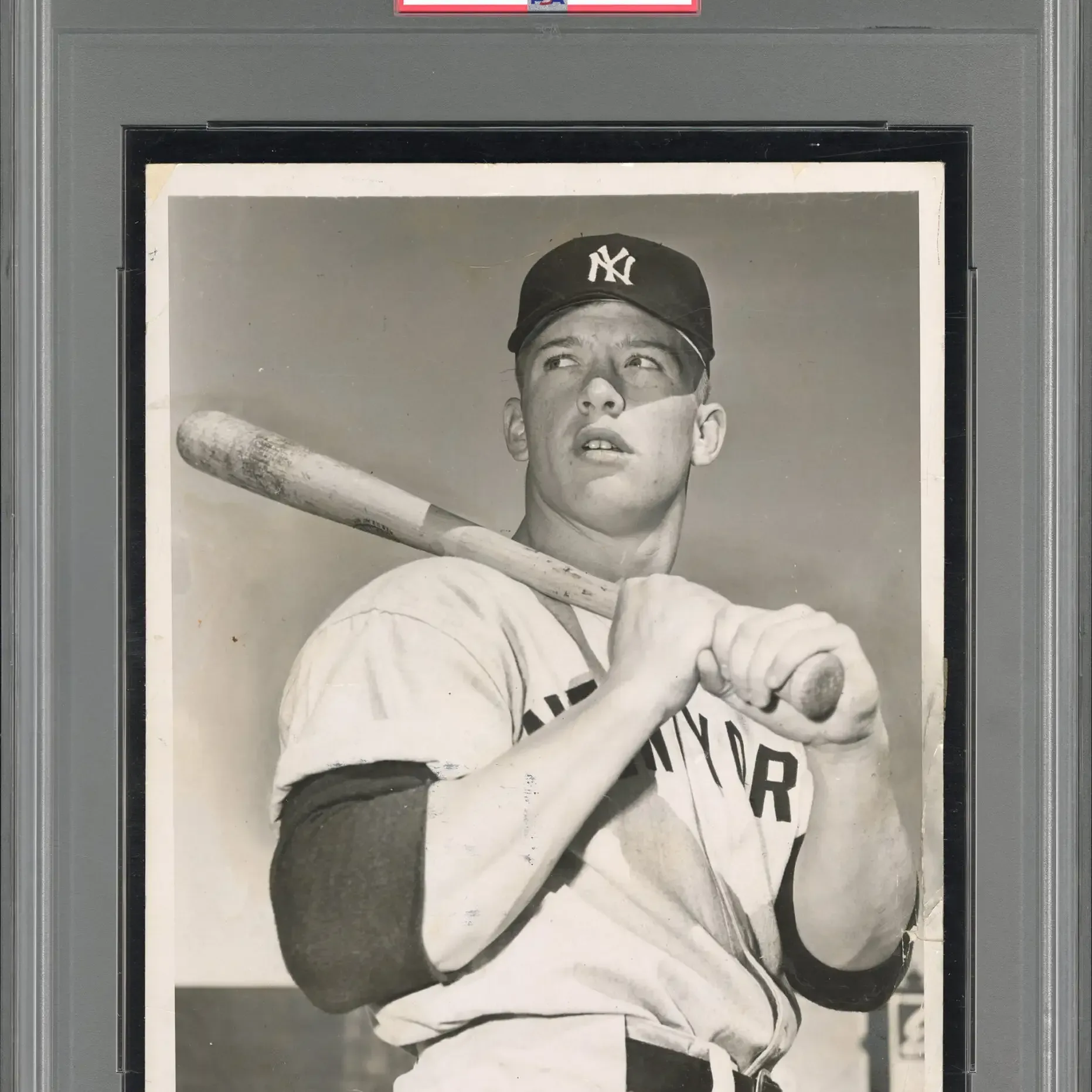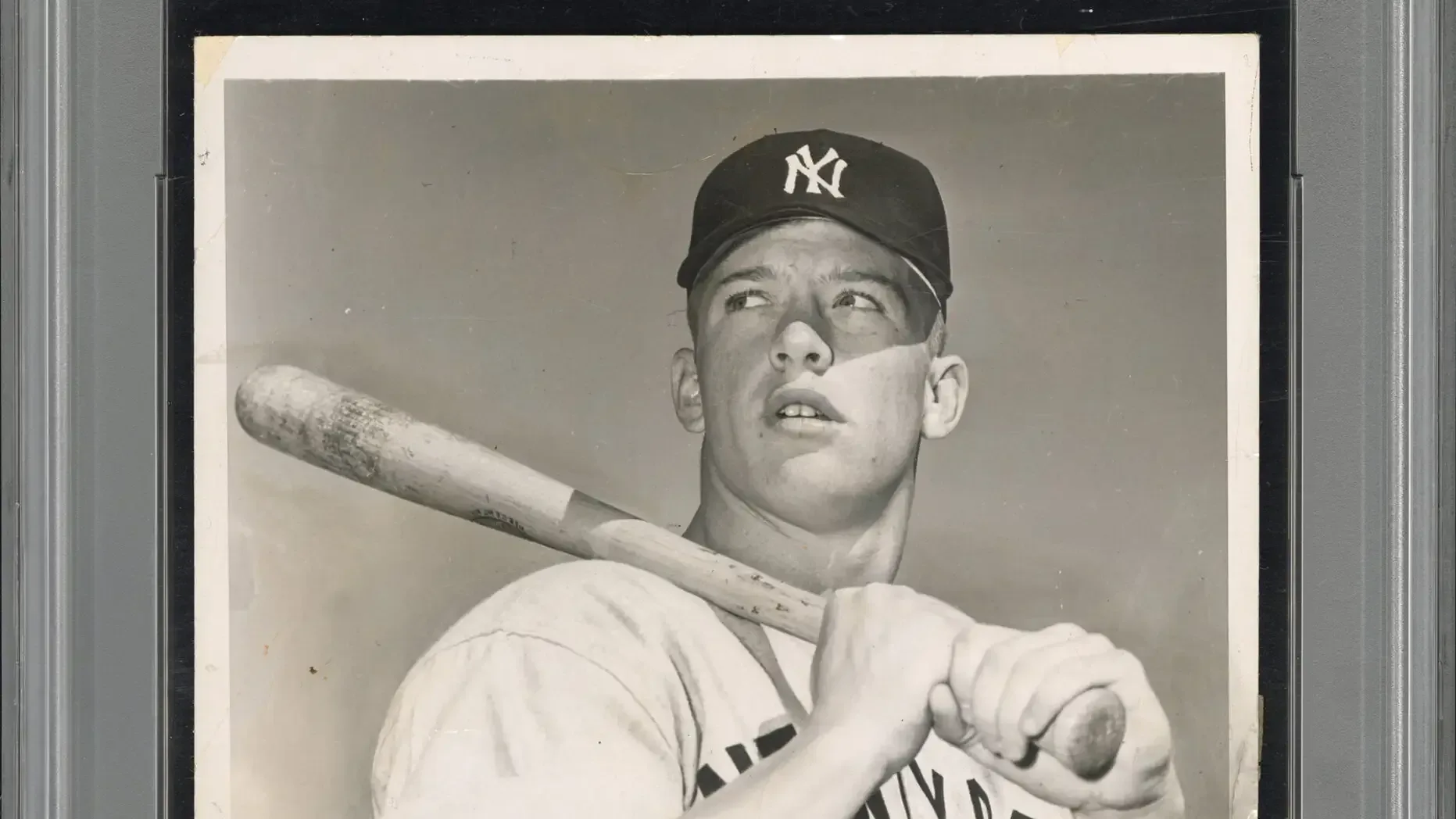
The black-and-white original behind one of sports collecting’s most famous card images has entered a price tier of its own. A Type I photograph of Mickey Mantle—the image later used on his 1952 Topps card—has been sold in a private transaction for $3 million. Hunt Auctions brokered the sale on behalf of collector Ron Firman.
The result is described as the all-time record for a PSA-authenticated Type I photograph. It does more than add another enormous sale to the Mantle ledger: it places exceptional emphasis on the physical origin of a trading-card image. The celebrated 1952 Topps Mantle has long been a central postwar baseball-card collectible, but this sale concerns the earlier photographic object from which its familiar visual identity came.
That distinction matters. A card is a mass-produced collectible, even where surviving examples are scarce in high grade. This 7-by-9-inch press photograph was made for editorial use, not for collectors. Its value is built around the convergence of a consequential subject, an iconic eventual card image, a limited number of known first-generation examples and unusually strong documentary links to its working life.
What makes this a Type I photograph?
“Type I” is a classification for vintage photographs, not a condition grade. In the system developed by Henry Yee, Marshall Fogel and Khyber Oser, a Type I is a first-generation print developed from the original negative within two years of the picture being taken. In practical terms, it is as close as collectors can get to the original darkroom output from the negative.
The designation is important because a photo’s age alone does not establish its generation. An old print can be a later reproduction. Conversely, a Type I carries direct production-era proximity to the negative, a quality that can sharply elevate its importance to photograph collectors.
PSA has authenticated only three Type I copies of this particular Mantle image. Yee, principal authenticator for PSA Photo Authentication Services, has authenticated all three. The newly sold example therefore belongs to a remarkably small recognized population—not merely a scarce Mantle collectible, but one of three authenticated first-generation prints connected to the 1952 Topps image.
For collectors accustomed to card terminology, it helps to separate three related ideas:
- Authentication addresses whether an item is genuine and correctly classified.
- Encapsulation means the authenticated item has been placed in a protective holder.
- Condition grading evaluates a collectible’s physical state; this is distinct from proving that a photograph is a Type I.
The $3 million result is consequently not a simple verdict on a pleasing vintage Mantle image. It reflects provenance, production generation, rarity and cultural connection to a cornerstone card.
The 1951 spring-training image that became a card landmark
The photo was taken on March 5, 1951, during a New York Yankees spring-training photo session. The photographer was connected to International News Service, although it is not known whether that person was an employee or freelancer. At the time, Mantle was a 19-year-old rookie who was still close to unknown on the national stage. The session produced an image that eventually became inseparable from his 1952 Topps card.
That subsequent card use transforms the photograph’s place in hobby history. To collectors, the 1952 Topps Mantle is not simply another player issue. It has become one of the most recognizable objects in American sports and popular culture. The photo is the primary visual artifact tied to that identity: not an alternate publicity shot, but the underlying image Topps selected.
It is also worth being precise about language often used around the card. The 1952 Topps Mantle is frequently called his rookie card in hobby conversation, and it is unquestionably his defining Topps card. Yet the earlier 1951 Bowman Mantle is also central to his card legacy. The prior record for an unsigned Type I original photograph, $843,750 in April 2024, was itself a Mantle image later used for the 1951 Bowman card.
That earlier record makes the new sale especially revealing. Mantle’s two key early card images have each generated headline-level interest as original photographs, but the image associated with the 1952 Topps card has now reached $3 million.
From newspaper archive to private record
The just-sold print was discovered in 2012 in the archives of a regional U.S. newspaper by Doug Allen, president and COO of Legendary Auctions. Its reverse bears an International News Photo stamp as well as stamps from at least five dates indicating newspaper use. Those marks are more than visual curiosities. They help document the photograph’s path through the news-photo ecosystem that produced, distributed and used the image.
For some collecting categories, writing, stamps and editorial markings might be viewed largely as distractions. With original press photography, they can be part of the object’s story. They may support provenance, identify the issuing service, show publication handling or demonstrate period circulation. In this case, the busy reverse reinforces that the photo was a functioning piece of editorial material before it became a high-end collectible.
After PSA/DNA authenticated and encapsulated the photograph in 2012, it sold for $59,750. Its latest $3 million private sale is an extraordinary increase from that figure, though the two transactions occurred in very different moments of the market and should not be treated as a broad, automatic pricing formula for every vintage image.
There is another relevant comparison within the tiny population. In November 2019, another Type I copy of the same Mantle image sold privately for $375,000. That copy carried a Newark Sunday News stamp and had a chipped upper-right corner. The third authenticated Type I is also in a private collection. Specific differences in markings, condition and provenance mean the three copies are related but not interchangeable.
A card-market signal, but not a simple comp
The sale arrived after a PSA 8 copy of the 1952 Topps Mantle card brought $3.721 million on August 23. The photo’s previous owner had not planned to sell, but that card result helped prompt the decision to move the photograph.
There is a clear connection between the two markets. When the card that made an image iconic rises to a major price level, attention can shift upstream to the original image. Yet photographs do not trade with the same volume, population reporting or readily comparable sale history as major cards. A high-grade Mantle card can be evaluated alongside more examples of the same issue and grade. A Type I photograph may have only a handful of known examples, with meaningful differences from one print to another.
That makes photo valuation closer to assessing a singular historical artifact than simply checking the most recent sale of a standardized issue. The Mantle print has scarcity, but scarcity alone does not explain $3 million. The buyer acquired a first-generation newsroom photograph tied to a world-famous card, authenticated as one of only three known Type I examples of that shot.
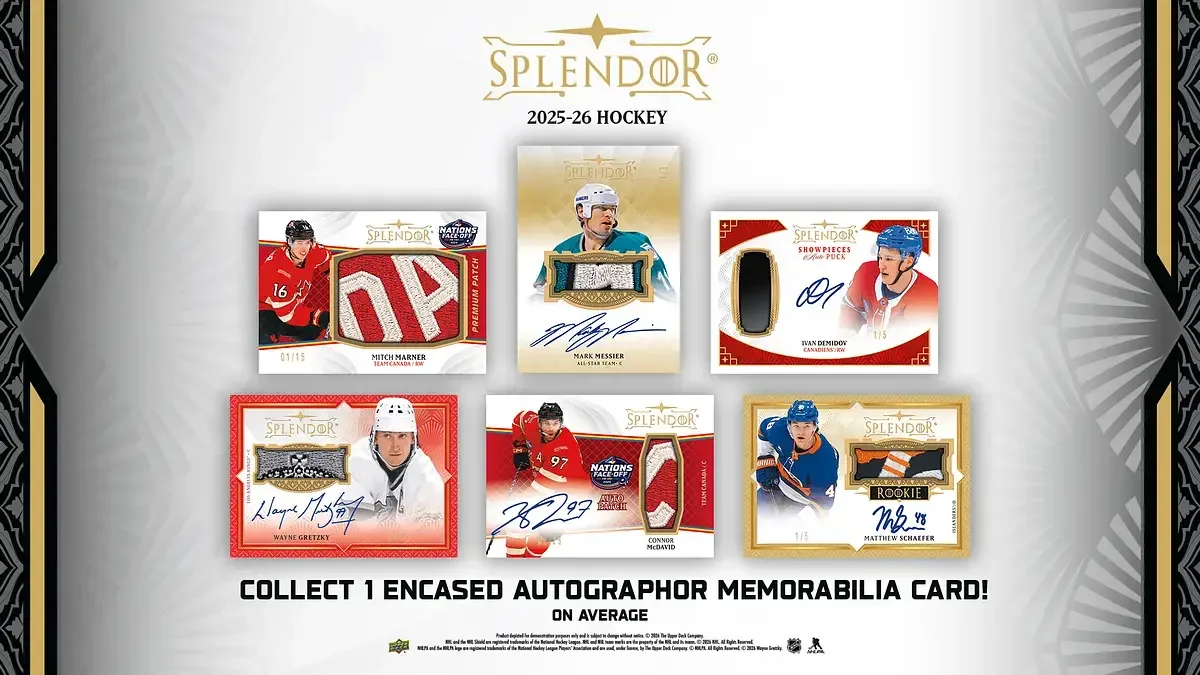
For a useful look at a very different sports-card format, 2025-26 Upper Deck Splendor’s one-card hockey boxes and memorabilia-driven format illustrate how modern premium products create rarity through deliberate release design. The Mantle photo represents the opposite route: rarity created by the survival of a working press object that was never intended as a retail collectible.
Why press-photo survival can be so consequential
News-service photographs were typically made to communicate the news of the day. Prints could be sent through distribution channels to publications, used in production, marked up, filed away, damaged or discarded. Their limited survival is a consequence of that utilitarian role.
As a result, vintage photo collectors often value not only a subject’s fame but also the print’s connection to its original purpose. A blank modern reprint can reproduce the image, but it cannot reproduce the original-negative relationship, production-era timing and real newsroom chain of use that define this Mantle piece.
That distinction also helps explain why the back of a photograph can matter as much as its front. Stamps, crop marks, captions, paper stock and date usage can be evidence examined during authentication. They may illuminate the photo’s history, but they do not eliminate the need for expert analysis. Collectors considering old sports photography should avoid assuming that any print of a famous image is an original Type I merely because it looks old or bears a stamp.
Practical takeaways for vintage-photo collectors
- Learn the classification vocabulary. Type I refers to a first-generation print made from the original negative within two years of the image; it is not shorthand for “old.”
- Evaluate the particular print, not only the image. A familiar photograph can exist in several generations and in prints with different condition or provenance.
- Do not dismiss editorial evidence automatically. News-service stamps and usage marks can be historically meaningful, especially when they help establish a print’s path.
- Separate card demand from photo comparables. A related card sale can increase attention, but it does not make all prints of that player or image equivalent.
- Use authentication as a foundation. With rare photography, confirming generation and originality is especially important before drawing value conclusions from a record sale.
Mantle’s image joins a wider historical-photo hierarchy
The $3 million result strengthens Mantle’s status in original photography as well as cards. But the historical framework extends further back. Yee identifies a 1902 Carl Horner photograph of Honus Wagner—the image later used for the 1909-11 T206 Wagner card—as the top prize in Type I baseball photography. Fogel owns the lone example. Yee has suggested that, if it reached the market, it could command an eight-figure price.
The comparison maps neatly onto the card world: the T206 Wagner is commonly viewed as the prewar grail, while the 1952 Topps Mantle holds an equivalent postwar position. Their source photographs occupy a similarly elevated lane because each is attached to an image that became larger than the card stock on which it was printed.
Still, collectors should be wary of reading a single, exceptional transaction as a guaranteed market-wide increase. The Mantle sale may lead owners of Type I Mantle photographs—and potentially other significant Type I baseball photographs—to reconsider asking prices. It also gives more visibility to a category in which individual images, original negative lineage and evidence of period use can matter profoundly. But the ingredients behind this sale are unusually difficult to duplicate.
For Ron Firman, the purchase centers on an admired player and the communal pull of sports heroes. For the broader hobby, it is a dramatic demonstration that a trading card’s history can extend beyond the card itself. The photograph used for the 1952 Topps Mantle is no longer merely a precursor to an icon. At $3 million, it stands as an iconically valued collectible in its own right.