Aqara has introduced six Matter-enabled smart-lighting products built to work with Apple Home, covering a surprisingly broad map of the house: a floor lamp, a recessed-style downlight, a small-base bulb, an LED strip, outdoor string lights and permanent outdoor lights. The lineup’s underlying pitch is straightforward: practical white lighting when nobody wants their kitchen to look like a side quest, plus controllable color zones when the mood calls for it.
The products support Matter, Thread and Zigbee, and Aqara says they can also work with its sensors and switches. For people assembling a smart-home setup around Apple Home, however, there is one important prerequisite: Apple Home control requires a HomePod mini, HomePod or Apple TV serving as both a Matter hub and a Thread border router. In other words, the lights may be clever, but they still need a suitably clever resident device to introduce them to the household.
Six lights, six different jobs
The new range is not one product in a collection of nearly identical boxes. Each model is aimed at a distinct lighting situation, from a small lamp fixture to an exterior roofline.
Floor Lamp T1: wall-wash lighting with 18 zones
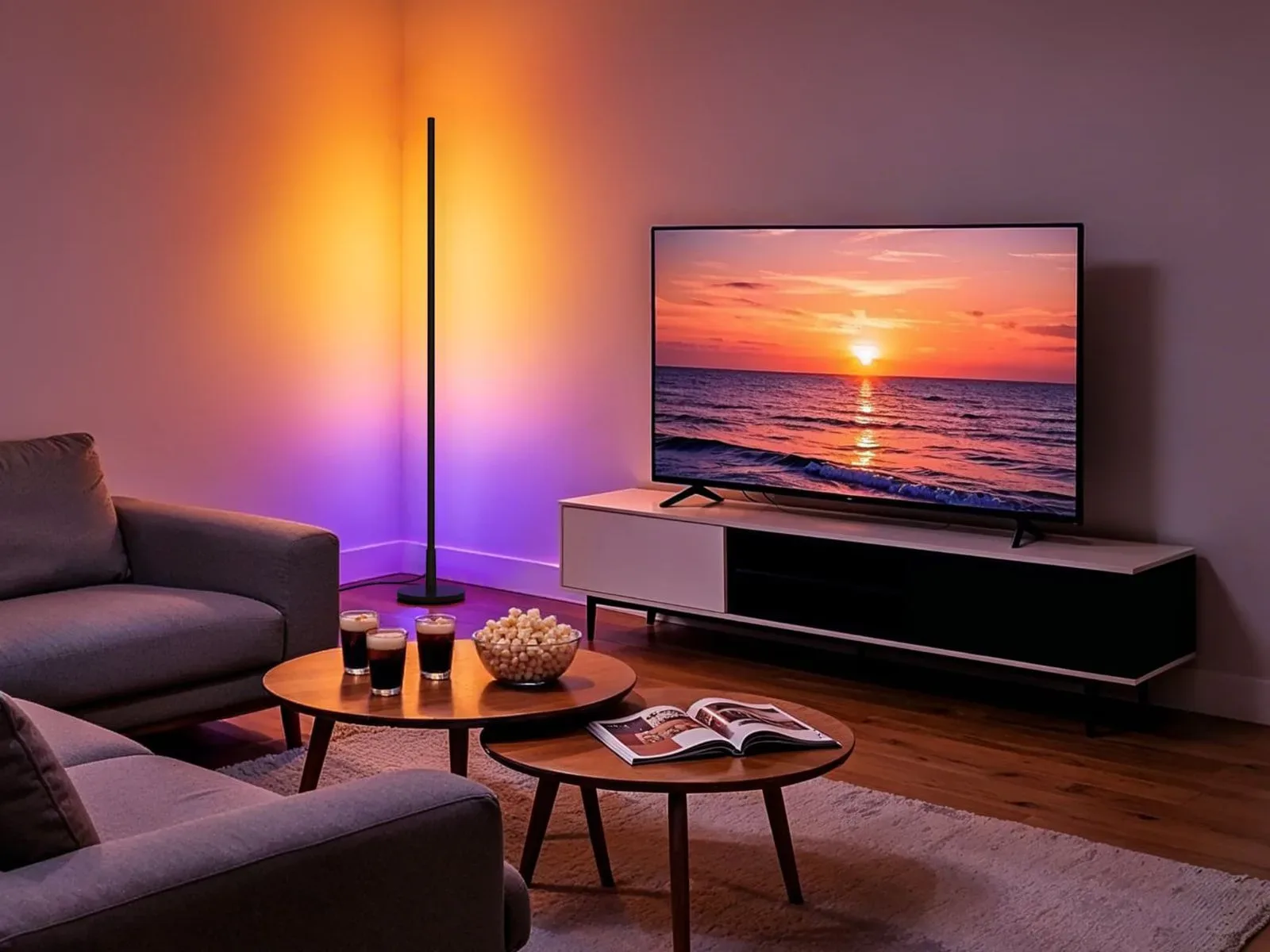
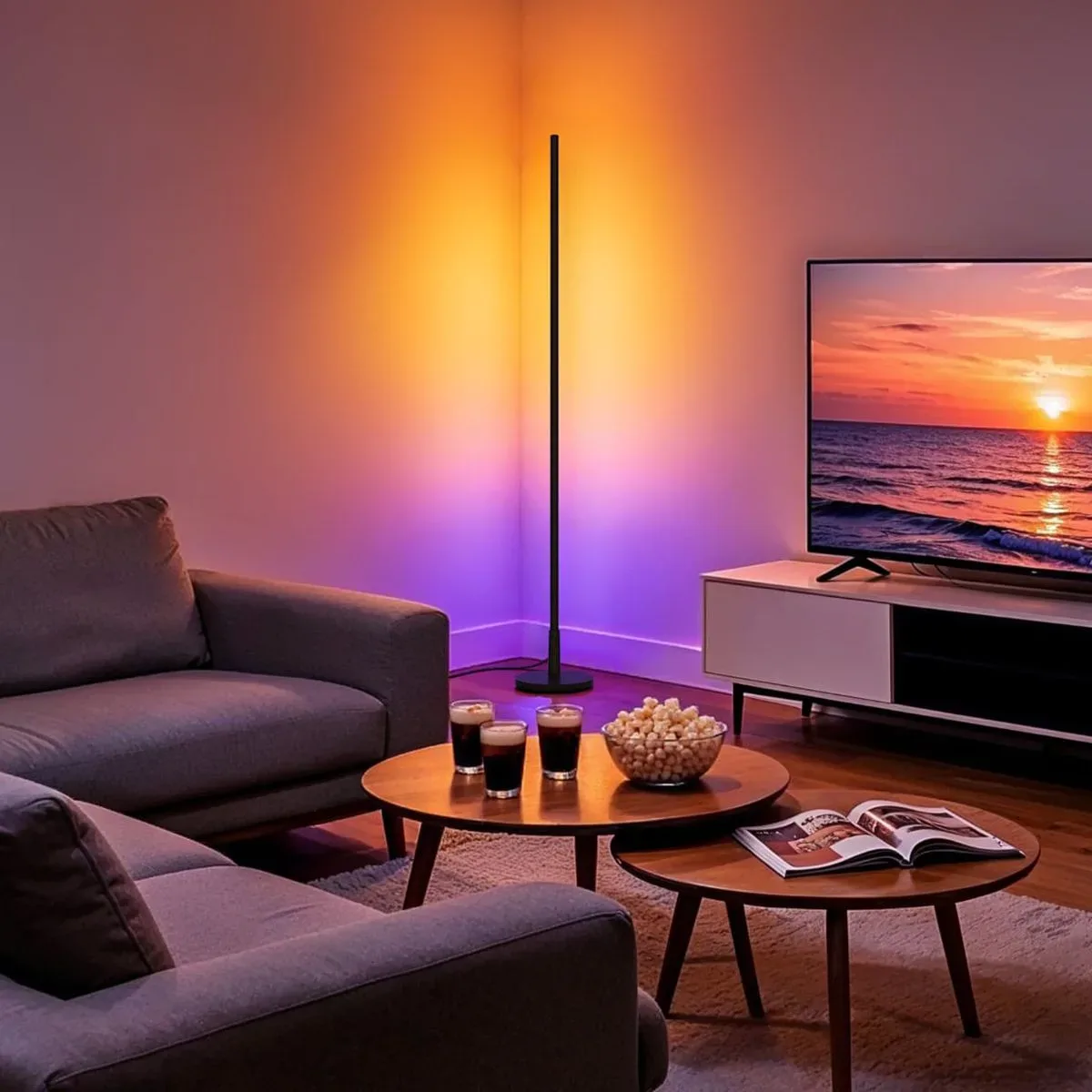
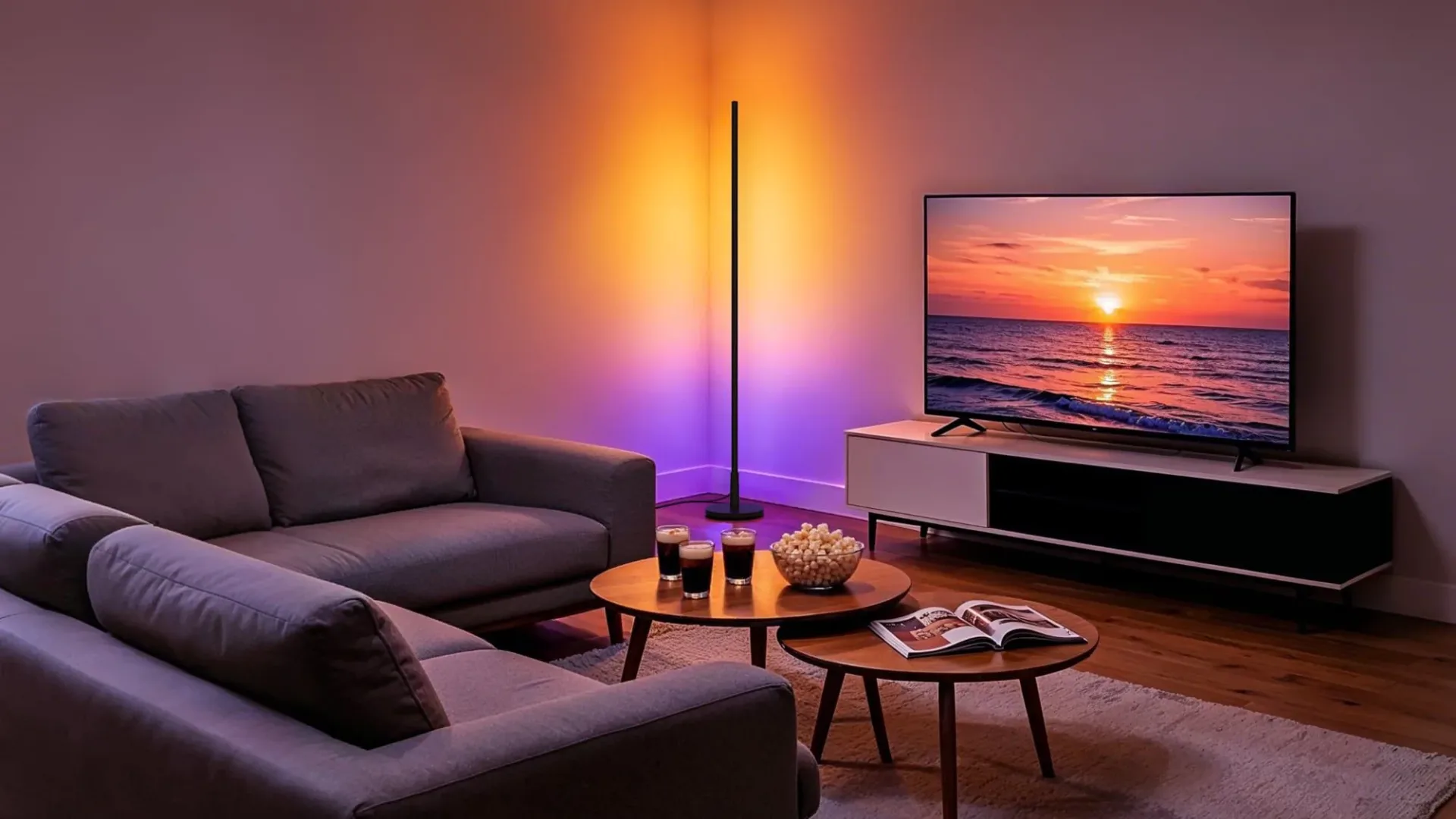
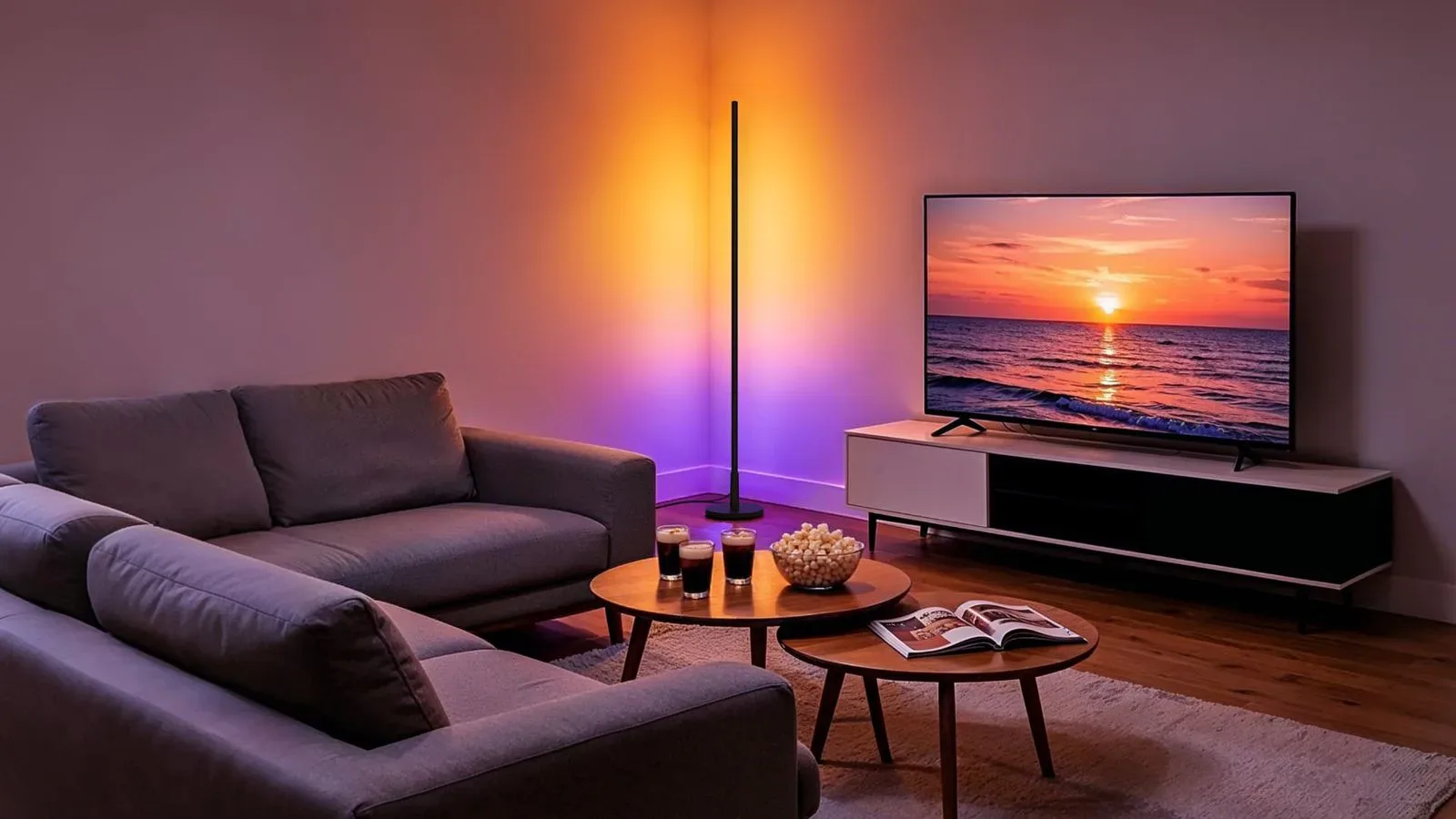
At $120, the Floor Lamp T1 is a rod-shaped lamp designed to cast a wall-wash effect. Rather than directing its contribution toward a desk or reading chair alone, a wall-wash design sends light across a nearby wall. That can make the wall itself part of the scene, whether the desired effect is a clean wash of white light or a multicolor display.
The T1 has 18 individually controllable zones. A zone is a separately addressable section of a lighting product; instead of the entire lamp having to show one color, different portions can be assigned different colors. The practical result is a segmented color effect or a smoother sequence of shades across the lamp, rather than a single uniform glow.
For white lighting, the T1 supports a 2,000K to 9,000K color-temperature range and reaches up to 1,000 lumens. Color temperature is measured in kelvins: lower settings generally create warmer, more amber-toned white light, while higher settings move toward a cooler white appearance. Lumens measure the amount of visible light output, so the 1,000-lumen figure is the key number for understanding the lamp’s stated brightness rather than its color options.
LED Downlight T2: a slimmer retrofit option
The $50 LED Downlight T2 targets low ceilings and retrofit projects with its slim profile. “Retrofitting” here means adding modern hardware to an existing space rather than designing the lighting around new construction. That makes physical fit at least as important as its smart features: an especially deep fixture is not useful if the ceiling space cannot accommodate it.
The Downlight T2 supports 16 million colors and white light from 2,000K to 9,000K. That puts it in the same white-temperature territory as the Floor Lamp T1, while making its own case through its form factor. A recessed or ceiling-oriented light plays a fundamentally different role from an accent lamp: it is more likely to be part of the room’s regular illumination rather than an optional corner effect.
E12 LED Bulb T2: for smaller screw bases
Aqara’s $24 E12 LED Bulb T2 is the most direct replacement-style option in the group. The E12 designation matters because it identifies a smaller screw base used in certain lamps and fixtures. Smart-bulb shopping can become needlessly dramatic when a buyer discovers too late that a standard-size bulb will not fit; this model is specifically intended for lamps that use the smaller base.
The bulb offers adjustable white lighting as well as up to 16 million colors. It does not come with a separate housing, mounting system or strip-routing plan, so it is the least visually disruptive way to add Aqara’s smart-lighting approach to a compatible fixture already in a room.
LED Strip T2: under-cabinet and shelf lighting
The trimmable LED Strip T2 is intended for use under cabinets and along shelves. It has 108 LEDs per meter, and Aqara says that density is intended to produce even lighting without visible hotspots. Hotspots are conspicuously bright points that can appear when individual diodes are too apparent through a diffuser or against a reflective surface. A more even strip matters most on surfaces where people will see the light directly or in reflection, such as a countertop backsplash or a glossy shelf.
The strip offers 18 controllable zones for every three meters, enabling color gradients across its length. A gradient is a gradual transition between colors rather than a hard boundary between separate color blocks. The strip begins at $66 for a 10-foot length, with 16-foot and 32-foot versions also available.
“Trimmable” is a useful word, but it is not an invitation to freestyle with scissors. It means the strip is designed to be shortened for an installation, helping it fit around cabinets or shelves without leaving an excess coil in view. It is still sensible to plan the path, mounting surface and final length before committing to a cut.
Outdoor String Lights H1: party lighting with an IP65 rating
The Outdoor String Lights H1 arrive in 50-foot and 100-foot lengths, priced at $130 and $220 respectively. They support white light between 2,000K and 9,000K, while independently controllable zones enable color gradients and flowing animations.
The important durability specification is IP65 dust and water resistance. An IP rating is a standardized ingress-protection label. In this case, the “6” indicates a dust-protection rating, while the “5” refers to resistance to water jets. It is a useful distinction for an outdoor product, but it should not be casually translated into “submersible” or “indestructible.” The stated rating supports use where dust and weather exposure are part of the job; it does not erase the need to follow the product’s installation and power guidance.
The string-light format makes most sense where the fixture itself is part of the visual design. Hanging points, railings and open outdoor gathering areas all favor that style more naturally than a neat, continuous architectural line. The H1’s zones expand its role beyond one-color patio lighting, though the warm-to-cool white range gives it an everyday mode when an animation would be a little much for Tuesday.
Permanent Outdoor Lights H1: a more architectural installation
The Permanent Outdoor Lights H1 start at $190 for a 50-foot strand. Unlike the outdoor string lights’ zone-based emphasis, Aqara says every light on this model can be independently controlled. That gives the permanent version a finer degree of control over its color layout, whether it is used for ordinary white exterior lighting or holiday-oriented colors.
The system is extendable and cuttable, with multiple mounting options intended to adapt it to different rooflines. That flexibility is important because rooflines are not standardized: corners, eaves, angles and varying lengths can turn a seemingly simple light run into an installation problem. Buyers considering this type of product should treat the physical layout as a central decision, not a footnote after choosing colors in an app. Measure the intended run, identify the available power arrangement and consider where any mounting hardware will go before buying an expandable lighting system.
What Matter, Thread and Zigbee mean in this lineup
The three protocol names attached to the lights answer different questions, and they are easy to blur together.
- Matter is the interoperability standard at the center of the Apple Home compatibility story. Its purpose is to help compatible smart-home devices work across supported ecosystems rather than being locked to one brand’s app or platform.
- Thread is the network technology used by compatible low-power smart-home devices. For these Aqara lights to work with Apple Home over Thread, an Apple device must function as a Thread border router as well as a Matter hub.
- Zigbee is another smart-home protocol, one that works with Aqara hubs and other platforms.
The practical implication is that a product can list all three names without every setup using them in exactly the same way. An Apple Home household needs the applicable Apple hub arrangement to take advantage of the specified Apple integration. A home already built around Aqara sensors, switches and hubs may also have a reason to consider the Zigbee side of the equation.
That setup check is worth doing before selecting a fixture. A $24 E12 bulb and a $190 permanent outdoor-light run differ enormously in scope, but neither changes the requirement for an appropriate Apple Home hub when Apple Home is the intended control platform. Smart-home compatibility is not merely a logo on packaging; it is the combination of device support, the chosen platform and the hub already present in the home.
Apple users comparing connected-device arrangements may also find some useful context in this guide to how EV routing works with CarPlay and Android Auto. It concerns vehicle navigation rather than lighting, but it illustrates the broader point that connected Apple experiences depend on which compatible hardware and services are part of the setup.
How to choose among the new Aqara lights
The clearest way to narrow the field is to start with the installation location, not with the maximum number of colors.
- For an existing small-base lamp: the E12 LED Bulb T2 is the relevant choice, provided the fixture uses that smaller screw base.
- For a low-profile ceiling project: the LED Downlight T2 is the option Aqara positions for low ceilings and retrofits.
- For indirect visual atmosphere indoors: the Floor Lamp T1 brings wall-wash lighting, 18 zones and up to 1,000 lumens.
- For cabinet edges and shelving: the trimmable LED Strip T2 is built for that linear task and offers gradients along its run.
- For a hanging outdoor look: the Outdoor String Lights H1 pair IP65 dust and water resistance with animated zone effects.
- For a roofline-focused exterior project: the Permanent Outdoor Lights H1 provide per-light control, extension and cutting options, plus multiple mounting approaches.
The color feature sets are substantial across the lineup, but there is a useful dividing line between decorative capability and daily lighting utility. Adjustable white temperatures can make a light suitable for routine use without committing every room or outdoor edge to saturated colors. Meanwhile, controllable zones, gradients and independently controlled lamps are the tools that add visual personality when desired.
Aqara’s new range therefore spans from one small bulb to a customizable exterior installation, all while placing Matter and Apple Home support at the center of the proposition. The most important purchase decision is not which product can make the wildest pattern. It is which one physically fits the location, provides the needed kind of light and matches the smart-home infrastructure already in place.
Shop the products
Check current price, model and availability at the retailer.