A portable gaming setup has a particularly annoying weak point: the moment a handheld, phone and earbuds all need power at once, just as the spare cable has somehow vanished into a backpack’s darkest pocket. Anker’s 25,000mAh 165W power bank is positioned as an answer to that very specific travelling-player problem, with two built-in USB-C cables, additional USB-C and USB-A connections, and enough stated output to support more demanding devices than a typical phone-focused battery pack.
The power bank is listed at $91, reduced from $135. That is described as a 32% reduction and the lowest listed price on Amazon in 90 days. As with any retailer price, that figure is a snapshot rather than a promise of how long the listing will remain at that level, so prospective buyers should verify the displayed price and seller details before ordering.
Why wattage matters more than the port count
Capacity and output answer two different questions. Milliamp-hours (mAh) are the battery’s stated capacity, while watts (W) describe how much power it can deliver at a given time. A large-capacity battery with low output may be useful for slowly topping up a phone, but it may not be the right fit when a handheld gaming PC is active, its screen is lit and a game is placing sustained demand on the system.
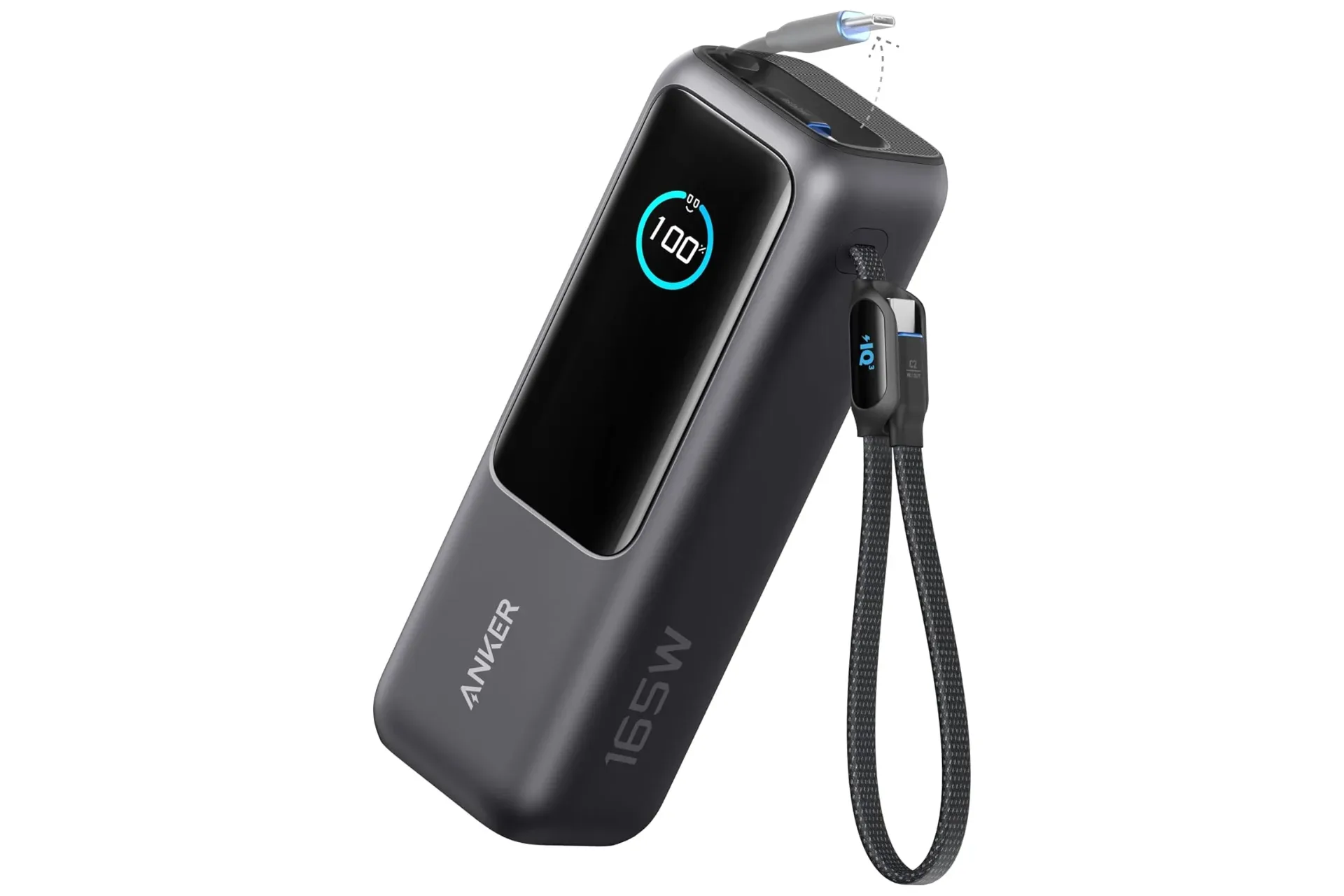
Anker rates this model for 165W of shared output. Its USB-C outputs can provide up to 100W each, subject to the overall shared limit. “Shared” is the important qualifier: it means 165W is the maximum budget across connected devices, not 165W available independently from every connection at the same time.
That distinction is practical rather than merely technical. A player charging one handheld has a different use case from a group charging a handheld, phone, laptop and earbuds together. With several devices connected, they draw from the same total power pool. The claimed four-device capability is therefore about connection flexibility, while the 165W rating is the ceiling the combined setup must work within.
The company’s pitch is that the higher output can keep a gaming handheld charging while it is in use rather than merely slowing battery drain. Whether any particular device reaches its fastest possible charging speed depends on that device’s own charging limits and the power profile it requests. A 100W-capable port does not force 100W into every product plugged into it; compatible devices determine their own needs.
That makes this model most relevant to people who carry more than a phone. Laptop users, handheld-PC owners and travellers with several USB-powered accessories may get more value from the output headroom than someone whose routine is limited to overnight phone charging.
Four charging connections, including two cables already attached
The standout design choice is cable storage. Rather than asking travellers to bring every lead separately, the battery has two integrated USB-C cables. One retractable cable extends to as much as 2.3 feet. The other is about a foot long and doubles as a carrying strap.
Those are not identical solutions for the same job. The longer retractable lead is meant to allow some distance between the battery and the device—for example, putting the pack beside a bag while using a handheld in a seat. The short strap cable is more about immediate access and compactness. Both approaches reduce one of the common points of failure in a travel charging kit: owning the correct cable but leaving it at home.
Anker rates the retractable cable for 20,000 pulls and the strap cable for more than 20,000 bends. Those are manufacturer durability claims, not a guarantee that every cable will last for a particular number of journeys. Still, the numbers matter because integrated cables cannot simply be swapped out as casually as a loose lead if they become damaged. Treating both cables gently—especially avoiding sharp bends and forceful pulling—remains sensible.
Alongside the integrated cables, the unit includes one separate USB-C port and one USB-A port. In total, that supports charging up to four devices simultaneously. USB-A remains useful for older accessories and cables, while the USB-C connections are the centerpiece for newer handhelds, phones and laptops.
A more realistic packing use case
For a gaming trip, the four connections could be allocated to a handheld, phone, earbuds and another accessory, or to a handheld and laptop with remaining ports available for smaller devices. The built-in leads are particularly useful in the first scenario because they free travellers from packing cables just to cover the most basic USB-C needs.
It is also worth separating “four devices can connect” from “four devices will charge at their maximum speed.” The specifications establish the available connections and shared output, but individual charging behavior will vary with device requirements and the combined load. Buyers planning to power a demanding laptop and handheld simultaneously should regard the 165W shared ceiling as the key specification to consider.
25,000mAh capacity and what it does—and does not—tell you
The stated 25,000mAh capacity puts this in the larger travel-battery category. It is intended for extended time away from wall power rather than the quick, pocketable phone top-up associated with smaller packs. That makes it potentially useful at conventions, on road trips, during long flights and for visits where outlets are limited.
Capacity figures should not be read as a direct count of full recharges for every device. Different hardware has different batteries, conversion losses occur when power is moved and regulated, and using a device while charging changes the result. In plain terms, capacity is a useful comparison point between battery packs, but it is not a universal guarantee of exactly how many handheld sessions or phone charges the pack will provide.
For players, the more useful question is often whether a power bank can sustain the device at a useful rate when the game is already running. Here, the combination of 25,000mAh capacity and high claimed USB-C output is the central appeal. It aims to cover both sides of portable power: a substantial reserve of energy and the ability to deliver it at a rate suitable for higher-demand gear.
That same emphasis on portable setups makes other hardware maintenance worth remembering. A charging solution cannot fix every apparent device issue; for display-specific diagnosis, our guide to why a monitor flickers at startup and how to troubleshoot it covers a separate, but similarly frustrating, part of keeping a gaming station working.
Travel: designed around the 100Wh carry-on threshold
Anker says the battery was designed to meet the 100Wh threshold used for carry-on batteries by airlines. This is an important detail for a 25,000mAh product, because a power bank that cannot travel in the cabin is much less convenient for the people most likely to benefit from it.
Airline battery policies should always be checked with the specific carrier before departure, particularly for international itineraries or flights involving multiple airlines. The relevant restrictions can cover where batteries are packed as well as their capacity. The stated design target is promising for travel, but it does not replace confirming the rules applicable to a particular trip.
For air travellers who use handhelds, cabin power can be inconsistent or unavailable. A battery that can accompany a player in carry-on luggage can make a long journey less dependent on a working seat outlet. That is a stronger use case than simply carrying extra capacity “just in case”: it gives the player a dedicated power source that can also serve a phone and other essential small electronics.
Recharge needs and what is included
The power bank itself is said to recharge quickly when paired with a charger rated at 100W or more. That wording is significant because the battery pack’s own recharge speed is only one half of the equation. A buyer who does not already own an adequately rated wall charger will need to account for the charger they plan to use. The supplied information identifies the 100W-or-more recommendation, but does not establish the exact recharge time.
A protective pouch is included, which is a welcome practical extra for something likely to share a bag with controllers, adapters and loose accessories. Anker also lists an 18-month warranty. Keeping the pack in the pouch when travelling may help avoid cosmetic wear and reduce the chance of cable ends catching on other gear, though the pouch should not be treated as a substitute for sensible battery handling.
Who this power bank suits best
- Handheld gaming PC owners: The high USB-C output is the key attraction for players who need a pack that can support a more power-hungry portable device during use.
- Multi-device travellers: Two built-in cables plus USB-C and USB-A ports provide flexibility for a phone, handheld, laptop and smaller accessories.
- People who regularly forget cables: The retractable cable and strap cable address that problem directly, without adding more loose items to pack.
- Frequent flyers: Its stated 100Wh-oriented design makes it relevant for carry-on planning, subject to the traveller verifying airline rules.
Conversely, someone seeking the smallest possible emergency phone battery may find the capacity, output and cable system more than they need. This is not presented as a minimalist accessory. Its appeal lies in consolidating a substantial battery reserve, multiple ports and two always-available USB-C leads into one travel-oriented unit.
At the listed $91 price, the value proposition is less about a single specification than the combination: 25,000mAh capacity, 165W shared output, up to 100W from USB-C outputs, four-device charging, integrated cables, a pouch and an 18-month warranty. For a portable gaming kit that repeatedly ends up short on power or cables, that combination is the feature set worth weighing against the pack’s larger travel-focused role.
Shop the products
Check current price, model and availability at the retailer.