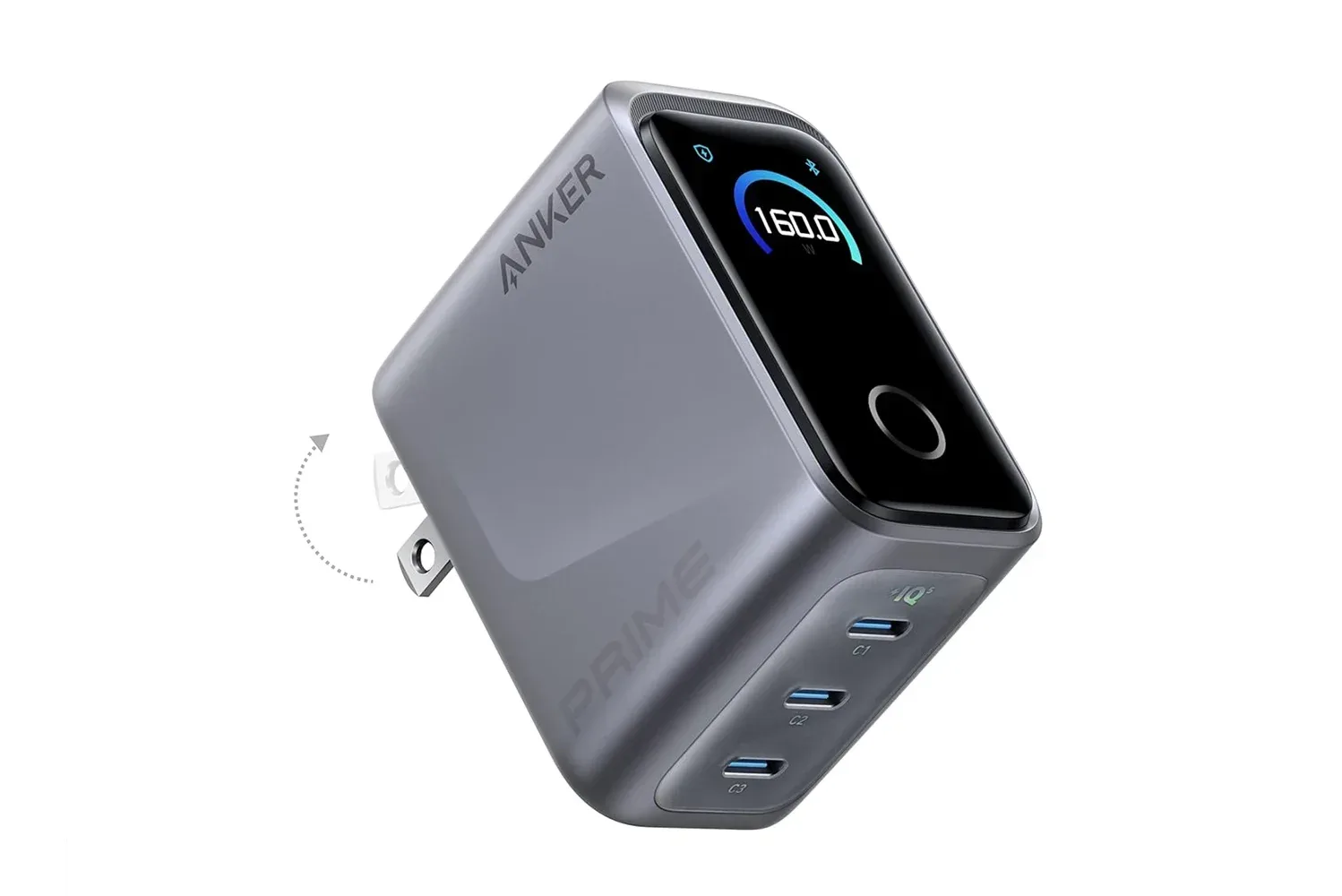
A powerful laptop charger is rarely exciting until it becomes the one bulky item that refuses to fit comfortably in a travel bag. Anker’s Prime 160W charger aims to solve that problem by putting three USB-C ports and up to 160W of combined output into a body the company compares with an AirPods Pro 3 charging case.
The charger is currently listed for $99 for Prime members, against a stated $149 list price. That is a 33% reduction, and the offer is part of a Prime Big Deal promotion. Prime membership is required for that price. Free returns are available, but prospective buyers should pay close attention to what comes in the package: it includes the charger and a welcome guide, not a USB-C cable.
That omission is not trivial on a high-wattage adapter. The charger may support up to 140W from any one of its ports when used on its own, but the cable between charger and device must also be rated to carry that level of power. Buying the compact brick without accounting for the cable is a little like buying a sports car and then discovering the road to your house has a 25 mph limit.
What the 160W rating actually means
There are two figures worth separating. 160W is the charger’s total available output across all three USB-C ports. 140W is the maximum Anker says a single port can provide when it is used alone. Watts measure electrical power, so these numbers describe the rate at which compatible devices can be supplied with energy, not a guaranteed charging speed for every device in every circumstance.
Anker says each of its three USB-C ports can reach the 140W maximum in single-device use and sustain that output during longer charging. Its illustrative claim is that a 16-inch MacBook Pro can reach 50% from empty in 25 minutes. As always, actual results depend on the laptop model, its charging behavior, battery condition, the cable, and what the computer is doing while plugged in.
When multiple devices are connected, the 160W ceiling has to be shared. Anker uses the name PowerIQ 5.0 for its automatic power allocation system. In practical terms, this means the charger determines how to divide its available output among the connected devices rather than requiring the owner to manually choose a dedicated “laptop” port.
The company says a 16-inch MacBook Pro, iPhone 16 Pro Max and 11-inch iPad Pro can charge together in the same overall time as they would with their original 140W, 35W and 35W adapters. Those listed adapter ratings total more than 160W, so this should not be read as every port supplying its device’s theoretical peak rating all at once. It is better understood as a claim about the devices completing their charging cycles together, where demand normally changes as batteries fill.
A compact charger built around gallium nitride
Anker puts the charger’s power density at 1.35 watts per cubic centimeter. Power density describes how much output a device packs into its physical volume. Higher density is particularly useful for travel hardware, where the goal is less about setting up an elaborate charging station and more about removing an extra brick from a backpack.
Related coverage includes Anker Prime 160W Charger Falls to $99 for Prime Members.
The compact design relies on gallium nitride, commonly shortened to GaN. It is a semiconductor material used in charger designs because it can waste less energy as heat than older silicon-based designs. That efficiency can help manufacturers make smaller high-output chargers. It does not erase heat entirely, nor does it make every USB-C cable interchangeable, but it explains why a charger intended for a large laptop can occupy far less space than the large white laptop adapter many people recognize.
For a gaming-minded desk setup, the attraction is straightforward. A single wall outlet can serve a power-hungry notebook plus a phone and tablet, leaving more sockets on a crowded power strip for a monitor, console or other equipment. For travel, it could replace separate adapters for a MacBook Pro or MacBook Air and smaller USB-C devices. Anker also lists recent iPhones and Samsung Galaxy phones among the products the charger is designed to support.
Compatibility, however, is not the same thing as every device pulling 140W. A phone is designed to request far less power than a large laptop. The charger offers capacity and flexibility; the connected device negotiates how much it will accept. That distinction is useful when comparing multi-port adapters, because a very large total wattage number alone does not tell a buyer what happens after a second or third device is plugged in.
The display is a practical diagnostic tool, not just charger cosplay
One unusually visible feature is the charger’s built-in display. It shows the power delivered by each port in real time, and touch controls allow switching between charging modes. Custom modes can also be configured in Anker’s app over Bluetooth.
Whether a wall charger needs a screen is a fair question. A charger is not exactly a device most people want to manage like a smart home appliance. Still, a live readout can have a practical purpose. If a laptop is charging unexpectedly slowly, seeing the current output may help narrow down whether the issue is connected to the device, the chosen port, the cable or the broader power-sharing arrangement.
The screen does not replace the need to buy appropriate cables. Since no cable is included, owners who want to pursue the stated 140W single-port capability need a cable explicitly rated for that power. A lesser-rated cable may still charge a device, but it may prevent it from receiving the maximum level the adapter and laptop could otherwise negotiate. The accessory is therefore best considered a charger-and-cable purchase rather than a complete charging kit at the $99 promotional price.
That same principle applies to routine battery care. Fast charging is a convenience feature, while device-level settings govern charging limits and battery-management behavior. Samsung phone users, for example, may want to understand the meaning of the battery charge-limit indicator before assuming it signals a fault; the shield icon on a Galaxy battery can represent a charge limit rather than a security alert.
Who this deal suits—and who should pause
The strongest case for this Anker charger is someone consolidating USB-C power at a desk or while traveling. Its feature set is designed for people who might charge a larger laptop, phone and tablet in the same window and prefer one small adapter to several individual ones. A 24-month warranty is included. The product also holds a 4.6-out-of-5 buyer rating across nearly 1,300 Amazon reviews, though aggregate customer ratings are a general signal rather than a guarantee that a particular device-and-cable combination will fit every buyer’s needs.
It is less compelling for a person who only charges a phone and a low-power accessory, or for anyone who already has a compact multi-port adapter that meets their needs. The sale price is lower than Anker’s stated list price, but a buyer still needs to budget for suitable cables if they do not already own them. The total-output limit also deserves consideration for anyone expecting three devices to each sustain their individual maximum input simultaneously.
In other words, the value is not merely that this adapter is rated for 160W. The value is that it combines high single-port output, three USB-C connections, automatic power distribution and visible output information in a notably small form. At the current Prime-only $99 price, it is a targeted upgrade for high-power USB-C households and travelers—as long as the cable requirement is treated as part of the purchase rather than an afterthought.
Shop the products
Check current price, model and availability at the retailer.