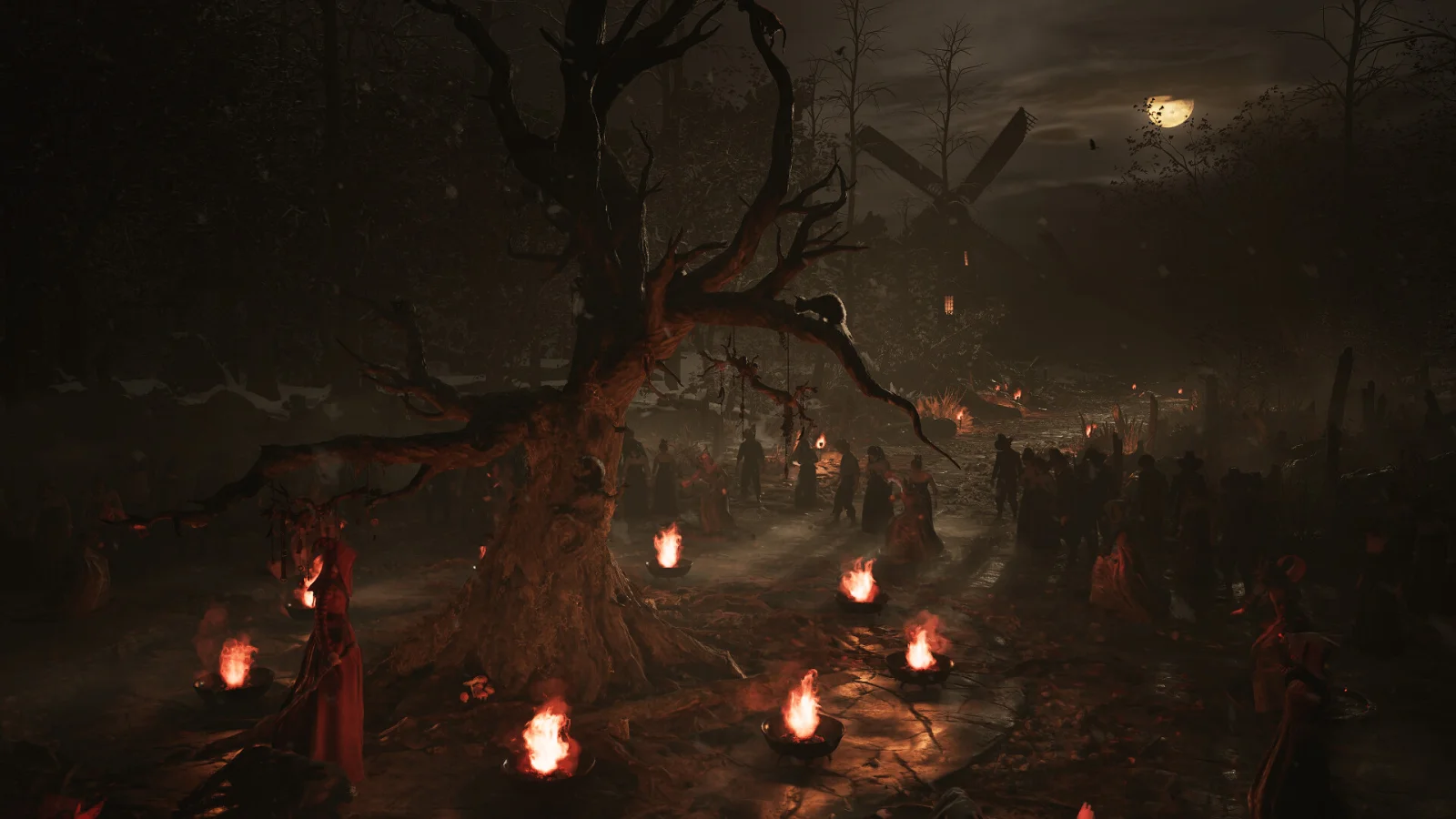
1666: Amsterdam is shaping up as a distinctly strange stealth game: part occult investigation, part urban infiltration sandbox, and part feline-assisted possession caper. Set amid witch hunts in 1666 Amsterdam, it follows Noa, a witch tasked with identifying and eliminating the Originals—demonic forces operating through people who have entered immortal pacts.
The premise has a formal deadline built into it. Noa has a calendar year to pursue her quarry, while some of her magical abilities are tied to the full moon. Yet the game’s most compelling hook appears to be less about directly casting spells at enemies and more about quietly navigating a hostile city that is suspicious of anyone who looks, moves or enters somewhere they should not.
That tension makes 1666: Amsterdam sound less like a straightforward action game than a close-quarters social-stealth puzzle. The city’s first Early Access content covers a compact selection of streets and canals, but the density matters more than the map’s footprint. Homes, shops, a university and a prison are reportedly among the locations players can enter, turning a few Amsterdam blocks into an interlocking web of locked doors, watchful guards, rumors and opportunities.
A witch hunt where discretion is the useful spell
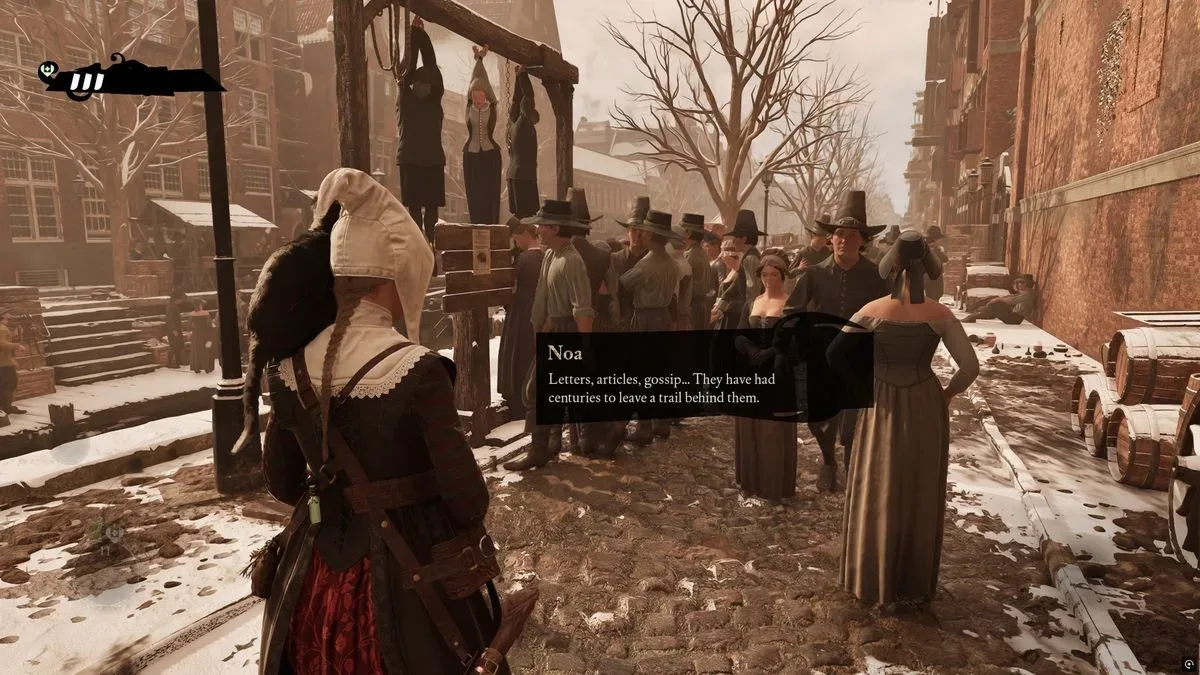
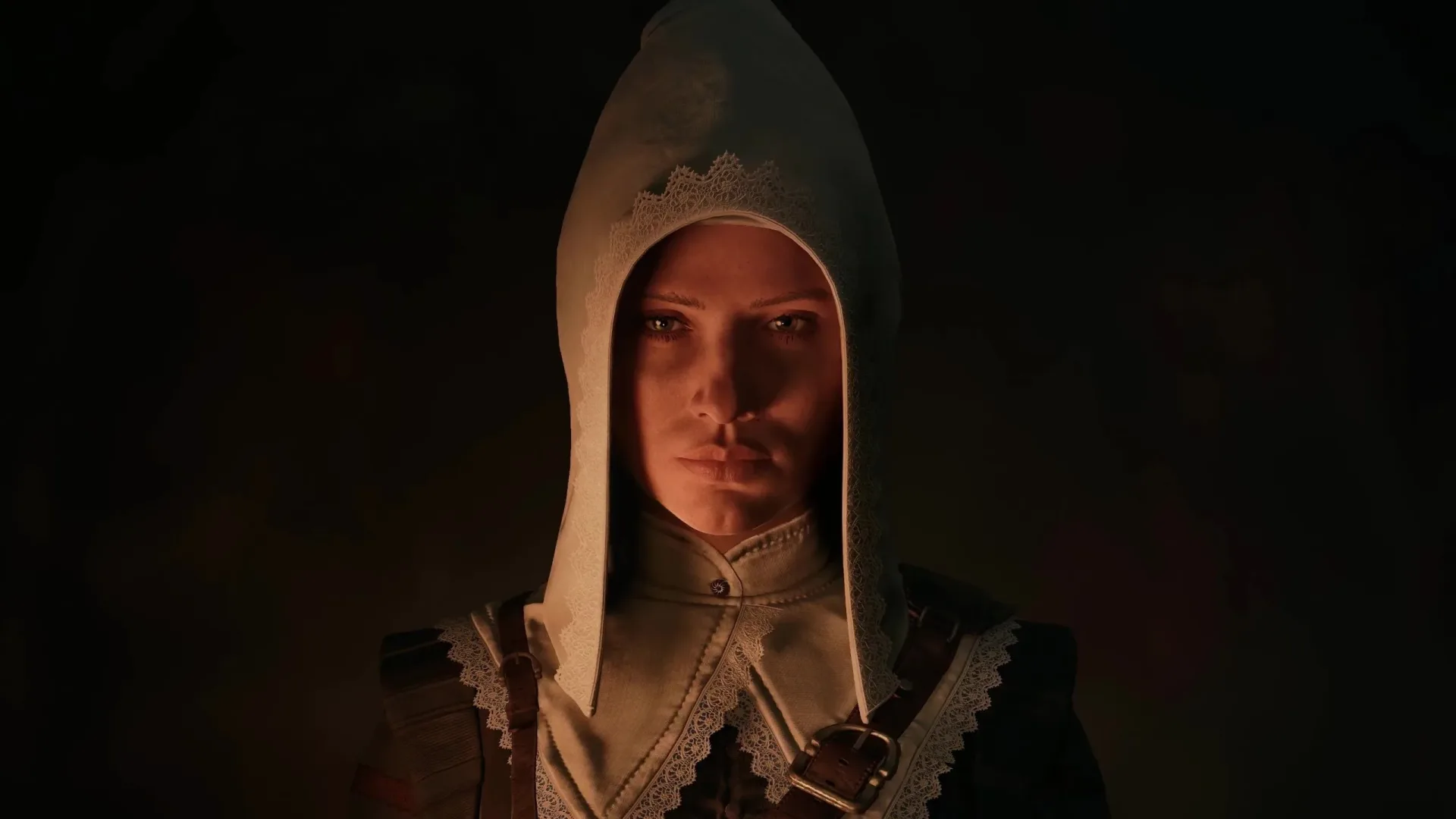
Noa can assume an overtly witchy red-robed appearance, but it is not a convenient superhero costume. It attracts attention. Blending in with a more ordinary black dress and white bonnet is safer, and even rushing through public space can create trouble. A suspicion meter responds when Noa is spotted in restricted places or behaves oddly around bystanders.
That setup makes the basic act of searching for a target more involved. The player may have a name and a rough part of the city to investigate, perhaps supplemented by a note suggesting a particular cluster of houses. But opening a window to look inside, lingering in an alley, or simply making the wrong move can draw escalating scrutiny. If guards give chase, Noa can take to a broom and skim along the canals to escape, though the broader design seems to encourage avoiding that sort of attention in the first place.
It is an appealing constraint for a game centered on supernatural power. Noa is not presented as someone who can casually storm every guarded building with magic blazing. She is fragile, and crucial information about targets and the demons within them lies behind doors that conventional access will not open. Notices posted on public boards and conversations overheard at inns can point an investigation in the right direction, but they are only the first step.
The comparison point is clear: a compact location with many layered routes, where observing routines and exploiting the right disguise or role matters more than following a bright objective marker. There is Assassin’s Creed lineage around the project, but the reported structure sounds closer to the tightly designed social spaces associated with classic Hitman. The important distinction is that Noa’s toolkit is not built around costumes alone. It is built around a cat named Aaron.
Aaron the cat is the lockpick, scout and possession engine
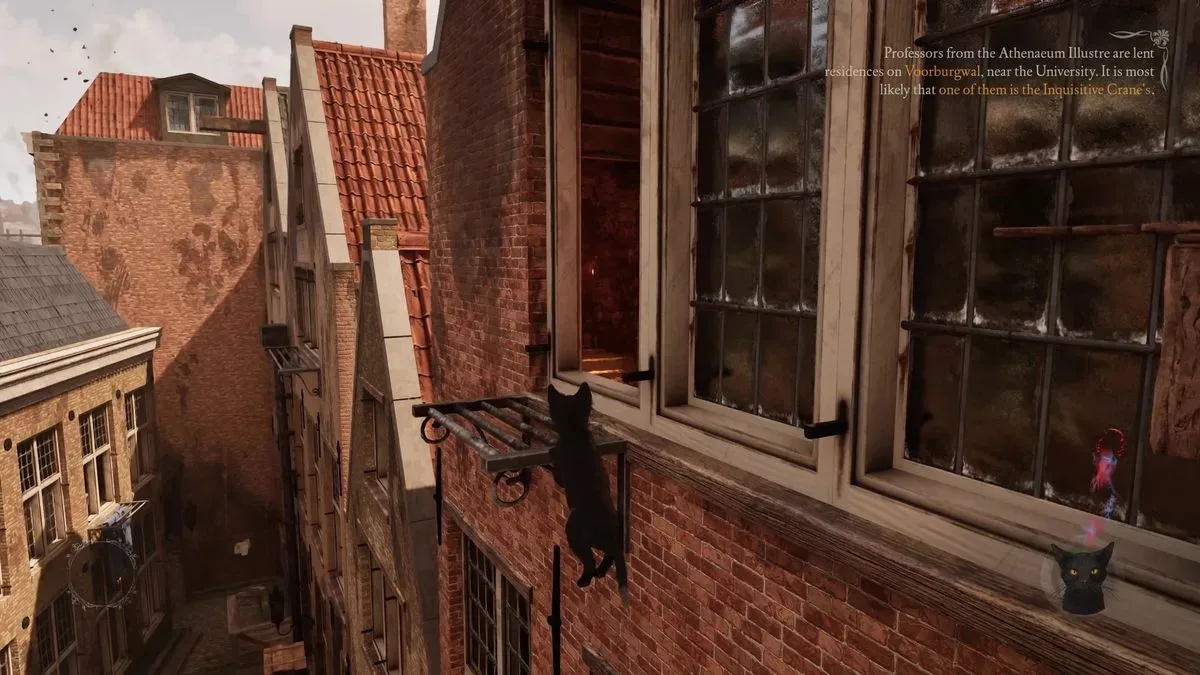
Aaron is Noa’s familiar, and he is no ordinary animal companion. The cat is inhabited by the spirit of a confused historian from 1999, a detail that connects the 17th-century storyline to a contemporary narrative thread. Players can take direct control of Aaron, using his small size and agility to reach ledges, navigate narrow gaps, inspect rooms and steal one item at a time.
Related coverage includes 1666: Amsterdam Turns Witchcraft and Possession Into a Dense Stealth Sandbox.
More significantly, a cat sitting near an open window is less likely to cause alarm than a witch peering through it. Aaron can work his way through a building to unlatch a door from within, clearing a route for Noa. The arrangement turns the familiar into an infiltration tool in the most literal sense: first the cat gets inside, then the witch follows.
But that is only the beginning. Certain people are afraid of cats, and Aaron can attack them. After scratching a suitable target, the spirit inhabiting Aaron can possess that person, allowing Noa to command the newly occupied host. A servant can unlock interior doors or use a key to open the front entrance. The same possessed person can then escort Noa through a guarded threshold without causing the immediate suspicion she would face alone.
This possession system is where 1666: Amsterdam appears to find its identity. Different bodies create different solutions. A scholar encountered on the street may offer access to university laboratories. A criminal with lockpicks can be directed to break into a building. Even a guard can potentially be used against fellow guards, including by ordering them to knock out a colleague with a truncheon. Rather than providing a single prescribed route, the game can ask players to notice who is nearby, what authority or equipment they have, and how Aaron might turn those traits into a path forward.
It is also an unusual variation on body-switching games of the past. The historical echo to Omikron: The Nomad Soul is easy to see, though the reported freedom to jump among available bodies makes the idea feel more systemic here. The cat’s involvement is equally important: possession is not merely an abstract menu power, but something enabled by scouting, proximity, fear and physical access.
Searching the wrong house can still move the investigation forward
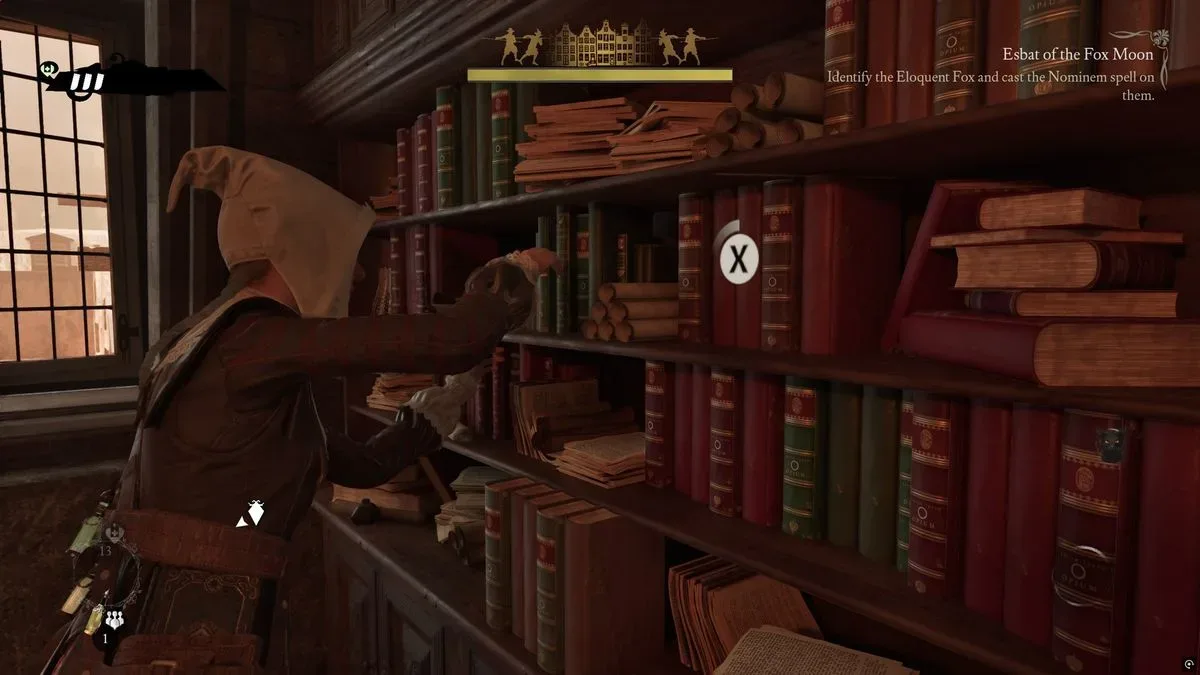
A good stealth sandbox makes an unsuccessful lead feel less like wasted time and more like a detour with value. 1666: Amsterdam reportedly supports that approach. Entering the wrong house may still mean access to bookshelves, tables and other places where materials or clues can be found. Ingredients can be gathered for potions, and recipes can unlock brief but valuable advantages, such as moving through restricted areas without being challenged for a limited time.
One reported example involved possessing a baker largely to get Noa unchallenged access to the ingredients stored in the shop. That is the kind of mundane, slightly ridiculous solution that can make systemic stealth games memorable. The goal is not necessarily a dramatic assassination or a huge fight. Sometimes it is gaining legal-looking access to a pantry because the next potion may solve a more serious problem.
Hidden coffers left by Noa’s coven also feed into progression. These rewards can provide upgrades, including increased health, through a pick-three selection system with a roguelike flavor. Choices can be kept or rerolled after death if they are not locked in, giving progression some flexibility as well as chance.
The effects are not always immediately clear before they are tested. Reported options include hiding in bushes, drawing guards into tight spaces and trapping them, plus a possible aerial mobility ability that could open routes through high windows. In the game’s layered story, Clio—a present-day scholar interpreting material left by her ancestors Noa and Aaron—learns additional magical words. That framing helps explain why powers may be discovered piecemeal rather than laid out as a conventional, fully explained skill tree.
Early Access roughness remains visible
The central possession-and-investigation loop has generated the strongest enthusiasm, but 1666: Amsterdam is not presented as a finished, polished stealth classic. It is in Early Access, and the weaknesses described so far are substantial enough to watch. Tutorials reportedly do not clearly communicate every tool Noa has for entering forbidden areas, which is particularly problematic in a game asking players to experiment with an unfamiliar mixture of magic, social stealth and body control.
Combat is another concern. Boss encounters that interrupt investigations have been characterized as generic, with uninteresting attack patterns. Noa’s broom-based attacks are not inherently the problem; rather, the fights do not yet appear to match the inventiveness of infiltrating a house through a cat, a servant and a set of locked internal doors. That is an area where a major rethink could make the game’s action feel more connected to its best systems.
There is also an unresolved concern around AI use in the game’s production. Its use has reportedly been reduced or reconsidered to some degree, but the available information does not establish the full scope of the change. That remains an issue worth following as development continues.
A compact city designed for curiosity
The currently described Early Access slice includes one map, two primary missions and three targets, alongside more linear sequences set in 1999. Even after roughly 10 hours in that material, only a portion of the streets around Noa’s safe haven had been explored. That suggests the game’s ambition is not to offer a vast historical city filled with interchangeable activities. Instead, it is aiming for a smaller place where a door, a window, a particular NPC and a scrap of gossip can each matter.
For players who enjoy games that reward patient observation and improvised plans, that density could be the real spell. 1666: Amsterdam’s mix of full-moon witchcraft, alternate-era storytelling, animal scouting, temporary body control and covert investigation is undeniably odd. Its Early Access problems may be just as real. But the underlying idea—a stealth sandbox where the best disguise may be a possessed baker and the best burglar may be a cat—has a personality all its own.
Those watching the wider PC landscape can also check our coverage of Game of Thrones: War for Westeros and its plans to welcome RTS newcomers. It is a very different kind of strategy game, but both projects underline how much a clear mechanical hook can matter when a game asks players to learn unfamiliar systems.