Late Fame gives Willem Dafoe an unusually quiet register to play in, and that choice is the film’s great appeal. As Ed Saxberger, an ageing New Yorker who once showed promise as a poet and now works sorting other people’s writing at a post office, Dafoe strips away the flamboyance often associated with his screen presence. The result is a character study with a gently bruised sense of possibility: a man confronted by the prospect that an old creative life may not be entirely over.
That prospect arrives through Wilson Meyers, an ambitious younger writer who introduces Ed to the Enthusiasm Society, a literary circle eager to treat him as a rediscovered talent. Their plans for a reading give the film its modest narrative momentum, but the drama is less interested in grand comeback beats than in the awkward, tender, and occasionally absurd social currents around artistic recognition.
A performance built on restraint
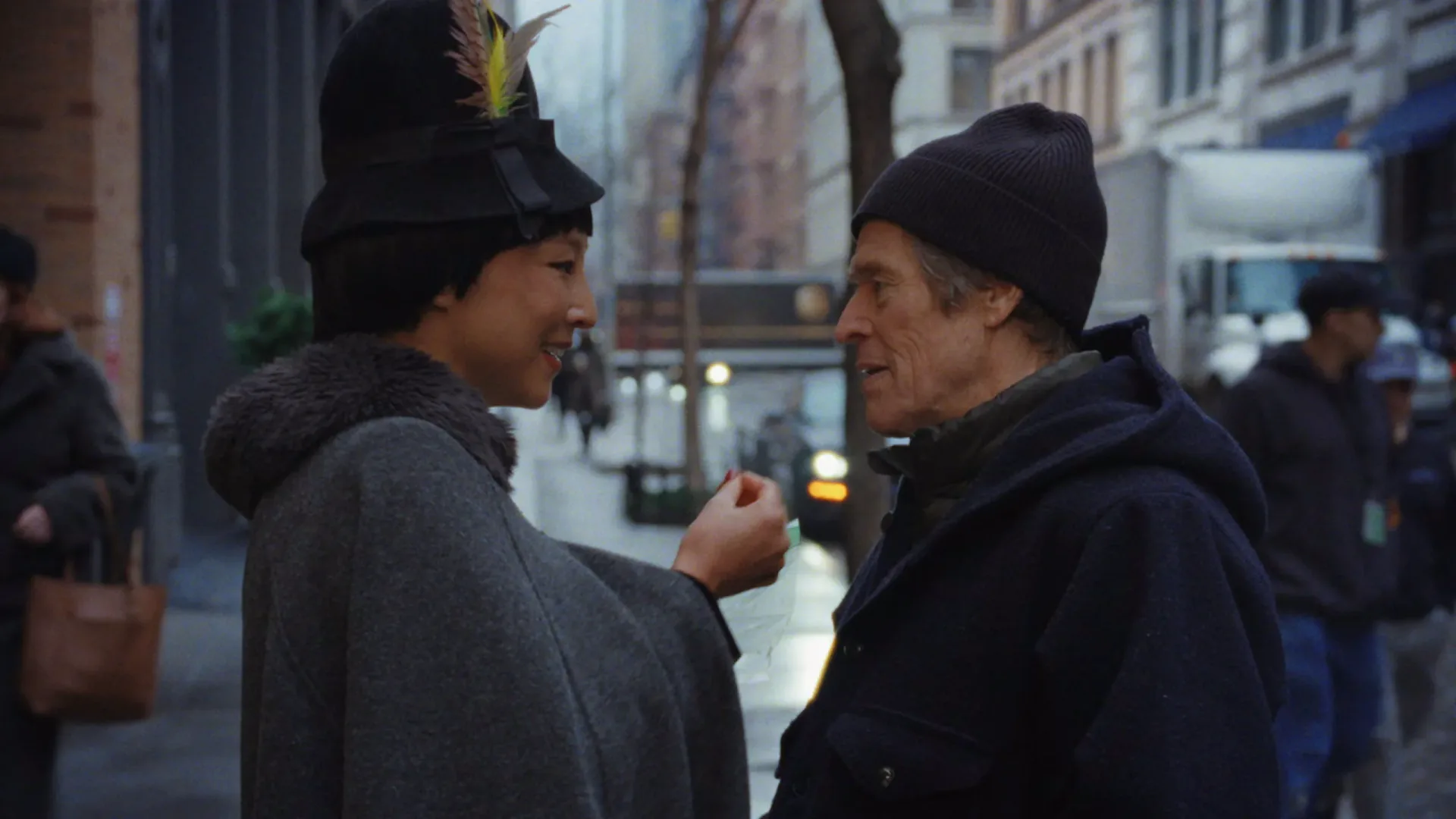
Dafoe’s low-key work anchors the movie’s shifting tones. Ed is neither romanticised as a neglected genius nor dismissed as a relic; he is allowed uncertainty, writer’s block, and a wary responsiveness to attention. The film’s compassion extends beyond him, too. It moves between his pool-bar friends and literary gatherings without turning either world into an easy punchline, giving ambition and insecurity room to coexist across the social divide.
Greta Lee provides a striking counterpoint as Gloria Gardener, an actor and singer whose theatrical confidence and flirtation play sharply against Ed’s reserve. Her performance reportedly gets two standout sequences, and the material leaves a sense that the film could profitably spend more time in Gloria’s orbit. Edmund Donovan’s Wilson, meanwhile, embodies the more snobbish edge of literary aspiration without reducing the character to a simple villain.
Poetry on the page, and in the cuts
Samy Burch’s contemporary-New York adaptation of Arthur Schnitzler’s posthumously published 1895 novella finds a fittingly literary cadence. Kent Jones shapes exchanges with brisk, staccato cutting, then pauses on stillness in a manner that suggests a breath between lines. As Ed wanders familiar streets, the film settles into an observant, lyrical rhythm.
That stylisation has a limitation. Ed’s poetic voice-over can lean toward the very sentimentality the story is equipped to scrutinise. Still, the film’s refusal to inflate its ending into a conventional triumph is a strength. Its anti-climactic finish seems designed to preserve the uncertainty at the heart of Ed’s late attention: recognition is meaningful, but it does not magically resolve a life.
Verdict
Late Fame is an intimate drama for viewers drawn to performance-led stories about art, ageing, and the complicated hunger to be seen. Its measured pace and occasional overripe narration may not suit anyone looking for a big, cathartic comeback story, but Dafoe’s restraint and the film’s humane eye make its small-scale observations linger.