

 Léa SeydouxLucy Weiss
 Catherine DeneuveEryn
 Jella HaaseElsa Kühn
 Laurence RuppPhilip Weiss
 Sylvester GrothHermann Kühn
 Katharina LorenzMaike
 Regina FritschInge Weiss
 Raphael NicholasHr. Engel
 Anton RubtsovArian
 Nils StrunkLukas
Gentle Monster builds its drama around an intimate catastrophe, then repeatedly tests how long it can stay with the person most devastated by it. Léa Seydoux plays Lucy, a pianist living with her husband Philip and their son in a vast countryside house near Munich. What initially appears to be a promising home for the family becomes the setting for a shattering investigation: special investigator Elsa arrives with a team examining Philip over possible possession of child-sexual-exploitation material.
It is a premise that makes emotional clarity essential. The investigation does not merely threaten Lucy’s domestic stability; it forces her to confront what she knew, what she did not know, and what a life built around marriage and motherhood becomes when its foundation is suddenly intolerable. Writer-director Marie Kreutzer finds the film’s strongest material in that rupture. When it observes Lucy absorbing new shocks and attempting to survive their consequences, the drama becomes piercingly concentrated.
A performance that gives the crisis its weight
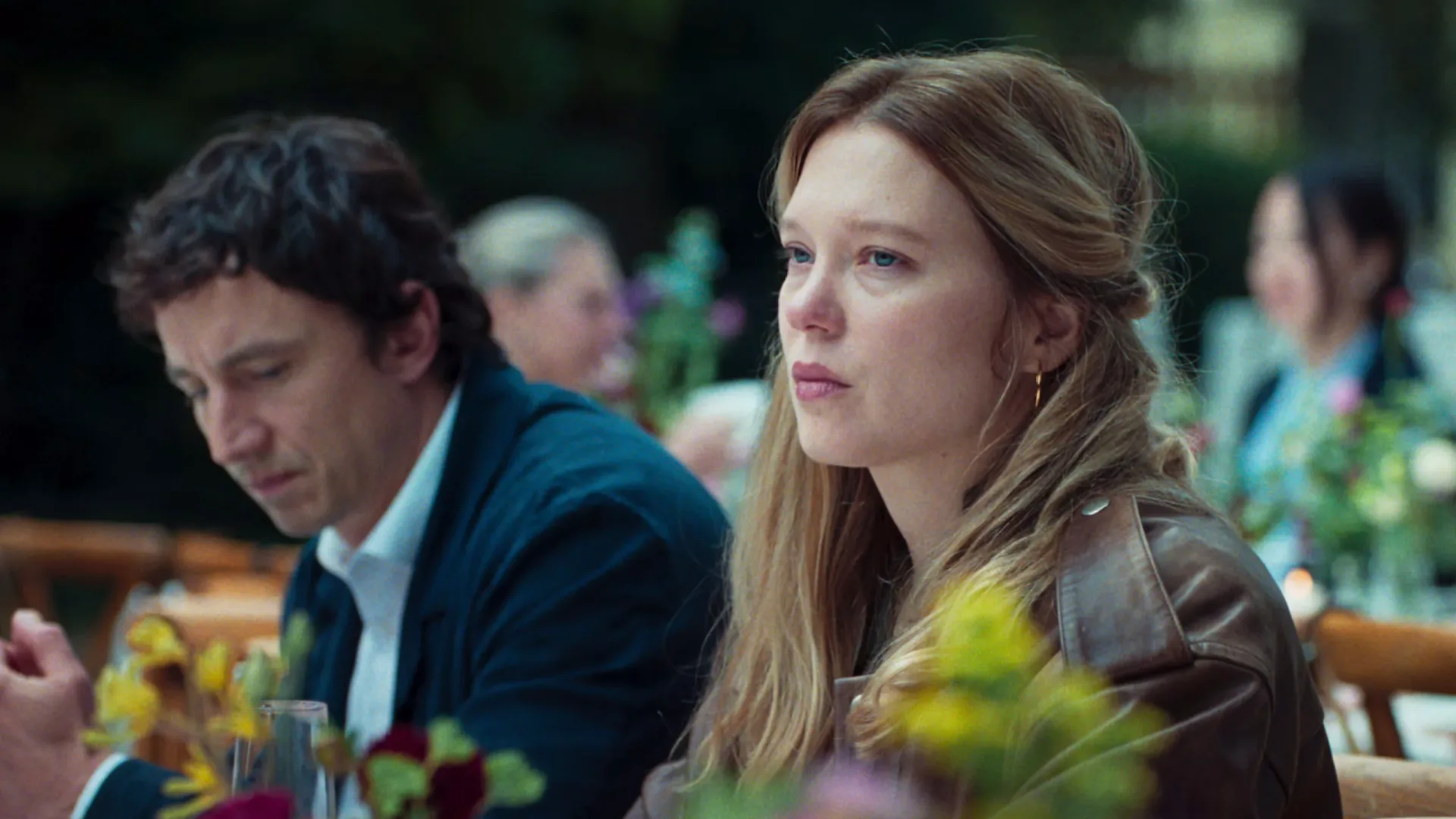
Seydoux is the film’s anchoring force. Lucy is presented as soulful but increasingly dazed, a woman trying to pull herself free from what feels like a train-wreck marriage while the damage continues to reveal itself. The performance’s value is not simply that it conveys distress. Seydoux works through panic, vulnerability and emotional disorientation with enough modulation that Lucy is not reduced to a symbolic victim of her husband’s actions.
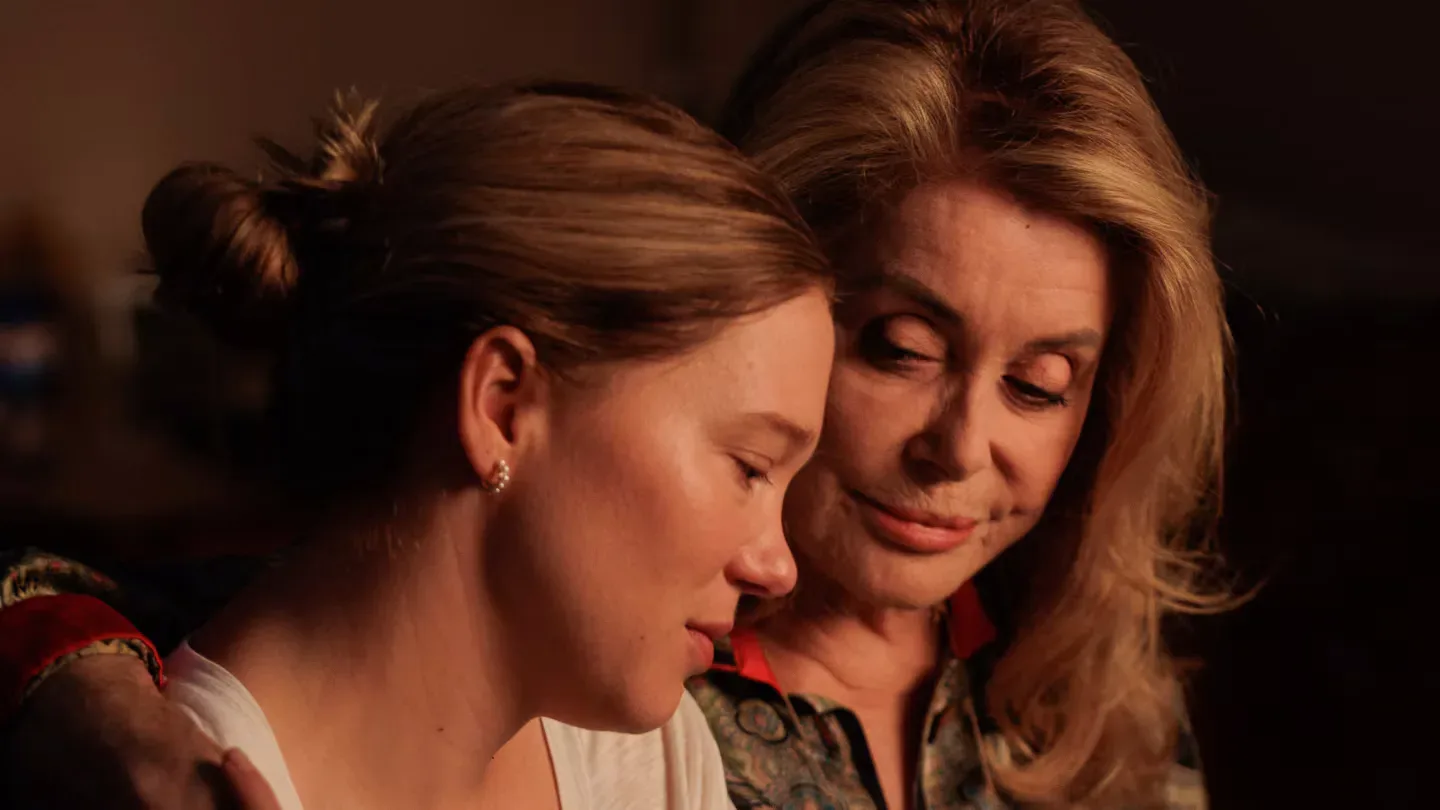
Kreutzer’s camera frequently stays close to Seydoux’s face as revelations bear down on Lucy. That visual proximity makes the film feel less interested in procedural discovery than in aftermath: the private, isolating work of enduring knowledge that cannot be undone. The approach gives Seydoux room to register thought as well as feeling. Lucy’s anguish is immediate, but the performance also suggests a person trying to establish what she can trust in herself after betrayal has reordered her world.
This is where Gentle Monster is most affecting. Its drama does not offer easy moral relief, and Lucy’s situation carries questions that cannot be tidied up by one revelation or one decision. Seydoux gives those questions human scale. Her work keeps the film connected to an individual consciousness rather than letting its difficult subject matter become merely an instrument for grim seriousness.
Music as expression—and emphasis
Lucy’s professional life gives the film a recurring expressive device. She performs stripped-back versions of male-written pop songs, beginning with Charles & Eddie’s “Would I Lie To You?” and later including The Cure’s “Boys Don’t Cry.” These choices establish an early atmosphere of fragility and impending betrayal. They also frame Lucy as an artist who takes familiar material and remakes it through her own voice.
That idea has clear thematic force. The songs can be read as a way of showing Lucy reconstructing language that was not originally hers, an impulse that gains particular resonance as she confronts the collapse of her marriage. A later moment of musical and physical symbolism, placing her at a literal fork in the road, presses the point more directly. This is one of the film’s limitations: its emotions can arrive with too much underlining. Rather than trusting the accumulated force of Seydoux’s performance, the storytelling occasionally announces its metaphor.
Still, the musical thread is not decorative. It gives Lucy an identity beyond the immediate crisis and provides a counterpoint to the home that is no longer safe as a source of certainty. The tension between performing songs written by men and making them personal is a thoughtful detail, even when the film’s symbolism becomes conspicuous.
A divided perspective weakens the central drama
The major structural complication is Elsa’s parallel storyline. Jella Haase plays the investigator assigned to Philip’s case, but Elsa’s own home life is compromised by her elderly father’s harassment of his live-in nurse. The connection is deliberately uncomfortable. Elsa is professionally positioned to see the seriousness of Lucy’s situation, yet her willingness to keep the nurse in that household makes her moral footing less secure.
On paper, this broadens the film’s examination of male abuse and the compromises surrounding it. It asks how people can recognize harm in one setting while failing to act decisively in another. Elsa’s dilemma is thorny, and Haase is commendable in a role built around reserve, professional bleakness and difficult contradictions.
But the expansion comes at a cost. Elsa’s story draws attention from Lucy precisely when Lucy’s experience is most dramatically charged. The film has introduced a devastating crisis and supplied an actor capable of rendering its every aftershock, yet it disperses its focus into a second domestic moral quandary. That choice makes the larger portrait of men’s wrongdoing more expansive, but not necessarily more persuasive. The connections are conceptually clear; the emotional center becomes less clear.
Elsa is also harder to read than Lucy. That opacity may be intentional, reflecting a person shaped by grim work and a compromised private life. Even so, intention does not eliminate the issue of emphasis. Her thread can feel like an extension of the film’s argument rather than a development that deepens its protagonist’s journey. The result is an uneven balance between a close character study and a broader social diagnosis.
Severe questions, no simple release
Gentle Monster is strongest as a drama of moral aftermath. It does not promise comforting answers to the questions raised by Philip’s alleged conduct, Lucy’s shattered assumptions, or Elsa’s failure to resolve the harm unfolding in her own home. The refusal of easy resolution is appropriate to the material. These are not problems the film treats as solvable through a tidy declaration of insight.
Its limitation is subtler: the film sometimes seems uncertain whether it wants its central subject to be Lucy’s singular devastation or a wider account of gendered cruelty and complicity. Both ambitions have substance, but they do not always reinforce one another. The broader design can make the drama feel less disciplined than Seydoux’s performance. Where she finds nuance within panic and pain, the narrative occasionally reaches for a larger, more emphatic statement.
For viewers receptive to intense, performance-led drama, the case for watching rests squarely on Seydoux. Her work gives Gentle Monster an emotional precision that survives its heavier gestures and split attention. Haase adds a credible, troubled counterpoint, while Kreutzer’s close camera ensures that Lucy’s isolation is never merely an abstract theme. This is a serious film with an affecting center, even if its most powerful story is not always allowed to remain fully in the spotlight.