


 Gianna JunKwon Se-jeong
 Koo Kyo-hwanSeo Young-cheol
 Ji Chang-wookChoi Hyun-seok
 Kim Shin-rockChoi Hyun-hee
 Shin Hyun-beenKong Seol-hee
 Go SooHan Kyu-seong
 Lee Joong-okLee Bong-seok
 Kim Jong-taeKang Woo-cheol
 Hwang Jae-yeolCitizen
 Lee Dam-heeLee So-eun
 Chae Seo-eunBully Girl
Yeon Sang-ho returns to zombie-adjacent horror with Colony, a survival thriller that finds a pointed new angle on the infected. The film’s creatures are not straightforward undead, and that distinction matters. They result from a specifically engineered virus, but its most consequential effect is not merely bodily transformation: it connects the infected through a hive mind. That premise gives Colony an immediate identity within a crowded genre, shifting the danger from an individual monster’s speed or strength to a collective intelligence capable of adapting to human resistance.
The result sounds like a setup for a dense examination of contagion, control, and group consciousness. Instead, the film appears to understand its greatest asset as kinetic horror. Its attention is trained on survival, on the urgent business of getting its endangered characters through the next violent encounter. That emphasis brings a real benefit: the film can move with a fierce, almost delirious momentum. It also leaves some promising character and thematic possibilities less developed than the premise suggests.
A monster idea that changes the threat
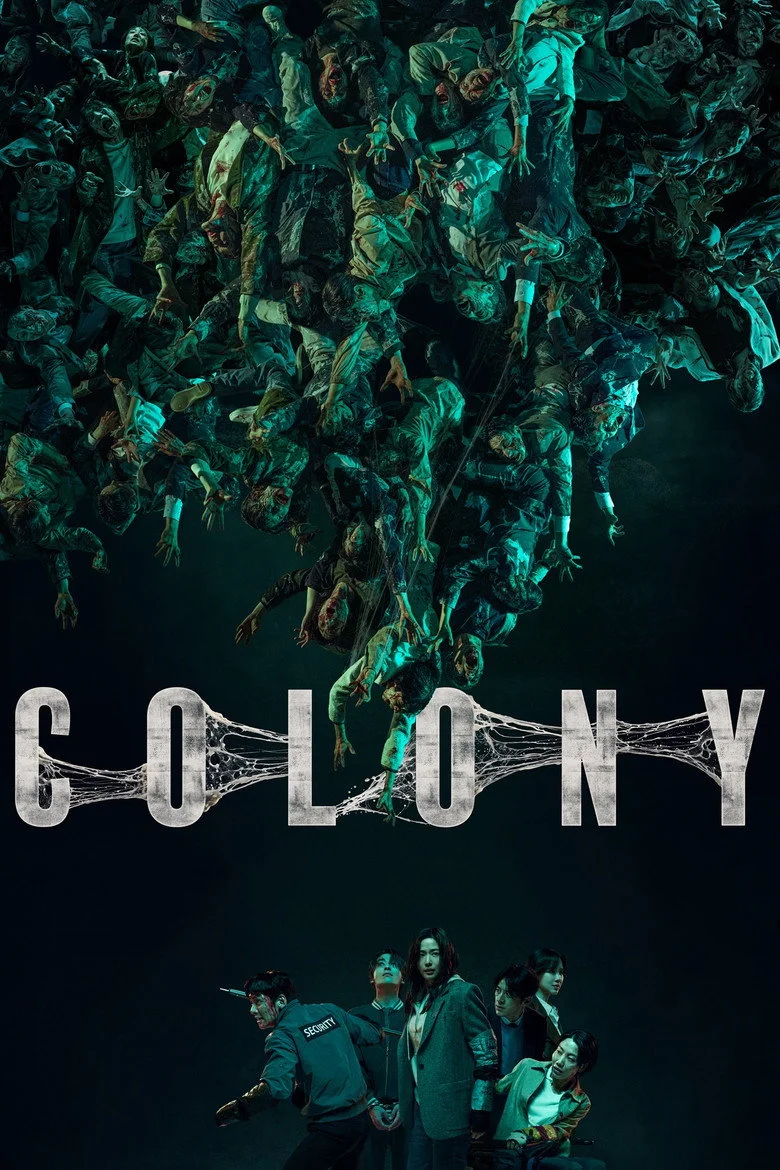
Colony earns its tension by making the infected feel coordinated in a way that is unsettling before any attack begins. Their shared communication is expressed through synchronized writhing and spasmodic seizures, an image that turns the body into evidence of a larger network operating beneath the surface. The horror is not simply that these people have changed. It is that they no longer appear to be acting alone.
That collective behavior also gives the infected a tactical edge. Their ability to adapt against what humans throw at them makes familiar survival-horror logic less dependable. Barricades, escape plans, and improvised responses carry less reassurance when the threat can learn. The film’s central innovation therefore does useful dramatic work: it makes the next confrontation feel potentially volatile rather than like a routine replay of zombie-movie rules.
There is a particularly effective tension in how the concept joins the cerebral and the grotesque. A hive mind is an abstract idea, but the film gives it a physical, disturbing expression. The infected seize and move together; collective intelligence becomes something visible in contorted bodies. This is a strong horror choice because it avoids explaining the premise only through exposition. The idea is communicated through movement, and movement becomes the film’s most distinctive language.
Movement as the film’s main spectacle
The infected are brought to life through dancers and contortionists, and that choice seems central to Colony’s impact. Rather than relying on a standard shambling or sprinting template, the attackers run, flip, crawl, and trip over one another in their rush toward victims. The effect is a form of physical chaos: fast, animalistic, and difficult to predict.
That ferocity gives the set-pieces their force. The creatures do not simply approach; they seem to fling themselves through space with a gruesome urgency. Their movements can read as uncontrolled at a glance, yet the hive-mind premise adds an unnerving counterpoint. What looks like disorder may belong to a larger shared will. This contradiction—bodies behaving with apparent frenzy while functioning as part of a collective—helps make the action feel more alarming than a conventional chase.
The film’s bloodlust is described as near-cartoonish, which points to a deliberately heightened tone. For viewers seeking restraint, grim realism, or prolonged psychological dread, that extremity may limit the appeal. But it also clarifies the kind of entertainment Colony prioritizes. This is horror driven by propulsion and spectacle, where the creatures’ alarming physicality supplies the reason to keep moving. The approach suits a film more interested in the pressure of escape than in slowing down to anatomize every implication of its outbreak.
Survivors under pressure, but not fully explored
At the human end of the story is scientist Kwon Se-jeong, played by Jun Ji-hyun, traveling with a motley band of survivors. The group is easy to root for, which gives the film a necessary emotional baseline amid the carnage. A survival thriller does not need an elaborate interpersonal web to make danger register; a clear sense that these people should get out alive can be enough to make an attack land.
Still, the survivors are underdeveloped. That limitation affects the stakes even when the action is effective. Rooting for a group is not the same as knowing them deeply, and the film’s apparent headlong pace leaves limited room for individual textures, relationships, or conflicting priorities to become especially vivid. The danger remains immediate, but the drama may not accumulate the added weight that comes when a film gives each threatened person a distinct interior life.
This is less a contradiction than a consequence of the film’s design. Colony seems built to keep the audience in motion alongside its characters, hurling them from one crisis to another. The trade-off is clear: velocity can sharpen suspense, but it can also reduce opportunities for character development. Viewers who value creature choreography and escalating set-pieces may find that bargain easy to accept. Those looking for the human drama to match the ingenuity of the infection concept may find the film thinner.
A villain with an argument the film only partly pursues
The more provocative human presence is Seo Young-cheol, the architect of the virus, played by Koo Kyo-hwan. He is presented as more compelling than the survivor ensemble because he supplies a human face for the catastrophe and because his perspective carries an unsettling provocation: the infected may be an improvement on humanity.
Koo’s detached, psychotic swagger gives that notion an appropriate instability. The performance does not merely position Seo as an inventor of evil; it makes him persuasive enough, at moments, to invite consideration of his claim. That is a useful complication for a genre story. If the antagonist’s worldview can briefly sound plausible, even in distorted form, then the conflict has the potential to become more than a matter of humans fleeing monsters.
Colony does not delve deeply into this argument, however. The film leaves the possibility of a fuller inquiry—into collective intelligence, human failure, and the seductive logic of replacing flawed people with something newly connected—largely on the table. Yet that restraint is not necessarily a simple misstep. It follows from the film’s survival-first priorities. The thematic suggestion operates more as charged background radiation than as the main subject of the story.
That choice will divide the audience. There is real appeal in a film that plants a provocative idea without interrupting its momentum to explain everything. Ambiguity can keep a horror premise alive in the imagination. At the same time, the concept is rich enough that its relative lack of exploration can feel like a missed opportunity. Colony has the raw material for an especially searching genre film; what it offers instead is a leaner, more immediate sprint through the consequences.
Built for viewers who want horror to move
Colony is best recommended as an energetic creature-feature survival thriller with a genuinely memorable hook. Its infected are scary not just because they are aggressive, but because their aggression appears networked, adaptable, and expressed through unnaturally coordinated bodies. The use of dancers and contortionists gives the horror a tangible physical signature, while the rapid progression from one set-piece to the next keeps the film’s focus on panic, pursuit, and escape.
The caveat is equally straightforward. The survivors do not receive enough development to fully capitalize on the emotional stakes, and Seo’s provocative view of the infected remains more tantalizing than fully examined. These are meaningful limitations, particularly because the film’s virus concept opens doors to richer character and thematic material. But they do not erase the achievement of its central horror design. When Colony puts its collective of infected bodies in motion, it appears to deliver exactly the kind of wild, high-pressure genre jolt its premise promises.