Warhammer 40,000 has a reputation that can make it intimidating to anyone arriving from fandom rather than miniatures, games, or sprawling science-fiction lore. The names are grandiose, the armor is enormous, swords exist alongside faster-than-light travel, and the setting is populated by legions whose titles practically dare a newcomer to take them seriously.
Yet beneath that deliberately excessive surface, the Horus Heresy offers something much more legible: a catastrophe driven by intimate bonds. It is a story about sons, fathers, brothers, duty, resentment, loyalty and the unbearable knowledge that people who love one another can still choose opposing sides. For readers looking for fiction built around emotional ruin rather than neat comfort, that is a strong foundation.
That does not make Warhammer 40,000 secretly subtle or restrained. The attraction is almost the opposite. Its tragedy is huge, theatrical and merciless. A personal betrayal can alter the fate of a legion. A disagreement among brothers becomes a civil war. Characters carry the emotional weight of familial connection while making decisions at a scale that destroys worlds and institutions. That combination gives the series its particular charge.
The Horus Heresy starts with a family-shaped war
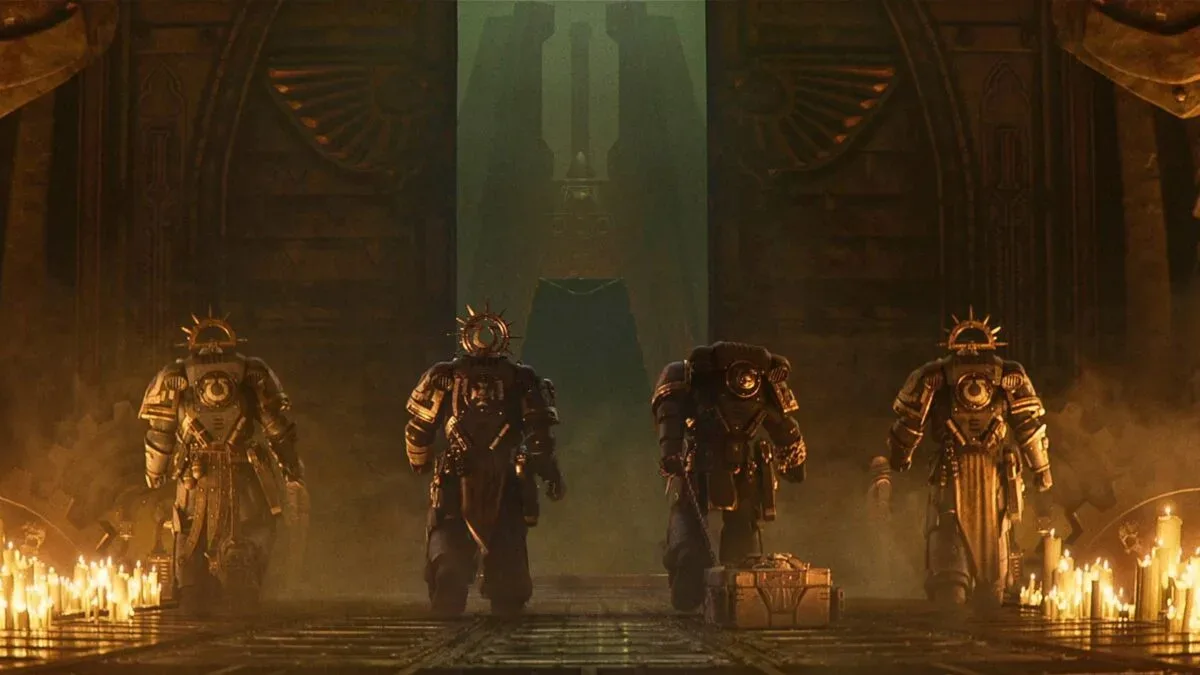
The Horus Heresy is set 10,000 years before the era associated with Warhammer 40,000’s tabletop setting and video games. Its central conflict begins when Horus, a primarch who leads the Emperor of Mankind’s 16th Legion of space marines, turns against the Emperor. Influenced by demonic corruption, he gathers allies who command legions of their own and prepares a rebellion.
Before that rebellion can become open war, however, Horus needs to deal with people inside his own forces—and those of his allies—who will not accept the break. That is where the story’s most potent dramatic material lies. This is not merely a war between two impersonal military blocs. It is a purge shaped by recognition: characters understand exactly who they are abandoning, betraying, or condemning.
The relevant vocabulary matters because it explains why the stakes feel so personal. In this setting, primarchs are genetic sons of the Emperor. The space marines under each primarch are genetically derived from that primarch, creating a chain of relationships that is routinely understood in familial terms. They are not simply coworkers in matching armor. They see themselves, broadly, as fathers, sons and brothers.
That premise turns hierarchy into melodrama in the best possible sense. Orders are never only orders. Loyalty is never only professional obligation. When a commander chooses rebellion, those beneath him are forced to interpret that choice through ties of inherited identity and mutual devotion. The setting’s language of lineage gives every fracture a familial sting.
Why the series clicks for readers who want suffering
“Angst” can be a loose term, but in fan communities it usually points toward stories where yearning, guilt, separation, emotional repression and devastating choices are not side dishes. They are the meal. The Horus Heresy works in that register because its core question is not simply who has the bigger army. It is what happens when loyalty and love point in incompatible directions.
Related coverage includes Warhammer 40,000 Novels Are a Surprisingly Great Cure for AO3 Withdrawal.
A reader does not have to settle whether the relationships should be read as explicitly romantic or profoundly filial for the tension to work. The material leaves room for an emotionally charged fandom lens, while its family structure is overt enough to make the anguish clear either way. What matters is the intensity of connection before the break—and the damage after it.
In practical terms, that means the books can suit someone who wants their genre fiction to linger on betrayal rather than race past it. The narrative ingredients include beloved brothers turning against one another, forces once separated by faction finding common cause in doomed circumstances, and people confronting the consequences of devotion that survives even when trust does not.
There is also a grimly romantic streak to the catastrophe. At one point amid Horus’ purge, a dying man is held by a robot animated through the barely living remains of a legion brother. The dying man proposes that they go together. The details are unmistakably Warhammer—mechanical, grotesque and militarized—but the emotional purpose is elegantly direct: companionship persists at the edge of death.
That is the trick. Warhammer’s aesthetic can look like pure spectacle from the outside, but spectacle gives its grief a larger stage. The setting’s maximalism is not a barrier to melodrama; it is an amplifier for it.
The appeal is not that Warhammer becomes fanfiction
Calling the Horus Heresy a useful alternative for fanfiction readers should not be mistaken for a claim that the novels replicate every part of fan-created work. The supplied material specifically notes that these books are not a destination for explicit sexual content, with Fulgrim-focused material presented as an exception. Anyone seeking that particular mode of reading will need to calibrate expectations.
But fic readers are not a single audience with a single need. Plenty arrive for character dynamics, reinterpretive possibility, heightened emotional stakes, or a premise that makes it almost impossible not to imagine the relationships before and after the page. On those terms, the Horus Heresy has plenty to offer.
Its major appeal is that the emotional drama is already embedded in the premise. Readers need not invent why these people matter to one another: the text’s worldbuilding establishes their kinship, their bonds of command and their shared origin. From there, the tragedy emerges when those structures fail. The ambiguity around how some bonds are read can be a feature rather than a flaw for readers accustomed to approaching a canon through a fandom lens.
That makes the books especially useful for an audience whose favorite stories are powered by the moment a relationship reaches its breaking point. The eventual rebellion is vast, but it becomes meaningful through smaller relational disasters: someone deciding whom to believe, whom to save, whom to follow, and whom they can no longer recognize.
Do not mistake the armor for the whole story
Newcomers may reasonably bounce off Warhammer 40,000’s image. The franchise can initially appear built from a young teenager’s definition of cool: superhuman men, extravagant weaponry, medieval blades, power armor, ominous proper nouns, and legions with names such as the Death Guard and Iron Hands. That first impression is not difficult to understand.
But the Horus Heresy demonstrates why the franchise endures as more than a catalogue of aggressive nouns. It understands that an army carries emotional baggage. Its most effective ideas gain force not from technical explanations of equipment, but from the pain of watching a collective identity come apart. A legion is a family-shaped institution. A primarch is both leader and genetic father figure. The Emperor sits over all of it as the ultimate paternal authority. When Horus rebels, he weaponizes a structure that was meant to bind everyone together.
That is an inherently tragic setup. It turns kinship into a fault line.
There is a useful parallel in the way games can make suspicion feel transformative before they have fully explained the world around it. Dark Souls can make one small act of distrust feel world-changing; the Horus Heresy works at a far more operatic scale, but it likewise treats doubt as a force with consequences. Once confidence breaks, every prior bond has to be reconsidered.
A reasonable way to approach an enormous setting
The scale of Warhammer can encourage the wrong kind of entry anxiety. Someone who hears “10,000 years before the familiar setting” may assume a massive homework assignment is required before the story can land. The supplied account suggests a more useful approach: start with the Horus Heresy’s core situation and let the emotional architecture do the work.
You only need a few concepts at first:
- The Emperor of Mankind: the father figure above the primarchs.
- Primarchs: the Emperor’s genetic sons and leaders of space marine legions.
- Space marines: genetically linked to their primarchs and organized into legions.
- Horus: the primarch whose rebellion sets the central tragedy in motion.
- Heresy: the name for that break and the conflict it unleashes.
Everything else can arrive when it becomes emotionally relevant. That approach prevents terminology from obscuring the point of the tale. You are not beginning with an encyclopedia; you are beginning with a family disaster unfolding at absurd military scale.
The genre trappings are still there, of course. Demonic corruption is not a metaphor quietly lurking in the background; it is a direct component of Horus’ path toward rebellion. Robots, power armor and immense legions are not decorative either. But these elements are most accessible when treated as the machinery that intensifies the human—or human-adjacent—conflict.
Why this recommendation is more than a joke
There is comedy in telling somebody searching for devastating, character-forward fiction to pick up a franchise famous for colossal armored soldiers. The joke works because the packaging and the emotional payload seem mismatched. Yet the Horus Heresy’s premise genuinely supports the recommendation.
It offers a tragedy where betrayal is not abstract, where duty is inseparable from identity, and where affection does not guarantee safety. It is not an escape from dark emotional material. It is a different delivery system for it: one with demonic corruption, doomed legions, contested loyalty and enough room for readers to draw their own conclusions about what certain bonds mean.
For people whose ideal late-night reading involves heartbreak dialed well past reasonable limits, Warhammer 40,000 may be less of a detour than it appears. Behind the swords, armor and extravagantly named armies is a story built to hurt precisely because its characters begin as something like family.