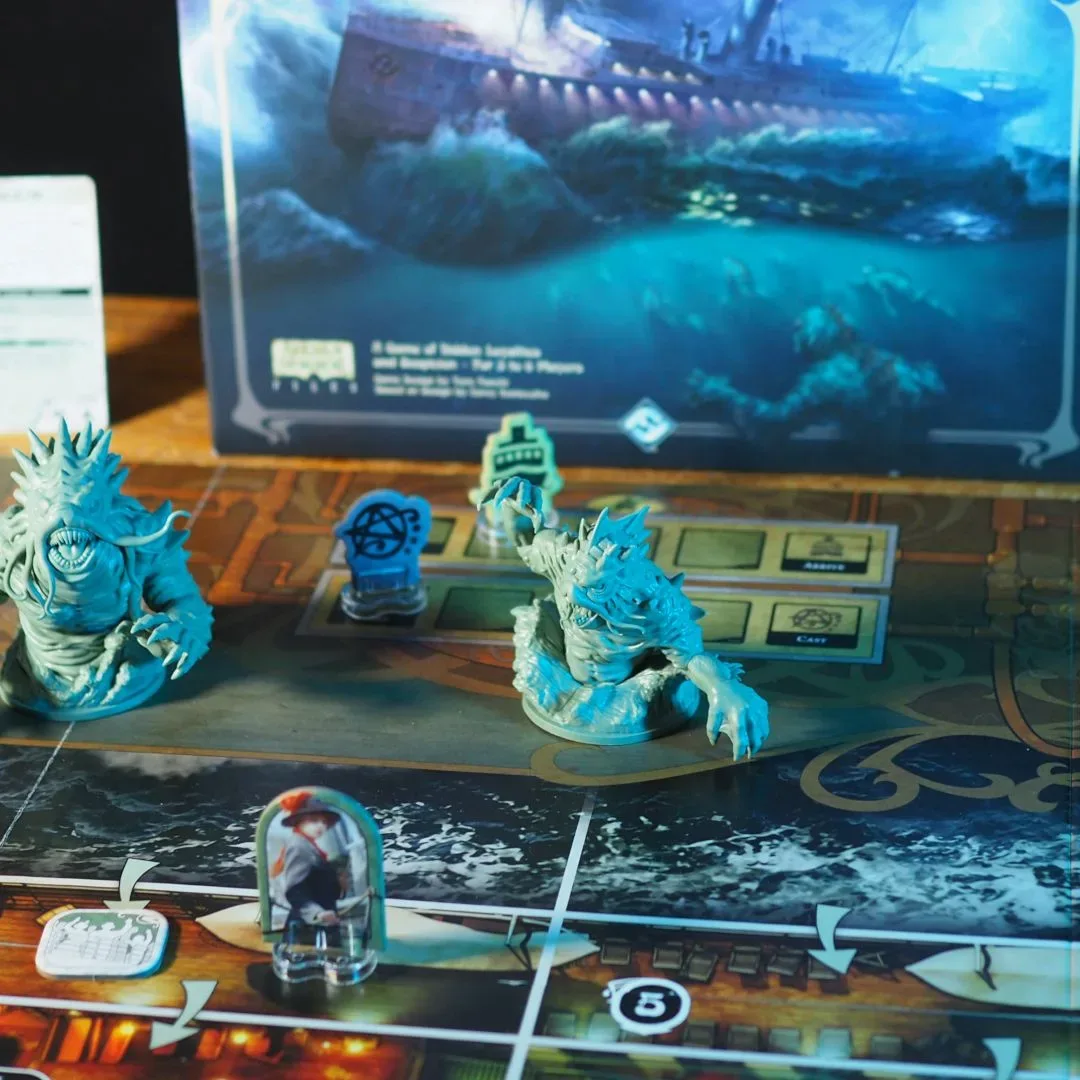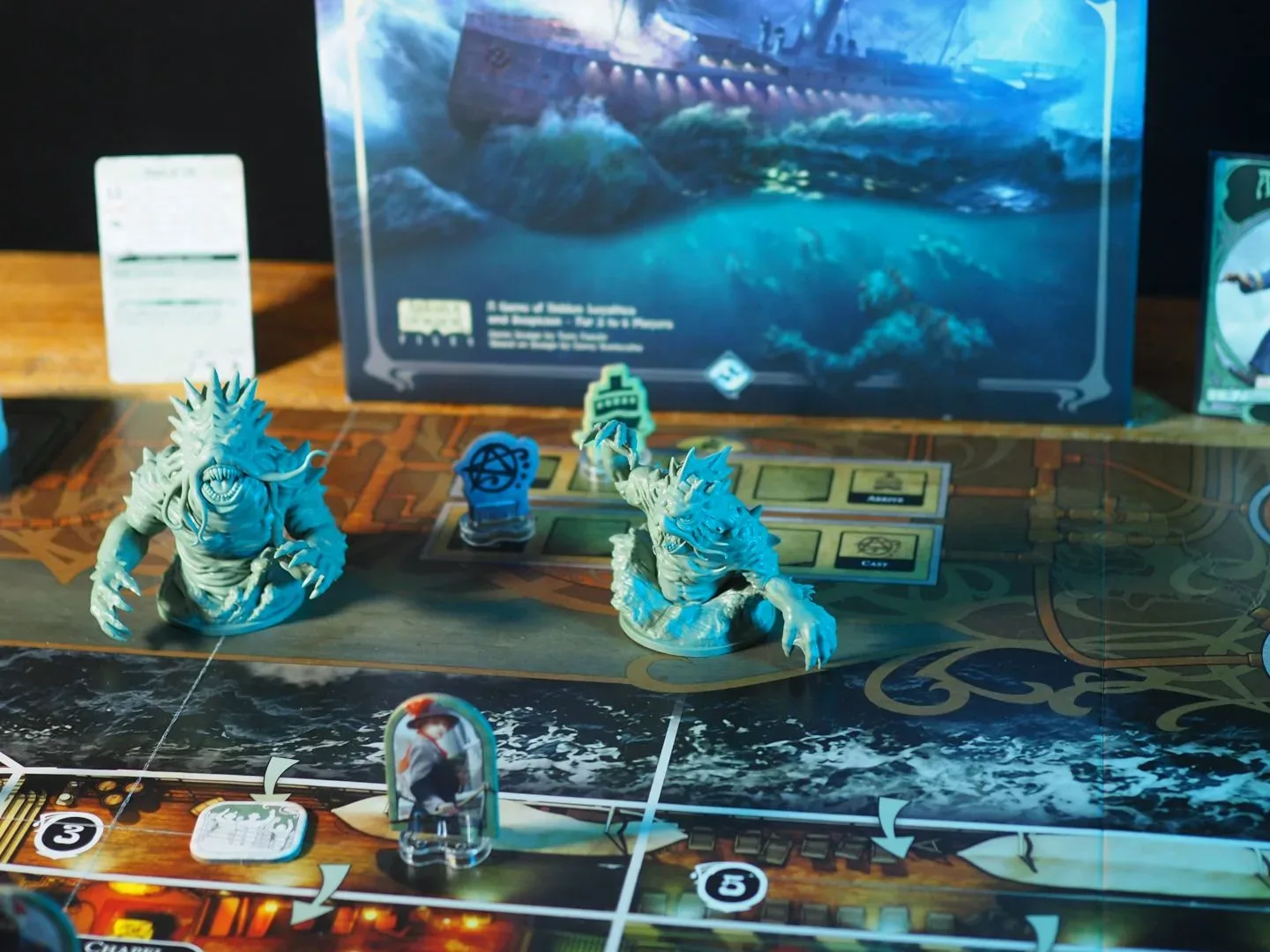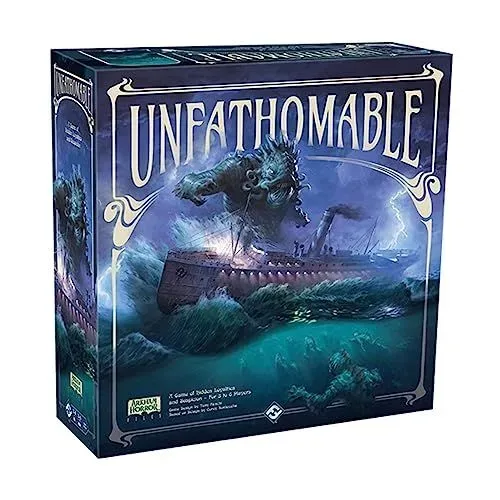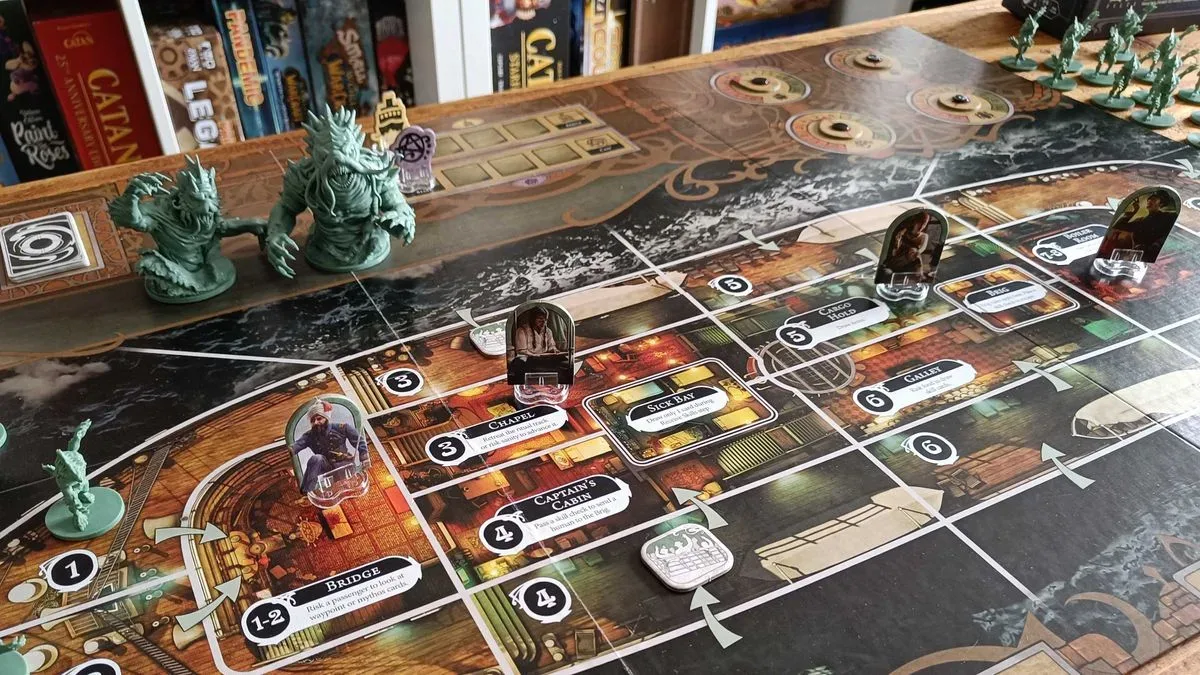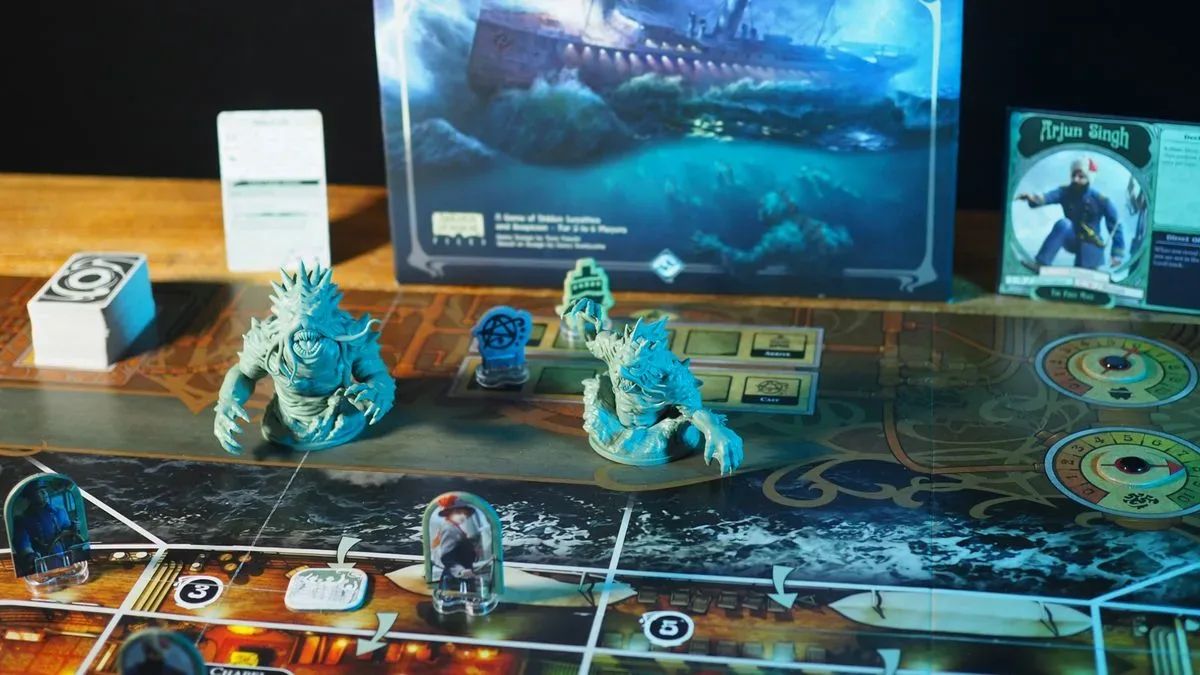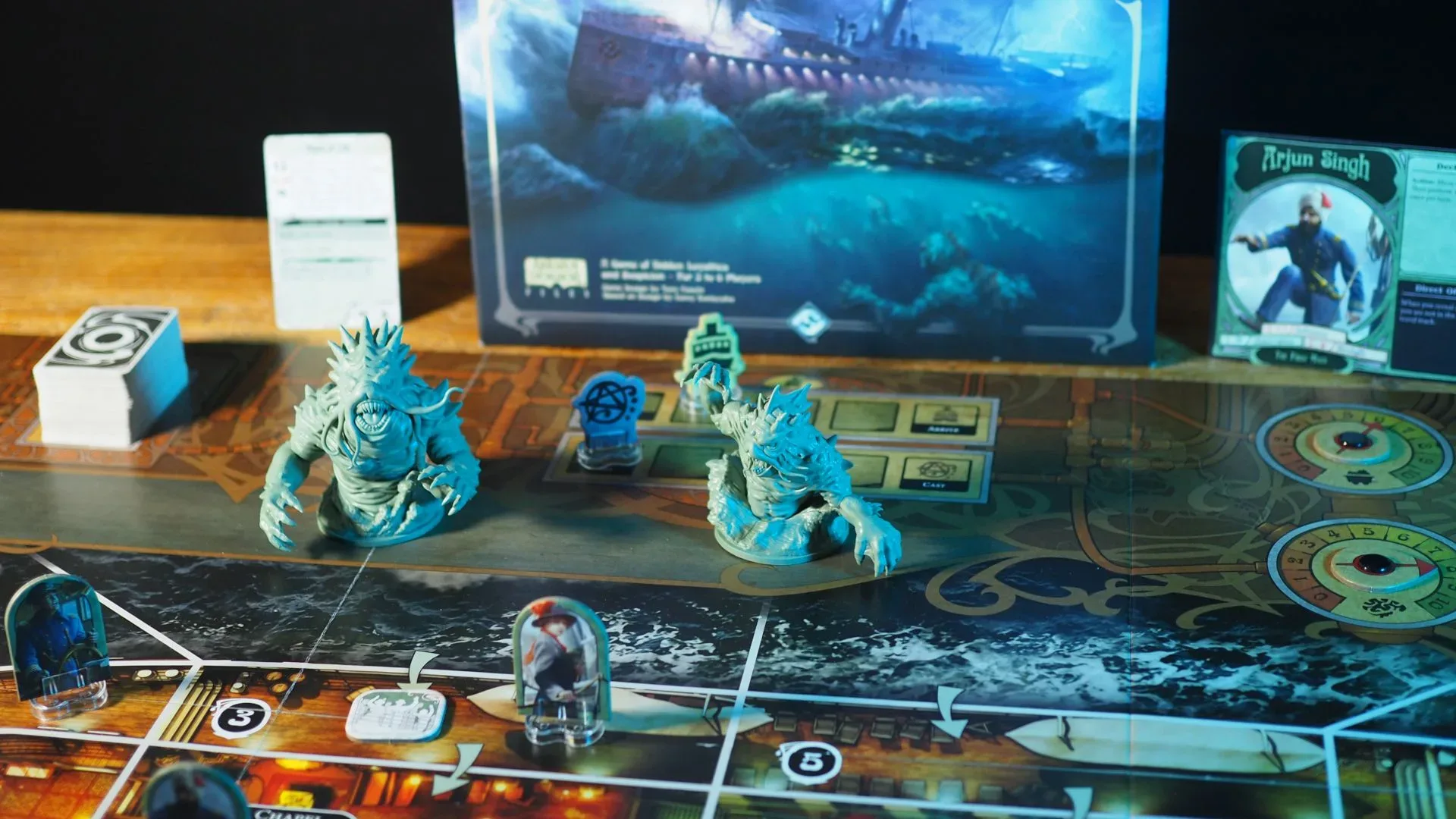
Sea monsters are an efficient horror device. They have scales, teeth, too many limbs, and the decency to announce themselves by climbing out of the ocean. Unfathomable is more interested in a worse kind of terror: the person across the table who insists they contributed a helpful card to the last crisis while the ship quietly catches fire.
The board game places its players aboard a 1920s cruise ship crossing the ocean. A few days after departure, storms arrive, the water becomes alarmingly active, and Deep Ones begin coming aboard. Something immense appears to be directing the assault from the darkness. The survivors must keep the vessel functional, protect its resources, repel attackers and survive long enough to escape.
That sounds like a straightforward cooperative horror premise. It is not. Some people at the table are secretly Deep One hybrids. Once called by their masters, they begin undermining the ship from within. Unfathomable’s central achievement is how it welds that hidden-loyalty suspicion to a desperate fight for survival. The monsters create immediate, visible trouble. The traitor system makes every attempted solution suspicious.
A cruise ship with two emergencies at once
On the surface, the group has a practical job: prevent the Deep Ones from wrecking the ship or exhausting the crew’s resources, and repair the damage that does get through. The pressure comes from persistence. Defeating monsters does not mean the ocean has run out of monsters. More can emerge from the depths, so the goal is not a clean victory over every threat. It is endurance.
That distinction matters. A game about clearing a board can become a problem of efficiency: identify the strongest move, remove the nearest danger, repeat. Unfathomable instead frames each action against an ongoing crisis. Resources can be drained. Damage needs attention. Enemies can return. Time is not merely a turn counter; it is an adversary. Every job done now competes with another job that may become worse if ignored.
The setting supports that design unusually well. A ship is a contained space with nowhere reassuring to go. The group cannot simply leave the scene of the horror. The ocean is both barrier and source of danger, while the vessel’s condition makes the abstract notion of “team health” feel concrete. A sabotaged system is not just a lost point; it is another reason everyone aboard may fail to reach safety.
The clever part is that failure has fingerprints, but no clear culprit
Unfathomable uses event cards to introduce developments, dilemmas and catastrophes. To resolve these crises, every player contributes numbered cards toward a specified total. Loyal players are expected to add positive values and help the group meet the requirement. Deep One hybrids can slip negative values into the contribution to pull the result down.
Then the pile is shuffled.
Related coverage includes Unfathomable Turns a Lovecraftian Cruise Into a Relentless Game of Distrust.
That shuffle is the engine of the game’s paranoia. It means the group can see that a crisis went wrong, but cannot directly prove who made it go wrong. A failed event offers information, but incomplete information. Someone may have sabotaged the test. Or several people may have been unable to contribute enough. Or the person mounting the loudest accusation may be using the failure to redirect attention away from their own negative card.
This is a useful way to understand hidden-role or social-deduction games. The roles are concealed, and players must infer allegiance from decisions, outcomes and conversation rather than from perfect evidence. In Unfathomable, the deduction is attached to a board-game problem rather than existing as a separate conversation game. Players are not only debating trust; they are also facing a ship under assault and a new event every turn.
That produces a more interesting kind of accusation than “you looked suspicious.” A player may question why somebody chose a particular option, why they failed to respond to a visible threat, or why a crisis fell just short of its target. Yet every one of those observations remains open to explanation. Perhaps that player had weak cards. Perhaps they had to prioritize another emergency. Perhaps they are a hybrid and have just received a convenient excuse.
Why the hidden contributions matter
- They preserve uncertainty. The group knows sabotage is possible without being handed a receipt for it.
- They give traitors room to play subtly. Sabotage need not look like an obvious, theatrical attempt to sink the ship.
- They make ordinary cooperation emotionally loaded. Even a sensible move can be interrogated after a bad outcome.
- They stop the monsters from being the only enemy. The external threat and internal distrust continuously amplify one another.
A less concealed sabotage system would make the traitor role too easy to identify or too obvious to perform. A system with no observable consequences would leave loyal players guessing at random. Unfathomable’s shuffled pool sits between those extremes. The outcome gives the table something to argue about, but not enough to settle the argument.
Horror built from pressure, not just from creatures
The Deep Ones provide the recognizable monster-horror component: creatures rising from the sea, an unseen titanic force, storms and a vessel under attack. But the more distinctive tension comes from having to cooperate with people who may be actively working against the group.
That is why the premise has more bite than a conventional monster defense. A visible Deep One is at least honest about its intentions. It wants aboard the ship, and it is plainly bad news. A suspected hybrid can assist with one emergency, hinder another, offer a persuasive defense and still be part of the danger. The uncertainty changes the table dynamic. Players must decide how much evidence they need before treating someone as a threat, all while the visible situation deteriorates.
There is also a thematic neatness in the split. The game’s human characters are attempting to preserve an orderly passage through an increasingly unnatural ocean. Meanwhile, deception makes the social order aboard the ship unstable. The group is managing structural damage and interpersonal damage at the same time. One can be repaired; the other may only become clearer after another disaster.
For players who enjoy horror beyond screens, that makes Unfathomable a compelling companion to videogame horror that also relies on constrained spaces and escalating danger. The broader genre can stretch from a tabletop ship under siege to digital survival scenarios, including the uncertain browser offering around Resident Evil Outbreak. Unfathomable’s particular twist is that the potential betrayal is not scripted by the game alone; it comes from a real person trying to sell everyone else on a lie.
What a two-to-four-hour session asks of a group
Unfathomable games can run from two to four hours. That is a substantial commitment, especially for a game whose tension depends on sustained attention. The length is not incidental to the experience: a slow accumulation of crises gives doubts time to develop, harden and turn into table politics. A quick burst of suspicion can be fun, but long-form uncertainty allows players to build cases, revise them and discover that their confidence may have been misplaced.
It also establishes a clear practical consideration. This is best suited to a group that wants an involved session and is comfortable with discussion, bluffing and being questioned about decisions. Players expecting a light, rapid monster game may find the commitment and scrutiny demanding. Conversely, people who like the idea of every shared task becoming a small trust exercise may find that the length is part of the appeal.
The game’s deception is not about a player literally stepping away to break something while nobody is watching. It is more embedded in the group’s procedures. Everyone participates in resolving events. Everyone can explain their decisions. Everyone can claim they did their part. That makes the social aspect feel integrated rather than bolted onto the ship’s survival mechanics.
Buying considerations: value is more than the ticket price
Unfathomable carries a relatively high standard price, though discounts have been observed that bring it below $75 in the United States or under £80 in the United Kingdom. Those figures should be treated as deal thresholds rather than a promise of a current price; listings and promotions change.
The more important question is whether a prospective group will use what the game is built to provide. Its value proposition is strongest for players seeking a lengthy horror board-game event with both tactical pressure and social deception. The game asks participants to track threats, help solve crises, discuss contested outcomes and tolerate the possibility that a teammate is lying. That is a very specific evening, not an all-purpose pick for every table.
It may be particularly well suited to seasonal horror gatherings because the atmosphere comes from the group as much as the components. The ocean threats establish the Halloween mood, while the accusations generate the stories people are likely to remember: the crisis that failed by a narrow margin, the player everyone trusted too long, or the innocent person condemned on flimsy evidence while the real hybrid smiled politely and contributed another negative number.
Why Unfathomable’s paranoia works
Unfathomable does not treat traitors as a novelty layered over a monster game. The traitor possibility reshapes the meaning of the cooperative half. Repairing the ship, fighting the Deep Ones and contributing to events all become acts that can be judged, doubted or misread. The group is constantly asked to confront two questions: can we hold this ship together, and can we trust the people holding the tools?
Its strongest idea is not simply that people can be worse than monsters. It is that reliable evidence is scarce precisely when teamwork matters most. The card contributions create uncertainty without making outcomes meaningless; the external pressure ensures that debates have consequences; and the sea-bound horror setting gives the whole process a claustrophobic frame.
For a group prepared to commit the time, Unfathomable offers a specific brand of horror: the monsters keep arriving, the ship keeps demanding help, and the person promising to save everyone may be the reason the crisis never gets solved.
Shop the products
Check current price, model and availability at the retailer.