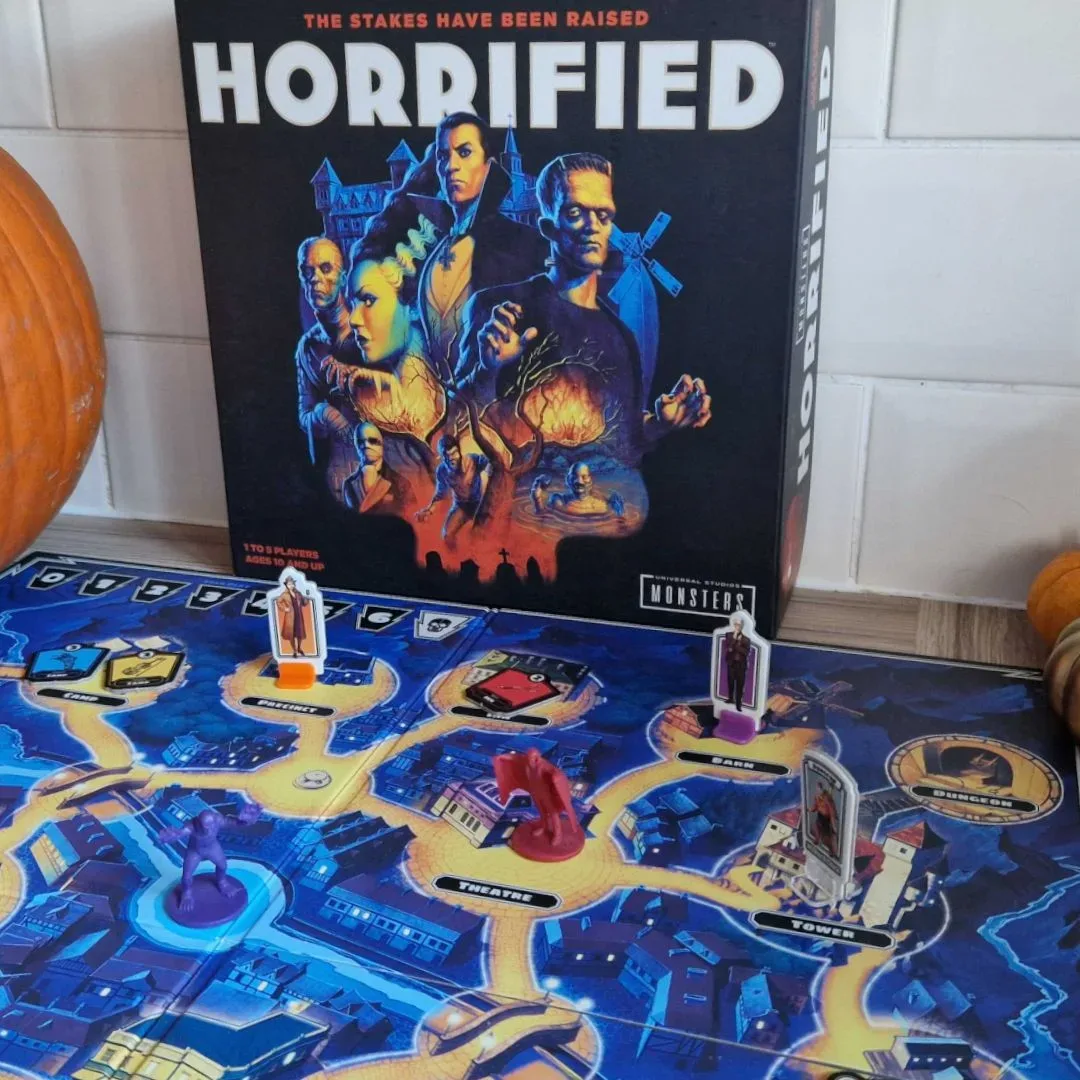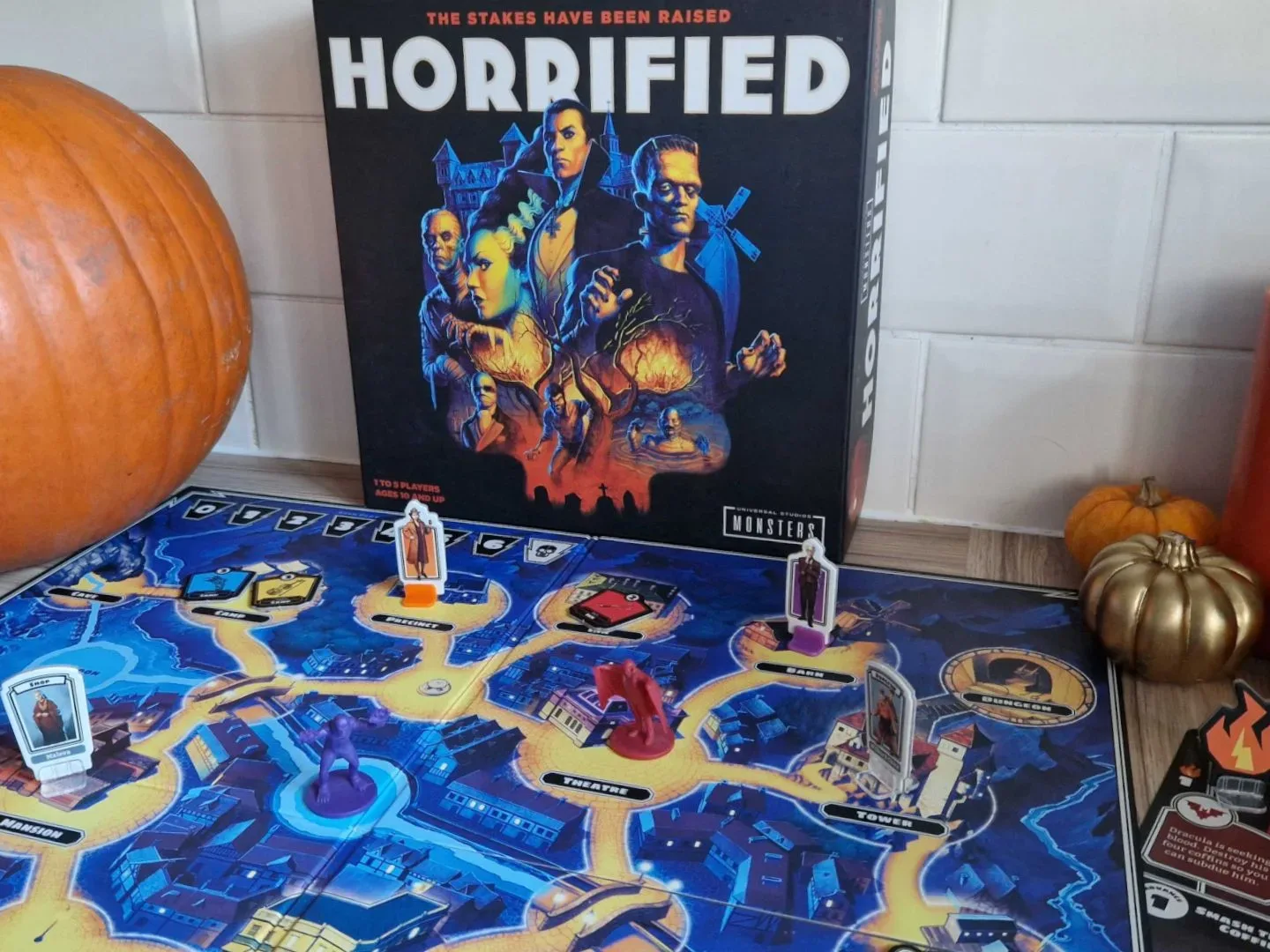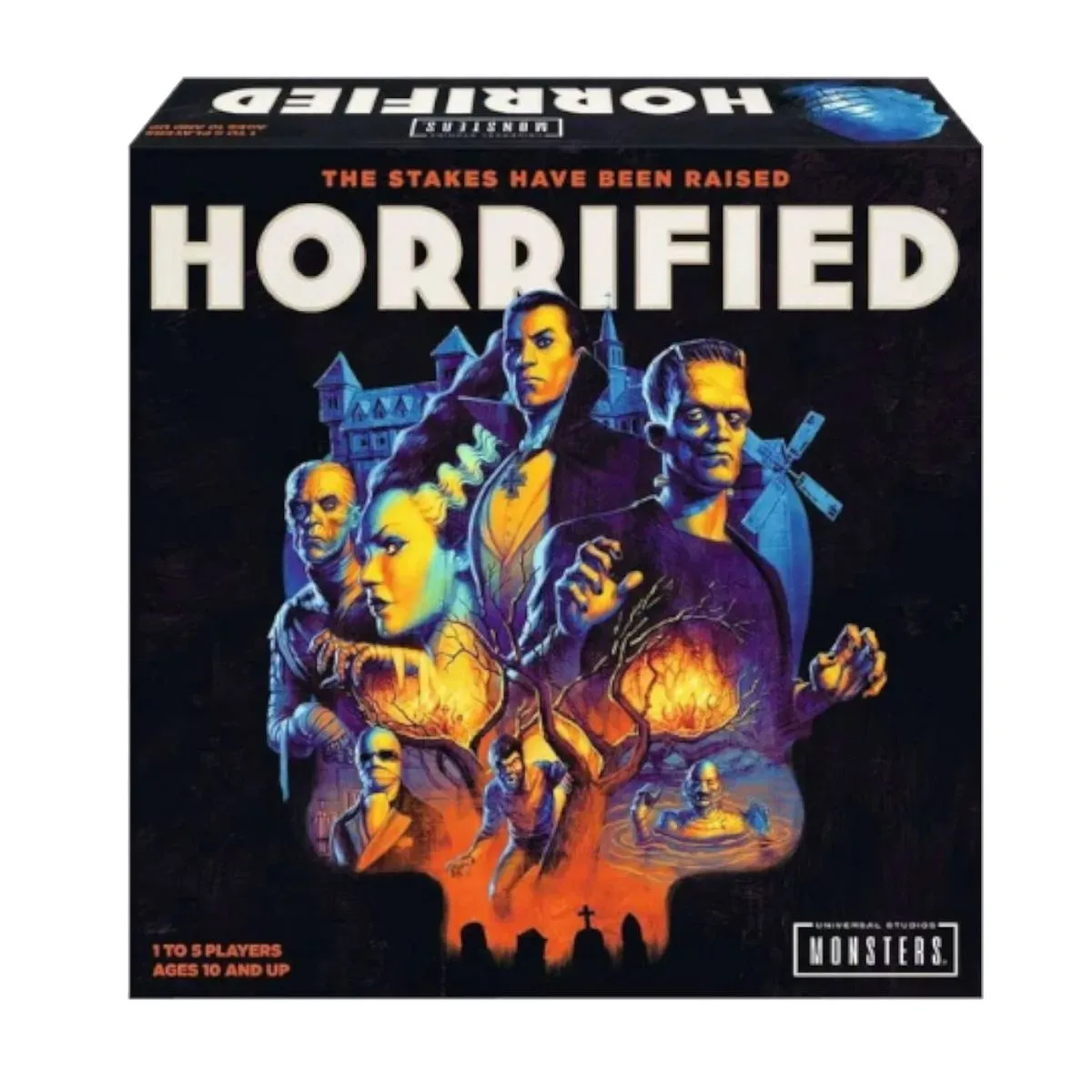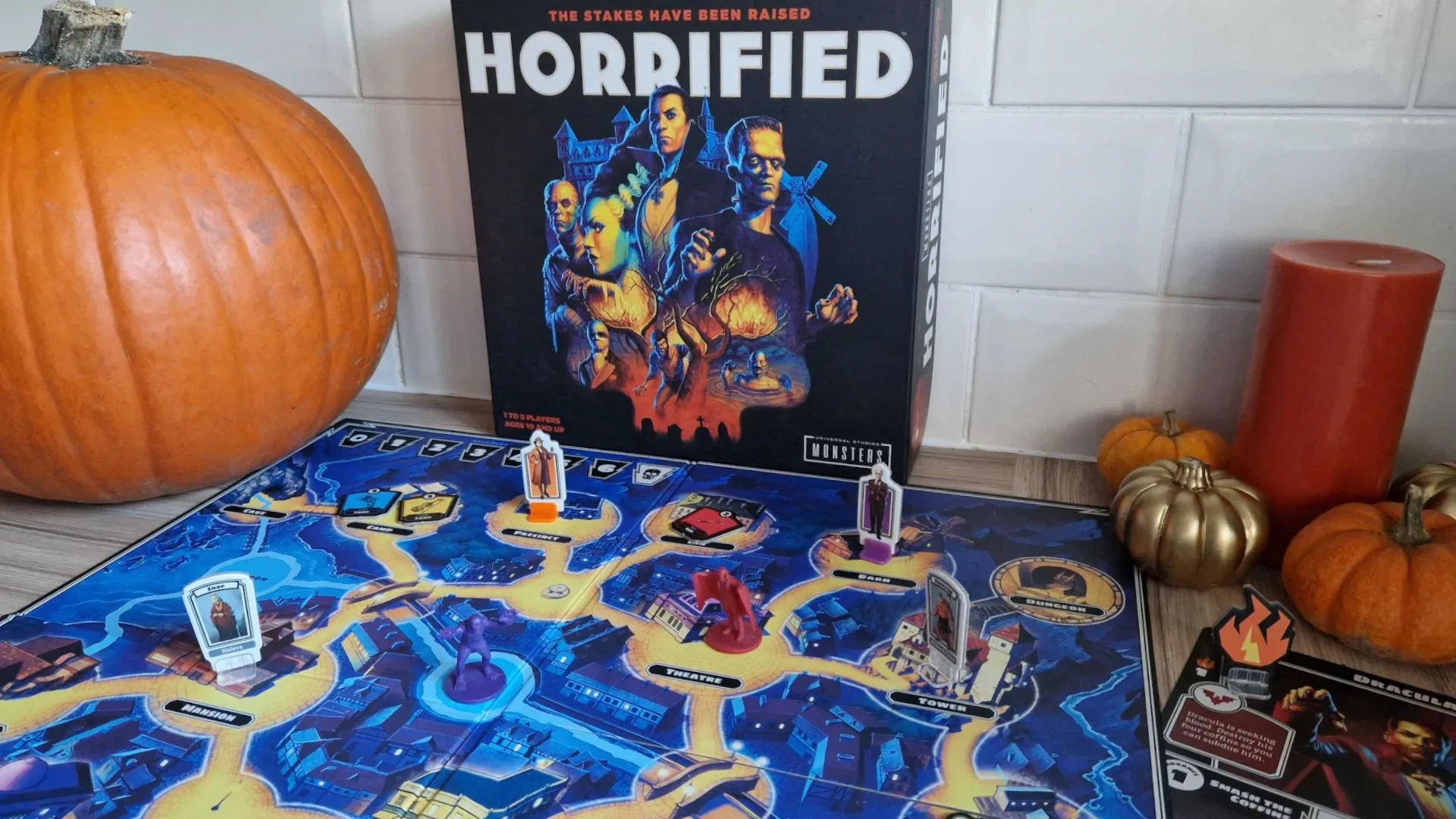
Halloween board games can fall into a familiar trap: the theme does all the heavy lifting. A box may promise moonlit castles, growling monsters and a table full of gothic art, only to deliver rules that are too thin for repeat plays or so demanding that half the group checks out before the first werewolf howl. Horrified has a clearer proposition. It uses its old-school monster premise to give players a cooperative problem to solve, while keeping that problem legible enough for a family or mixed-experience group.
That balance is the important part. The game is recommended for ages 10 and up, and its scares are rooted in classic horror imagery rather than extreme material. Yet it is not simply a themed activity where players drift around a board until a result happens. Every turn presses the group to decide what matters most: advancing a monster-specific objective, protecting a threatened villager, helping a teammate, or holding onto a resource that may be needed later.
For a Halloween gathering, that produces a more useful kind of tension than a game that merely looks spooky. Players have a shared emergency, enough uncertainty to make plans feel precarious, and a clear reason to talk through each choice. The horror is not just decorative. It is built into the pressure of trying to save a village while several legendary problems refuse to wait their turn.
Universal Monsters give the game a familiar doorway in
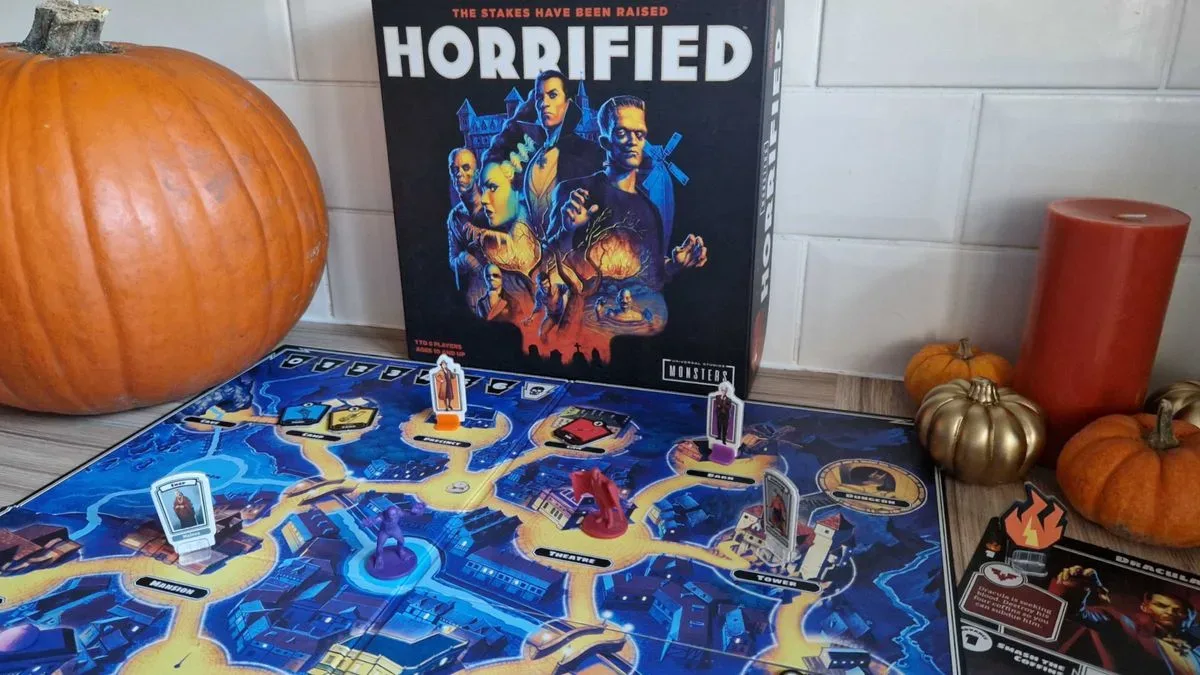
The original Horrified takes place in a deliberately gothic European village, a setting of looming castles, windmills and ominous institutions. Its roster includes Universal Monsters such as Dracula, Frankenstein’s Monster, the Wolf Man and the Mummy. That familiarity matters because it lowers the barrier to explaining the premise. The table understands the stakes quickly: monsters have arrived, villagers are vulnerable, and the heroes need to prevent the situation from becoming a complete catastrophe.
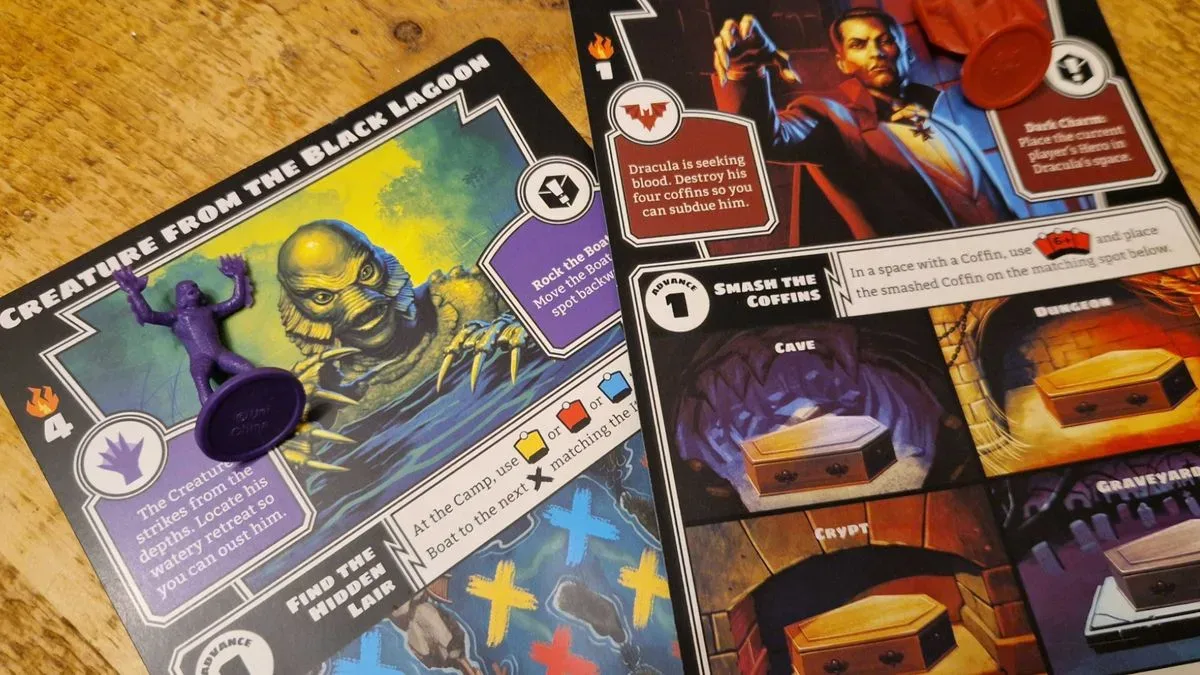
More importantly, the monsters are not presented as interchangeable targets. The game does not ask players to simply pile up attacks until a health total disappears. Each creature brings a distinct route to defeat. Dracula, for example, involves destroying coffins, while the Creature from the Black Lagoon requires players to locate its lair. These are separate objectives with their own demands, so the group is managing a set of miniature missions rather than repeating one action against different character art.
That design gives the theme functional weight. Dracula’s coffins are not a bit of flavor text pasted onto a generic combat system; they are part of what players need to deal with. The Creature’s lair is not just a reference for fans to recognize; it shapes the work required to win. A player does not need deep knowledge of classic monster movies to follow these goals, but the monster identities make the goals easier to remember and help the game retain personality across sessions.
Co-op means the real opponent is the unfolding crisis
Horrified is a cooperative game, meaning the players are all on the same side and either succeed or lose together. Instead of competing against another player’s score, everyone must keep the village from tipping into panic while completing the requirements to defeat the selected monsters.
That shared-loss structure is especially effective here because there are multiple duties demanding attention at once. At the beginning of a session, players choose two monsters, with the option to add more for a tougher challenge. Choosing the villains is therefore also a way of setting the evening’s workload. Two monster objectives already need to be pursued in parallel. Adding further creatures raises the number of threats and the amount of coordination the team needs.
Related coverage includes Horrified Remains a Standout Halloween Board Game for Families and Friends.
It is tempting in any cooperative game to identify one obvious task and focus on it until it is finished. Horrified pushes back against that instinct. Monsters can activate after turns, and an event card may cause some to act more than once. Their behavior prioritizes movement toward and attacks on players or civilians where possible. As the group gathers what it needs to finish one monster’s sequence, another danger can be moving closer to someone who cannot simply be ignored.
This is the central source of the game’s tension: progress is necessary, but progress alone is not safety. Leaving a villager exposed can have a cost. Letting an ally absorb danger can have a cost. Spending an item to avoid an immediate attack can also have a cost, because those items may be exactly what the team needs to overcome a monster later.
The terror track turns local mistakes into a collective problem
Horrified measures the village’s worsening situation with a global terror level. When a villager is eaten or a player is hurt, that level rises. Cross the designated threshold and the group loses. In practical terms, this means a bad development is not contained to the player nearest the problem. Everyone has to account for it.
The terror track also explains why civilian rescue cannot be treated as optional side business. Villagers appear around the map, and rescuing them can pull players away from the tasks needed to defeat the monsters. But leaving them in danger may accelerate the shared loss condition. The most productive move on paper is not always the right move for the board state.
That framework resembles the pressure created by Pandemic: the group must contain an escalating system while also working toward its win condition. The comparison is useful as a description of the feeling rather than a claim that the games are identical. In both cases, players are asked to respond to a board that can worsen between their turns. Horrified channels that structure through monster movement, vulnerable villagers and genre-specific challenges.
For groups new to cooperative board games, this can be a helpful lesson in what the format offers. A turn can be discussed openly. Players can point out risks another person has missed. A plan can change when an event card rearranges priorities. The enjoyment is as much in making a workable plan together as it is in finally clearing the required objectives.
Items are resources, not loot
The item system makes the group’s decisions sharper. Items are generally needed for monster objectives, yet they can also be surrendered to protect a player from an attack. This is a classic resource-management dilemma: use a limited tool now to prevent immediate harm, or preserve it for a future requirement that may be even more important.
Resource management does not need to mean accounting-heavy play. Here, it simply means treating available items as finite and valuable. If the team uses something defensively, it may make the current turn survivable while making a monster harder to defeat. If the team refuses to spend it, the terror level may rise because a player takes damage. There is no universal answer, which is exactly why the choice generates conversation.
Good play, then, is less about memorizing one ideal sequence and more about prioritization. Which monster objective is closest to completion? Which villager is genuinely at risk before the group can intervene? Which player is positioned to solve an emergency without derailing the entire plan? Is it worth accepting a short-term setback to retain the exact resource needed for a decisive move?
The game can deal an awkward opening. A villager might appear close to a monster, or a needed item may not emerge as quickly as the group would like. That randomness can be frustrating if players expect a perfectly controllable puzzle. But it also serves the game’s horror framing: the team is meant to be responding to trouble, not executing an uninterrupted script. The key question becomes whether players can recover through better decisions, communication and reassessment.
A practical fit for families and friend groups
Horrified’s age recommendation is worth taking seriously. Its systems ask players to track several objectives, make tradeoffs with shared consequences and plan beyond the immediate turn. Very young children may find that demand more frustrating than fun. The game can be a better fit for older children, teenagers and adults who want a spooky theme without moving into horror that is designed to unsettle rather than entertain.
It is also a sensible choice when the table includes people with different appetites for complexity. The premise is easy to state, while the monster objectives and rising terror ensure that more strategically minded players still have meaningful decisions to chew over. That does not guarantee the game will suit every group—cooperative games require players to enjoy discussing plans—but it gives a mixed table a shared framework rather than asking everyone to learn an elaborate competitive engine.
The original game’s full price is listed at $45/£40, though it is often available for less. That makes the value question less about whether Halloween décor is worth the money and more about replayability. Selecting different pairs of monsters changes the blend of objectives and the pressure placed on the team, while adding monsters raises the challenge. The box therefore has a mechanism for varying sessions without requiring players to invent their own rules.
The wider Horrified line offers theme choices, but the original has a clear identity
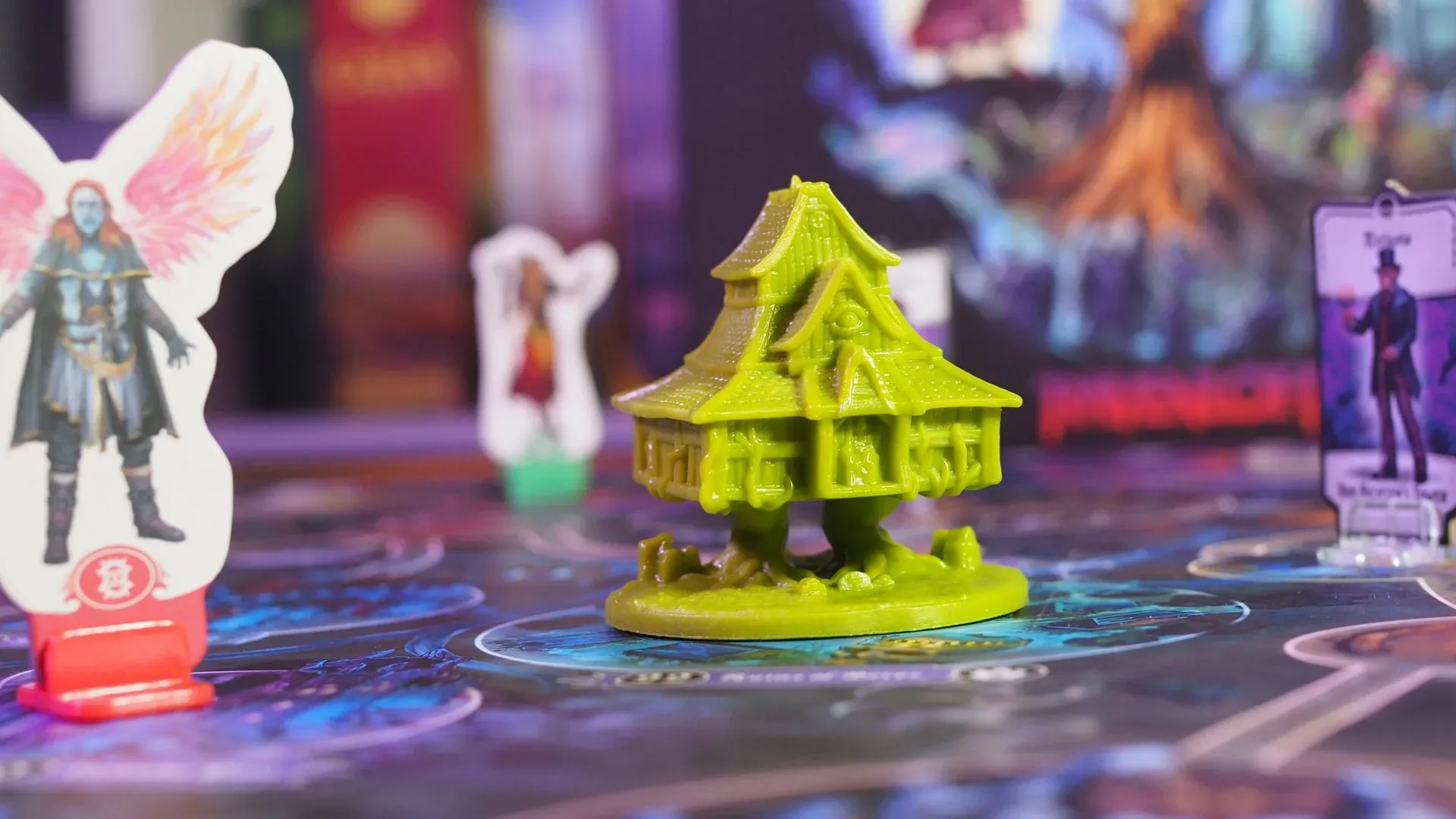
Those who do not connect with the Universal Monsters setting have alternatives within the series. Other entries include North American cryptids with an X-Files-like flavor and adventures involving classic Dungeons & Dragons foes. Horrified: Ravenloft is the most recent installment mentioned here; it also uses a Dungeons & Dragons setting while returning to a gothic tone.
Those variations make sense because the underlying structure can accommodate different creature lineups and different types of genre appeal. Still, the original has a particularly tidy match between subject and systems. Its classic monsters are immediately recognizable, its village evokes the right kind of old horror atmosphere, and its objectives feel suitably tailored to the villains. It presents Halloween not as a jump-scare contest but as a team puzzle with a wonderfully theatrical sense of danger.
Anyone building an October game night could use Horrified as the main event rather than background entertainment. It supplies a clear beginning, an escalation mechanism, moments of rescue and sacrifice, and a final push toward stopping the monsters before panic wins. For people who want to carry the genre mood beyond the board, this site has also covered how a franchise can change while trying to retain its core identity in the discussion around Cyberpunk: Edgerunners Season 2.
Horrified ultimately earns its seasonal reputation because it asks players to participate in the monster-movie drama rather than merely admire it. Every saved villager, withheld item and delayed objective becomes a small act of collective nerve. That is a much stronger recipe for a memorable Halloween table than a spooky box alone.
Shop the products
Check current price, model and availability at the retailer.