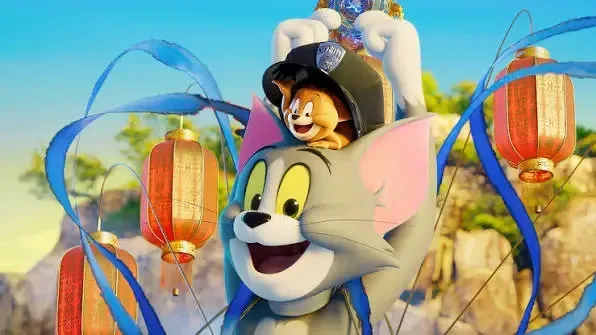
Tom and Jerry: Forbidden Compass begins with the kind of simple disagreement that ought to power a whole Tom and Jerry cartoon. Jerry wants into a New York exhibition dedicated to an astral compass. Tom, working security, blocks him. A chase breaks out, the museum becomes a playground for sabotage, and for a few minutes the old mechanism clicks into place: one determined cat, one tiny adversary, and a situation escalating far beyond all reasonable proportions.
Then the compass activates, sends both characters to Golden City, and the film largely leaves that wonderfully modest premise behind. Directed and written by Zhang Gang, this China-U.S.-Canada animated feature turns the duo into passengers within a sprawling fantasy story built around celestial missions, magical artifacts and a villain called Mega-Rat. It is a dramatic change in scale, but not a change the characters seem equipped to carry.
For Tom and Jerry, the point has traditionally been legibility. The pair can turn hunger, a nap, a household task or a bit of petty territorialism into operatic destruction. Dialogue has never needed to do much of the work because the personalities and the physical conflict are instantly readable. Forbidden Compass substitutes that clarity with lore. There are masters from heaven, a missing compass, magical local allies, a cave-bound enemy and a grand mission whose details pile up faster than the movie can make them matter.
The result is not simply a Tom and Jerry film with an unusual setting. It is a fantasy adventure that periodically remembers it has Tom and Jerry in it.
A chase becomes a mythology assignment
Golden City is modeled after Beijing's Forbidden City, and its plot draws on Chinese mythology. That could have provided a distinct visual and narrative frame for a cat-and-mouse comedy. Instead, the movie introduces the Phoenix Master and Feeny, a flamboyant birdlike sidekick, along with supernatural roof-ornament characters including Sonny and Xander. Their task is to recover the compass, and Mega-Rat and his henchrats stand in the way.
Nothing about a cartoon needs to avoid a big adventure; Tom and Jerry have traveled widely and survived every sort of outlandish disaster across decades. The issue is that this particular quest makes its title duo increasingly peripheral. Rather than letting Tom and Jerry's rivalry derail, reshape and eventually resolve the quest, the surrounding mythology dictates the action. They are mistaken for exalted figures, guided around Golden City and pulled through plot developments that do not consistently grow out of either character's wants.
That is a strange fate for two animated icons whose entire appeal rests on forceful, selfish, comprehensible objectives. Tom wants Jerry gone. Jerry wants Tom humiliated, food acquired or a peaceful corner of the house preserved. Their plans are absurd but never vague. Here, the film asks viewers to follow the rules of a fantastical world while its nominal leads have too little agency inside it.
The mismatch is especially clear because the opening promises something else. The museum sequence offers a glimpse of the concentrated comic aggression people associate with these characters. Once the story crosses into Golden City, that rhythm is sidelined for most of the 104-minute running time. The familiar slapstick does not entirely vanish, but it no longer feels like the movie's organizing principle.
Related coverage includes Tom and Jerry: Forbidden Compass Loses the Duo in a Chaotic Fantasy Quest.
Too many visual languages in one frame
The animation has a similarly unsettled identity. Tom and Jerry themselves appear in a contemporary, rounded 3D style that can coexist with the film's other character designs. Yet the environments and action move among several competing visual modes: imagery influenced by traditional Chinese landscape painting, glossy family-animation character work, manga-adjacent combat, broad Hollywood-style pratfalls and dense digital crowd scenes.
Mixing styles can be exciting when a movie establishes a clear visual hierarchy. Here, it more often creates noise. Golden City has a setting rich enough to support either a lush storybook approach or a rambunctious cartoon exaggeration, but the film repeatedly crowds that possibility with frantic movement and busy imagery. Background villagers, in particular, register as indistinct digital faces rather than a community with a coherent presence in the world.
The movie's cultural-tourism moments add to the awkwardness. A few scenes pause for guidebook-like admiration of local landmarks, rather than finding more organic ways to integrate place with plot and character. It is possible to make a family fantasy that celebrates a setting without reducing it to a checklist; this one too often feels caught between selling spectacle and explaining it.
Its cultural crosscurrents are undeniably notable. The film is a China Film Group, Warner Bros. Pictures and Origin Animation production, with China Film Group state-owned, and it uses a globally recognizable American cartoon property within a story that is unmistakably centered on a Chinese fantasy setting. But industrial novelty is not the same as artistic cohesion. The collaboration yields a curio whose pieces remain conspicuously separate.
The jokes cannot compete with the clutter
A Tom and Jerry feature needs an impeccable sense of comic timing. Even when the violence is grandly impossible, the setup, impact and recovery must be clean enough for the gag to land. Forbidden Compass instead often buries physical comedy beneath exposition, action choreography and side-character business. One sequence sends Tom and Jerry through a meal of noodles and dumplings while a rap track pushes a generic aspirational refrain. It is emblematic of the film's approach: an opportunity for behavior and visual comedy is treated as a loud montage in search of momentum.
There is a reason the duo's most durable shorts remain so easy to revisit. They can be bizarre, violent and fast without becoming difficult to parse. Every gag has a target, an obstacle and a clear reversal. A piano drops, a trap malfunctions, a disguise backfires. The logic is elastic but precise. By comparison, the fantasy mechanics in Forbidden Compass feel diffuse. The movie keeps moving, but movement alone cannot replace escalation.
That distinction matters for children as much as adults. Bright colors, magical creatures and action are not automatically engaging when the story gives viewers little stable ground. Young audiences can follow complicated worlds; they simply need a reason to care about who is doing what and why. Parents familiar with the old cartoons may be even more disappointed, since this feature offers only a brief opening reminder of the duo's special comic chemistry.
For a sharper reminder of how games and cartoons benefit from clear competitive rules, Joking Joystick's guide to the unwritten rules of couch multiplayer gets at the same essential pleasure: a small contest becomes memorable when everyone understands the stakes, however silly they are. Tom and Jerry have always operated on that principle. The forbidden compass never quite does.
Credits, language and release details
Tom and Jerry: Forbidden Compass is rated PG and runs 104 minutes. Zhang Gang directs and receives screenplay credit, adapting the characters created by William Hanna and Joseph Barbera. Chen Mengyue edited the film, while Hank Lee composed the music. The credited voice cast includes John Shang, Ruan Yeifei, Kyle McCarley and Brent Mukai, with Cantonese and English dialogue.
The producers are Zhang Gang, Chen Bofei, Jasmine Gao, Huixia Zhang and Shaojing Yang. Viva Kids is listed for the U.S. release and Wuzhou Film Distribution for China.
There is an intriguing film somewhere inside this arrangement: a Chinese-mythology caper in which Tom and Jerry's compulsive feud continually wrecks the plans of gods, demons and palace guards. That version would not need to abandon its setting or simplify itself into nostalgia. It would only need to trust the cat and mouse to do what they do best—turn every grand plan into collateral damage.
As it stands, Tom and Jerry: Forbidden Compass spends too much of its time explaining a fantasy universe and too little allowing its stars to cause trouble inside it. The opening chase offers a quick flash of the cartoon's old alchemy. The long journey that follows is busy, visually overstuffed and oddly detached from the two characters whose names are above the title.