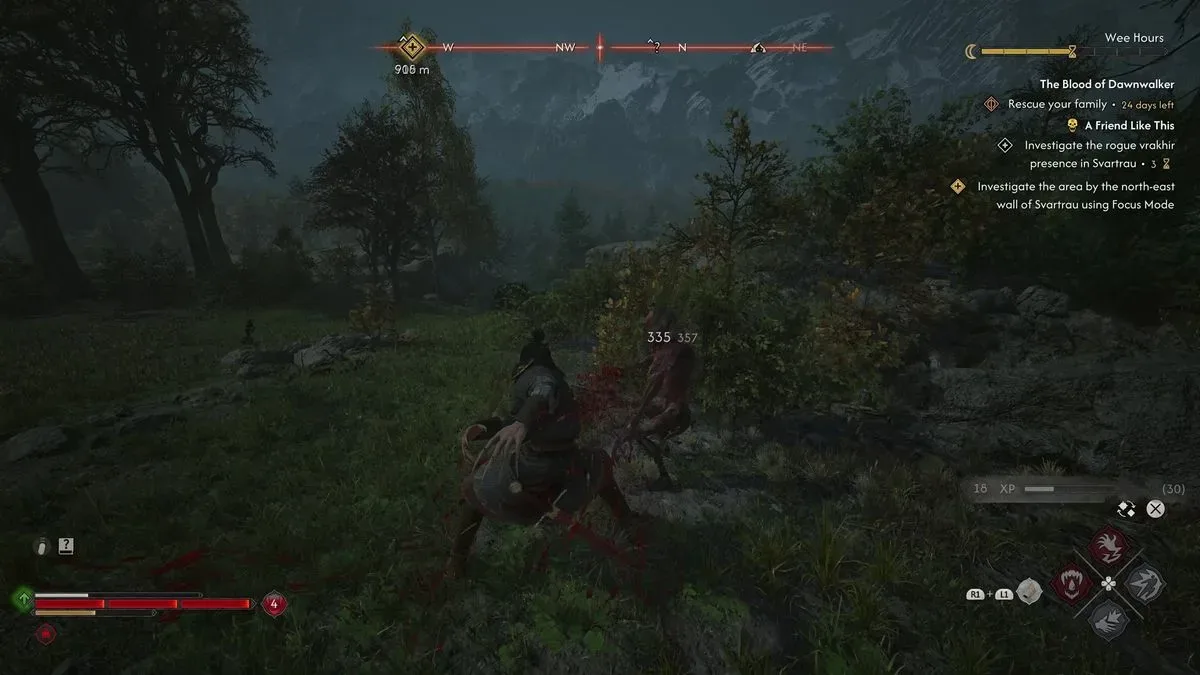
Choosing between claws and a sword in The Blood of Dawnwalker is not quite the clean, blood-splattered referendum on personal style it first appears to be. Coen’s combat options change with the clock: during daylight, he is restricted to bare fists or blades, while nighttime brings out his vampiric claws. That transformation makes claws feel like the obvious special occasion answer. They are fast, aggressive, and capable of delivering damage that can stand beside a conventional blade.
Still, the best answer is not simply “claws forever” or “sword because swords are cool,” although the latter has made a respectable case for itself in fantasy games since someone first put a wolf pelt on a loading screen. The better choice depends on the character’s current equipment, perks, armour effects, and attack values. For many setups, claws appear to have a modest overall advantage. But a focused sword build, particularly one supported by strong gear, can be more useful over the full rhythm of the game.
The essential thing is to treat claws and swords as parts of a changing build rather than as two weapons competing in a vacuum. One is tied to Coen’s nocturnal vampire form. The other can remain relevant whether it is day or night. That single distinction turns a close combat comparison into a practical question about uptime, preparation, and what is currently sitting in the inventory screen.
Claws are often the quickest route to strong combat
Claws are generally the more appealing option when comparing their basic combat qualities. They are quicker than swords and can deal damage in the same neighbourhood as a blade. In a fight where speed, repeated strikes, and immediate pressure matter, that can make the vampiric option feel more effective. A weapon does not have to show an enormous damage advantage to be useful; attack pace can alter how forcefully a combat style performs in the moment.
That is why claws are often the leading recommendation in ordinary circumstances. If their damage is comparable to a sword’s, the faster approach can tilt the trade in their favour. They are not merely a flashy alternate animation reserved for moonlit drama. They can be a meaningful combat tool with enough impact to justify choosing them over a blade when Coen’s vampire side is available.
However, “usually better” is not the same as “always better.” A sword can be strengthened by weapon properties, armour, and perks that specifically improve blade damage or related effects. Likewise, a character equipped to benefit from claws may find the night form pulls further ahead. The current loadout is therefore more important than a broad rule of thumb. A player who ignores build bonuses in favour of a supposedly universal winner may be leaving damage on the table—and possibly doing it with great theatrical conviction.
Start with the numbers shown in the inventory
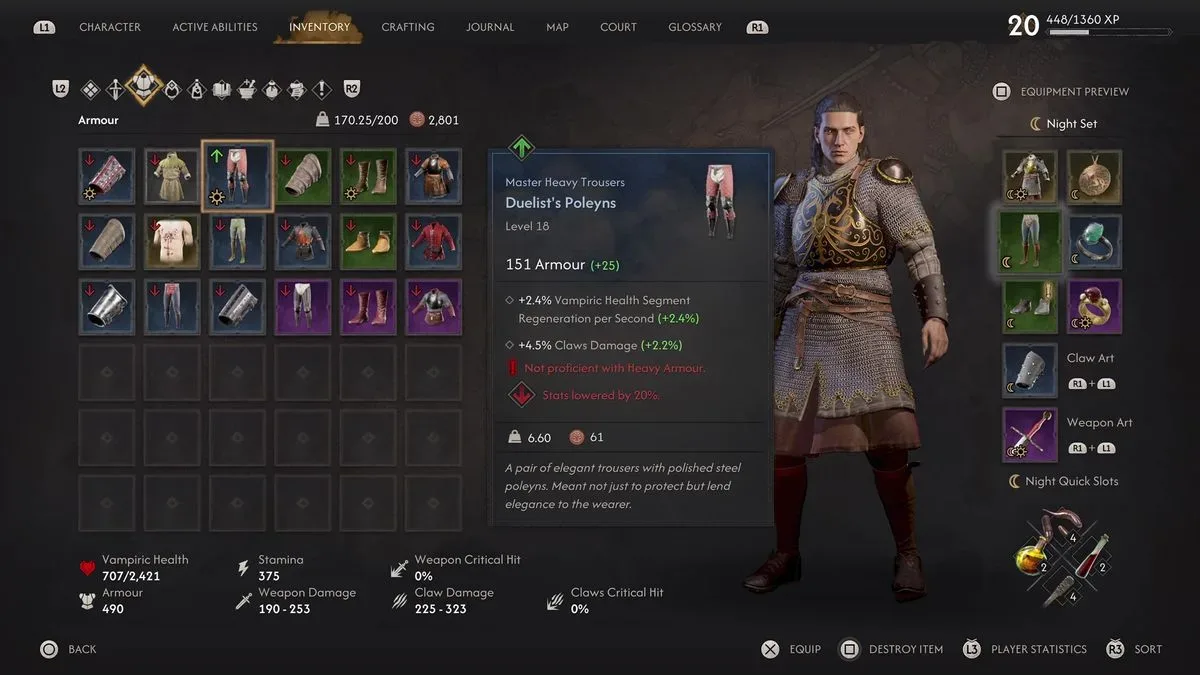
The most direct way to settle the question for a particular build is built into the game’s inventory interface. Beneath the listed items, the screen displays the present damage for sword attacks and claw attacks. This is the first comparison worth making before committing to a weapon direction.
If one figure is clearly ahead, there is little need to turn the choice into a philosophical crisis between humanity and vampirehood. Use the attack type that has the obvious damage advantage, then consider whether its perks and armour effects reinforce that lead. This check is particularly valuable after changing equipment. A newly acquired piece of armour, a perk selection, or a better sword can change which option makes sense.
There are a few useful questions to apply while reading those values:
- Is claw damage distinctly higher than sword damage right now?
- Does the sword’s damage lead by enough to offset claws’ faster feel?
- Do any equipped perks, weapons, or armour pieces explicitly favour one combat style?
- Will the selected option actually be available during the portion of the day when it is needed?
The displayed totals are not an abstract tier list. They represent the state of Coen’s current build. That distinction matters. A player with bonuses aimed at one weapon type should not expect the other to automatically outperform it merely because it has a broader reputation for speed or power.
The day-night cycle changes the value of a sword
Claws have one unavoidable limitation: Coen can only use them at night. A sword is available across both halves of the cycle, giving it a consistency advantage that basic damage comparisons do not fully capture. Even if claws are somewhat better in their usable window, a powerful sword remains a practical investment because it does not clock out when the sun comes up.
This makes a dedicated sword setup an attractive target for players who want one reliable combat identity for daytime and nighttime play. A blade capable of exceeding claw damage does more than improve a single matchup; it provides a weapon that can keep doing its job throughout the entire cycle. In that sense, a sword build has the potential to earn more total use than a claws-first approach, simply because it is never locked behind the hour.
That does not mean everyone should abandon claws in pursuit of steel. If the character’s existing gear strongly favours claws, the night form remains a highly effective answer when it is accessible. Rather, the point is that swords benefit from a kind of strategic convenience. Their ceiling may require more specific investment, but their availability gives successful blade builds a strong argument.
It is the familiar video-game equipment dilemma: the exciting option may have the flashiest identity, while the dependable option quietly keeps working every shift. For an appropriately unserious parallel, weapon choices can sometimes resemble the collector’s escalating process of buying one small thing: first there is a simple preference, then there is a comparison, then suddenly every bonus on every item has become very important.
Perks and armour can overturn the default recommendation
Because both weapon categories can be modified by the wider build, players should inspect every relevant source of specialization. Perks may improve the damage or effects of swords or claws. Armour can also push a choice in one direction. Weapons themselves naturally matter as well, especially when better blades become available.
This is where an apparently close contest becomes more nuanced. Claws may be the stronger general pick because they are fast and often hit hard enough to compete with blades. But a sword-supported setup can overcome that baseline. Conversely, a character whose perks and equipment enhance vampiric attacks should not switch just because a sword is technically usable for longer.
A sensible approach is to avoid deciding too early that Coen is exclusively a claw fighter or exclusively a swordsman. Revisit the values after meaningful upgrades. If an armour change favours claws, let the night build capitalize on it. If a blade upgrade produces a substantial sword lead, use the all-day weapon. Flexibility is more valuable than loyalty to a menu icon.
The Sword of St. Mihai gives blade builds a major goal
Players interested in making swords their dominant answer have a clear objective: locating the sword shards needed to unlock the fabled Sword of St. Mihai. That weapon is a meaningful reason to pursue a blade-focused plan, especially for anyone seeking an option that can remain dangerous both day and night.
The Sword of St. Mihai does not erase the usefulness of claws. Instead, it sharpens the case for checking whether a high-end sword setup can surpass them. If a powerful blade and supporting build make sword attacks deadlier than claw attacks, the blade becomes the efficient, always-accessible choice. Coen gets a solution that avoids the limitation of relying on an ability available only during nighttime hours.
For players who enjoy keeping a game’s systems organized rather than treating an inventory as a haunted attic, the principle resembles the advice in how to store retro games so they can be found and played. The useful item is not necessarily the rarest-looking one; it is the one that fits the actual way it will be used. Here, that means weighing raw damage, build bonuses, speed, and availability together.
A practical recommendation for most builds
For the average comparison, use claws at night when their displayed damage is competitive with the sword. Their speed and strong damage output give them a slight edge in many cases. They are a natural fit for Coen’s vampire form and deserve more consideration than a temporary novelty weapon.
At the same time, do not overlook swords merely because claws can be powerful. Check the inventory values beneath the item list, account for every perk and armour bonus, and pay attention to the fact that claws are limited to nighttime. When a sword has a decisive damage lead—or when a blade-focused setup is coming together around a strong weapon such as the Sword of St. Mihai—it can be the superior long-term choice.
In short: claws are often the better immediate pick, but the best weapon is the one supported by the current build and usable when Coen needs it. The vampire gets the claws; the player gets the spreadsheet. Everybody wins, except perhaps the enemies, who were not consulted.