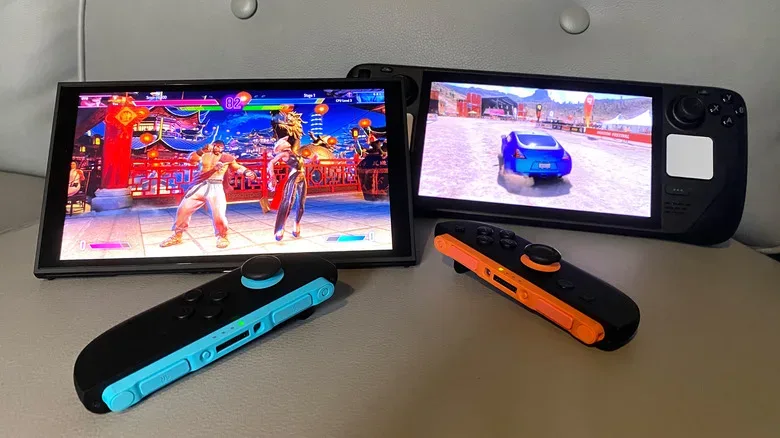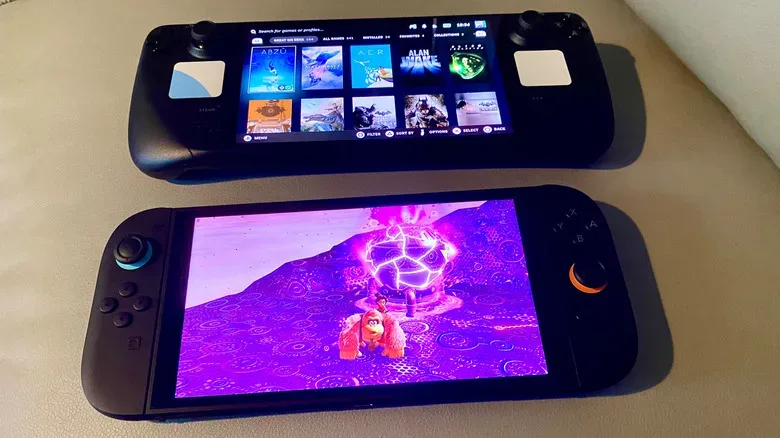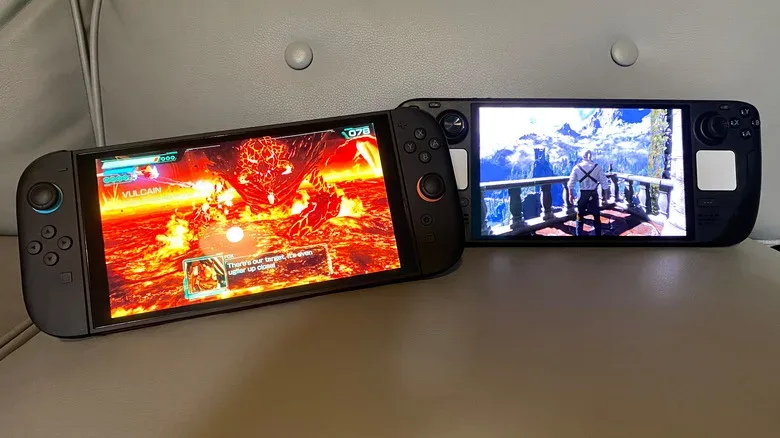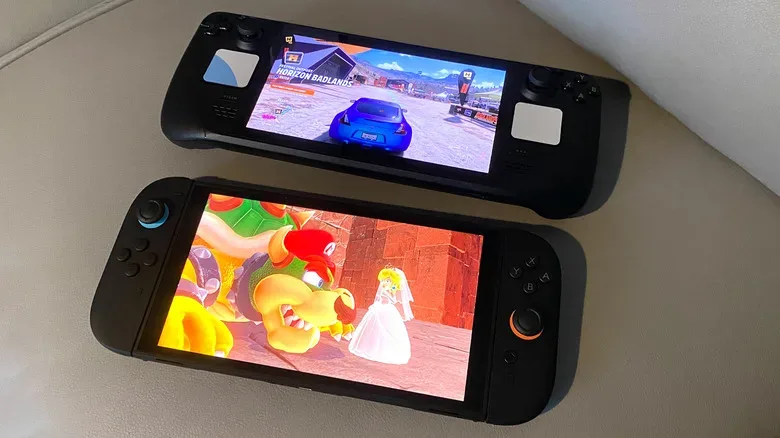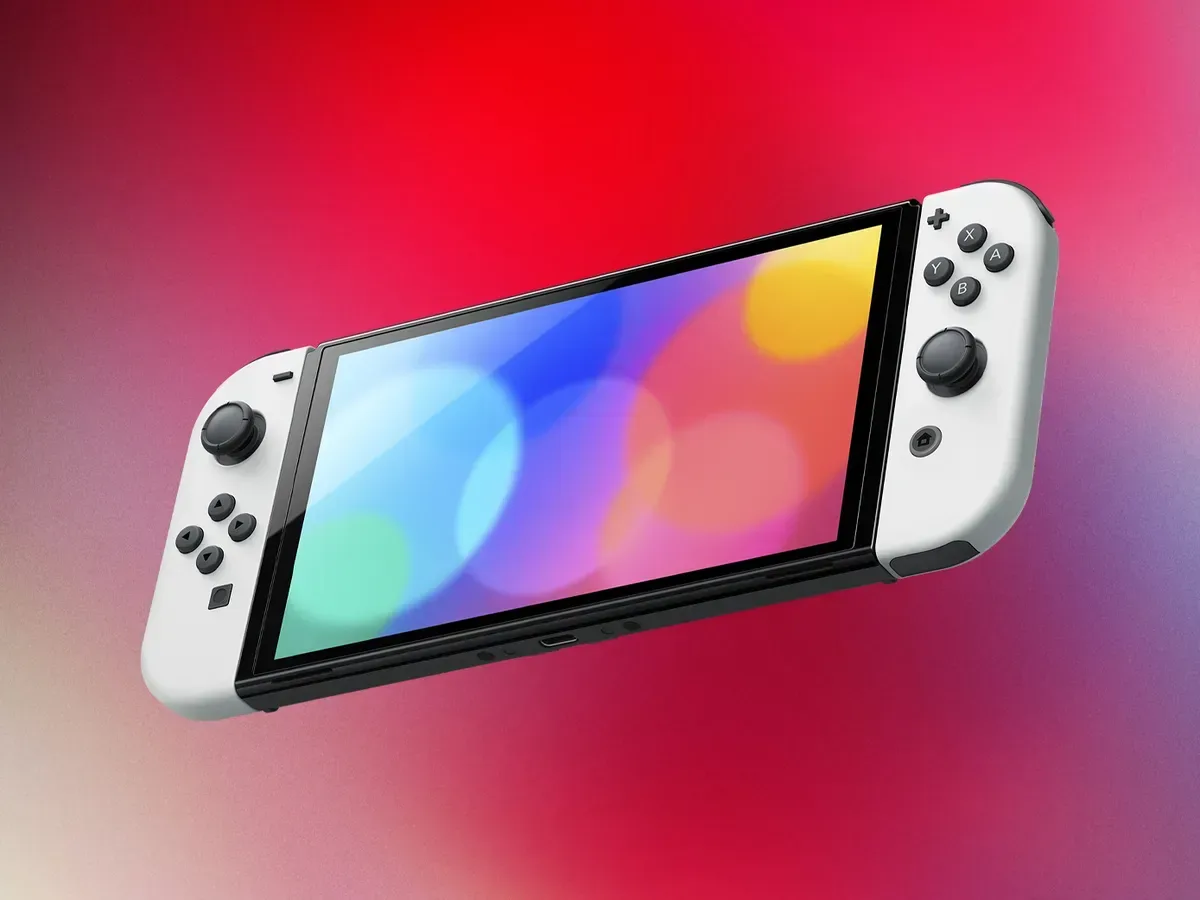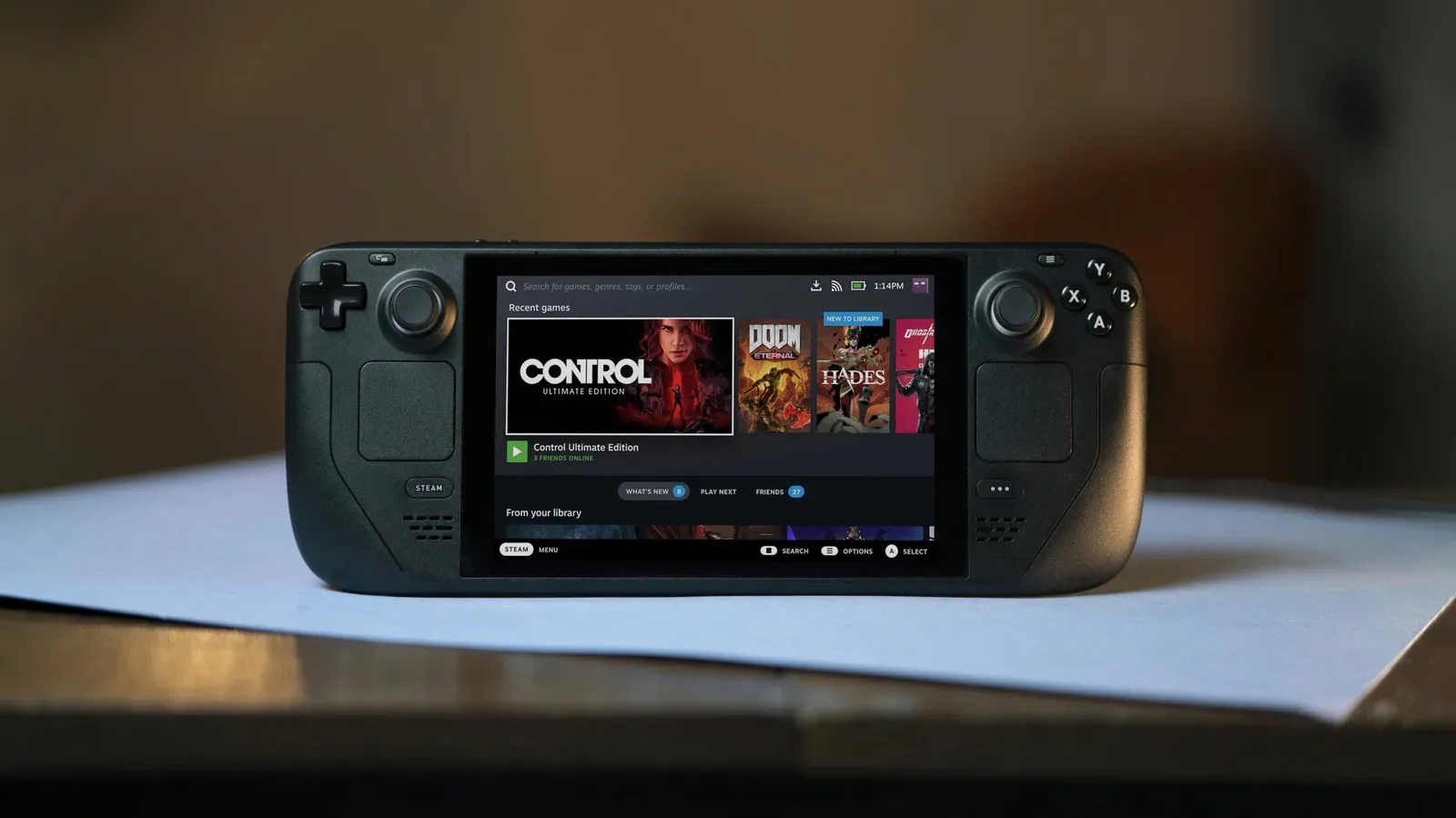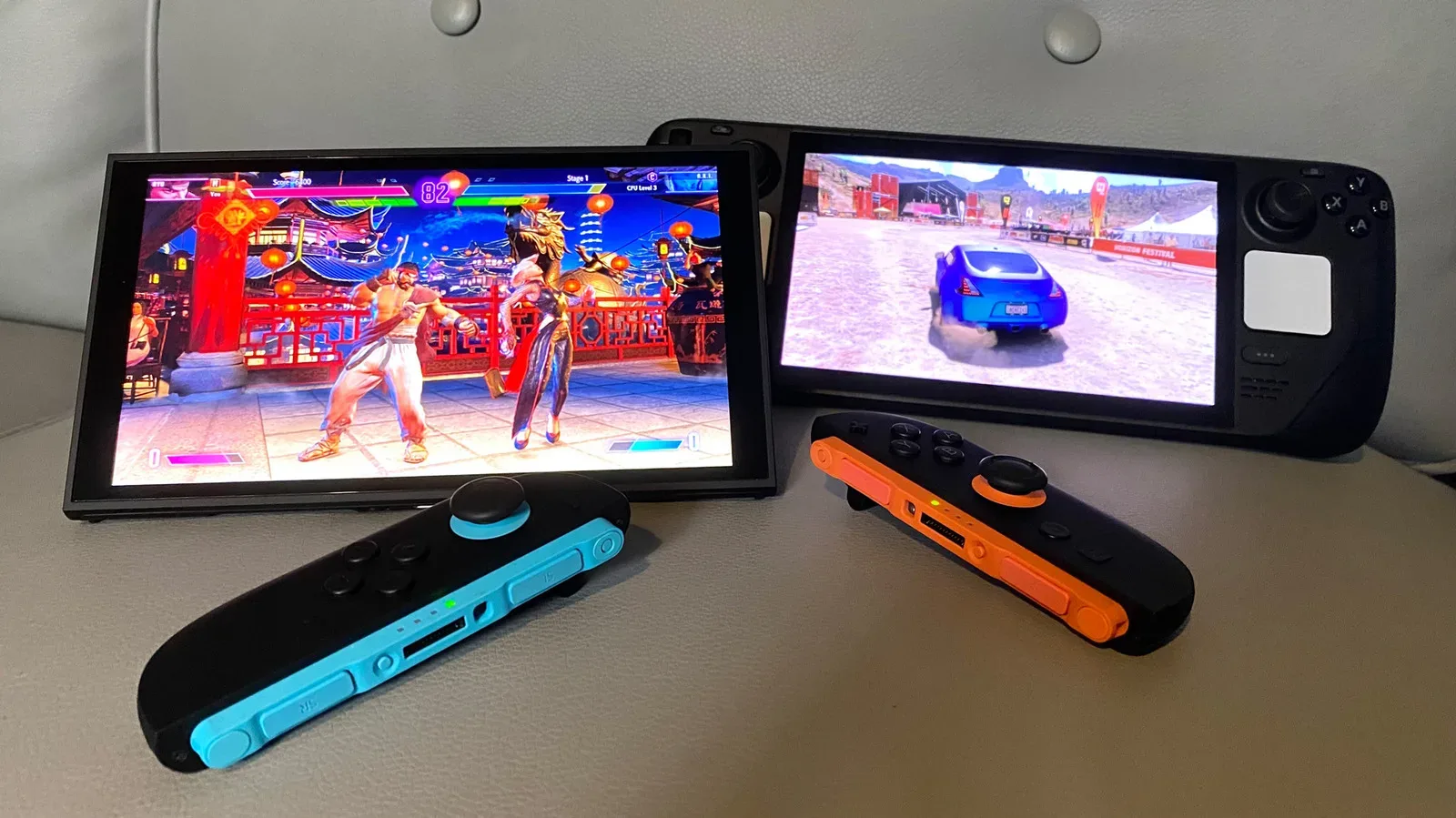
The Steam Deck and Nintendo Switch 2 may share the same basic silhouette—screen, controls, portable ambitions—but they are built around notably different ideas of what a handheld should be. Valve’s machine is a compact PC designed to bring a vast PC library into a portable form. Nintendo’s is a dedicated hybrid console intended to move cleanly from handheld sessions to the living-room television.
That distinction matters because “more powerful” is not a single, permanent answer. Switch 2 is generally ahead in graphics capability, and its advantage becomes much more substantial while docked. Steam Deck, meanwhile, brings a higher-clocked CPU, more unified memory, a better display for handheld viewing, and the particular benefits and complications that come with PC gaming.
For anyone choosing between them, benchmark-style numbers are useful, but they cannot decide the purchase alone. Resolution targets, upscaling, game optimization, library preferences, pricing, and whether the device will spend more time in a backpack or beneath a TV all change the practical answer.
Switch 2 has the stronger graphics case, especially in the dock
In handheld use, the two devices are closer than their very different software ecosystems might suggest. Switch 2’s Nvidia Ampere-based GPU is estimated to reach around 1.71 TFLOPS in portable mode. Steam Deck’s AMD RDNA 2 graphics hardware sits around 1.6 TFLOPS. Those figures do not tell the full story—different architectures and game engines make direct comparisons imperfect—but they underline that Nintendo does not begin with an overwhelming portable-mode lead.
The gap changes dramatically when Switch 2 is docked. Its graphics hardware can draw on up to 3.7 TFLOPS, a major increase over its handheld ceiling. Steam Deck does not receive an equivalent performance uplift simply by being connected to a dock. It can output to a television, but attaching cables is not a magic protein shake for its silicon.
That docking headroom is central to Switch 2’s ability to target 4K output in selected games on modern televisions. Metroid Prime 4, for instance, is cited as capable of 4K at 60 frames per second, with Nvidia’s DLSS technology doing important work in reaching that result. The important nuance is that a 4K output signal and a game rendering every pixel natively at 4K are not necessarily the same thing. Upscaling is part of the equation, not a dirty secret hidden under the dock.
Steam Deck remains capable within its intended portable targets. Elden Ring at 720p and 30 fps is an example of the sort of result it can deliver. At a handheld screen size, that can be a reasonable compromise, even if it is far removed from the television-focused targets Switch 2 can pursue while docked.
Steam Deck’s CPU and memory advantages complicate the picture
Graphics hardware is only one part of the hardware conversation. Steam Deck uses a four-core AMD Zen 2 processor with clock speeds that can reach 3.5GHz. Switch 2 uses an eight-core ARM Cortex-A78C CPU that normally runs at 1.1GHz. On the blunt measurement of clock speed, Valve’s handheld has a clear advantage. On core count, Nintendo’s has twice as many.
Related coverage includes Steam Deck vs. Switch 2: Power, Features and Value Compared.
Neither of those individual statistics should be treated as a victory screen. Switch 2’s ARM processor is from a more modern design family than Steam Deck’s Zen 2 chip, helping it remain competitive despite the lower stated clock. Performance depends on workload, software tools, operating system overhead, thermal limits, and how a particular engine divides jobs across its available cores.
Memory is one area where Steam Deck has a straightforward specification lead: 16GB of unified memory, compared with 12GB in Switch 2. More memory can give developers and PC users extra breathing room, though it does not guarantee that every game will run better. A fixed console with less memory can still make highly effective use of its resources when games are developed specifically around that exact hardware.
Fixed-hardware optimization favors Switch 2
Nintendo’s biggest real-world advantage is less glamorous than TFLOPS and more meaningful than most spec-sheet sparring: every Switch 2 owner has the same core hardware. Developers know the CPU, GPU, memory allocation, display targets, and system environment they are working with. That gives them a defined target for optimization.
Steam Deck also has fixed internal components, but it belongs to the broader PC ecosystem. PC games are made to function across an immense field of hardware combinations, drivers, operating systems, display resolutions, and performance expectations. A studio is not automatically creating its game around Steam Deck’s power envelope. As a result, players can encounter titles that need lower settings, resolution adjustments, frame-rate caps, or upscaling to become comfortable on the handheld.
Valve’s Steam Deck Verified filter remains useful for separating games that should work well from those likely to require compromises or additional attention. Still, Verified status is guidance rather than a universal promise of identical performance forever. Major patches, drivers, updates, and more demanding new releases can all alter the equation.
Switch 2 also has a valuable technology advantage through DLSS. Nvidia’s AI-assisted upscaling allows a game to start from a lower internal resolution and reconstruct an image intended to look sharper at its output resolution. That is a major reason games can aim high on a modest portable-power budget. Cyberpunk 2077 can reach 1080p when Switch 2 is docked using this sort of assistance.
Its more than 1,500 CUDA cores additionally support effects such as ray tracing in games including Star Wars Outlaws. Steam Deck can technically run ray tracing, but it lacks dedicated CUDA cores, and activating the feature can devastate frame-rate performance. That makes the setting far less practical on Valve’s device in demanding games.
Switch 2 is the cleaner television machine
For players who regularly switch from sofa to commute, Switch 2 has the more natural design. Its dock is made for a fast, console-like handoff between portable play and the television. The interface and expected behavior are built around that transition, which is difficult to overstate for households that value convenience over fiddling.
Steam Deck can be connected to a television through a dock, but the official dock adds $79. Its big-screen experience is more PC-like, which can be liberating for tinkerers and less inviting for someone who wants to pick up a controller and immediately navigate a simple console dashboard. Steam Deck’s hardware performance also remains the same rather than stepping up in docked mode.
That said, a TV-first player should not assume every Switch 2 game will look or perform identically. Developers make their own technical decisions, and output resolution, internal resolution, visual settings, and frame-rate targets vary by title. The point is that Switch 2 has the stronger platform-level route to high-resolution television play.
Those considering Nintendo’s hardware options may also want to keep an eye on the Zelda 40th Anniversary Switch 2 console and Pro Controller, which is set for October 29.
Steam Deck OLED wins the screen comparison
When the priority is simply playing in the hands, Steam Deck OLED has a persuasive advantage. Valve no longer makes the original LCD version, and the current OLED model brings the richer contrast, deeper blacks, and more vivid presentation associated with OLED technology.
Switch 2’s screen is slightly larger and offers a 1080p resolution. Steam Deck OLED uses a 1,280 by 800 display. Resolution is not the entire story, however. Nintendo’s LCD panel is a step down in picture quality when compared directly with the Deck’s OLED screen. For darker games, colorful indies, or late-night sessions in which contrast does much of the visual heavy lifting, the Deck display is a meaningful selling point.
This is the clearest reminder that theoretical graphics power and perceived image quality are separate subjects. A device can have the more capable GPU yet lose the handheld screen contest. Depending on where and how someone plays, the display may be more noticeable every day than docked TFLOPS.
Prices and game libraries may be the deciding factors
Hardware pricing has become unusually important in this matchup. The 512GB Steam Deck OLED costs $789, while the 1TB version is $949. Switch 2 costs $499. That leaves Nintendo’s system dramatically cheaper at entry, even before accounting for the extra $79 required for Steam Deck’s official dock if television play is part of the plan.
The software-cost story cuts in the other direction. Steam’s frequent sales can make it easier to assemble a broad collection of older releases and indie games at low prices. Nintendo’s eShop has sales too, but major first-party releases are usually more resistant to steep discounts. At the time considered here, Mario Kart World still carries a $79 price.
There is no universal winner because the libraries are fundamentally different. Switch 2 is the obvious choice for players who prioritize Nintendo exclusives such as Donkey Kong Bananza, Mario Kart World, and The Legend of Zelda: Tears of the Kingdom. Steam Deck is better suited to someone who wants PC storefront flexibility, discounted catalog games, and a large supply of indie releases.
Which handheld is more powerful?
Switch 2 takes the overall graphics-power crown, particularly when docked. Its portable GPU edge is modest on paper, but its docked 3.7-TFLOPS ceiling, DLSS support, CUDA hardware, ray-tracing potential, and fixed-platform optimization give it a stronger route to ambitious modern presentation on a television.
Steam Deck should not be dismissed as the weaker all-around choice. It has 16GB of unified memory, a faster-clocked CPU, an excellent OLED panel, and access to a PC library where sales can substantially soften the cost of ownership. It is also a different proposition: not a direct substitute for Nintendo’s simple hybrid-console formula, but a portable PC with the freedom and maintenance that label implies.
- Choose Switch 2 for the strongest overall graphics capability, easy docked TV play, Nintendo exclusives, and a $499 starting price.
- Choose Steam Deck OLED for its superior handheld screen, 16GB of memory, PC storefront access, and frequent opportunities to buy games at reduced prices.
- Treat raw specs cautiously: Switch 2 wins the GPU-and-dock argument, while Steam Deck wins several handheld and PC-value arguments that benchmarks cannot settle.