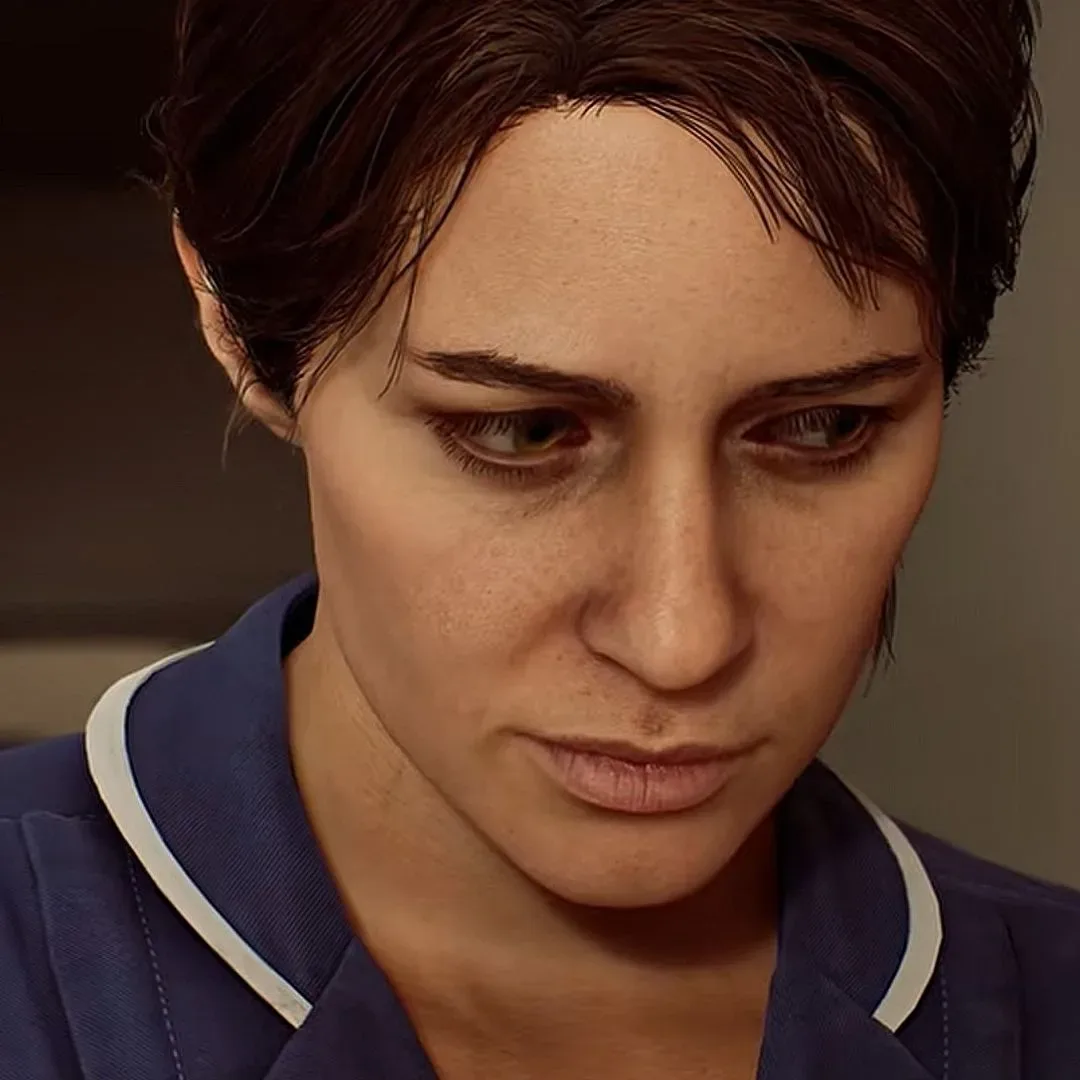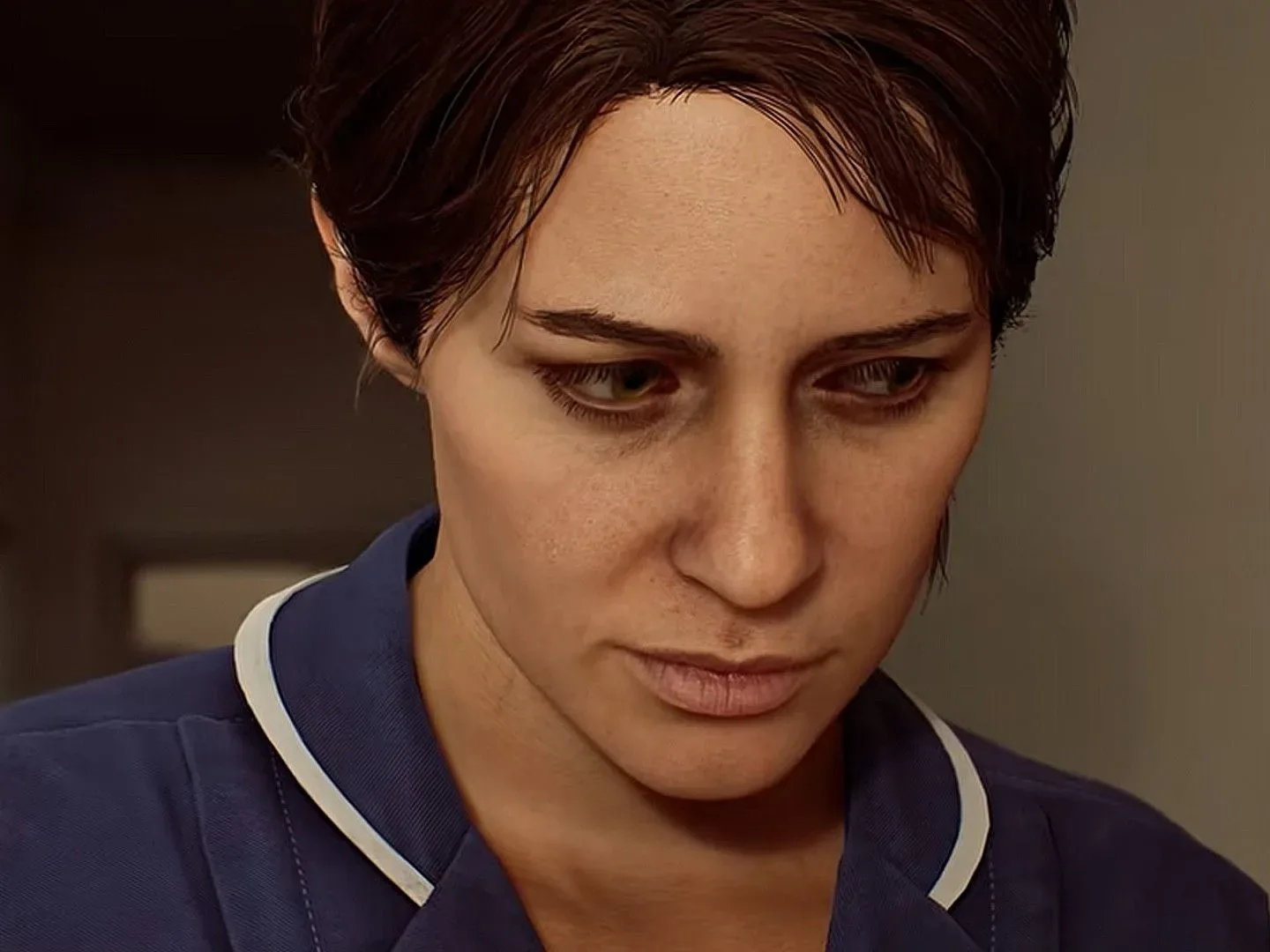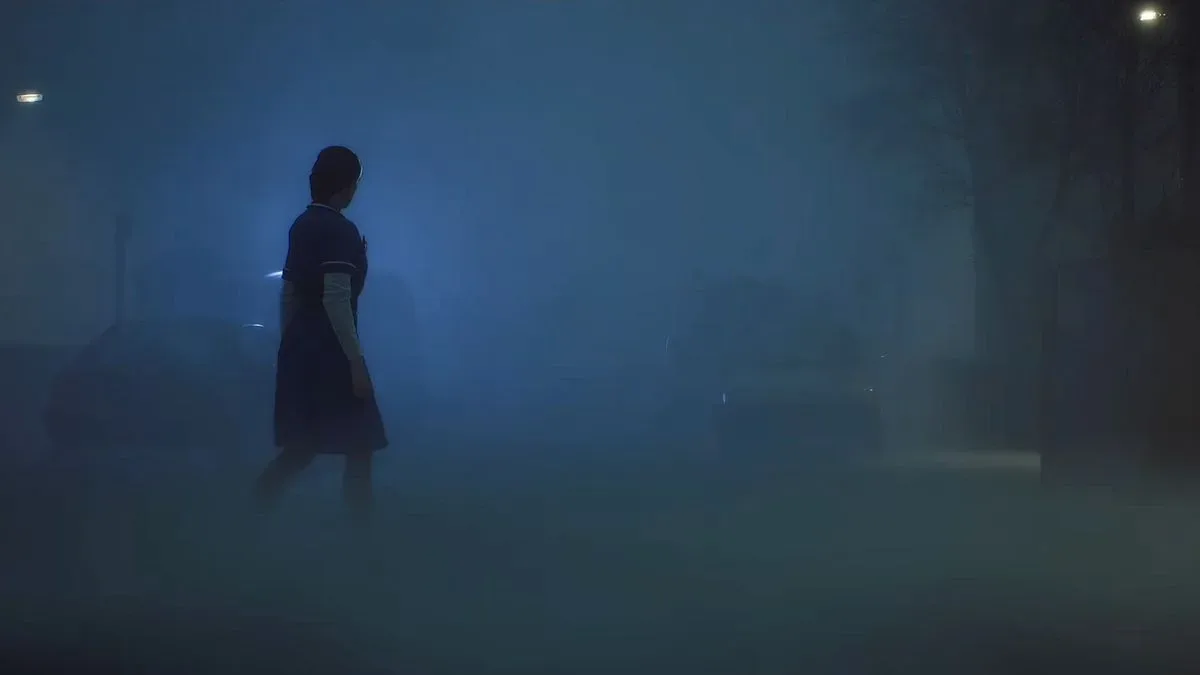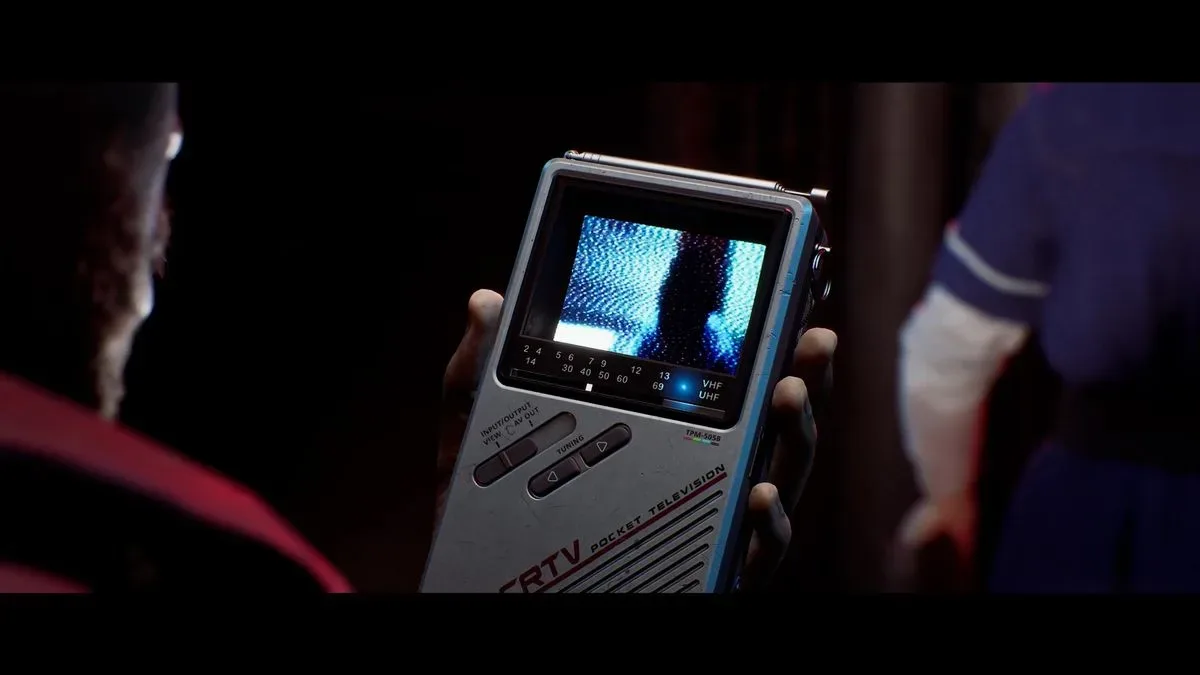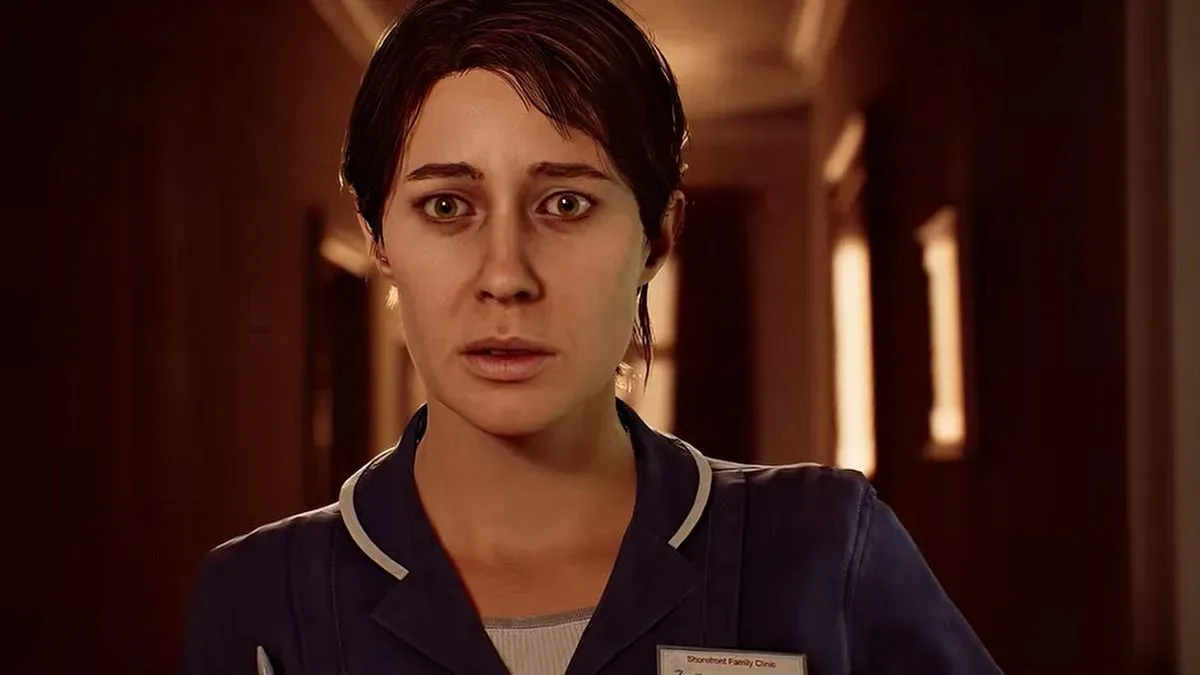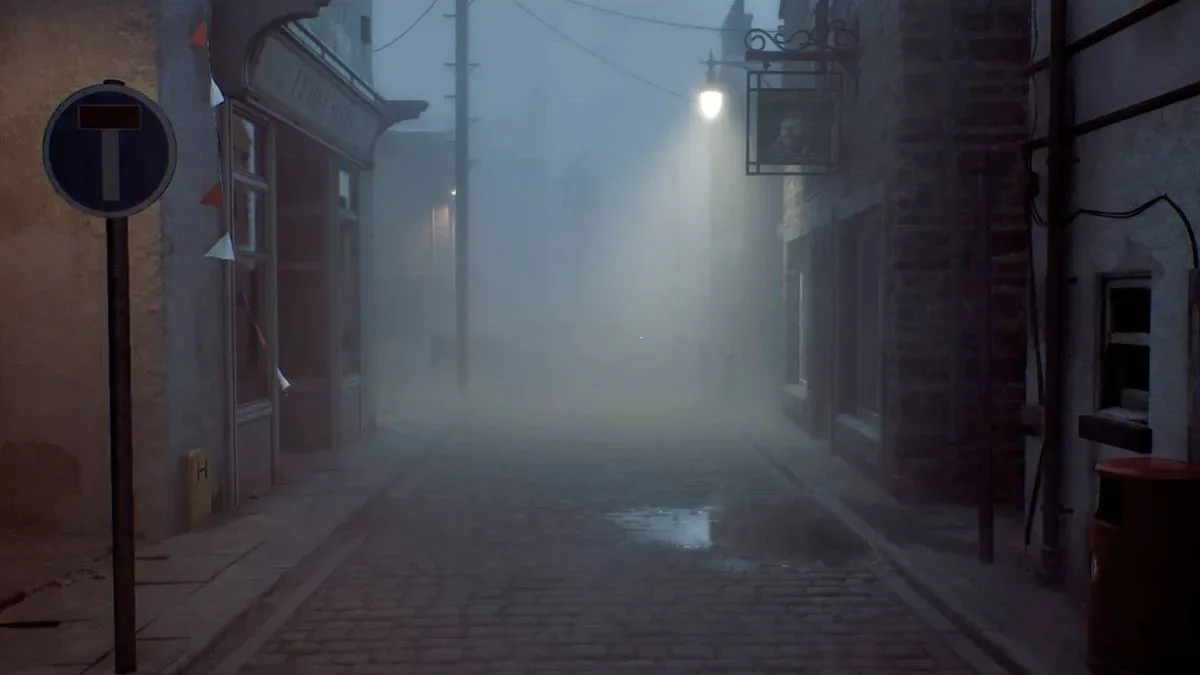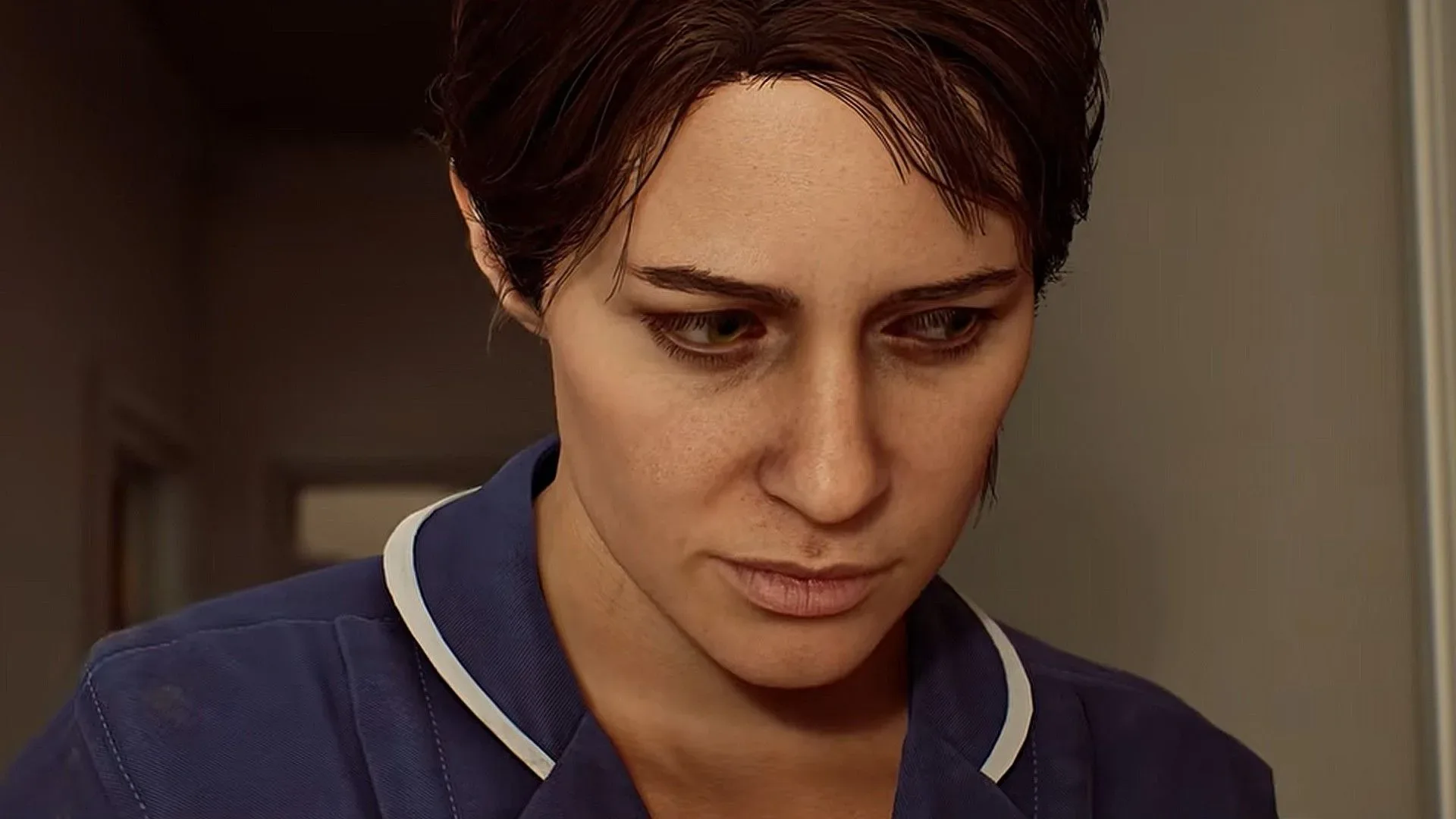
Silent Hill Townfall begins by placing Simon at the center of St. Amelia’s fog, but its most affecting perspective may belong to someone initially heard rather than seen. Zoe Ellis, the nurse whose voice reaches Simon through his handheld CRTV, is first framed as a distant presence asking him to return and free her. That setup invites a familiar reading: a disembodied woman whose suffering motivates a male protagonist’s search.
Then the game hands Zoe the controls.
In Part 2: Zoe, the shift is not merely a narrative reveal. It changes what danger means, what failure means, and what St. Amelia’s horrors appear to be accusing its people of. Zoe’s chapter presents a nurse overwhelmed by an increased workload, sent toward a house on Church Avenue after failing to reach one of her regular patients, Mr Stewart. She is not introduced as a conquering hero with a reliable arsenal. She has a pager, an address, a job she has been asked to do, and a sense that she may already have arrived too late.
That is an unusually potent foundation for psychological horror. Simon can meet threats with limited combat options; Zoe largely survives by moving, hiding, distracting enemies and refusing to stop. Her section makes the player inhabit not just fear of bodily harm, but the panic of responsibility without authority.
A change in perspective changes the stakes
Perspective shifts can be a mechanical novelty, but Townfall’s switch has a more precise purpose. Zoe’s connection to the abandoned clinic is uncovered through clues among her belongings, which lead into a flashback. The player sees her look through her pager before she is dispatched to Mr Stewart’s home. In practical terms, the objective is direct: get to the patient. Emotionally, every step is made difficult by the knowledge that she missed a prior call because demand had become unmanageable.
The story is set in mid-1990s Scotland and ties Zoe’s experience to sexism within a medical hierarchy. She is a nurse rather than a physician, yet the scenario places extraordinary demands on her. The distinction is central, not incidental. Zoe is positioned as a caregiver expected to take on extra work, while the authority and status associated with doctors remain elsewhere. When the system breaks down, the person with the least institutional power is still expected to absorb its consequences.
That arrangement lets Townfall make a broader horror idea concrete. Institutional horror is fear generated by an organization or social structure that should protect people but instead harms, neglects, or abandons them. Here, the clinic, workload and medical chain of command are not background texture. They shape Zoe’s terror. The nightmare does not start only when she encounters monsters; it starts with an impossible obligation being placed on someone who has been given too little support to meet it.
Her failure to reach Mr Stewart is therefore not treated as a simple personal flaw. The scene’s power comes from the collision between a human being’s care for a patient and a workplace structure that makes care impossible to provide at the required scale. Zoe is made to carry the guilt anyway.
Related coverage includes Silent Hill Townfall Makes Zoe Ellis Its Quietest and Most Vital Hero.
Why Zoe’s enemies matter
Silent Hill has long used creatures and distorted spaces as expressions of psychological strain. In Townfall, the contrast between Simon’s foes and Zoe’s is especially revealing. Simon encounters hammer-headed figures moving through the fog with their wrists bound behind them. Zoe is stalked by humanoid people who are naked, wounded, bloated and scarred. They are horrific, but they remain recognizably vulnerable.
That visual difference supports an interpretation of Zoe’s character: even under extreme pressure, she cannot easily turn suffering people into faceless monsters. She sees people who need care. The same impulse that makes her a nurse also leaves her exposed in a town where the need is overwhelming and the available help is absent.
The danger is reinforced through a medical image twisted into an attack. If Zoe is spotted, cannula needles connected to lengths of tubing emerge from reopened surgical wounds and strike at her. A cannula is a tube used to provide access to the body for medical purposes, commonly in clinical care. Townfall repurposes that language and imagery into something predatory. Tools associated with treatment become weapons. The horror is not that medicine is inherently monstrous; it is that Zoe’s experiences of care, injury and professional failure have become impossible to separate.
This is where the chapter’s mechanics and symbolism reinforce one another. Zoe does not have Simon’s weapons. Instead, she can use items such as discarded beer bottles to distract or briefly stun enemies, then run through the fog. The player is asked to create a small window of safety rather than establish control over a space. That difference produces tension without needing to declare Zoe weak. Her survival depends on awareness, quick decisions and endurance.
There is a meaningful distinction between being unable to overpower an enemy and being powerless. Zoe has agency: she continues toward the house, keeps following the path back to the hospital, and acts even while fear and blame surround her. But her agency is bounded by a world that withholds the resources, recognition and protection she needs. Townfall’s horror is sharper because it understands that those conditions are not the same thing.
Guilt is the chapter’s real pursuer
At Mr Stewart’s house, Zoe’s fears are confirmed in the cruelest possible manner: she receives a message that she is too late. Later, a call in a telephone box brings direct abuse from Dr. Glenn, who blames her for Mr Stewart’s death and, more expansively, for everyone’s death. The accusation is deliberately disproportionate. One nurse becomes the target for a disaster larger than any one person could solve.
This is the chapter’s most chilling idea. Zoe is not only grieving what has happened. She is being told to interpret systemic collapse as proof of her personal guilt. The burden is “borrowed” in the sense that it belongs to failures above and around her, yet it is assigned to her all the same.
In psychological-horror terms, guilt often turns private anguish into a hostile world. Townfall’s use of guilt appears more socially pointed. Zoe’s anguish has a clear material context: a sharply increased workload, a missed visit, a dead patient, a doctor’s condemnation and the diminished standing granted to her work. The game does not need to resolve every aspect of St. Amelia to make that emotional logic legible. Zoe is haunted because she has been asked to achieve the impossible, then punished for not doing so.
Her vulnerability is thus not simply a scare-delivery device. It is an argument about who gets blamed when care fails. The nurse’s role requires attention to others’ pain; her position within the hierarchy makes it easier for others to deny the cost of that attention. Townfall transforms that contradiction into its most unsettling enemy design and its most urgent objective structure.
A Gothic heroine who refuses the usual role
Townfall’s mist, isolation and distant voice naturally evoke Gothic horror, a tradition that often centers hidden histories, oppressive environments and people trapped by forces larger than themselves. In many familiar Gothic patterns, women are presented as victims to be rescued, dangerous seducers, or absent figures whose stories exist chiefly to motivate a man. Zoe initially seems as if she could be the absent woman in that structure: an urgent voice on a device, essential to Simon’s quest but physically inaccessible.
Her playable chapter disrupts that expectation. Zoe is certainly imperiled, but she is not reduced to an objective. She has a working life, an obligation, a relationship to the town’s suffering and an inner world that actively shapes the horror. The fact that she receives less physical combat power than Simon does not turn her into a passive character. Rather, it identifies what kind of fight her story is about.
That fight is one of resolve. Zoe continues when there is no clean way to fix the crisis and no assurance that the people judging her will ever acknowledge the forces that constrained her. Her strength is quiet because it does not arrive as a triumphant combat sequence. It arrives in persistence: going to the patient’s home, trying to reconnect with the hospital, and continuing to seek a way forward after being told that she has failed.
For players, that makes the chapter an important reminder that horror-game tension does not require a larger weapon or a louder confrontation. Scarcity, uncertainty and limited defensive options can create fear, but they can also communicate character. Zoe’s evasion-focused play does not merely make her sections feel more fragile. It places players in the mindset of a person who must preserve herself while still feeling responsible for everyone else.
What Zoe adds to St. Amelia
Simon’s journey through St. Amelia has its own threats and mysteries, but Zoe provides a different measure of the town’s tragedy. The CRTV messages initially establish her as an enigma. The flashback, clinic clues and journey to Church Avenue make her a person caught in the machinery behind that enigma. Her section asks players to view the town not only as a place of supernatural menace, but as a place where people were overworked, unsupported and later blamed for the consequences.
That focus also gives Townfall a distinct relationship with combat. Simon’s intermittent fighting frames danger as something that can sometimes be met head-on. Zoe’s gameplay insists that some threats cannot be solved through force, particularly when the real source of terror is an unfair demand for care from someone who lacks the authority to change the system producing the demand.
It is a grim proposition, but it is also why Zoe becomes so compelling. She is not a decorative tragedy tucked behind Simon’s story. She is a lens through which the town’s guilt becomes comprehensible. The pager, the abandoned clinic, the beer-bottle distractions, the surgically distorted enemies and Dr. Glenn’s blame all point toward the same pressure: a caregiver has been made responsible for fixing what an entire structure failed to prevent.
For a dose of less traumatic Gothic atmosphere after St. Amelia’s fog, the season’s Gothic monsters and haunted mansions on the tabletop may be a considerably gentler destination.
Zoe’s segments may be short and driven by narrative, but their impact comes from how completely they reorganize the player’s understanding of the stakes. In a game full of fog, threats and uncertain messages, the clearest terror is the demand that one exhausted person must save everyone—and the cruelty of blaming her when she cannot.