There is a particular kind of fear that only games can create: the moment when progress is technically simple, the next path is obvious, and yet every instinct says not to take another step. The original Silent Hill finds that feeling almost immediately. Its early alley sequence, played shortly after Harry Mason enters the fog-bound town, remains a remarkably concentrated piece of interactive horror.
Nothing about the basic objective sounds complicated. Harry walks forward. He passes through a gate. He follows an alley. But the scene steadily strips away the comforts that make virtual spaces readable and safe. Visibility collapses. Sound grows oppressive. The environment changes from an uneasy townscape into something rusted, enclosed and hostile. The camera becomes a source of friction rather than a helpful window. By the time small, knife-wielding creatures emerge from the darkness, the player is not simply facing enemies. They have been conditioned to doubt the route, the controls and their ability to understand what is happening.
That is why this introduction has lingered for so long. It is not primarily remembered as a difficult fight or a complicated puzzle. It is remembered as an encounter with dread before the game has even properly explained its rules.
A warning that sets the tone before the first step
Silent Hill opens with a direct warning about violent and disturbing images. On its own, a content notice cannot make a game frightening. In this case, though, it works as an unusually blunt piece of framing. It tells players that the game intends to go somewhere unpleasant, then asks them to choose to continue.
The opening presentation follows with pre-rendered cinematic material before placing control in the player’s hands. That transition matters. A cutscene can establish a mood at a safe distance; the player watches it happen. Once Harry begins walking through Silent Hill’s fog, responsibility shifts. The player chooses where to look, which direction to travel and whether to keep pressing onward. Horror becomes more personal when the scary place is no longer merely on screen, but somewhere the player is actively steering into.
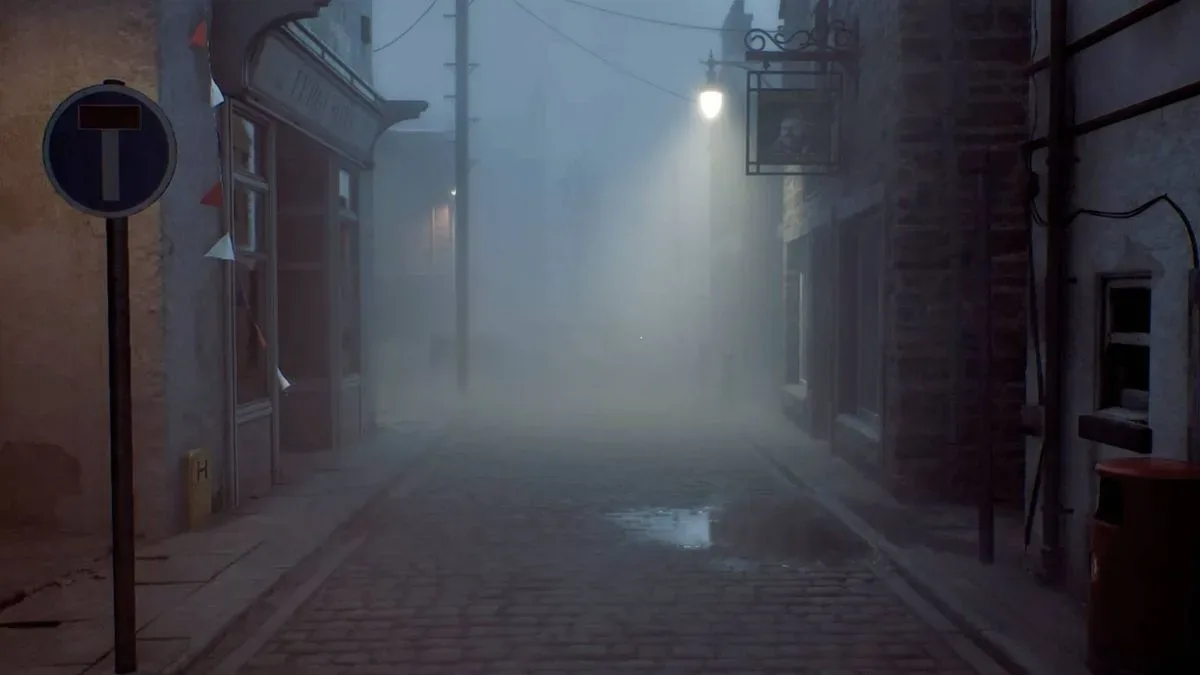
The town’s fog is essential here. Fog is not just scenery. It is a visibility constraint: a design choice that limits what a player can see ahead, around corners or in the distance. That limitation removes the normal reassurance of being able to survey a space and judge its risks. A road might be clear, or it might conceal a threat a few steps away. The player has inadequate information, but still has to move.
The low, sustained background sound reinforces that uncertainty. Rather than offering a clean musical cue that announces a monster or a coming set piece, the audio establishes a constant uneasy baseline. Even Harry’s footsteps become part of the tension. In a quiet and obscured environment, ordinary movement is no longer neutral. Each footfall is evidence that the player is venturing deeper into a place they cannot properly see.
The alley turns familiar geography into a trap
The sequence starts with a clear shock: a gate opens onto a mutilated, bloody body. An air-raid siren then sounds in the distance. These are overt horror signals, but the stronger move is what follows. Rather than immediately resolving the tension with a confrontation, the game makes the player continue through the alley.
Related coverage includes Silent Hill's Alleyway Opening Still Defines Video Game Dread.
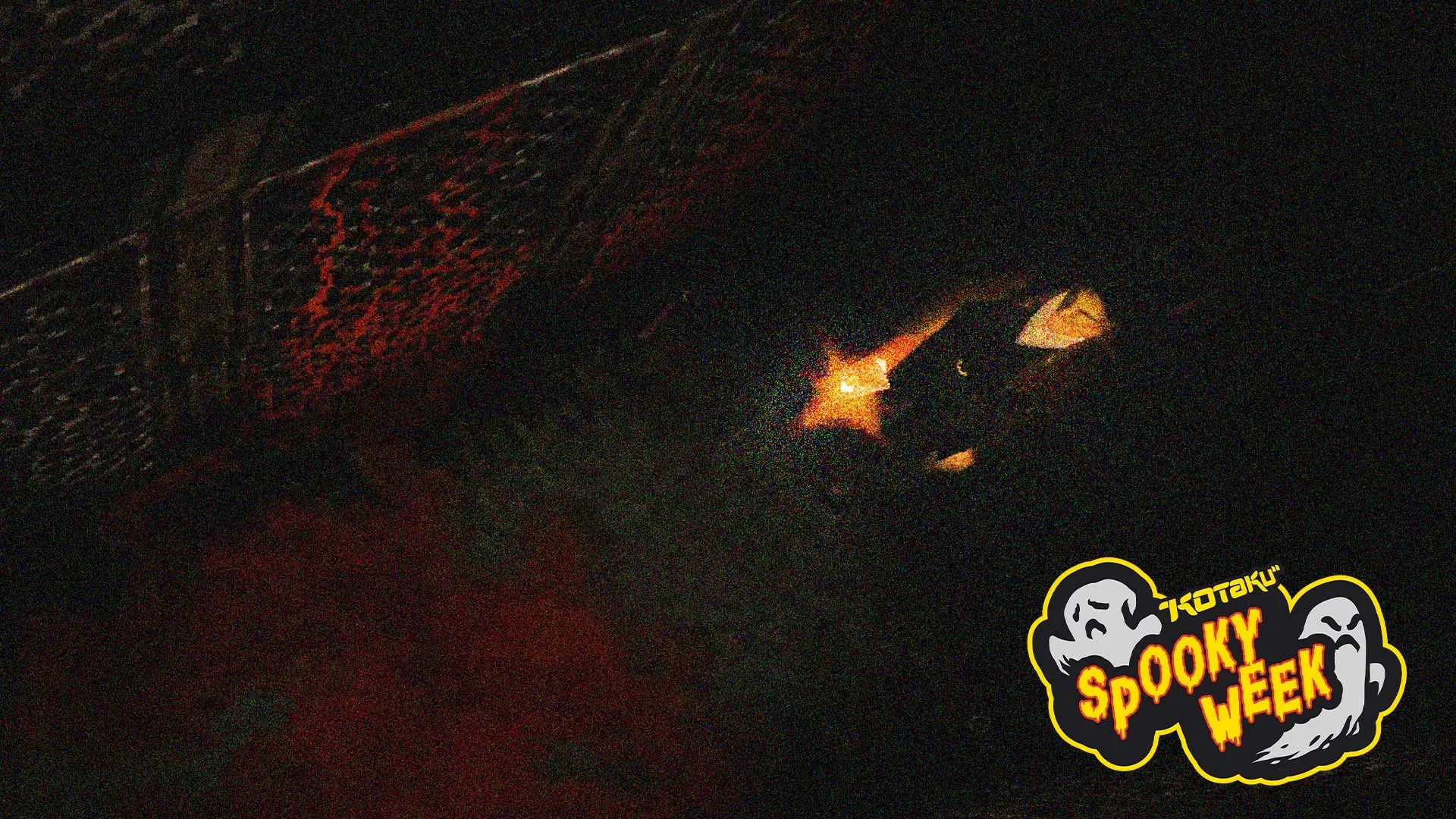
As Harry proceeds, the route grows darker and more distorted. He uses a small lighter to navigate, leaving the player with only a narrow, fragile pool of illumination. Fencing and concrete turn the space into a constricted corridor. Rusted surfaces and escalating music make the shift feel less like an ordinary journey through town and more like a descent into a nightmare that has swallowed the environment whole.
The fixed camera is central to that transformation. A fixed camera is an angle placed by the designers rather than one the player can freely rotate. Fixed views can compose spaces dramatically, hide information and make a location feel cinematic. In this alley, the camera’s unsteady movement makes it feel actively unreliable. Instead of granting command over the scene, it contributes to a sense of disorientation.
That choice has a practical effect on the player’s relationship with the controls. A player may know which direction they intend to go, but camera placement can make movement feel awkward or uncertain. In most genres, that would be a frustrating obstacle. In horror, the same loss of ease can be purposeful. It makes the body of the player—not only the character—feel less capable of responding calmly to danger.
There is an important distinction here: the sequence does not depend on hiding every threat. It gives players things to see—bloodied bodies, oppressive structures, darkness, the aftermath of violence—and lets anticipation do the rest. The environment communicates that something is wrong long before it fully specifies what the danger is. This is horror through accumulation.
The scripted attack weaponizes misunderstanding
At the end of the alley, Harry finds further bodies, including a corpse displayed in a horrifying fashion. When he turns back, small childlike creatures carrying knives emerge and attack. For a first-time player, the natural reaction is to flee or fight back. Yet this is a scripted moment: Harry must take damage and lose consciousness for the scene to advance.
A scripted sequence is a preplanned event that triggers under set conditions, often to deliver a story beat or transition. Scripted scenes are common in games, but they can be unusually potent in horror when the player does not realize that the apparent failure is required. The player still has buttons to press and a character to move, so the threat feels immediate. But the usual assumption—that good play will produce escape—has been quietly suspended.
That misunderstanding turns the attack into more than an early monster encounter. It becomes a brief crisis of agency. Agency in games means the player’s perceived ability to make meaningful choices and affect outcomes. The alley attack lets the player believe agency is intact, then reveals that survival is not currently available. The sensation can be especially intense because it is not communicated as a conventional cutscene. The player learns the rule by experiencing the consequence.
After Harry awakens in a diner and speaks with a police officer, control returns. Yet the opening does not let the player settle for long. A giant bat-like monster crashes through the diner’s glass when Harry attempts to leave. The rhythm is brutally efficient: the alley produces fear, the diner offers a pause, and the monster punctures that pause. Safety is established only long enough for the game to demonstrate that it cannot be trusted.
Why childhood fear does not need to be “rational” to be real
This opening can be especially overwhelming for someone encountering horror games for the first time. A player familiar with the genre may recognize the warning signs: ominous sound, limited visibility, deliberate camera angles and a sequence that is likely to be scripted. But genre literacy is learned. Without it, every unfamiliar element can feel like proof that the game has broken the ordinary contract of play.
That is a useful reminder when revisiting older games. It is tempting to assess a PlayStation-era horror scene strictly through modern technical expectations: its visual detail, controls or presentation. But fear is not measured solely by technical fidelity. It is shaped by context, expectation and interaction. A player who has never faced this style of horror does not approach a dark alley as a veteran parsing an encounter. They approach it as an unexplained place that has suddenly stopped obeying the logic of more familiar games.
The original Silent Hill also demonstrates why roughness can serve mood. Fog obscures clarity. Fixed views limit control. A lighter makes darkness tangible. Unsettling audio refuses to let the player relax. Whether each element feels dated or effective in isolation is less important than their combined result: an environment that feels resistant to being understood.
For another example of how games can make uncertainty a meaningful part of play rather than a mere inconvenience, see this look at how routine JRPG battles can become risky experiments. The genres are vastly different, but both show that unease can emerge when players cannot fully rely on familiar systems.
A remake can reproduce events, not the original encounter
The possibility of returning to this opening in a future remake raises a difficult question: what exactly should be preserved? The recognizable events can be retained—the fog, the alley, the siren, the bodies, the attack and the collapse. But the power of the original sequence was never only a checklist of images. It was the feeling of walking into an unknown kind of game at a time when its language had not yet become familiar.
A new version could potentially recreate the route and intensify its presentation, but it cannot recreate a player’s first encounter with horror, nor erase decades of accumulated knowledge about games. That is not a flaw in the idea of revisiting it. It simply explains why the memory of the original alley can remain uniquely frightening even after later experience with other entries in the series and horror games such as Resident Evil.
The enduring lesson is modest but powerful: horror does not always need a long chase, a difficult battle or a surprise that arrives from nowhere. Sometimes it only needs a path forward, a camera that will not quite cooperate, a sound that will not go away and the creeping realization that turning back may be worse.