Romancing SaGa 3: Destinies United is shaping up to give a familiar turn-based JRPG structure a more unpredictable center. The forthcoming 3D remake of the 1995 game has standard genre touchstones—overworld encounters, turn order, elemental or enemy weaknesses, spells and party management—but its Glimmer system appears designed to make even an ordinary attack selection feel like a possible experiment.
That distinction matters. In many role-playing games, a routine encounter eventually becomes a matter of using the same proven sequence until the reward screen arrives. The combat-focused preview shown at New York Comic Con instead suggests that Romancing SaGa 3 can turn repeat actions into opportunities: use an attack with a lightbulb icon, and it may evolve into a newly learned technique. The immediate objective may still be to defeat the enemy, but the longer-term incentive becomes discovering what each party member can add to their limited ability collection.
The result is a remake that looks less interested in treating battles as filler and more interested in making them a place for small, repeatable surprises. There is still plenty that remains unknown about the full game, including how long that novelty holds up across a full campaign and how broadly its systems can be combined. But the preview offers a clear explanation for why this particular remake may appeal beyond players already familiar with the SaGa series.
The Glimmer system turns attacks into possibilities
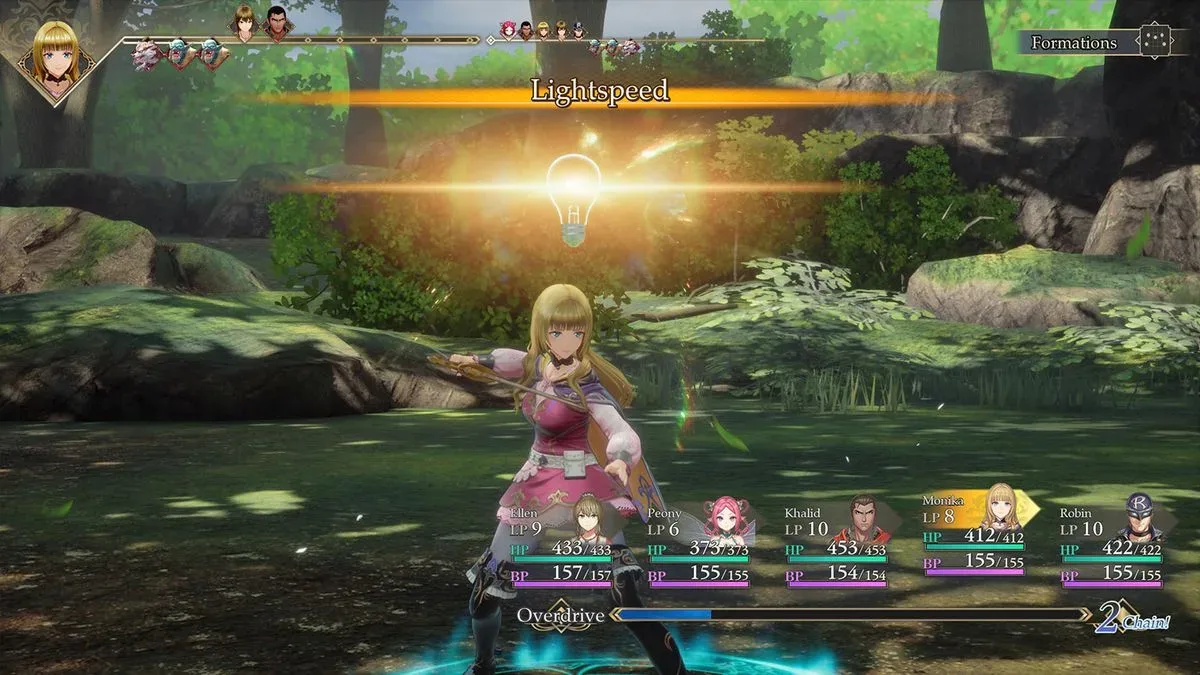
Glimmer is the key term to know. It is a system in which an existing action can potentially produce a stronger or otherwise different technique. A lightbulb indicator alongside an attack signals that possibility. In the preview, Peony—the spear-wielding fairy in the party—can transform a basic Spear Attack into Giant Swing. Once learned, Giant Swing joins the character’s available abilities.
In practical terms, that makes a command selection do double duty. Picking an attack can be a sensible tactical decision for the current turn, while also carrying the chance of expanding a character’s toolkit for later encounters. The player is balancing reliability against curiosity: exploit a known weakness with an established move, or keep trying an action that may yield a new option.
That is where the system’s appeal appears to lie. The randomness is not presented as a replacement for strategy. Enemy weaknesses still matter, and stronger moves will presumably have their own combat uses. Instead, the chance element gives experimentation a purpose. The player is not simply hoping for a large damage number; they are potentially building a broader repertoire.
The preview indicates that weapon choice is important to this process. Some spells and attacks can only be glimmered when a character has a particular weapon equipped. That restriction could make equipment management more meaningful than a pure attack-stat upgrade. Swapping weapons may affect not only a party member’s immediate performance but also the menu of abilities they can potentially discover.
There is an important limit: ability slots are finite. That means the system is not just about accumulating every technique without consequence. At some stage, players may need to decide which discoveries deserve to remain equipped and which should give way. The preview did not establish the exact rules for that management, so it would be premature to call it deep buildcraft. Still, limited slots should ensure that the pleasure of finding a technique is followed by an actual choice.
Related coverage includes Romancing SaGa 3: Destinies United Makes Every JRPG Battle Feel Like an Experiment.
A party of oddballs supports a flexible battle identity
The preview party is an appropriately unusual collection: leader Khalid, Peony, a masked superhero-like figure, and Flurry, a snowman with prominent eyebrows. That lineup gives the battle system a sense of character before the mechanics even begin to branch out.
More importantly, the party’s identities seem tied to the game’s experimentation. Newly learned moves described in the preview include multi-hit techniques, area-of-effect attacks and thunder kicks. An area-of-effect attack is one capable of hitting multiple targets rather than a single opponent, while a multi-hit move strikes more than once. Those categories can change how players approach groups of enemies or a single durable target. Their presence suggests that Glimmer may add tactical variety, not merely incremental power.
The battle flow otherwise uses a recognisable structure. Players can strike enemies in the overworld before being struck themselves, gaining an advantage as combat begins. The game then shifts to turn-based battles, where commands are selected and combatants act in an order influenced by their attributes and setup. This familiarity is useful: it gives the more eccentric parts of the system a stable foundation. A player does not need to learn an entirely alien combat language before they can appreciate an attack unexpectedly becoming something new.
Formations make positioning an accessible decision
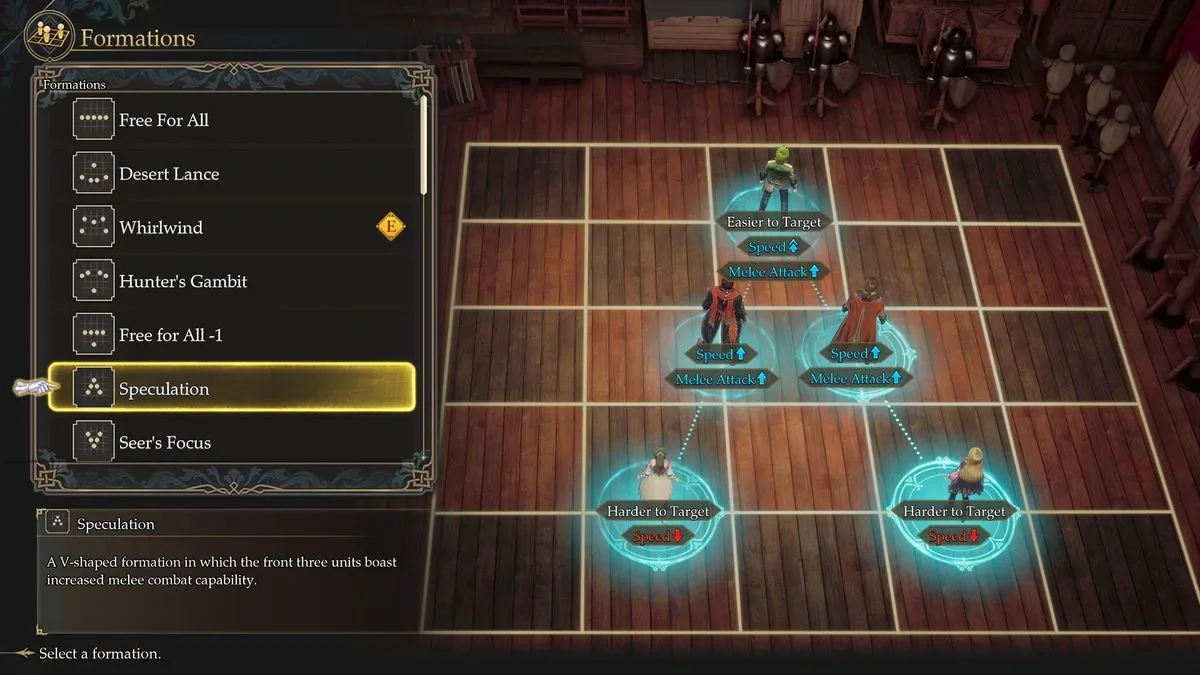
Party formations are another mechanical layer, though the preview frames them in a clear, readable way rather than as an opaque spreadsheet. These preset arrangements alter attributes for the group.
- Speculation places the team in a V shape and boosts melee capability for the three characters at the front.
- Whirlwind increases the speed of every party member, helping them act earlier in the turn order.
Formations can often be intimidating in turn-based RPGs because their benefits are hidden behind dense terminology or assumptions about positioning. The examples here are easy to parse. Want to lean into close-range offense? Put the appropriate fighters forward with Speculation. Want a faster team? Consider Whirlwind.
Of course, the full value of either option will depend on circumstances the preview did not settle: enemy behavior, character roles, defensive trade-offs and the range of other formations. But the apparent clarity is promising. The formation screen could give players a quick way to change a group’s priorities without requiring a wholesale rebuild of equipment and abilities.
That approach fits neatly with Glimmer. A player could choose a formation for immediate survival or speed, while still experimenting with attacks in hopes of shaping future options. The systems encourage adjustment at different scales—one turn at a time, one battle at a time, and across a broader run through a dungeon.
Gwayne provides the test for a growing toolkit
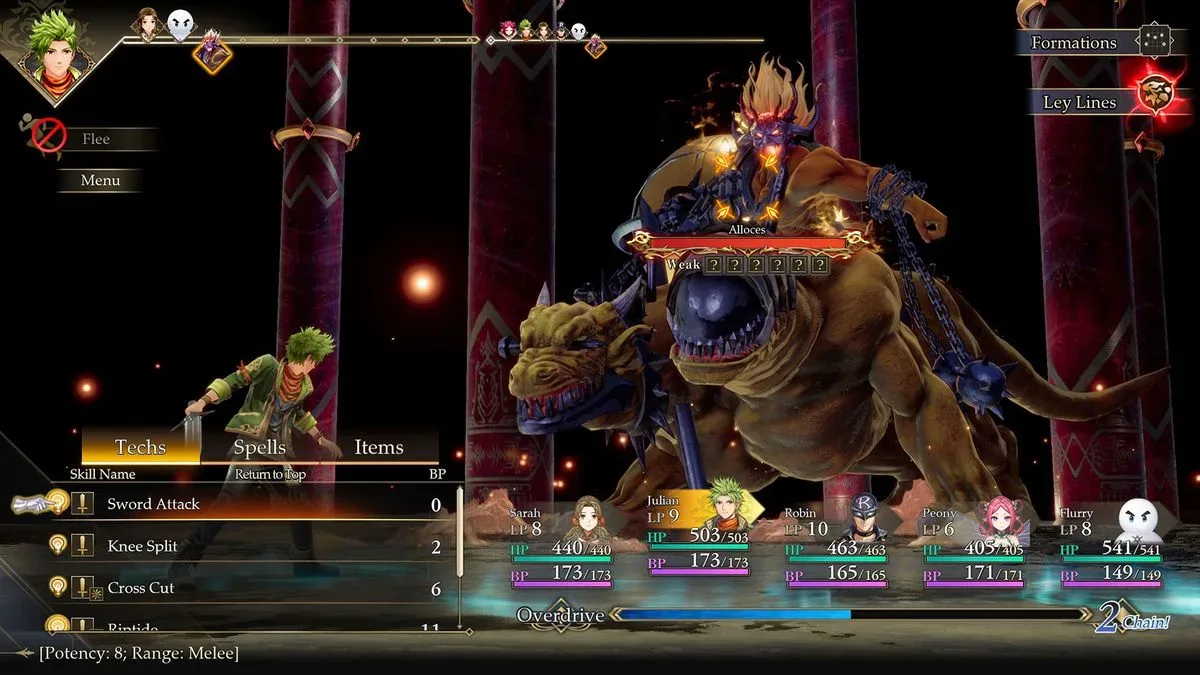
The preview segment culminates in a fight with Gwayne, a dragon boss. Bosses are where a game’s layered mechanics have to justify themselves, and this encounter appears structured as a check on what the party learned on the way there. The group searches for weaknesses while using the attacks gained and developed during the dungeon.
It also introduces Overdrive and United Attacks. Overdrive is a meter that fills during battle. Once it is full, the party can unleash a United Attack: a powerful move that chains multiple party members’ attacks for heavy damage. In other words, the game is not only asking which individual technique to use, but also when it is worth cashing in a shared resource for a coordinated offensive burst.
That creates a sensible escalation path for a boss fight. Basic attacks and weaknesses establish the rhythm. Glimmered abilities provide fresh tactical choices. Formation effects influence party performance. Then Overdrive gives the group a high-impact moment when the meter is ready. None of those systems needs to be revolutionary on its own; the potential is in their combination.
The brief hands-on segment ended before Gwayne was defeated, so there is no basis yet to judge the boss’s final phase, the encounter’s difficulty, or how the game handles failure and recovery. The more modest takeaway is that the preview deliberately used Gwayne to showcase how the systems stack: discoveries made in earlier fights can become relevant when a tougher enemy finally puts the party under pressure.
What remains to be seen before launch
The strongest caution is endurance. A mechanic that makes the first several discoveries exciting can lose force if useful Glimmers become too rare, too predictable or too easy to manage once an optimal set of techniques is found. Conversely, if advancement relies too heavily on luck, players could feel pushed to repeat encounters rather than adapt strategically. The preview establishes that chance is part of the appeal, but it cannot yet show how the balance will feel over a full game.
Likewise, the weapon-dependent nature of some Glimmers sounds fertile for experimentation, but the breadth of weapon options and the ease of switching were not demonstrated in detail. It remains unclear how frequently players will want to rotate gear, whether certain characters are restricted to narrow roles, and how much room exists to build unconventional parties.
Those uncertainties are reasons to watch rather than reasons to write the game off. The preview already communicates a coherent design goal: routine combat should be a source of discovery, and players should have several understandable ways to alter their approach. For fans looking beyond the expected turn-based loop, that could be a notably compelling hook.
Romancing SaGa 3: Destinies United is being developed by Xeen and published by Square Enix. It is scheduled for February 16, 2027, on PC, PlayStation 5, Xbox Series X, Nintendo Switch 2 and Nintendo Switch. Its unusual mixture of weapon-linked technique discovery, preset formations and cooperative finishing power makes it one of the more intriguing upcoming turn-based RPGs to keep on the radar. Players tracking the wider genre can also follow our ongoing industry coverage.