Our Share of Sand places its central question in the hands of a 12-year-old girl: when a child sees the machinery of adult power hurt someone, what can she possibly do with that knowledge? Shalini Adnani’s drama, set amid a contemporary Indian sand-mining crisis, approaches class, caste, inherited wealth and silence through a deliberately constrained perspective. The result is a dark social story in which the luxury surrounding one family is never separate from the labor and danger endured by another.
The 95-minute UK-India-Greece production was part of Critics’ Week at the Venice Film Festival, where it was reviewed online on August 31, 2026. Adnani directs from her own screenplay, with Maya Mehta leading the cast as Maya, a British Asian girl who has come to India to stay with her father, Rohan. Mohammad Zeeshan Ayyub plays Rohan, an industrialist whose business is tied to the extraction and construction economy. Ellora Torchia plays Maya’s mother, Priti, while Jyoti Dogra appears as Maya’s paternal aunt Arti. Krish Raj More plays Kiran, a boy near Maya’s age whose place in the family’s world turns out to be radically unlike hers.
A family legend with something missing
Before Maya’s contemporary story takes shape, the film opens on an earlier, almost mythic image: workers sifting through a sandy riverbank find an enormous diamond. Their faces are obscured, and the discovery immediately creates a moral problem. Do they notify the boss? The film does not supply a clean answer, nor does it rush to turn the moment into a puzzle for viewers to solve. Instead, that uncertainty hangs over everything that follows.
Years later, Arti shows Maya the diamond and recounts the family story attached to it. In the version Maya receives, her grandfather found the stone and used a portion of its value to lift the family up in the difficult period after partition. It is the kind of origin tale prosperous families often preserve: a narrative of perseverance, risk and earned success. Yet the opening has already made the story unstable. Was the grandfather a worker who found the gem? Or did he take credit for a discovery made by workers under his authority?
That unresolved gap is not a minor plot wrinkle. It is the film’s governing pressure point. A fortune can be surrounded by a reassuring account of how it was made, while the people whose work enabled it disappear from the record. Our Share of Sand uses the diamond as an emblem of wealth that has been polished into mythology, its rougher history concealed beneath the shine.
Maya’s arrival is not a homecoming
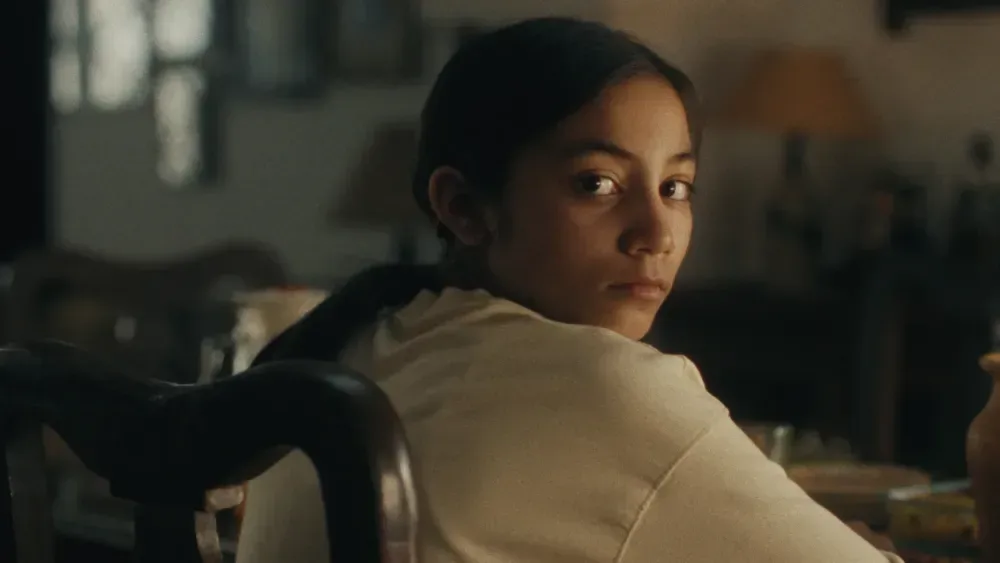
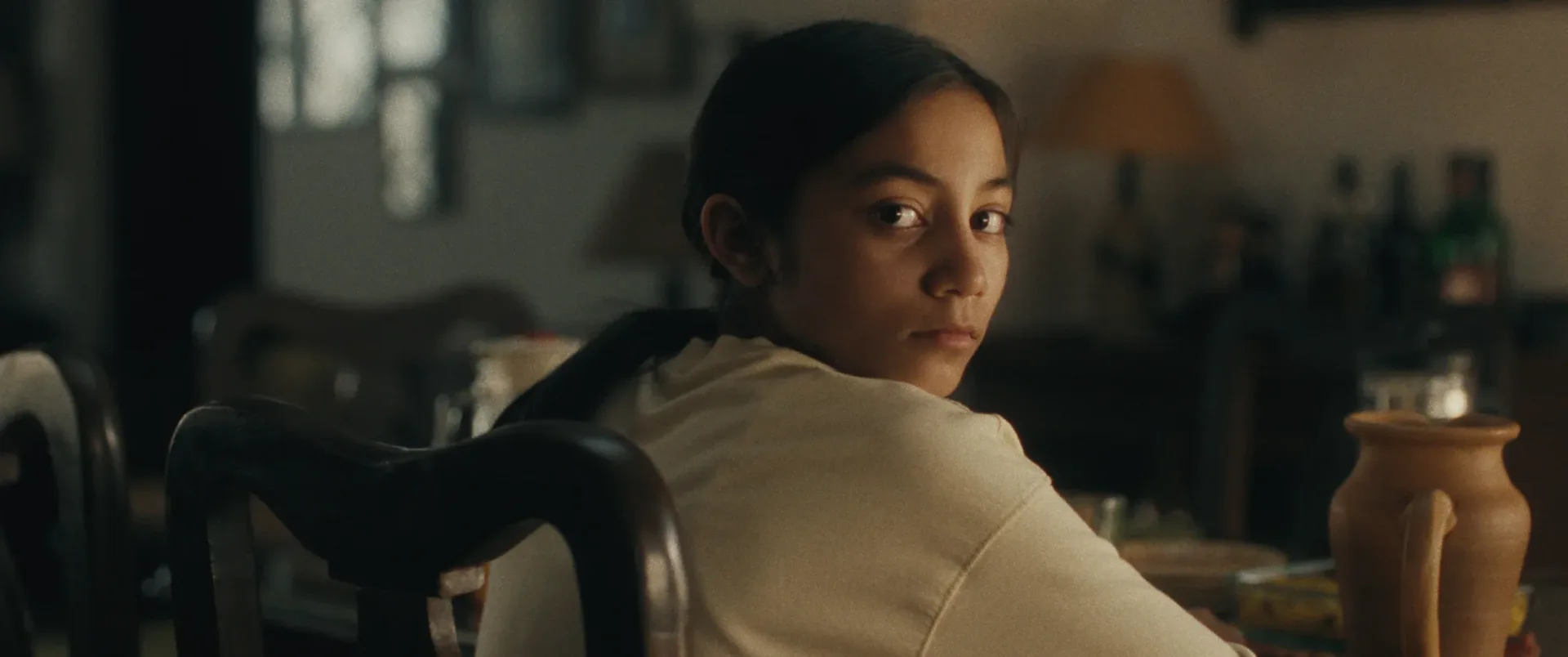
Maya’s position makes her an especially useful lens for this world. She is connected to the family by blood but is still an outsider in practical terms, arriving from Britain and speaking little Hindi or Marathi. Her partial unfamiliarity is not treated as a magical source of clarity. She does not instantly understand the family’s economic arrangements or the social hierarchies around her. What she possesses is the unsettled attention of someone young enough to notice behavior adults have learned to normalize.
Her friendship with Kiran grows from that uneasy distance. They are approximately the same age, but language and status separate them. Maya does not have much command of Kiran’s languages; Kiran does not speak English. They can nevertheless communicate to a limited extent, a fragile connection that makes the larger divide more painful. Rohan’s response provides a sharp correction to Maya’s assumptions: Kiran is not another child free to spend time as he likes. He is working for Rohan.
Kiran is one of the divers essential to Rohan’s operations and, by extension, to the cement supply chain supporting India’s rapid development. The fact that a child’s presence in this work structure can initially be overlooked is part of the film’s indictment. Maya’s family can imagine itself as caring and respectable while treating another child’s labor as ordinary. The story does not need a speech to establish the imbalance. A scolding order to return to work tells Maya, and the audience, who is permitted leisure and who is expected to be useful.
Related coverage includes Our Share of Sand Uses a Child’s Gaze to Expose Power and Silence.
An accident that cannot be compartmentalized
The plot’s decisive event comes when Rohan’s willingness to bypass regulations contributes to a nighttime accident that permanently injures Kiran. Maya witnesses what happens. Priti, who is British Indian, shares the burden of knowing enough to question whether the police should be told the full truth. The question is not merely whether the family will face legal consequences. It is whether Maya and Priti will accept the moral compartmentalization that protects Rohan’s standing and the family’s accumulated comfort.
Adnani’s approach is notably narrow in scope. The drama stays near Maya’s confined experience rather than setting out to map every dimension of Indian political life. Caste is not repeatedly identified in dialogue as a formal concept, but it shapes the world with the force of an unspoken rule. The workers’ position, their hesitation, their anger and the limits on what they can safely say all point toward entrenched social divisions. The film’s concern is not that discrimination exists as an abstract topic; it is that it structures whose injury is treated as tragic, inconvenient or simply expected.
That focus also leaves several figures defined primarily by their role in the conflict. There is limited information about Maya’s life before this visit, Kiran’s life away from work, or the fuller inner lives of the adults around them. The restriction can make the characters feel less expansive than the social reality the film evokes. But it is connected to the story’s chosen vantage point. Maya knows fragments, glimpses and contradictions. She is beginning to see a system that has been carefully hidden in plain sight.
Dark images, close spaces and watchful cameras
Adric Watson’s cinematography gives that unease a physical form. Tight, grimy compositions box Maya and Arti into frames that diminish the sense of safety their relative privilege might ordinarily provide. The spaces are not necessarily small, but the images make them feel pressurized. A family compound can look protective while functioning as a barrier between its residents and the people who support their lifestyle.
Night photography and security-camera perspectives add another layer. Surveillance appears in unexpected places around the compound, connecting domestic comfort with observation and control. The visual idea suggests that maintaining social supremacy is not passive. It requires boundaries, watchfulness and systems that make certain people visible primarily as risks, workers or intruders. The film does not develop this into a broad examination of every contemporary political condition in India, but the implication is clear enough: hierarchy can be enforced through what is monitored, what is recorded and what is ignored.
Natural settings are equally uneasy. Rivers, forests and sand ought to suggest life, renewal or open space. Here, they are part of an extractive economy and therefore carry menace. Sand is material for growth, cement and wealth, but its removal and processing expose laborers to danger. The film turns the landscape into a grimly naturalistic fairy tale, where a diamond is not a wish-granting treasure but a clue to buried exploitation.
Maya Mehta anchors the uncertainty
Mehta’s debut performance is central to the film’s tension. Maya is not presented as a miniature adult who can diagnose every injustice around her. Her reactions carry confusion, alarm and a gradually intensifying awareness of her own family’s implication. That restraint matters. The drama is less interested in celebrating a young hero than in showing how difficult it is to speak when the people demanding silence are also the people who provide home, identity and security.
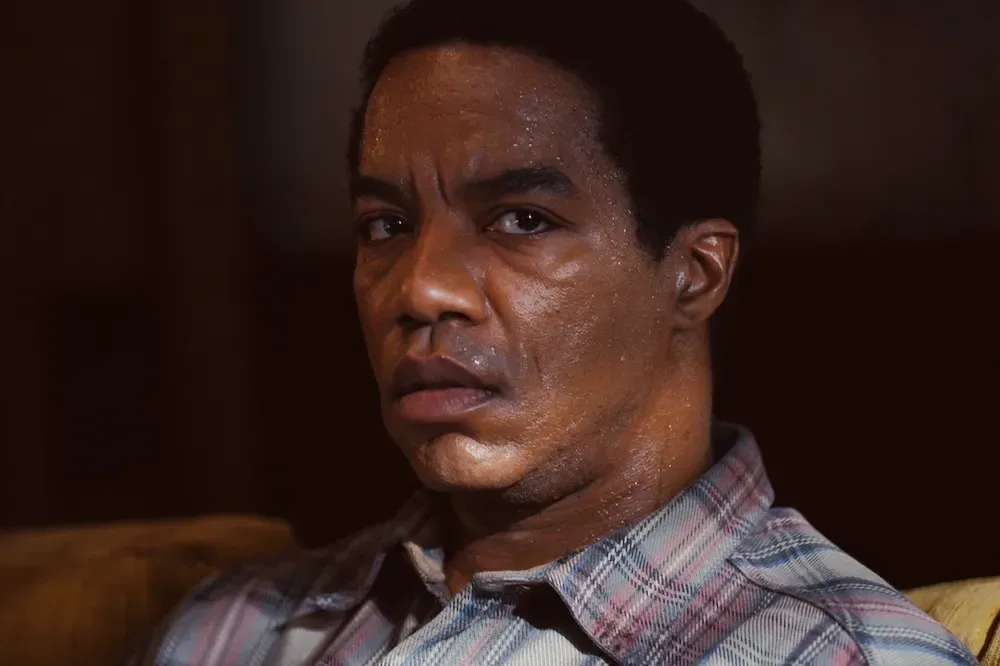
Ayyub’s Rohan embodies authority that does not require constant theatrical cruelty to be intimidating. The character’s power is institutional as well as personal: he directs work, shapes the family’s expectations and has reasons to contain the consequences of the accident. Torchia’s Priti introduces a quieter form of conflict, caught between maternal responsibility, moral apprehension and the pressure to preserve the family’s stability. Dogra’s Arti, meanwhile, carries the weight of the family story, including the inherited belief that prosperity is proof of virtue.
For readers interested in stories about how systems convert human suffering into something easily managed or hidden, this look at media horror and institutional pressure explores a very different genre built around a related discomfort: the machinery behind public narratives can be as frightening as the individual choices within them.
A social drama built from silence
Our Share of Sand does not offer simple reassurance that seeing injustice is the same as changing it. Maya’s recognition is only the beginning of a harder dilemma. If she talks, she risks betraying her father and disrupting a family identity built around success. If she remains silent, she helps preserve the conditions that injured Kiran. The story’s brooding power comes from refusing to make either path feel easy.
With dialogue in Hindi, English and Marathi, Adnani’s film frames language itself as part of Maya’s partial access to the world around her. She can witness pain before she can fully articulate the structures producing it. By tying a child’s dawning awareness to the family’s uncertain diamond legend and the concrete consequences of industrial negligence, the film makes inherited advantage feel less like a distant history than an ongoing decision about whom to believe, protect and sacrifice.
Key credits
- Director and screenwriter: Shalini Adnani
- Cinematography: Adric Watson
- Editor: Anna Meller
- Music: Ted Regklis
- Cast: Maya Mehta, Mohammad Zeeshan Ayyub, Ellora Torchia, Krish Raj More, Ravi Ranjan and Jyoti Dogra
- Running time: 95 minutes