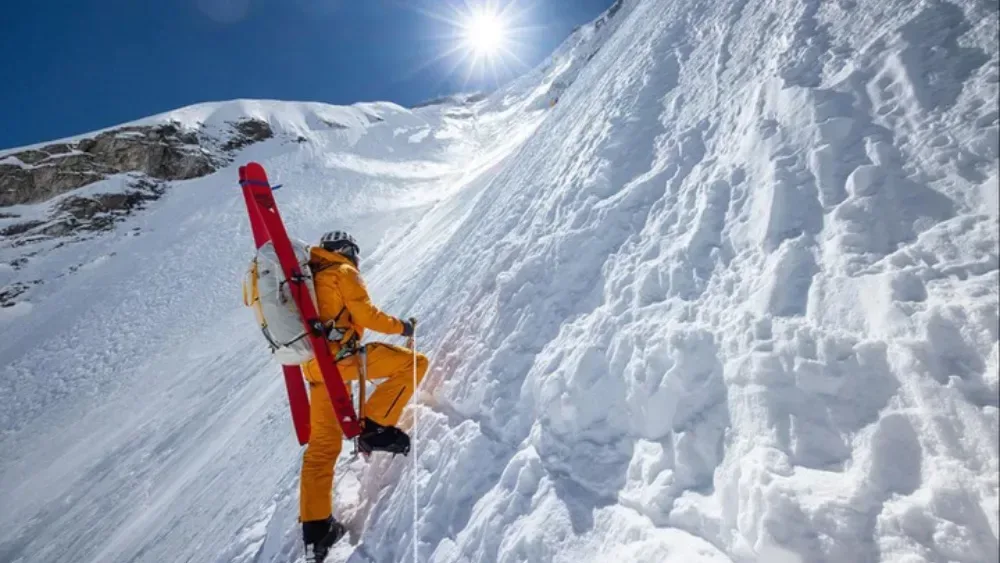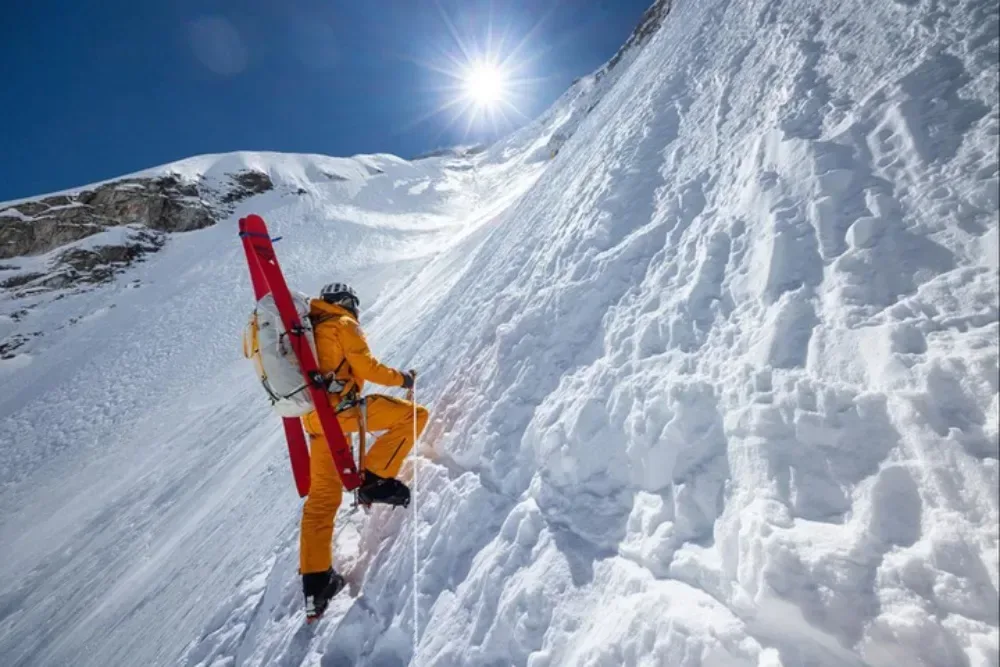
Everest: The Other Side arrives with the visual vocabulary of an all-timer expedition movie: enormous white faces of snow, tiny bright tents planted against a merciless landscape, and a goal so improbable it sounds like a challenge created to make a video-game achievement list blush. Jim Morrison wants to climb Everest and ski down its north face, pursuing a descent the film presents as unprecedented. On a purely photographic level, the documentary has the scale, access and impossible geography to make that objective compelling.
Yet the movie is shadowed by something its rousing surface cannot fully contain. Morrison had originally pursued the Everest ski-mountaineering dream with his partner, Hilaree Nelson. On September 26, 2022, while skiing in Nepal with Morrison, Nelson was caught in a small avalanche and fell nearly 6,000 feet to her death. The documentary therefore becomes an account of survival, mourning, ambition and a decision to continue after catastrophe. Its most difficult question is also the one it seems least prepared to confront for long: when an extreme pursuit has already exacted such a cost, what does completing it mean?
For viewers drawn to the intersection of documentary filmmaking and high-stakes adventure, the film’s tensions may feel familiar. Spectacle can communicate why a mountain matters to the people who risk everything on it. But a camera’s ability to make danger look magnificent can also turn doubt into background scenery. That conflict makes Everest: The Other Side a far more unsettled watch than a straightforward portrait of athletic achievement.
A dream transformed by loss
Nelson is not treated merely as a footnote in the expedition’s history. Early material establishes her as a formidable ski-mountaineer and an active force in the undertaking. The film includes her reflections on being a parent while also feeling called toward severe, potentially lethal mountains. Her sons, Grayden and Quinn, were 11 and 13 at the start of filming, and her thoughts about the competing demands of family and vocation give the material a moral clarity that the later expedition footage cannot easily match.
Those reflections are painful precisely because they do not resolve the problem. Nelson understood the danger; understanding it does not diminish the devastation for the people who loved her. The documentary reveals her death roughly a half-hour in, after initially presenting her as a present-tense central figure. That choice may land as a dramatic surprise for audiences who do not already know the story, but it also risks making a real death operate like a structural pivot. The emotional force is undeniable. The framing, however, can feel uncomfortably calculated.
Afterward, Morrison’s decision to persist is presented as both a private effort to process grief and a tribute to Nelson and other people he has lost. That emotional logic is comprehensible. Grief rarely produces neat, universally persuasive choices. Morrison’s history of bereavement deepens the sense that the mountain is tied to an attempt at meaning rather than a simple appetite for glory. Still, understanding the impulse is different from accepting the movie’s inclination to treat the result as a clean catharsis.
Images of Everest, and the limits of awe
The filmmakers, Elizabeth Chai Vasarhelyi and Jimmy Chin, know how to capture landscapes that seem to exceed ordinary human scale. Everest is filmed with enormous visual authority: high, hard expanses of snow; steep slopes that look less like terrain than a wall angled toward the sky; and climbers reduced to flecks of color in a world that does not negotiate. Jimmy Chin, Clair Popkin and Christopher Murphy are credited for camera work, while Caroline Ho’s score supplies orchestral momentum to the climb and descent.
There is no disputing the sheer potency of these images. At moments, the film can make a viewer appreciate why experienced athletes continue to seek places that appear terrifying from the safety of a seat. Morrison’s ascent and ski descent carry the tangible drama of a brutally difficult endeavor coming together under punishing conditions. The documentary has access to the kind of footage that makes a mountain seem at once sacred, alien and terrifyingly indifferent.
Related coverage includes Everest: The Other Side Turns a Ski-Mountaineering Dream Into a Difficult Reckoning.
But each soaring shot has to coexist with what the story has already established. Nelson died pursuing the same broad dream. Nepalese guide Pur Bahadur “Yukta” Gurung sustains a near-fatal injury during the venture. The film’s closing credits also pay tribute to Gurung after his death in another avalanche, one month before the documentary’s Venice premiere. No stirring musical cue can erase that context. Instead, the beauty becomes complicated: an invitation to marvel that is continually interrupted by knowledge of who paid for the possibility of that marvel.
The result is not that the expedition footage becomes worthless. It is that it asks the audience to perform a difficult split-screen reaction: admire the scale of the feat, while resisting the suggestion that the feat settles the moral argument.
The documentary’s missing reckoning
Vasarhelyi and Chin previously directed Free Solo, their 2018 film about climber Alex Honnold. That project’s sense of vertiginous achievement was inseparable from an openly terrifying premise, but Everest: The Other Side has a different burden. The danger here is not abstract or hypothetical. It has already become bereavement within the story itself. A film that continues to march toward a summit after that point needs to seriously consider its own appetite for uplift.
There are gestures toward such consideration. Vasarhelyi voices reservations at points, and the filmmakers’ relationship to Morrison and Nelson makes their proximity to the story unusually personal. Yet the larger approach repeatedly returns to forward drive: the mission continues, the mountain waits, the descent becomes the culminating prize. The movie seems more confident in documenting determination than in interrogating it.
That imbalance is especially noticeable in its treatment of the Sherpa team. The expedition depends on Nepalese expertise and labor, but the guides are not granted the same sustained interior space as Morrison or the directors. Gurung’s injury and later death make that absence even more troubling. When a documentary is contemplating risk, it matters whose risk is explored as a philosophical calling and whose is absorbed into the machinery of an expedition.
It also matters that the film does not stop at the moment when mourning makes continuation questionable. Instead, it frames perseverance as a route to spiritual and physical accomplishment. Some viewers may find genuine solace in that idea, particularly in Morrison’s effort to honor Nelson. Others may see a story too eager to convert profound loss into a final, exhilarating payoff.
What the film leaves hanging
Everest: The Other Side runs 116 minutes, and its strongest passages are often those that let unresolved feelings remain unresolved: Nelson talking about motherhood and risk, her children’s grief, the awareness that the mountain’s splendor is inseparable from its capacity to take people away. These elements carry more weight than any claim of a world-first descent.
That does not mean an extreme-sports documentary must condemn everyone who climbs, skis or films in dangerous places. A worthwhile movie could hold admiration and criticism together, recognizing technical accomplishment while asking why achievement is repeatedly given the last word. Here, the balance tilts toward a grand, determined finish even as the human evidence points toward ambiguity.
The film premiered out of competition at the Venice Film Festival on September 2, 2026. Its credited producers include Vasarhelyi, Chin, Shannon Dill, Anna Barnes, Bob Eisenhardt and Janet Yang; Bob Eisenhardt and Simona Ferrari edit. Those credits reflect the careful construction behind a documentary that is never short on polish or access. But polish is not perspective, and access does not automatically produce scrutiny.
In that sense, the movie plays like an expedition whose route has been expertly mapped while its destination remains underexamined. It can make Everest look overwhelming and make Morrison’s descent look astonishing. It cannot fully answer why audiences should receive that culmination as a victory when Nelson’s absence, Gurung’s fate and the costs carried by others remain so central. For another film wrestling with trauma without pretending it can be tidily conquered, see Mr Nelson, Did You Kill People? Puts Vietnam Trauma in a Punishing Loop.
Everest: The Other Side is an imposing piece of mountain filmmaking and an uneasy memorial. Its views are extraordinary. Its questions are more urgent still, even when the film seems determined to ski past them.