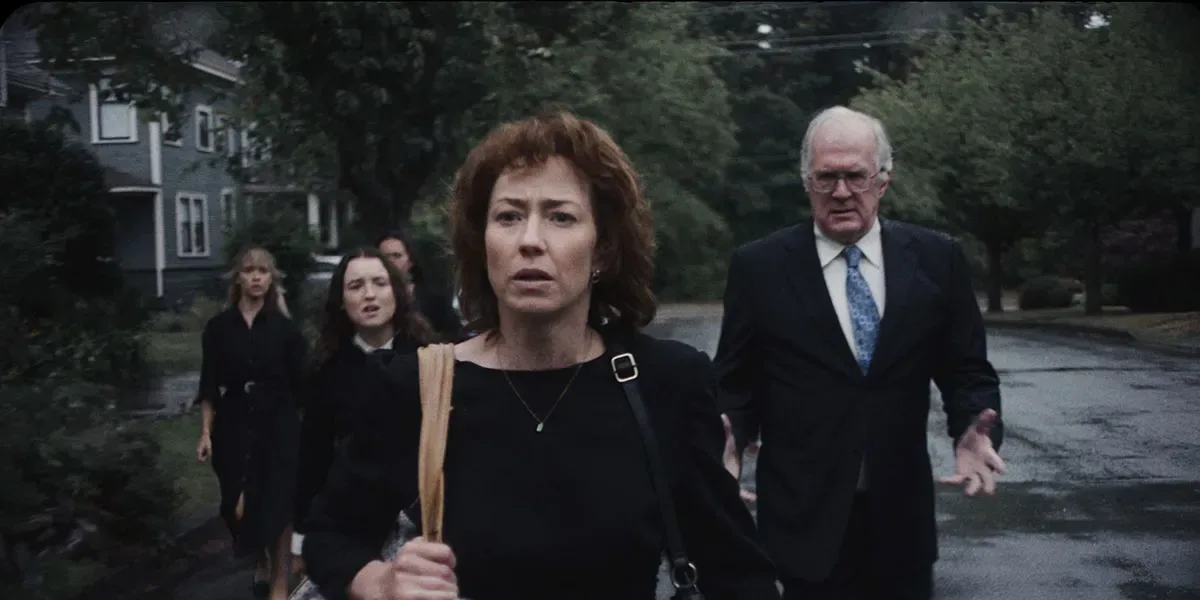
Shinya Tsukamoto’s Mr Nelson, Did You Kill People? arrives with material that should demand care, rigor and a willingness to sit with contradictions. Based on Allen Nelson’s nonfiction account, the 116-minute English-language drama follows a U.S. Marine home from Vietnam carrying profound psychological injuries, then tracks the long aftermath through fractured memories, family life and therapy. It screened in Competition at the Venice Film Festival on September 3, 2026.
The premise is immediately grave. Allen has witnessed and participated in atrocities during the Vietnam War, and the central question is neither decorative nor merely provocative: can a person speak plainly about what they did after war has broken their ability to live plainly? Tsukamoto, who serves as director, screenwriter, cinematographer and editor, frames that question with a deliberately oppressive visual and emotional approach. Yet the film’s reported shape suggests a difficult imbalance: its commitment to anti-war condemnation is often clearest in scenes of graphic violence, while the quieter work of understanding Allen, his community and the enduring mechanics of trauma receives far less definition.
A veteran divided across time
Allen Nelson is played at two ages, with Mark Merphy portraying the younger Marine and Rodney Hicks taking over as the older man. After returning from the front in an acute state of shellshock, Allen removes himself from his family rather than expose them to his fear, anger and paranoia. He stays in a derelict New York building, surrounded by decay, a cat and rats. The setting makes his isolation physical: a man who has come home but does not feel capable of occupying a home.
An encounter with a former classmate, now a teacher, creates one of the film’s key narrative threads. She asks Allen to address her pupils about his experiences. He resists. Later, nearby firecrackers trigger an episode in which he dives under a car, and ordinary pavement becomes the visual surface on which battlefield noise and chaos return. This is described as one of the film’s more effective moments: an abstract, spatially confined rendering of dissociation rather than a straightforward recreation of combat.
Allen eventually goes to the class, visibly overwhelmed, but cannot answer when a child asks the question that supplies both the memoir’s title and the film’s: did he kill people? The scene establishes a brutal gap between public ritual and private damage. A schoolroom wants testimony that can be received, learned from and filed away. Allen’s memories cannot yet be shaped into that kind of lesson.
Years later, he is married to Linda, played by Tatyana Ali, and helps raise her son. Sleep remains elusive without medication, as nightmares and violent memories continue to intrude. After an outburst, Allen begins sessions with Dr. Daniels, played by Geoffrey Rush. The therapy scenes are designed to unlock the story in pieces, bringing the past forward through flashback. On paper, that structure could provide a route into guilt, survival, self-conception and the difficult difference between confession and recovery. The film instead appears to use the present-day sessions chiefly as a delivery system for returns to wartime brutality.
When depiction overwhelms examination
There is no question that a Vietnam War film may need to show horror. Sanitizing the actions of soldiers or reducing Vietnamese suffering to an abstract talking point would be evasive. The problem posed here is not that Mr Nelson, Did You Kill People? depicts violence, but that it reportedly finds its strongest cinematic energy there. Violent deaths, decomposing bodies and imagery of infestation are assembled into recurring montages. These images can arrive whenever the contemporary story slows, creating an effect closer to a punishing refrain than a steadily deepening exploration.
That choice creates an uneasy tension. The film’s moral purpose is anti-war, but its pacing and emphasis risk making shock the primary dramatic resource. Meanwhile, the therapy rooms and domestic spaces are rendered in dark, brown-toned interiors that can feel inert. Instead of forcing the audience to confront the systems that produce war and the social aftermath that veterans must navigate, the film repeatedly returns to the most immediately visceral evidence that war is monstrous. It knows the answer is terrible; it seems less certain how to investigate the question.
Related coverage includes ‘Mr Nelson, Did You Kill People?’ Review: Vietnam Trauma Drama Struggles to Find Depth.
The limited treatment of Allen as a Black American is particularly consequential. His perspective could open a distinct examination of military service, citizenship, racial hierarchy, homecoming and the specific pressures placed on Black veterans. The film reportedly acknowledges that position only broadly, leaning on familiar character shapes rather than pursuing the subject with sustained specificity. That absence narrows a story whose central figure should have been allowed more interior complexity than anguish alone.
Linda is another casualty of this thinness. Ali is given the role of a steadfast, supportive partner, but not much material that defines her own desires, exhaustion, judgments or boundaries. A drama about PTSD within a family gains force when it recognizes that the survivor’s trauma affects people who cannot simply be reduced to instruments of care. Without that fuller perspective, Allen’s household risks becoming another backdrop for his pain.
Performers caught in a restrictive pattern
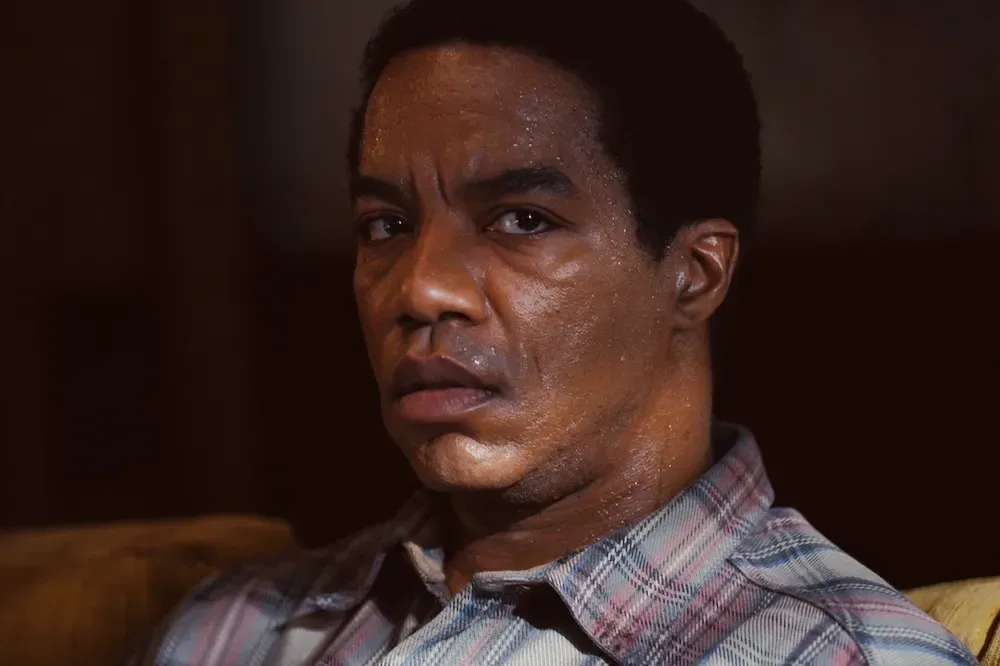
Hicks brings considerable stage experience to the role of older Allen, but the screenplay reportedly offers him a narrow emotional lane. Allen is pushed repeatedly toward sweaty distress, panic and eventual relief, with little tonal room between them. That is not a complaint that trauma should look neat or pleasant. Rather, a character can be deeply traumatized and still reveal humor, contradiction, calculation, avoidance, tenderness, resentment or silence with distinct meaning. The more a script confines a performer to a single register of suffering, the less the audience can understand the person doing the suffering.
Rush supplies authority as Dr. Daniels, though the therapist’s dramatic function appears frustratingly repetitive. Variations on the same question about why Allen killed people are pressed until the necessary breakthrough occurs. Therapy in cinema is often vulnerable to this shortcut: a professional repeats a key prompt, the protagonist finally speaks, and revelation is treated as resolution. The setup is especially limiting in a film that spends so much of its running time on the process. A richer version might examine resistance, memory’s unreliability, shame, the limits of clinical language or the fact that explaining an act is not the same as escaping its consequences.
Lily Franky, despite being prominently billed, reportedly enters very late for a single monologue delivered toward a closed bathroom door. That image may fit the film’s preoccupation with blocked communication, but it also points to a wider issue of construction. Supporting figures arrive, serve an immediate symbolic or emotional task, and recede before they can make the world around Allen feel inhabited.
An ending that will not release its grip
The film’s structure extends well beyond what may appear to be several logical stopping points. Allen’s life continues through changing family circumstances and visible aging, including scenes in which he has a beard, later gray hair, and eventually appears on a boat. Continuation is not inherently a flaw; a story about lifelong trauma should resist the false promise that one therapeutic admission fixes everything. But continuation needs to add a new dimension. If each apparent conclusion merely leads to another epilogue without altering the film’s emotional or intellectual stakes, duration becomes a burden rather than an argument.
That is the central frustration surrounding Mr Nelson, Did You Kill People?: it has the outline of a reckoning but seems to revisit the same emotional checkpoint again and again. A story based on a real veteran’s cautionary testimony has no shortage of urgency. The Vietnam War’s devastating human cost, the violence committed by U.S. forces, and the long-term damage done to those sent to fight all remain subjects that demand serious art. But seriousness is not automatically created by darkness, suffering or repetition.
Tsukamoto’s background makes the film’s abrasion understandable. His cinema is often associated with intense physicality and striking images, and a dissociative moment beneath a car indicates the kind of sensory disruption he can bring to Allen’s state of mind. Here, though, the harshest images reportedly carry more vitality than the character work intended to contextualize them. The result is an anti-war drama that can feel trapped between graphic flashback and static explanation.
For readers following Venice’s screen stories beyond the usual awards-season chatter, Joking Joystick’s look at how The Liberation turns a cult thriller into a study of need offers a useful contrast in films seeking emotional weight through genre material. Mr Nelson, Did You Kill People? clearly reaches for comparable moral gravity, and its subject is undeniably immense. Its difficulty is that the filmmaking, as described, too often mistakes relentless exposure to horror for a deeper encounter with what horror does after the shooting stops.
Film details
- Title: Mr Nelson, Did You Kill People?
- Original title: Nelson san, anata wa hito wo koroshimashitaka?
- Director, screenplay, cinematography and editing: Shinya Tsukamoto
- Based on: Allen Nelson’s nonfiction account Mr. Nelson, Did You Kill People?
- Cast: Rodney Hicks, Geoffrey Rush, Mark Merphy, Lily Franky and Tatyana Ali
- Music: ermhoi
- Running time: 116 minutes
- Production countries: Japan, the United States, Thailand and Vietnam