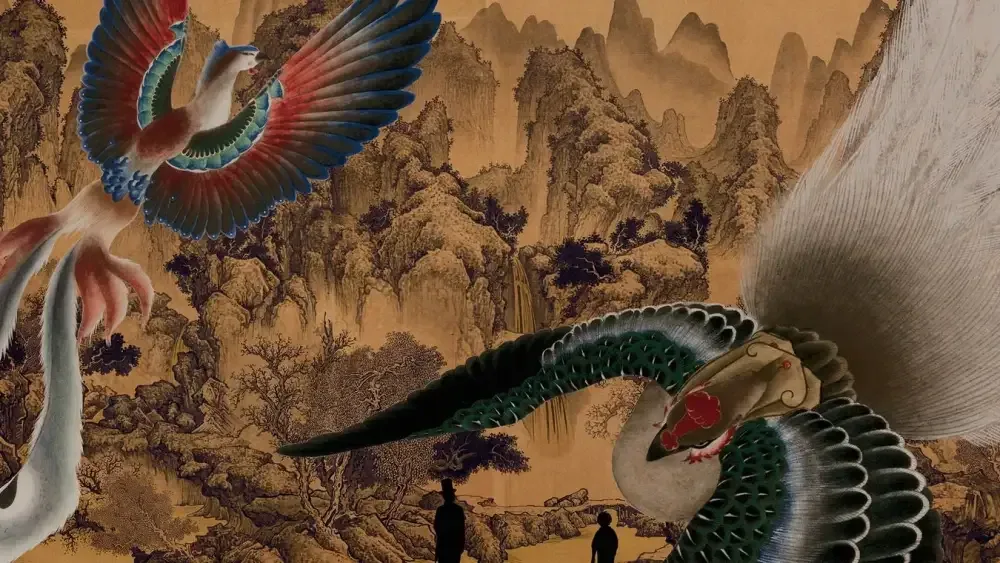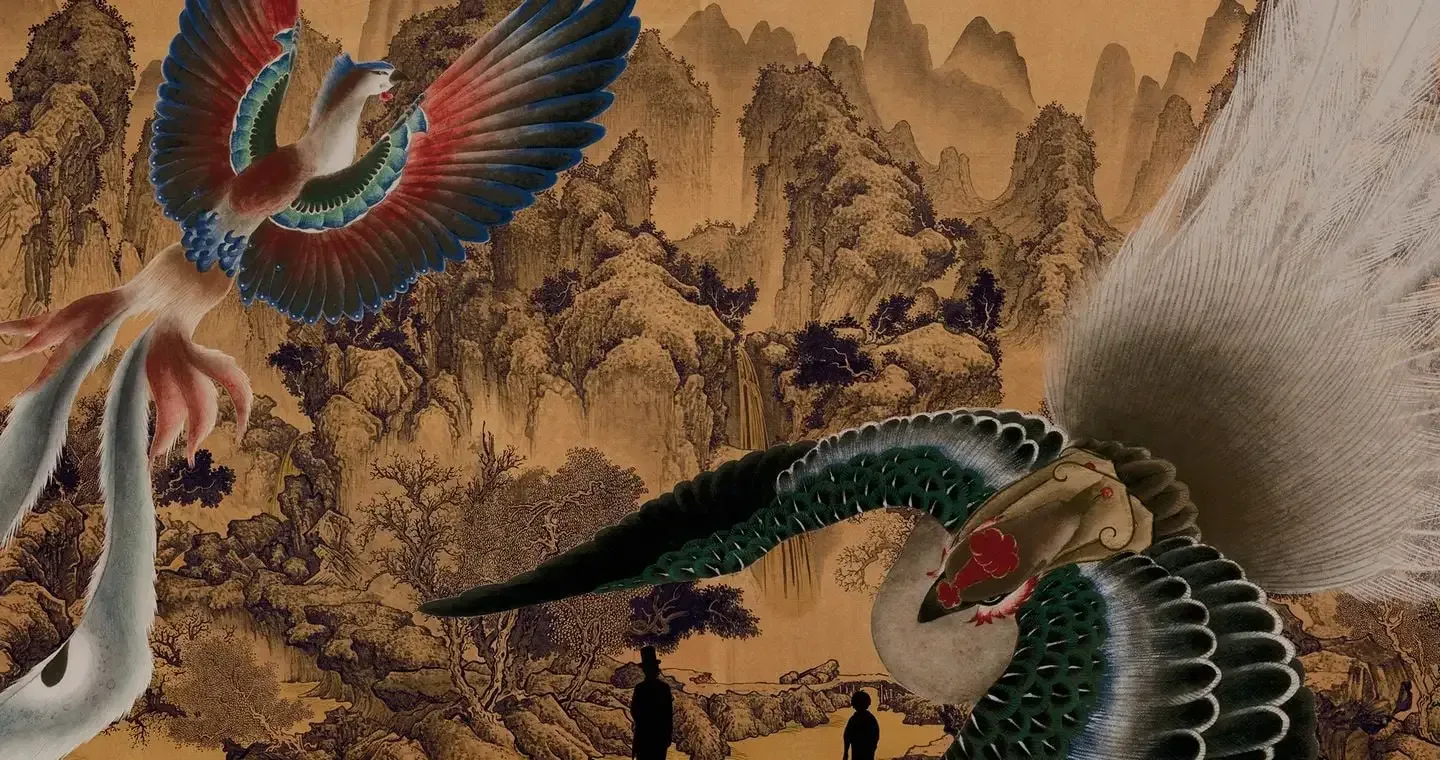
Magic Atlas is an animated feature whose most coherent language is its visual one. Directed by Sun Xun and produced in Singapore by Pi Animation Studio, the 85-minute film moves through paint, pen-and-ink drawings, canvas, newspaper and woodcut-like imagery without settling into a single house style. That restlessness is not a decorative side note. It is the film’s central force: a handmade, shifting surface pushing back against the industrial authoritarian world it depicts.
There is a story, but it deliberately does not behave like a conventional narrative engine. An orphaned boy, Xiao Zhi, lives within Luocha, a coal empire controlled by fascist industrialists. An imprisoned magician introduces him to secrets the regime would prefer remain hidden, including memories taken from ordinary people. Xiao Zhi’s position makes immediate sense: a child trying to understand a state that has taught him how to see the world, then criminalizes him when he questions that lesson. Yet the film regularly lets him fall out of view. Rather than steadily advancing his arc, it prioritizes atmosphere, images and associative leaps.
That choice will likely determine an audience’s response. Magic Atlas has the density and visual invention to reward attention, but it is also fragmented, opaque and unconcerned with guiding every viewer toward one clean interpretation. Its technical achievements are tangible enough to keep it from becoming remote. The result is an ambitious work that can be spellbinding moment to moment, even when its emotional thread is harder to hold.
A world built from materials, not one visual rule
The film was made over a decade, and its breadth of materials is visible in the way scenes refuse uniformity. At times, dense black ink and fine white outlines dominate the frame. Elsewhere, the imagery takes on the worn character of old pages, pencil and pen marks, broader painted fields or bursts of color that sharply oppose the enclosing black. Landscapes can be rendered with loose, impressionistic brushwork while figures carry more caricatured expression and elaborate line detail.
That is worth separating from a simple “mixed-media” label. Mixed media means a work uses more than one material or method. Here, the changing methods also alter the feeling of the world. The heavy ink shadows and white-on-black forms give Luocha a constricted, surveilled quality; an eruption of color or a softer landscape can briefly make the film feel as though it has escaped that system’s grip. The next transition may undo the escape entirely.
Magic Atlas therefore does not treat animation as a transparent delivery system for plot. The viewer is meant to notice the grain, marks and instability of the image. A factory’s presence is particularly forceful because it intrudes upon more gently painted mountain terrain. The contrast turns setting into an argument: mechanized power is not merely located in nature, but aggressively imposed upon it.
That tactile emphasis also lands at a moment when discussion of animation often turns toward automation and AI-generated imagery. Magic Atlas is not presented here as a technical manifesto on that subject, but its physical-looking methods offer a clear alternative aesthetic. Its images retain evidence of their materials, even as they become surreal or kaleidoscopic. For a related look at how AI’s wider economic effects intersect with games and technology, see AI, Gaming Hardware Prices and Developer Jobs: Following the Evidence.
The plot: memory as a crime
Luocha is a dystopia in the blunt, purposeful sense. Its rulers are generals and industrial despots; its politics are defined by repression, surveillance and control over what citizens are permitted to remember. The magician’s imprisonment is tied to returning some measure of freedom through memories stolen by the government. The premise makes memory more than personal recollection. It becomes a political resource, with the state seeking to monopolize the past so it can dictate the present.
One of the film’s most explicit moments has officials accuse a child of “criminally outmoded thinking” and of possessing “false memories.” The accusation carries an obvious contradiction: memories are called false because they do not match the approved version. Magic Atlas does not bury the regime’s Orwellian character under ambiguity. It pairs folkloric and dreamlike figures with the recognizable machinery of authoritarian rule: backroom politicians, factory systems and punishment for unauthorized thought.
Its surveillance image is equally grotesque. The system is represented by giant mosquitoes, a concept that fuses science-fiction monitoring with something bodily invasive and irritating. The idea is not subtle, but it does not need to be. In a film where visual transformations carry so much of the weight, the mosquito apparatus makes state observation feel like an infestation rather than a neutral technology.
The title’s “atlas” suggests mapping, but Magic Atlas is less interested in providing a stable map of Luocha than in repeatedly redrawing it. The country becomes an unstable collage of industry, mountains, animals, political spaces and religious or mythic references. This can make the story feel secondary, because the film is repeatedly asking the audience to process a new visual logic instead of simply follow the boy’s journey.
From sutra to whale to camera-headed horse
The opening establishes the film’s willingness to operate on several symbolic levels at once. It begins with the Avatamsaka Sutra, a Buddhist scripture associated here with the idea that past, present and future lie within the present. Waves consume the screen as painted creatures struggle. A narrator, voiced by Sun Xun, describes himself as being everywhere and having neither beginning nor end. These are not conventional scene-setting beats; they place time, identity and the universe in play before the political fable fully arrives.
Then come images that follow dream rather than realism: hybrid animals, including a horse with a camera in place of a head, travel through black fields traced in white. Blue water and a black whale give way to kaleidoscopic paintings. The film moves through what appear to be visual nods to Pieter Bruegel, bringing an additional historical-painting register into an already crowded field of symbols, deities, animals and industrial structures.
Such imagery can be compelling without yielding one fixed key. A camera-headed horse may suggest observation, recording, mediation or merely the absurdity of a world in which categories no longer stay separate. The film’s approach does not require viewers to decide. Its more important effect is accumulated disorientation: Luocha is a place where nature, technology, mythology and propaganda bleed into one another.
The score reinforces that lack of stable ground. Abstract electronic tones sit beside a visual world rooted in ink, paper and paint. Instead of smoothing the transitions, the sound creates dissonance. Dissonance, in this context, means elements that clash rather than comfortably resolve. The electronic score and handmade-looking image do not form an easy nostalgic whole; they sharpen the tension between the film’s many time periods and visual languages.
Its finest tension is between control and creative escape
The film’s ceaseless visual change is especially effective when read against Luocha’s urge to standardize thought. The regime seeks to manage public memory and define what is permissible. Magic Atlas responds with an image-making process that keeps slipping beyond a single official appearance. A monochrome prison of ink can become color; a natural landscape can be interrupted by machinery; a scene can trade painterly forms for drawn lines or worn-paper textures.
This does not mean that every stylistic switch solves a narrative problem. Some changes are more immediately striking than dramatically clarifying. But the film’s aesthetic instability is itself a rebuttal to the world it depicts. A controlled state wants categories that can be named, filed and enforced. Sun’s animation keeps making forms that are harder to contain.
The idea extends to art and entertainment inside the story. At a major festival, a costumed figure has a silhouette reminiscent of Mickey Mouse, though the resemblance remains uncertain rather than a confirmed reference. More important than identifying the character is the scene’s relationship to pacification: entertainment can be absorbed into a system that distracts or manages its public. Magic Atlas does not reduce art to propaganda, however. Its own shifting materials are too unruly for that. The film treats artistic expression as a site of danger, appropriation and possible freedom.
A message from Sun Xun near the end adds another layer, describing one standout sequence as a response to isolation during the Covid-19 pandemic and as the product of international artistic collaboration. The detail gives the film’s handmade sprawl a specific communal dimension. Even within an often solitary, nightmarish vision, collaboration becomes part of what made an image possible.
Why the film can be difficult to enter
Magic Atlas asks for patience. Xiao Zhi is introduced as an important point of access, but the film does not consistently use him as an emotional anchor. Its pacing is relaxed at the start and its later movement grows more metaphysical, eventually acknowledging the artifice of the created world. For viewers accustomed to a tightly paced dystopian adventure, that can make the experience feel elusive rather than immersive.
The issue is not that symbolism is inherently difficult. The political imagery is often direct, and individual images are vividly communicative. The greater challenge is fragmentation: characters, motifs and story momentum can disappear long enough for the film to feel like a sequence of extraordinary visions linked by theme rather than a steadily deepening drama.
Sun Xun has indicated that universal comprehension is not his aim. Magic Atlas supports that position through its form. It is not built as a riddle with a single intended answer, and trying to inventory every animal, visual reference or metaphysical proposition may be less productive than following the moods the images create. Still, openness is not the same as automatic emotional connection. The film’s biggest limitation is that its young protagonist and its human stakes can be eclipsed by the force of the visual invention around them.
What makes Magic Atlas stand out
For all of its narrative evasions, Magic Atlas has a rare commitment to making every scene feel materially alive. Its technical accomplishment is not simply the number of techniques involved, but the confidence with which it lets those techniques collide. Ink-heavy authoritarian spaces, delicate landscapes, old-page textures, strange creatures, painted oceans and electronic sound are all part of one unruly construction.
That construction finds a fitting subject in Luocha. A regime devoted to extraction, false histories and constant observation is answered by an animated world that cannot be flattened into one approved image. The film may mystify, and it may leave some viewers admiring it more than feeling close to it. Yet its imagery has the persistence of a dream: unstable, frequently troubling and difficult to dismiss once it has taken shape.
Magic Atlas screened in competition at the Tokyo Film Festival on Nov. 1, 2026, and also appeared in Locarno Film Festival’s Cineasti del Presente program. Sun Xun directed and co-wrote the Chinese-language film with Gong Mingchun and Kuai Yueha. Eric Xiaobo Zhang produced, with Trail Mix Media associated with the production.