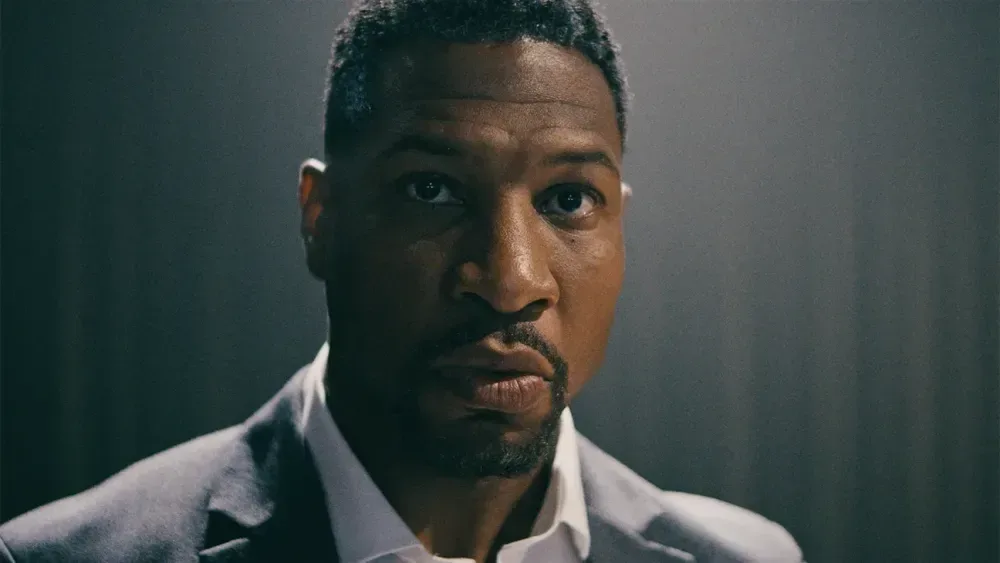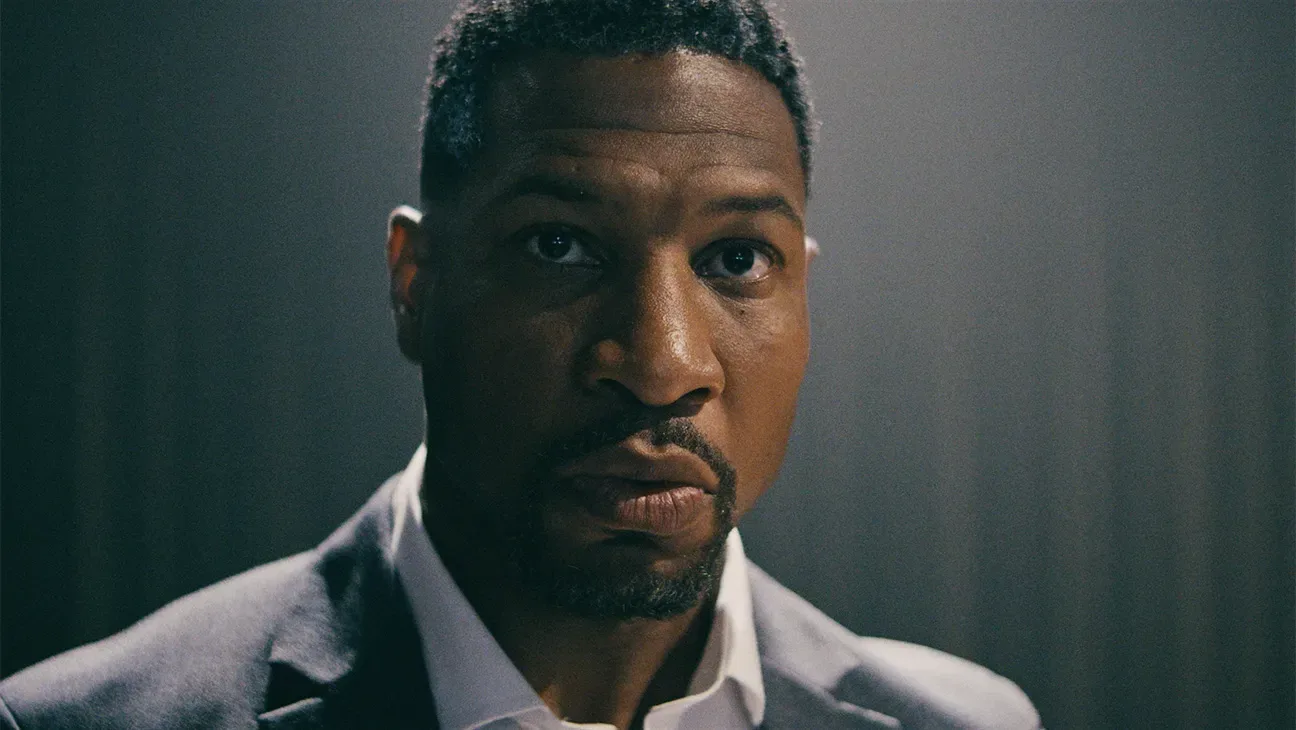
Run Hide Fight: Infidels is a 121-minute campus-terror thriller that positions itself as a standalone follow-up to 2020’s Run Hide Fight. Written and directed by Kyle Rankin, it stars Jonathan Majors as Clay Saunders, a former Delta Force captain and author whose appearance at Laughton University collides with a violent takeover of the campus.
The premise has the basic ingredients for a contained action movie: a crowded school event, fractured lines of authority, hostages, armed attackers and civilians forced to decide whether to flee, hide or fight back. But the film appears far less interested in building tension out of that situation than in assigning every character an ideological label and then treating that label as a punchline, target or proof of moral failure.
That is the central problem. Political provocation is not inherently incompatible with action filmmaking, satire or even exploitation cinema. A story can present an argument, invite disagreement and still give its people interior lives, credible motives and choices that create suspense. Infidels, however, reportedly builds its conflict through broad stereotypes rather than dramatic observation. The result is a movie whose attempted outrage often overwhelms its own plot.
A siege story built around a polemic
Majors’ Clay Saunders is introduced through an earlier military operation involving ISIS leader Asad al-Madhi, played by Alec Rayme. Seven years later, Saunders is promoting a book titled America Unafraid, described as an account of “the ways Islam will conquer the west.” His speaking event at Laughton University occurs as campus protesters occupy the student union, encouraged by a group calling itself the “elite freedom fighters.”
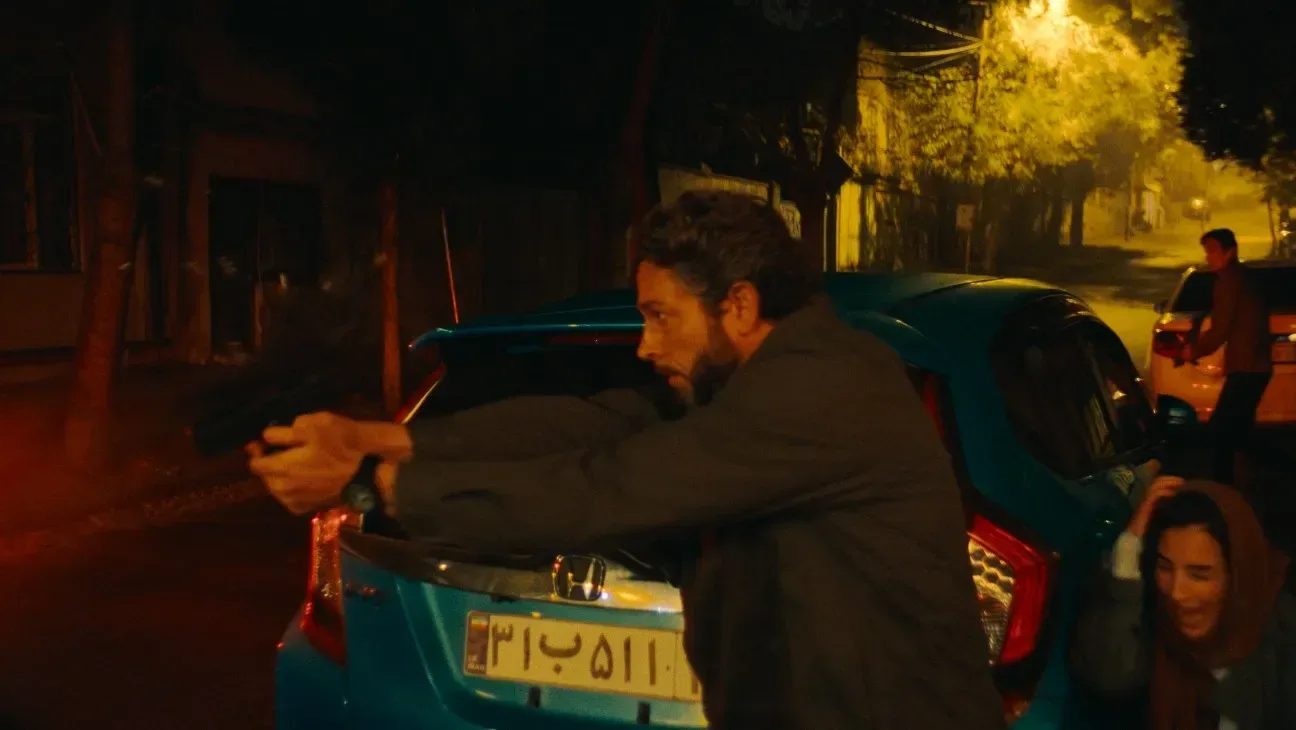
The protesters do not realize that the supposed allies are terrorists led by Ibrahim, al-Madhi’s son, played by Stephen Hailo. The attackers use the disruption as cover, establish positions around the university and begin killing people at the campus and its fall carnival. Ibrahim’s stated objective is to establish a caliphate at Laughton and force the surviving captives into conversion, “purification” or death.
It is an aggressively maximalist scenario. A campus protest becomes a terrorist staging ground; public officials are presented as ineffectual or beholden to appearances; a military veteran’s warnings are validated by catastrophe. That framework does not leave much room for ambiguity. The film’s apparent thesis arrives pre-installed in the premise, and later scenes exist largely to reinforce it.
“Strawman” is the useful term here. A strawman argument replaces a complicated opposing position with an easier, weaker version that can be defeated without engaging the real thing. In narrative terms, that can mean creating characters who exist only to say foolish things so another character can look sensible. Satire can use exaggeration, certainly, but effective satire still has to understand what it is exaggerating. The concern here is that liberals, Muslim characters and authority figures are not treated as people with coherent values or competing pressures. They are treated as symbols arranged for a foregone conclusion.
Characters as categories, not people
The university ensemble puts this issue in particularly sharp relief. Devlin, played by JC Kilcoyne, is the son of Saunders’ fallen comrade. He is outside the student union when the attack begins and becomes motivated both by the danger to his friend Kwan, played by Chris K. Lee, and by the hostage situation involving Lizzy, played by Tyler Aser. Lizzy has added value to Ibrahim because she is the daughter of a billionaire.
Related coverage includes Run Hide Fight: Infidels Review: A Campus Thriller Built on Blunt Provocation.
Devlin joins Terrence, a campus security guard played by David Lucas, and P.J., played by James Bingham. P.J. is characterized as a gamer, a liar about his military service and a man who uses an anti-Egyptian slur against a classmate. Yet after Devlin calls out his false claims of service—an offense commonly called stolen valor, meaning someone falsely presents themselves as having military service or honors—P.J. is still pushed toward a heroic function as he acts outside the limits observed by local authorities.
There is a potentially interesting tension buried in that setup. A character can be cowardly, prejudiced, dishonest or abrasive and still make one courageous choice during a crisis. Action cinema has room for compromised heroes and uneasy alliances. But a moral turn needs to be earned through behavior, consequence and sustained character development. Simply allowing a bigoted figure to participate in a rescue does not automatically resolve what the film has shown about him, especially when the narrative’s wider worldview seems structured to reward his contempt.
Other figures are similarly introduced through shorthand: Kwan is the computer expert; Farrah, portrayed by Charlotte Delaney Riggs, is a purple-haired bisexual campus activist; school dean George, played by Jason Gray-Stanford, is so concerned about appearing discriminatory that he resists calling police; Mayor Flores, played by Shazia Pascal, urges officials to lower tensions rather than launch an overwhelming response.
Those traits could be beginnings rather than endings. A hacker can be more than the person who knows computers. An activist can have an argument that is not reducible to hair color or sexual identity. A dean or mayor can face practical, legal and human questions during a fast-moving emergency. The reported treatment instead turns identity markers into complete character biographies, then uses those biographies as evidence against the people carrying them.
Why the action cannot carry the argument
An action thriller works when its mechanics are legible: viewers understand who is where, what each side wants, what obstacles are active and what a decision will cost. A campus is naturally suited to that kind of geography. A student union, carnival spaces, academic buildings and security checkpoints can create intersecting routes, changing vantage points and credible civilian peril.
But the stakes in Infidels are not merely physical. The attackers’ plot is designed to prove a political proposition, while the university’s response is designed to demonstrate institutional paralysis. That means the plot does not develop from believable decisions so much as it needs every decision to validate the film’s initial assumptions. Once that happens, the suspense question changes from “What will these people do?” to “How quickly will the story move every piece into its designated ideological slot?”
That is a poor exchange. The very best siege thrillers derive pressure from uncertainty, errors and constrained choices. People on opposing sides may make sensible decisions that clash. Officials can be slow because information is incomplete, not because they are cartoons. Civilians can be brave without the movie declaring an entire cultural worldview correct. There is no indication that Infidels is interested in these possibilities.
The picture’s depiction of Muslims is especially troubling because it conflates an entire religion with its extremist antagonists while placing that conflation at the center of the story’s political logic. The attackers are Islamic terrorists, but Saunders’ book and the film’s broader framing are described in terms of Islam as a civilizational threat. Those are fundamentally different categories. A thriller can portray terrorist violence; it should not need to flatten a vast and varied religious population into an extension of its villains to make its point.
Sue Obeidi of the Muslim Public Affairs Council Hollywood Bureau characterized the film as more ridiculous than offensive. That assessment gets at the strange limitation of this material: provocation can lose force when it is so blunt that it no longer resembles an effort to examine a subject. The film may seek a reaction, but caricature makes it difficult to take its politics—or its drama—seriously.
Jonathan Majors is not the movie’s engine
Majors is the most recognizable name in the cast, yet Clay Saunders reportedly appears chiefly near the beginning and end of the film. That structure puts much of the immediate campus story in Devlin’s hands, while Saunders functions as a framing presence and ideological lodestar.
His role therefore creates an expectation that the film is not positioned to satisfy. A character billed through the stature of a performer like Majors normally suggests a protagonist with sustained influence over the action. Here, his limited presence means he cannot provide the momentum, emotional center or evolving perspective that might have given the material a stronger throughline. The reported performance is also notably disengaged, an unfortunate fit for a character meant to embody the film’s certainty.
Rankin’s credits include The Battle of Shaker Heights, while the production is a Bonfire Legend project released by The Daily Wire. Dallas Sonnier and Ben Shapiro are listed as producers. Darin Moran served as cinematographer, Matthew Lorentz edited and Mondo Boys composed the music. The supporting cast includes Savanna Leigh James, Myles Clohessy, Erin Davie and Rayme alongside Hailo, Lucas, Kilcoyne, Aser, Bingham, Lee, Riggs, Gray-Stanford and Pascal.
The distribution context matters insofar as the movie’s politics are not background flavor; they are integral to its selling point and narrative construction. Audiences deciding whether to spend two hours with the film should expect a culture-war premise delivered without much visible curiosity about the communities and beliefs it invokes. For a separate look at how political-media brands continue to intersect with personality-driven entertainment, see this report on Chris Harrison’s Fox Nation project.
The practical viewing takeaway
Run Hide Fight: Infidels is not presented as a nuanced drama about campus activism, religion, counterterrorism or emergency response. It is a bluntly partisan action thriller whose political gestures appear to substitute for character, humor and credible escalation. Its closest idea of satire is to make progressive-coded characters smug, timid or absurd, while offering little examination of anyone on the other side of its argument.
Viewers looking for a tense contained thriller may find the campus siege premise initially promising. Viewers looking for a critique of institutional weakness or political correctness may also recognize what the film is reaching for. But an argument does not become persuasive simply because the stakes are violent, and a provocation does not become satire simply because it is loud. By reducing its targets so thoroughly, Infidels appears to leave itself with neither the bite of a serious political thriller nor the precision of an effective send-up.