Kingdom Hearts has always been easy to describe as a Disney crossover, but its earliest hours make a more persuasive case for a different label: a Disney and Final Fantasy crossover with an original hero standing between both worlds. Sora’s first steps from Destiny Islands into Traverse Town establish that balance unusually well. Donald and Goofy provide the instantly recognizable Disney connection, while characters drawn from Final Fantasy VIII, VII, and X make the surrounding universe feel broader than a parade of licensed destinations.
That balance has shifted across the series. Kingdom Hearts has built an enormous mythology of its own, and Disney worlds have remained a central part of its identity, even when their relationship to the overarching plot varies. Final Fantasy, however, has increasingly felt less like a coequal ingredient and more like an optional garnish. The absence was especially stark in the base version of Kingdom Hearts III, which did not include Final Fantasy characters; familiar faces only returned in the Re:Mind downloadable content.
That makes a replay of the original Kingdom Hearts a useful reminder of what those characters did for the series. They were not merely names placed in a journal for fans to recognize. Their placement, redesigns, and role in Traverse Town helped sell the game’s central proposition: worlds and characters with radically different tones could coexist without one side being treated as an afterthought.
Destiny Islands introduces Final Fantasy as part of Sora’s normal life
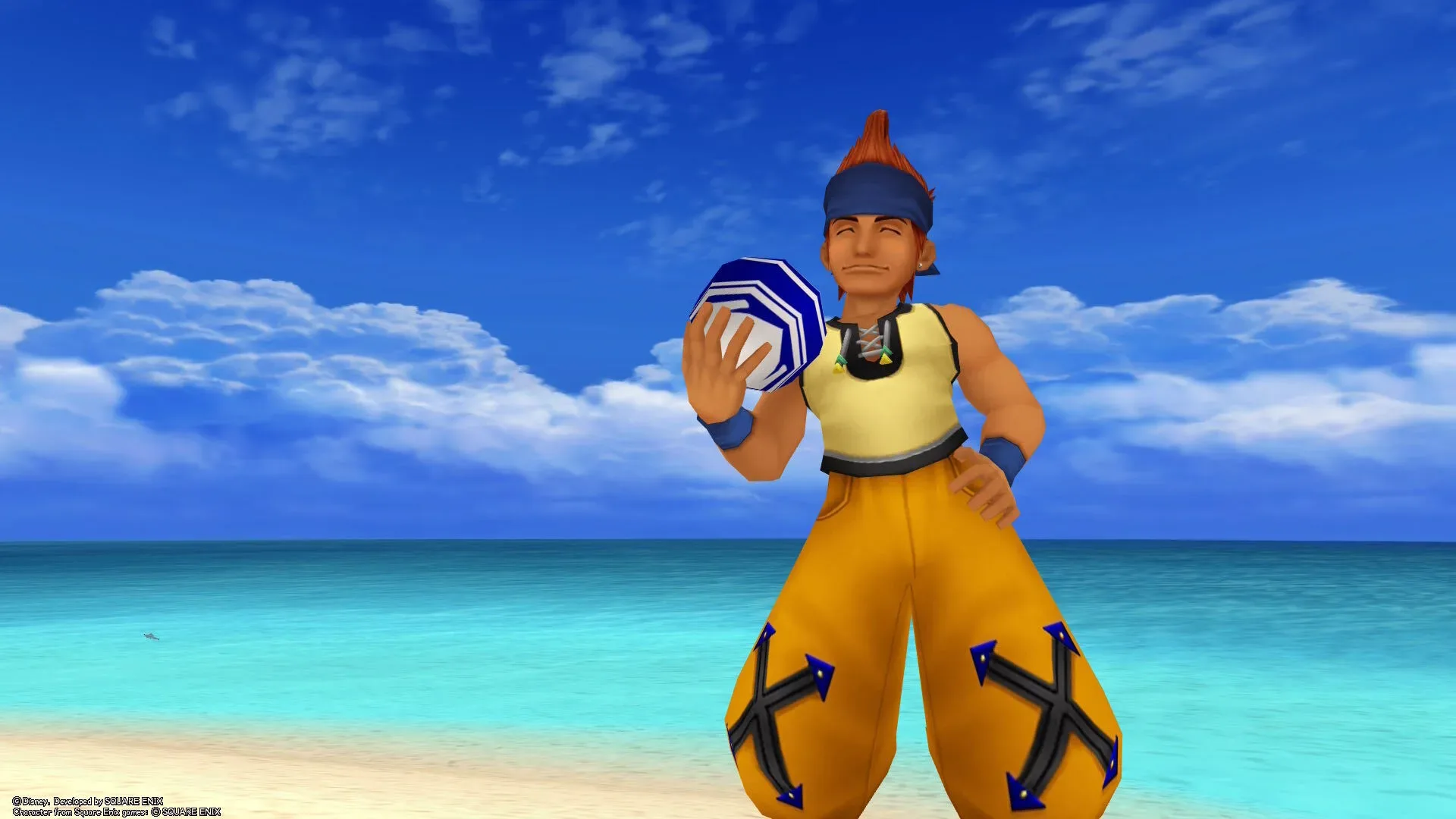
The first game does something quietly smart with Tidus and Wakka from Final Fantasy X and Selphie from Final Fantasy VIII. They are not presented as visitors from another franchise, nor are they introduced with lore-heavy explanation. They are simply children Sora knows on Destiny Islands.
For more context, explore GTA 6 Beer Labels Approved in the US, Pointing to a Possible Vice City Tie-In.
That choice matters because it makes Final Fantasy feel native to Kingdom Hearts from the start. Rather than appearing only as a reward for players already familiar with Square’s role-playing games, the trio establishes that Sora’s home has always contained traces of another game tradition. For a player who reaches Kingdom Hearts before Final Fantasy, they work as characters first and references second.
They are also deliberately adapted to their setting. Tidus carries a bokken, a wooden practice sword, rather than the kind of blade associated with combat in his original game. Selphie uses a jump rope in place of her nunchucks. These substitutions are more than visual jokes. They let the characters fit the childhood atmosphere of Destiny Islands, where sparring and competition feel like play rather than a life-or-death struggle.
Adaptation, in this context, means reshaping an existing character for a new story and tone rather than importing every part of the original version unchanged. Kingdom Hearts uses the Destiny Islands cast this way. Their histories are not treated as continuations of the worlds they came from; Spira, for example, is not part of the game’s discussion of Tidus and Wakka. The result is not a strict Final Fantasy continuity crossover. It is a remix.
That approach is precisely why their brief appearances carry weight. The game suggests a shared space where a youthful version of Selphie can hang out with Sora while a version of Leon from Final Fantasy VIII can occupy an entirely different emotional register elsewhere. The individual source games do not need to be reconciled into one timeline. Kingdom Hearts is making a new setting out of recognizable pieces.
Traverse Town makes the crossover premise feel bigger
If Destiny Islands normalizes Final Fantasy within Sora’s childhood, Traverse Town demonstrates why the series needed that connection. The town operates as a refuge for people whose home worlds have disappeared. Its mood is simultaneously welcoming and unsettled: Sora is meeting allies and learning the rules of a new journey, but he is also displaced and trying to return to Riku and Kairi.
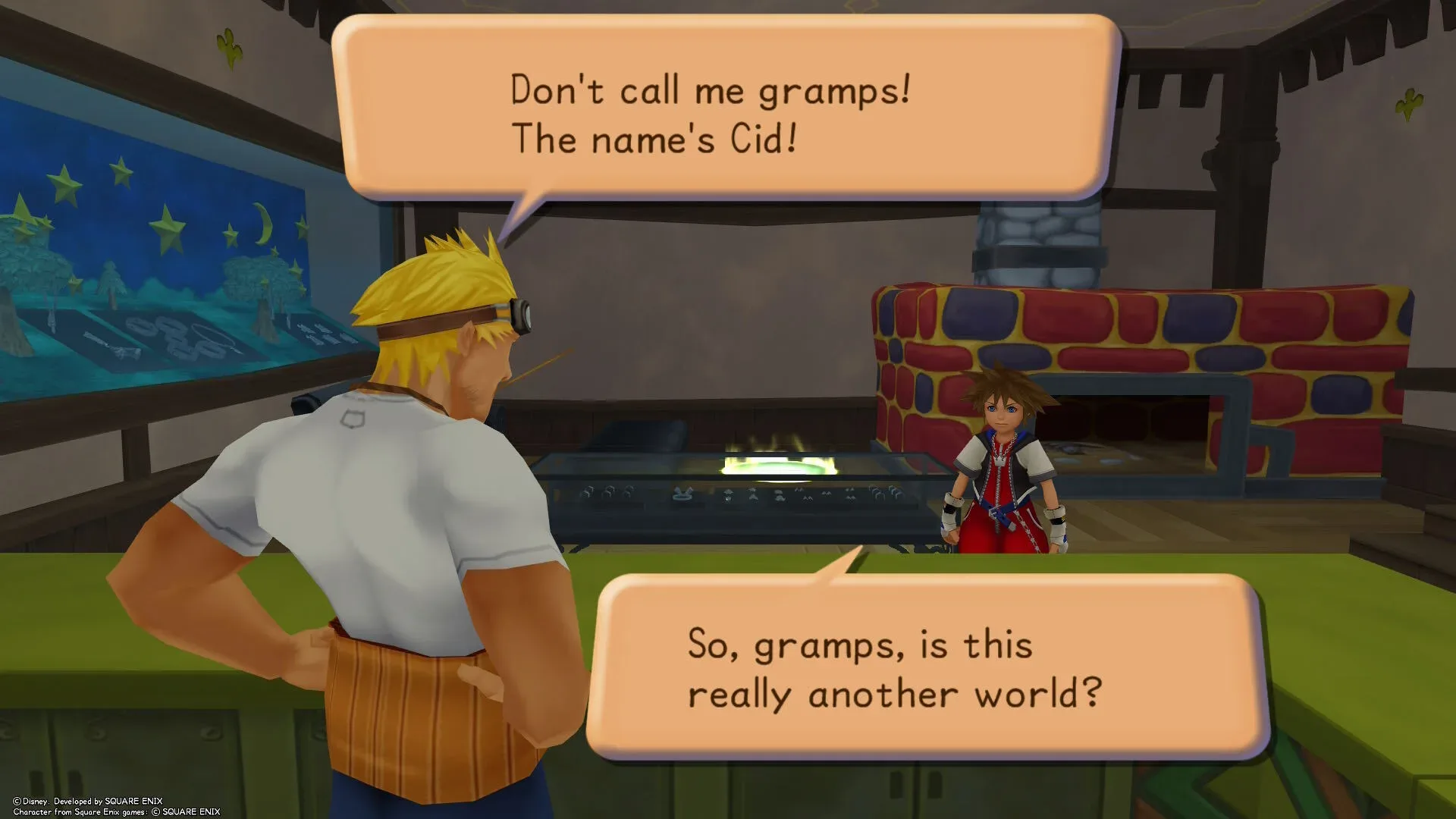
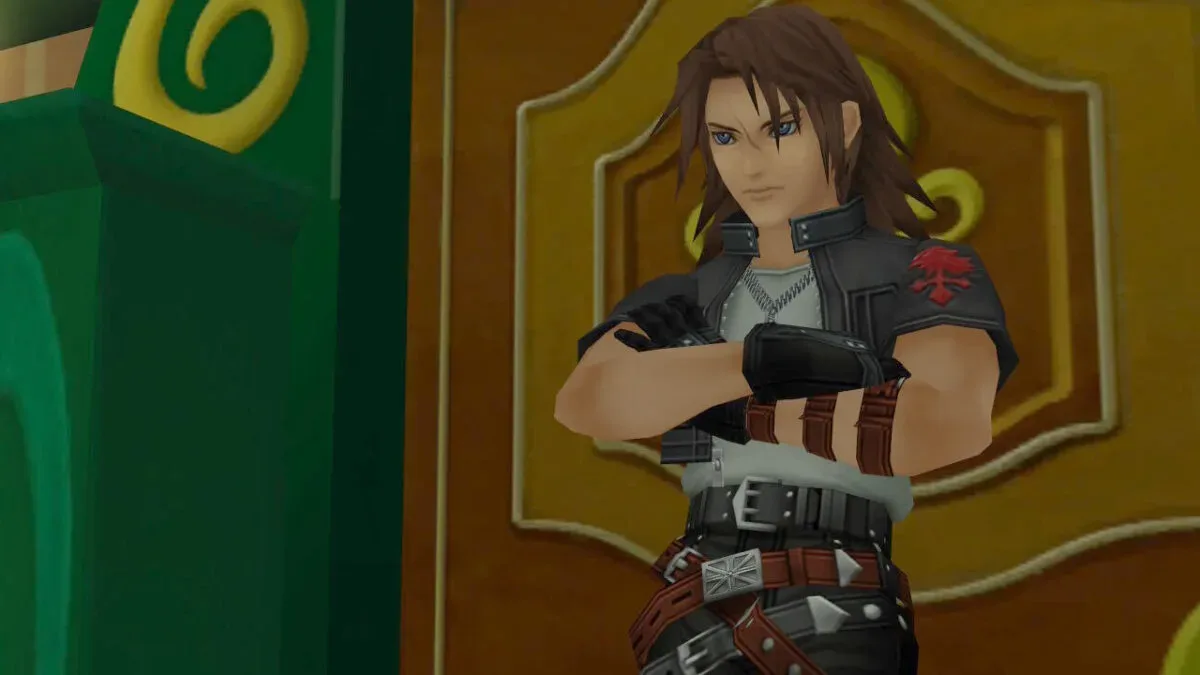
That emotional middle ground is an ideal home for the game’s Final Fantasy residents. Leon—Squall Leonhart’s Kingdom Hearts name—appears with Yuffie and Aerith from Final Fantasy VII, while Cid Highwind is also part of the town’s supporting cast. These characters help establish Traverse Town as more than a convenient hub between Disney locations. It is a place with its own population, problems, and atmosphere.
Leon’s alternate name is a particularly revealing detail. It signals that Kingdom Hearts is willing to retain a character’s essential identity while altering the circumstances around him. The game does not demand that newcomers know Final Fantasy VIII to understand Leon’s function in Sora’s story, but fans who do recognize him are invited to notice the transformation.
Yuffie and Aerith similarly retain enough of their recognizable personalities to register as more direct carryovers than the Destiny Islands trio. Cid remains a gruff presence, although Kingdom Hearts softens material that would clash with its all-ages Disney framing. He is also notable for communicating through text bubbles rather than voice acting in the original game. That detail reinforces the strange, handmade charm of Traverse Town: a collection of characters from different storytelling languages made to work together.
The point is not that every Final Fantasy cameo must be a perfect representation. A crossover becomes less interesting if it treats characters as museum pieces that cannot change. The original Kingdom Hearts instead asks whether a character can remain legible after being moved into a new genre, new age range, and new social circle. Often, it answers yes.
Why the mix worked better than a cameo checklist
There is a practical difference between a cameo and integration. A cameo is a short appearance designed primarily around recognition. Integration gives a returning character a job within the new work’s setting, whether that is teaching the protagonist, offering support, helping define a location, or bringing a particular emotional texture to the story.
The early Final Fantasy cast is integrated. Tidus, Wakka, and Selphie give Destiny Islands peer relationships beyond Sora, Riku, and Kairi. Leon, Yuffie, Aerith, and Cid give Traverse Town local authority and continuity. They are not the stars of Kingdom Hearts, but they support the architecture around Sora so effectively that their absence in later games can be felt even when the series has plenty of original characters.
It also helps that the original choices embrace contrast instead of avoiding it. Donald and Goofy are comic, expressive Disney companions. Leon brings a more guarded, dramatic energy. Aerith and Yuffie supply different kinds of warmth and humor. Sora is the connective tissue. He can move between the earnestness associated with Final Fantasy and the family-friendly playfulness associated with Disney because he has not fully belonged to either tradition before the adventure begins.
That is a more durable crossover model than simply inserting a new famous protagonist into a scene. The Final Fantasy characters made Kingdom Hearts feel like it had a cultural vocabulary beyond Disney films, while Disney’s characters stopped the game from becoming just another Square role-playing game with a few mascots attached.
What later games lost when Final Fantasy receded
Kingdom Hearts eventually became confident enough to foreground its own cast and mythology. That growth is not inherently a problem. A long-running series should be allowed to develop a voice beyond its initial hook, and Sora, Roxas, Aqua, and many others have become the emotional center for players.
But the franchise’s evolution created a potential imbalance. When Final Fantasy characters appear rarely, or not at all in a main game’s base release, the crossover’s original two-way promise becomes harder to see. The Disney side may still be visible through worlds and supporting characters, while the Square side is represented primarily by original Kingdom Hearts lore rather than by the wider Final Fantasy catalog.
This is why the question is not simply whether Kingdom Hearts IV should include more recognizable Final Fantasy faces. It is whether those characters should have a reason to be there. A random appearance by a newer hero could produce a moment of applause, but it would not recreate Traverse Town’s function. The stronger model would give Final Fantasy characters meaningful roles in a hub, a recurring support network, or a world whose story benefits from their particular qualities.
There is plenty of room for variation. The original game already showed that some characters can be radically recontextualized while others remain relatively close to their original versions. The important part is intentionality: choose the character because they enrich the new setting, not merely because their name is currently prominent.
A future crossover should restore the conversation between its halves
Reports have described Kingdom Hearts IV as pursuing fewer worlds at a larger scale. If that direction holds, it could create an opportunity rather than a limitation. Larger spaces and longer stays could give recurring non-Disney allies more room to matter. A hub with a stable Final Fantasy presence would offer players a sense of return and community between world visits, much as Traverse Town did in the first game.
That would not require Kingdom Hearts to abandon its original cast or diminish Disney’s role. It would mean treating Final Fantasy as part of the series’ atmosphere again. The early games understood that the value of the crossover was not limited to the novelty of seeing famous characters share a frame. It was the friction and harmony created when those characters shared a world.
Kingdom Hearts is at its most distinctive when it lets that conversation happen. Sora’s journey has always been about connection, and the series’ own connections are most convincing when Disney, Final Fantasy, and Kingdom Hearts’ original creations all have something meaningful to contribute. For another perspective on that balance, this discussion of Final Fantasy sharing the spotlight reaches a similar conclusion.
The original game’s Final Fantasy cast was never the whole story, nor should it be. But it helped make the story’s world feel possible. A return to that philosophy would be more valuable than any single surprise cameo.