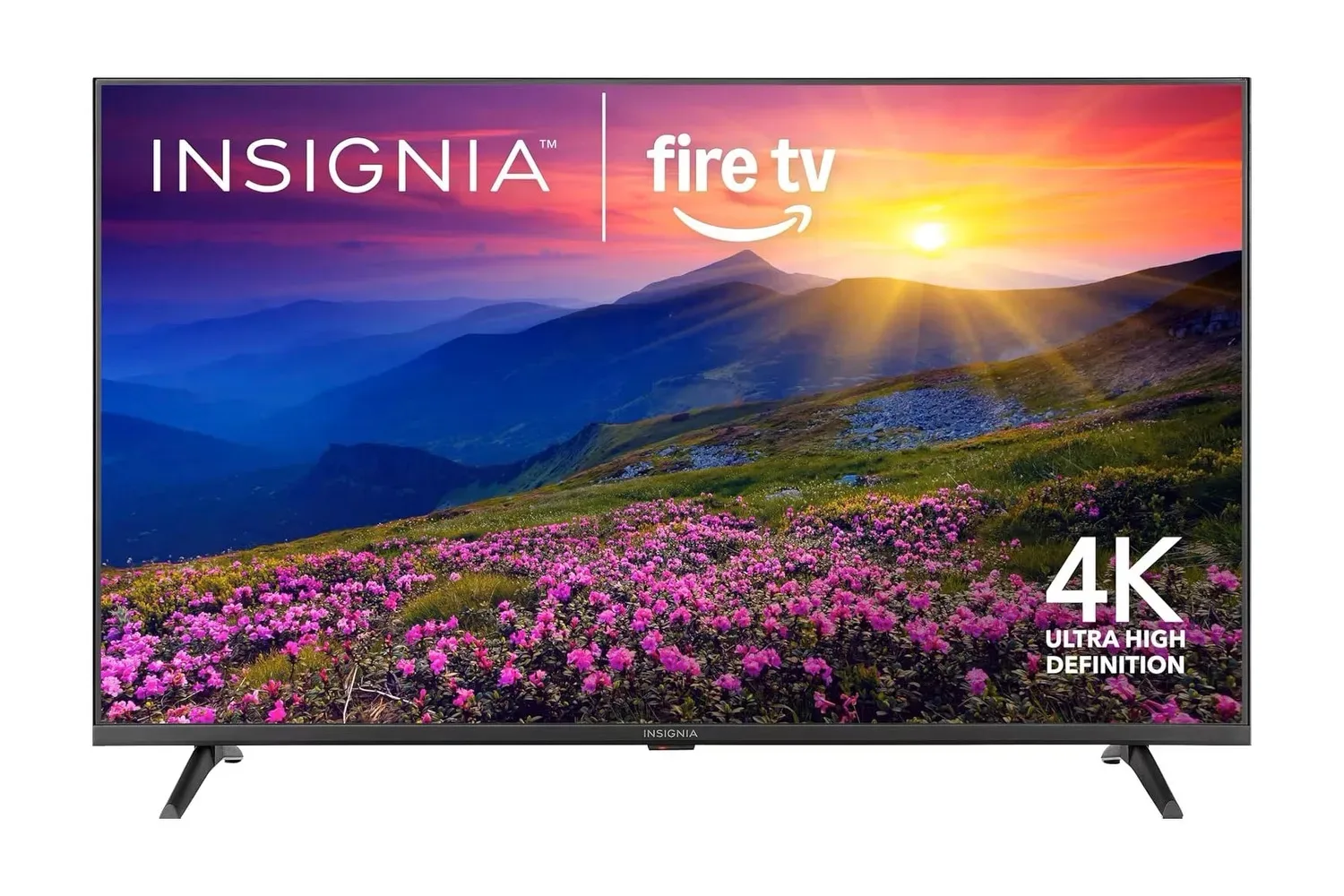
A large television at a small-display price is the pitch behind the current Insignia 50-inch F50 Series LED 4K UHD Smart Fire TV deal. The set is listed for $160, reduced from $300—a $140 cut, or roughly 47%. For someone putting together a bedroom, living-room, or game-room screen without spending heavily on the display alone, that is a meaningful shift in the budget.
The F50’s appeal is not about chasing every possible premium-panel specification. Its supplied feature set is more practical than flashy: a 50-inch 4K UHD, direct-lit LED screen with HDR10 support, Fire TV software built in, Apple AirPlay, an antenna tuner, and a notably broad selection of physical connections. Three HDMI inputs, including one with eARC support, leave room for a console, a streaming or disc device, and another source without immediately turning the back of the TV into a cable-swapping station.
That makes the deal relevant to gaming households even though the television is designed as an all-purpose smart TV. A game room often has competing needs: a console connection, access to video apps, a way to use headphones late at night, and perhaps a soundbar or older hardware still in service. The F50 addresses those basics at a price where the money saved can remain available for the rest of the setup.
What the $160 price includes
The 50-inch F50 displays 4K Ultra HD material. In simple terms, 4K UHD carries four times the pixel count of 1080p Full HD, which can provide a denser, more detailed image when the source content and viewing situation make use of it. The set also upscales lower-resolution material, meaning it processes sources below 4K for presentation on its 4K panel. Upscaling is useful for older video and ordinary HD programming, but it does not create the original detail of a native 4K signal; it is a conversion intended to make that content fit the screen more cleanly.
HDR10 is also supported. HDR, or high dynamic range, is a format designed to preserve a broader range between dark and bright portions of an image while improving the range of color information. In practical viewing terms, HDR10 support means compatible movies, shows, and other material can be presented with more nuance in highlights and shadows than standard dynamic-range material allows. The available information identifies the F50 as a direct-lit LED television, with illumination distributed behind the screen for uniform brightness across the panel.
Fire TV is integrated rather than requiring a separate streaming stick. The interface provides access to apps including Prime Video, Netflix, YouTube, Disney+, Hulu, and HBO Max, along with free ad-supported programming and live TV options. App catalogues and subscriptions are separate considerations, of course, but the basic benefit is immediate: the TV has streaming functionality as soon as it is connected to the internet and set up.
The included Alexa Voice Remote can search for programs, launch apps, and manage playback by voice. It can also be used to ask for weather information or operate compatible smart-home devices. For Apple households, AirPlay support allows photos, video, and music to be sent from an iPhone, iPad, or Mac to the television. That has a clear social use beyond streaming: sharing an album of photos or a video on a 50-inch screen is easier than crowding around a phone.
Why the ports matter more than a streaming-app list
Built-in streaming is convenient, but connections determine whether a television can serve the rest of a room’s hardware without compromise. The F50 has three HDMI ports. One supports eARC, short for enhanced Audio Return Channel. eARC lets a compatible television and soundbar use one HDMI cable for audio sent from the TV to the soundbar, reducing cable clutter and preserving the other HDMI inputs for devices such as consoles.
For a straightforward console-and-soundbar arrangement, that allocation can be especially useful. A console can occupy one HDMI port, a second device can occupy another, and the soundbar can use the eARC-capable port. It is worth noting what the supplied specifications do not establish: there is no provided information here about refresh rate, variable refresh rate, input latency, HDMI bandwidth, or advanced game-mode behavior. Buyers whose decision depends on competitive-play responsiveness or a particular high-frame-rate console feature should verify those specifications independently before treating this as a purpose-built performance-gaming display.
The remaining connectivity makes the F50 more adaptable than a streaming-only screen. It includes composite inputs, a coaxial input, digital optical audio output, a USB port, an Ethernet port, Wi-Fi, Bluetooth compatibility, and a headphone jack. Composite is particularly relevant to older equipment that does not use HDMI. Coaxial connects the set’s internal ATSC tuner to an indoor or outdoor antenna for local over-the-air broadcasts. Ethernet offers a wired network option, while Wi-Fi provides the usual wireless alternative.
Digital optical audio output is another path for connecting compatible audio equipment. It gives owners a second audio-routing option alongside HDMI eARC, which can matter when a room already has older sound hardware. The point is not that every buyer will use every jack; it is that the set can accommodate a mix of new and old devices instead of forcing an immediate all-HDMI replacement plan.
A reasonable fit for a shared or late-night gaming space
Two private-listening options stand out. Bluetooth-enabled headphones can connect wirelessly, while conventional wired headphones can use the 3.5 mm headphone jack. That flexibility is useful in apartments, shared bedrooms, and late-night sessions where television speakers or a soundbar would disturb someone else.
There is also a small but important practical distinction between a TV that has Bluetooth listed and one that offers the necessary alternative for people who do not own wireless headphones. The wired jack means the F50 does not require a new accessory just to make quiet listening possible. Conversely, Bluetooth provides a cable-free option to people who already have compatible headphones.
Mounting and placement should be considered before purchase. The display works with a 200 x 200 mm VESA mounting bracket, which can make wall installation possible where desk, cabinet, or floor space is limited. A base is included for buyers who prefer a conventional cabinet placement. The bracket itself is not identified as included, so a wall-mount plan calls for a separately obtained compatible mount.
Who should consider this deal—and who should check deeper
At $160, the F50 makes the most sense for shoppers who need a large, general-use screen and want everyday streaming, console connectivity, antenna support, and flexible audio without assembling a separate smart-TV stack. It could work as a primary display in a modest setup or as a secondary screen in a bedroom or dedicated game room. The one-year limited warranty offers the standard baseline of included coverage identified for this model.
It is also suited to people who have a mixture of devices. A newer console can use HDMI, a soundbar can take the eARC connection, and older gear may still have a route in through composite. Meanwhile, Fire TV handles casual viewing and the ATSC tuner provides a path to local broadcasts with an antenna. That is a broader role than a bare monitor, even if a monitor may be the better option for a buyer focused entirely on desktop gaming performance.
On the other hand, shoppers should avoid filling in absent details with assumptions. The supplied specifications confirm 4K UHD, HDR10, direct-lit LED illumination, three HDMI ports, eARC on one HDMI port, and the connectivity listed above. They do not provide the gaming-specific measurements and capabilities that some players prioritize. Anyone buying around a particular console feature, competitive multiplayer requirement, or premium-picture target should make that verification the first step.
For buyers who simply want a large 4K smart TV with plenty of ways to attach devices, the sale price changes the equation. The F50’s feature mix is less about one headline technology than it is about avoiding common compromises: there is built-in streaming instead of an extra dongle, a tuner instead of abandoning antenna broadcasts, HDMI eARC for a cleaner soundbar connection, and both wired and wireless headphone support. Those are the day-to-day conveniences that can make a low-cost room setup feel complete.
Anyone comparing screens for a compact gaming area may also find our look at discounted mini PCs and compact gaming setups useful for considering the rest of the hardware around the display.
Shop the products
Check current price, model and availability at the retailer.