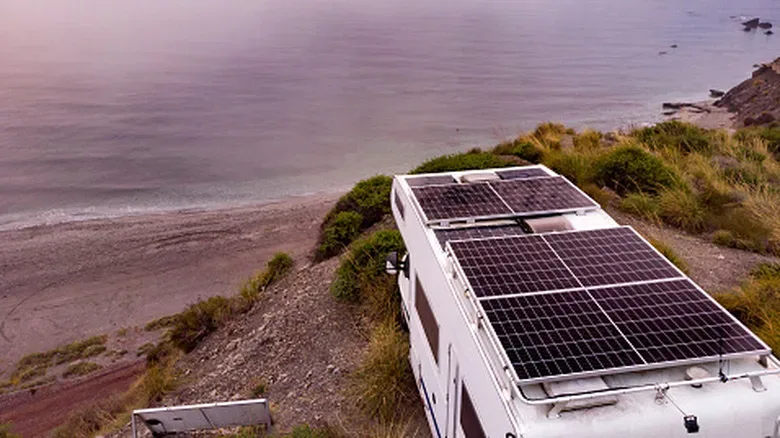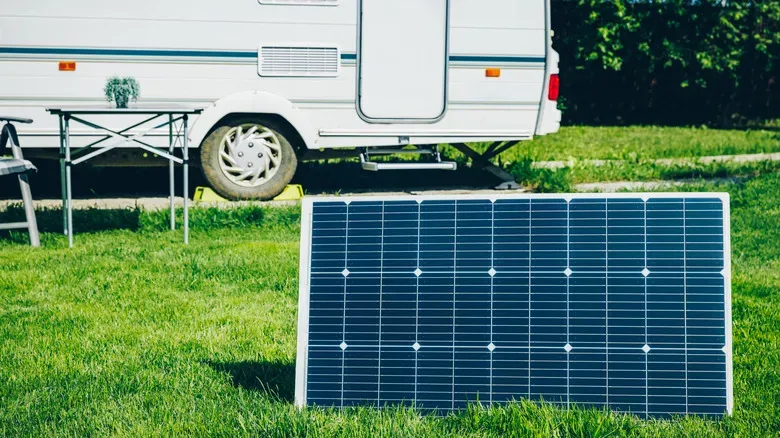
An RV solar system can make an off-grid stop quieter and less dependent on a conventional generator. It can keep lights, charging gear, navigation hardware, and selected appliances running without the familiar background soundtrack of an engine doing its best lawnmower impression. But the question, “How much solar do I need?” does not have a universal panel-count answer.
The honest answer is: enough solar to replace the energy your particular RV uses in a day, with room for the weather, shade, seasonal sunlight, and other real-world nonsense that happens between the sun and your roof. A minimalist setup for phones, lights, and a few small devices is a very different creature from a rig expected to support electric heating or high-demand cooking equipment.
Fully solar-powered RV living is possible in principle, but panels alone are not the whole party. A complete setup generally needs a battery bank to hold energy for later, a charge controller to manage the flow from panels into the batteries, and an inverter to turn battery-side DC power into AC power for appliances that need it. Many RV owners instead use solar alongside a non-solar generator, shore power, or another backup option. That hybrid approach can be especially practical when conditions are poor or demand climbs beyond what a roof-mounted array can comfortably provide.
The key is to do a small amount of arithmetic before buying hardware. It is less glamorous than bolting shiny panels onto the roof, but it is also how you avoid discovering that your power plan has entered its boss-fight phase at sundown.
First, separate watts from watt-hours
Watts and watt-hours are related, but they answer different questions. A device’s wattage tells you how much power it draws while operating. Watt-hours describe the total energy it consumes over time. For solar sizing, the daily watt-hour total is the number that matters most.
Use this straightforward calculation:
Watts × hours used = watt-hours used per day
For example, a 1,500W appliance operating for 10 minutes does not use 1,500 watt-hours. Ten minutes is one-sixth of an hour, so the calculation is:
1,500W × 1/6 hour = 250Wh
That is a meaningful amount of energy, but it is very different from running the same appliance for a full hour. Short, high-wattage bursts can be manageable; long stretches of electric heat or cooking are a much tougher assignment for a compact RV solar system.
Start by making a daily-use list. Include the obvious items and the background residents of the power budget that are easy to forget:
- Phone, tablet, camera, laptop, handheld console, and power-bank charging
- Interior and exterior lighting
- GPS, internet equipment, or other navigation and communications gear
- Fans and ventilation
- Portable heaters, where used
- Cooking devices and other kitchen equipment
- Any always-on loads connected to the RV’s electrical system
Look at each device label or manual. If it gives watts, that is your starting point. If it only lists volts and amps, multiply them to estimate watts:
Volts × amps = watts
Then multiply that result by the number of hours the item normally runs per day. Add every daily figure together. The result is your baseline energy target in watt-hours.
Panel ratings are not daily production guarantees
A panel labeled 100W does not steadily hand you 100W all day, and it certainly does not create 100 watts after dark. Its rating describes output under specified test conditions, not the messy conditions of an actual campsite. The useful question is how many watt-hours the panel is likely to generate across a day.
As a rough planning figure, a 100W panel may yield about 350Wh per day after allowing for changing sun exposure and weather. That number should be treated as an estimate, not a personal guarantee stamped by the Solar Goblin. It will move based on location, season, the panel’s angle, the length of the day, cloud cover, dirt, shading, and system losses.
Even a beautifully rated panel cannot reach its advertised maximum all the time. Forested routes, a nearby building, poor positioning, and low-sun days can all meaningfully cut production. Partial shade is particularly worth taking seriously: the fact that most of a panel is enjoying the sun does not necessarily mean the array is producing like a clear-sky brochure photo.
Temperature matters too. Solar panels generally operate more efficiently in cooler conditions, so a cold, bright day can be favorable for output. A blazing hot roof may look like solar paradise, yet heat can reduce panel efficiency. Sunlight is still essential, of course, but “hotter” is not automatically “better” for panel performance.
Use the 20% cushion before sizing the array
A practical planning rule is to aim for a system that can produce around 20% more energy than the calculated daily requirement. This buffer acknowledges that maximum panel output is not the everyday norm. It gives the setup more breathing room when sunlight is weaker, the panels are not ideally positioned, or a day includes an extra charging session.
Here is a simple example. Imagine your appliance and device worksheet totals 1,000Wh per day. Adding a 20% reserve gives you a target of:
1,000Wh × 1.2 = 1,200Wh per day
Using the rough 350Wh-per-day estimate for each 100W panel, three such panels could be considered a starting-point calculation, since 3 × 350Wh is about 1,050Wh. But that falls short of the 1,200Wh buffered goal, so four 100W panels, or an approximately 400W array, would better match that specific planning example. It does not mean 400W is the right answer for every RV. It means the array should follow the load calculation, not replace it.
A 400W panel or 400W total array may work well for many lighter-use setups, especially where device charging, lighting, and modest electronics make up the bulk of demand. It may not be enough for a power-hungry routine built around electric heating, serious cooking loads, or extended runs of energy-intensive equipment. The battery capacity and sunlight conditions remain just as important as the panel rating.
The battery bank keeps the night shift alive
Panels create power when usable sunlight is available. Batteries make that power useful later. Without sufficient battery storage, a setup may produce plenty during a good afternoon yet still leave little room for nighttime charging, morning use, or a cloudy follow-up day.
Think of the battery bank as an energy reserve rather than an accessory tacked onto the panels. Its appropriate size depends on the daily watt-hour budget, how much stored energy you want available after sunset, and how much resilience you need during weaker solar conditions. A larger array can refill a battery bank faster in good sun, but it cannot make a too-small battery hold more energy than it can hold.
The charge controller is the traffic manager between panel and battery. It controls charging so the battery bank receives power appropriately. The inverter serves another distinct job: it converts DC electricity from the battery side into AC electricity for compatible household-style RV loads and devices. Those pieces need to be chosen as a system, rather than as isolated boxes with impressive-sounding labels.
Size the inverter for simultaneous demand
Solar array sizing is mainly a daily-energy question. Inverter sizing is more about how much power may be needed at the same moment. If several AC appliances can run together, add their likely simultaneous wattage.
A useful rule of thumb is an inverter rated at roughly 1.25 times the maximum wattage you expect to need at one time. If your likely peak is 1,000W, the planning target would be about 1,250W. That margin can help account for demand variability rather than selecting an inverter that lives permanently on the edge of its capacity.
Do not confuse a large inverter with extra energy. A bigger inverter can support a larger instantaneous load, but it does not create battery capacity or solar production. In fact, it can make it easier to drain the battery bank rapidly if it encourages running equipment the rest of the system cannot replenish.
Make the calculation fit the trip, not the fantasy
The best RV solar plan is based on actual habits. A weekend traveler who charges a phone, runs LEDs, and uses GPS has a different daily profile from someone working remotely from the road, using multiple charging stations, or relying on electric appliances. Track normal use honestly, then consider the conditions of the trip: long stays beneath trees, cloudy seasons, and frequent movement can all lower the confidence of a solar-only plan.
Road-trip preparation is broader than power math, too. For those considering a digital document setup before departure, this guide explains how a driver’s license can be added to Apple Wallet and where it works. It is separate from the solar calculation, but it belongs to the same category of checking what will actually work before the wheels start rolling.
Ultimately, write down every device, convert its use into daily watt-hours, total the figures, and add the 20% headroom. Then select panels, a battery bank, charge controller, and inverter that support that plan together. The arithmetic is not optional decoration. It is the map that keeps a solar-equipped RV from becoming an unexpectedly elaborate way to own a dark, quiet box on wheels.