Gears of War: E-Day appears to understand precisely why Gears combat became iconic in the first place. Early campaign impressions describe a game that turns its strongest moments into loud, muscular reminders of the series’ appeal: frantic movement between cover, aggressive flanking, collapsing environments, and enormous arenas built to make every firefight feel like a desperate stand against an overwhelming force.
Those strengths do not automatically make the campaign a clean victory. The roughly 14-hour story is being assessed before completion, and only its campaign was available during the review period. Based on that unfinished view, E-Day’s combat, visuals, setting and major set pieces stand well above its storytelling, exploratory portions and the stretches that connect one battle to another. It is an encouraging but qualified report card for the first new Gears game in seven years.
Emergence Day gives the series a high-stakes starting point
E-Day revisits Emergence Day, the catastrophic event set 14 years before the original 2006 Gears of War. It is the moment when the Locust Horde erupts from underground and begins its assault on humanity. That premise places Marcus Fenix and Dominic Santiago in a version of the conflict where the enemy is not yet familiar, understood or manageable.
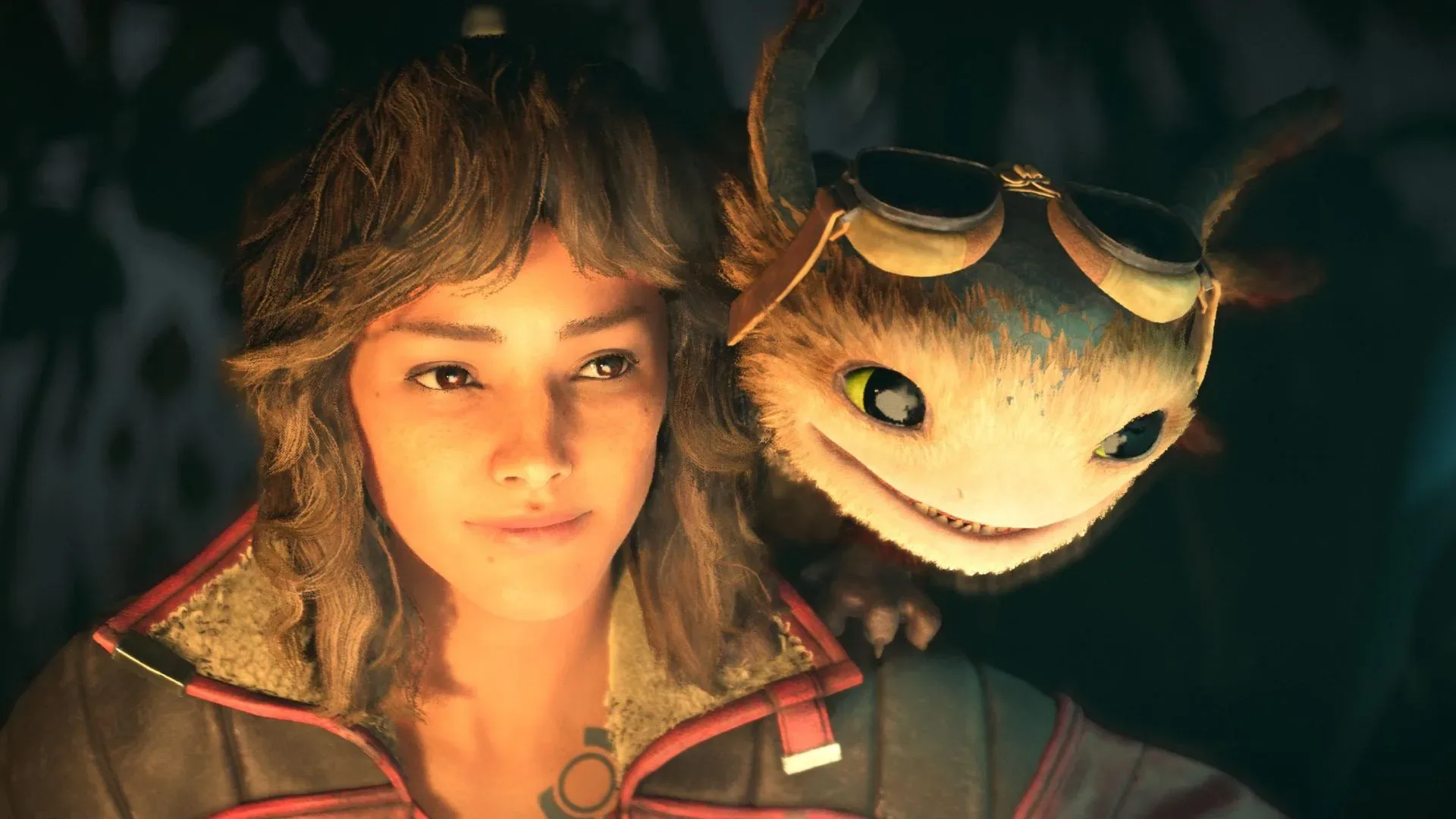
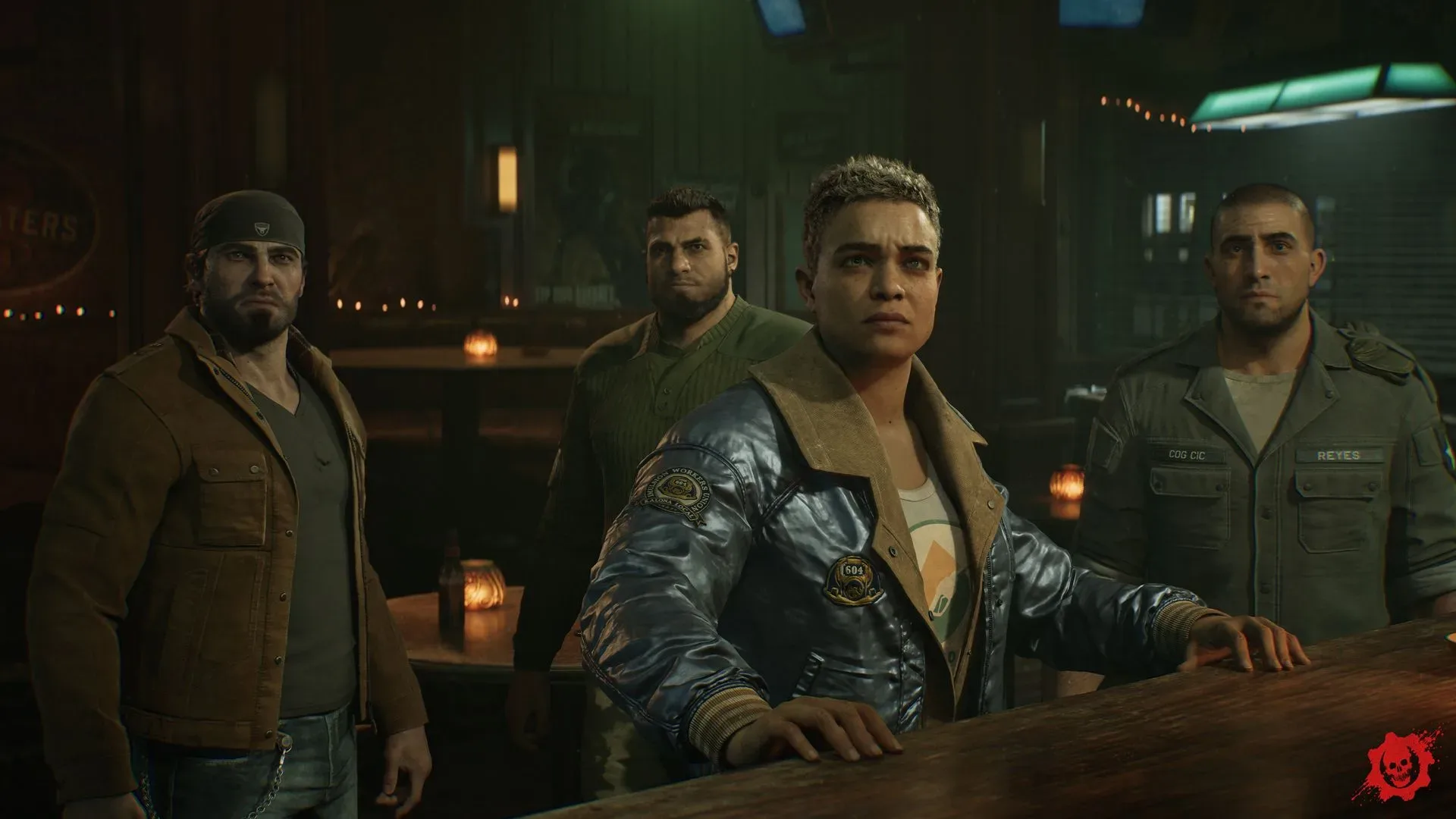
The pair are COG soldiers still living in the shadow of the Pendulum Wars when the new crisis begins. Rather than approaching the Locust war with the hardened certainty associated with later parts of the franchise, the setup puts them on home territory that is suddenly becoming a battlefield. They are joined in Bravo Squad by former Gear Mags Carter and rookie communications officer Lucas Reyes.
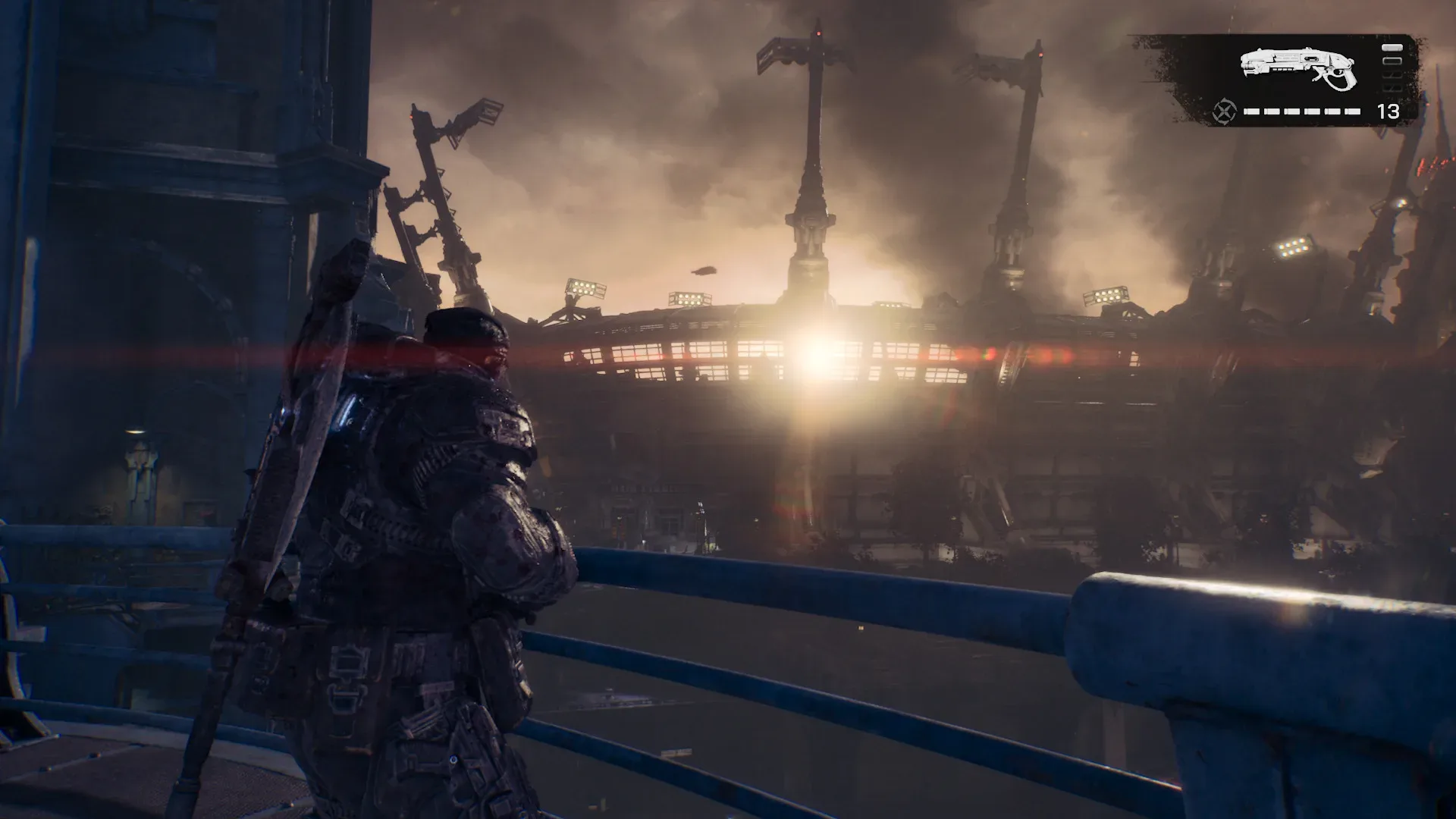
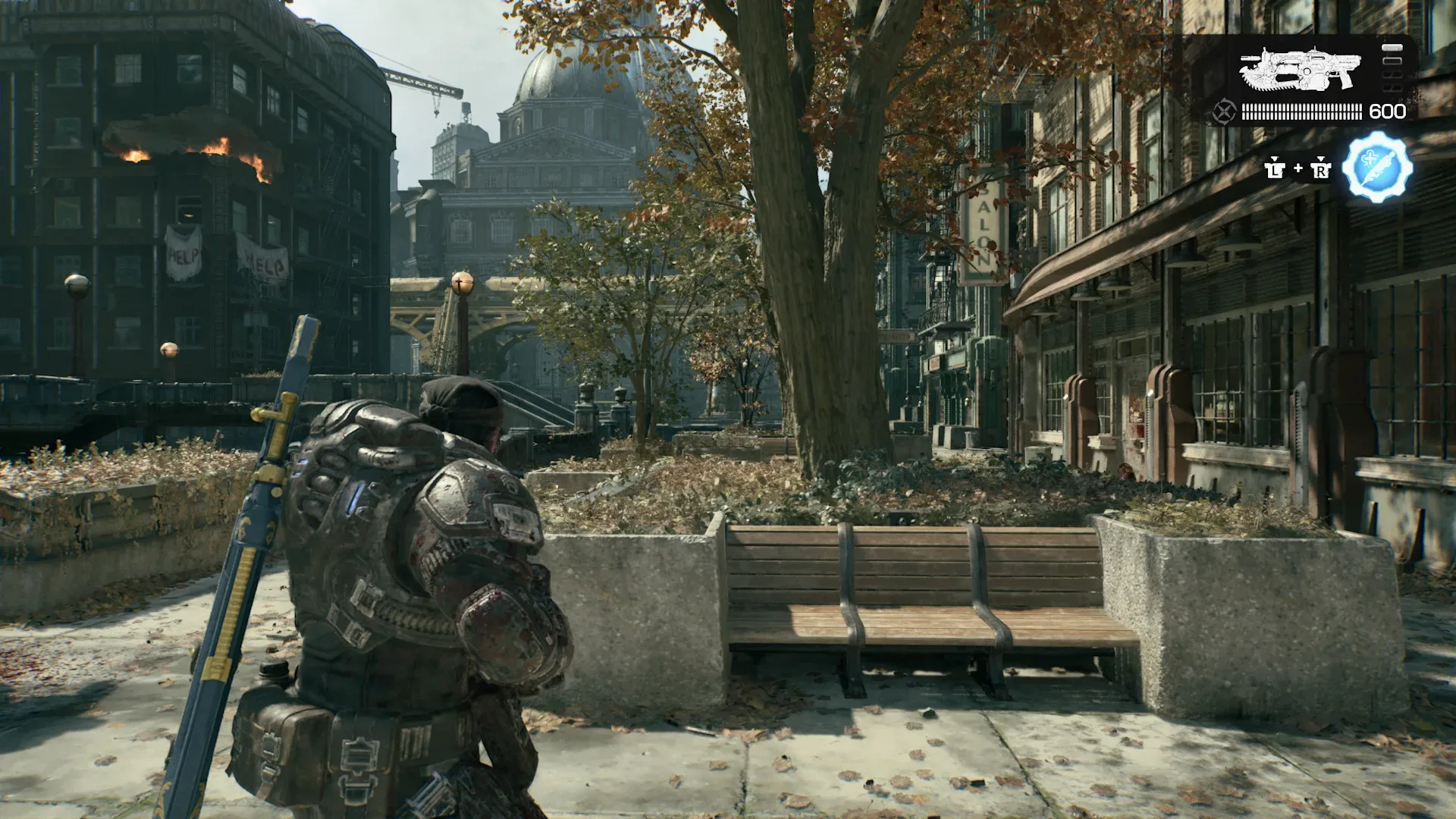
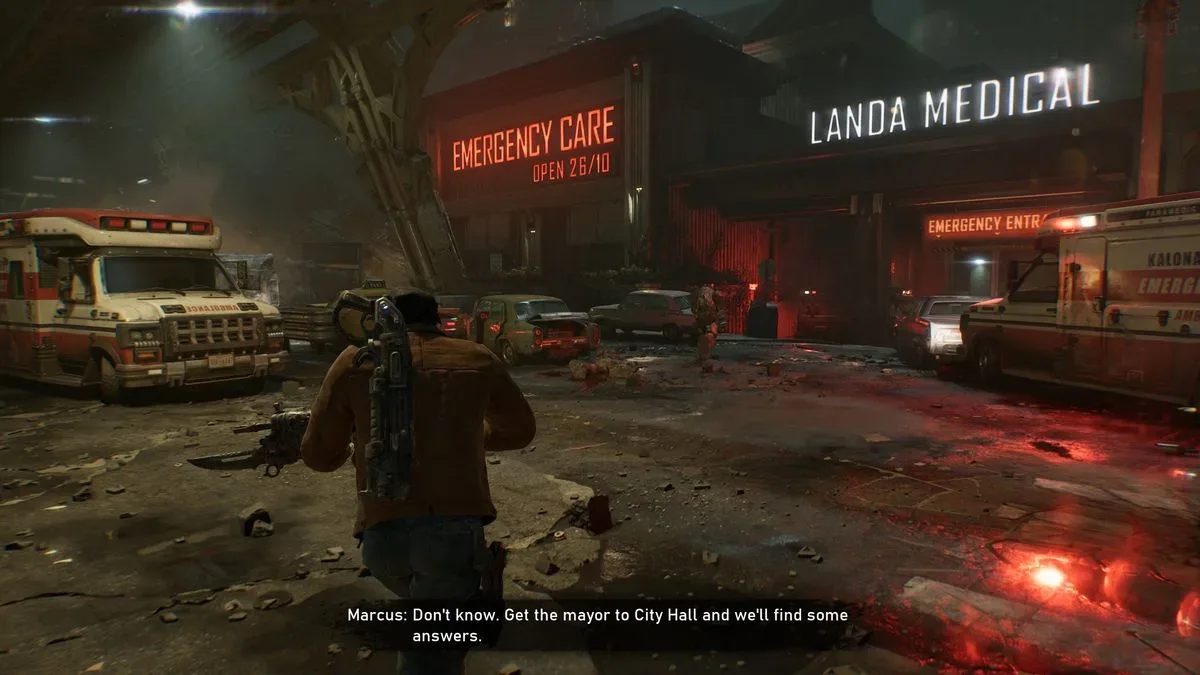
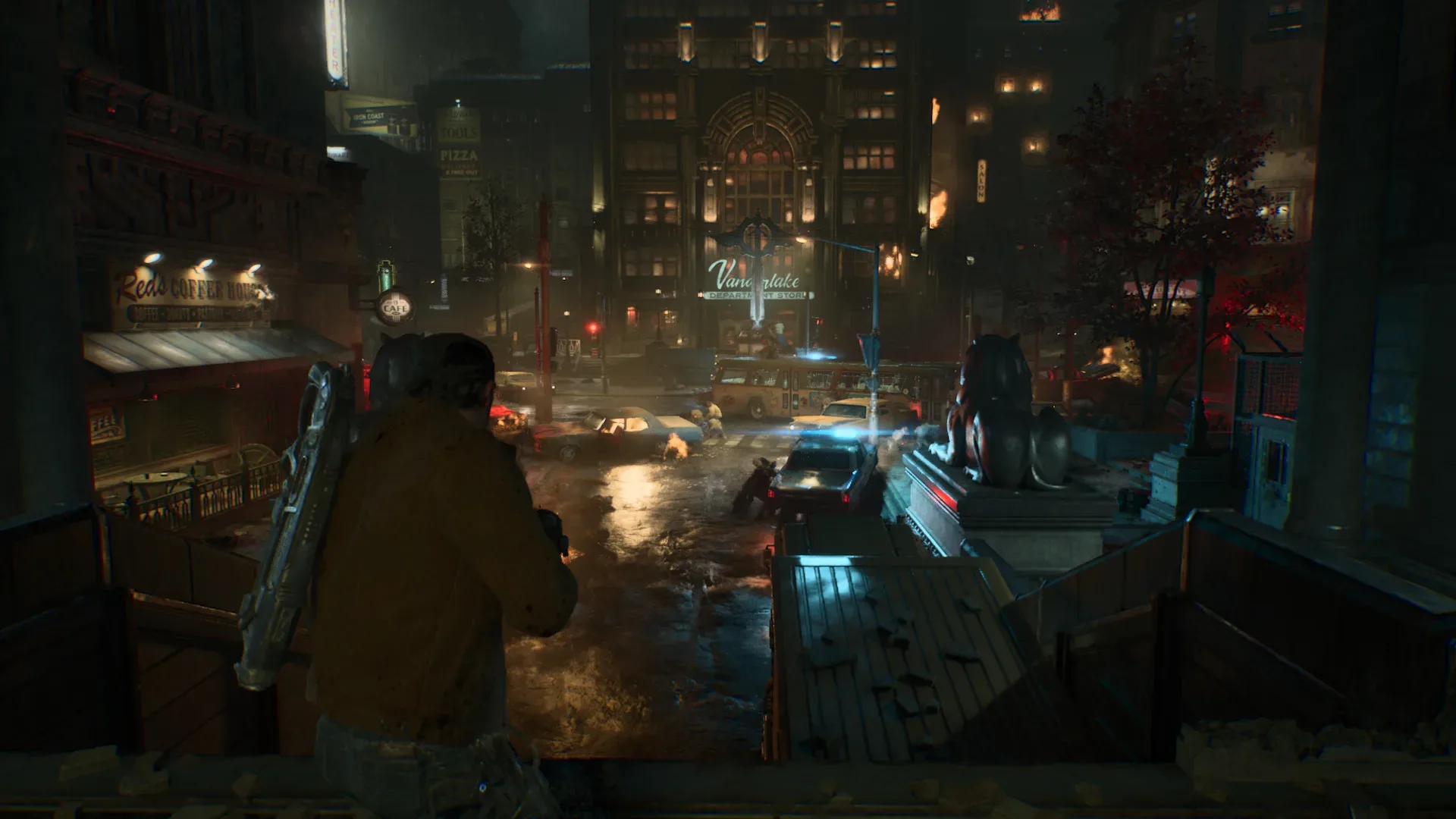
The setting seems to be one of the campaign’s clearest assets. Kalona, the city at the center of the action, is presented as an industrial metropolis with a rust-belt character. Its spaces combine the franchise’s familiar mix of gothic horror, baroque flourishes and postwar science-fiction design. The visual identity matters here because the game is asking players to witness an established world breaking apart at its foundational historical moment.
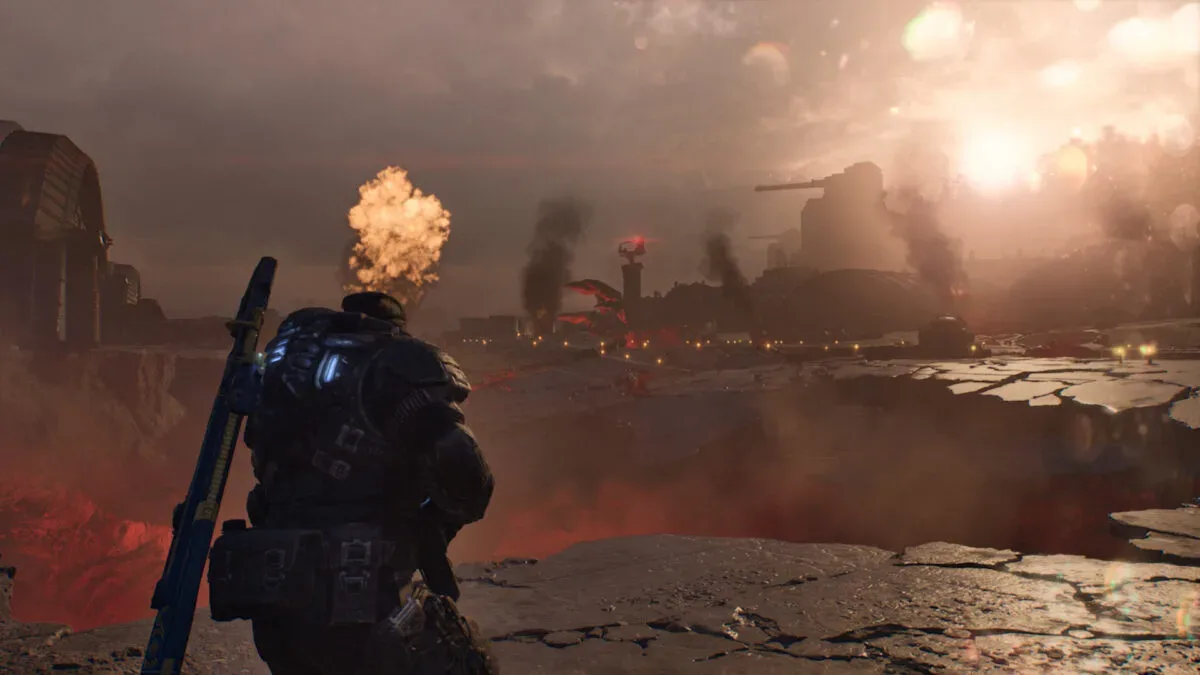
That destruction is not merely a backdrop. The campaign’s most successful environments reportedly include towering cantilever bridges, elaborate hotel lobbies and expansive airfields destabilized by Locust sinkholes. These locations support both spectacle and play: a bridge or hotel atrium is not just scenery, but an arena that dictates sightlines, cover options and routes around advancing enemies.
The cover shooting is the campaign’s main event
Gears has long been defined by cover-based combat, a third-person shooting format in which moving safely between walls, barriers and other objects is as important as aim. E-Day reportedly makes that familiar foundation feel urgent again. The best encounters have players weaving from position to position, circling around enemies and using the scale of the arena to create flanking opportunities.
One meaningful addition is the ability to go prone behind cover. Going prone means lying flat, reducing a character’s profile when fire and debris are passing overhead. It is a relatively straightforward movement option, but in a game so committed to battlefield pressure, it can change the emotional texture of a shootout. Instead of simply snapping behind a chest-high wall, players can hunker down as the environment erupts around them.
Related coverage includes Gears of War: E-Day Impresses in Combat but Stumbles Between Its Biggest Battles.
That detail points to an important difference between a mechanically functional shooter and one that sells a combat fantasy. The prone mechanic may not reinvent Gears, but it adds physicality to scenes where incoming rounds, impacts and collapsing surroundings are meant to feel oppressive. The game’s strongest sequences appear to use that pressure well, making survival and momentum feel inseparable.
There are caveats. Enemy AI is said to be inconsistent at times, and the newly introduced Locust creatures have not made a particularly strong impression in the campaign view so far. AI, or artificial intelligence, refers to the systems governing non-player enemies: how they move, seek cover, react to the player and cooperate with one another. In a cover shooter, weak enemy behavior can undercut a carefully designed arena, because the encounter depends on enemies creating pressure without behaving too predictably or passively.
Still, the moment-to-moment gunfights are the part most likely to bring players back. The campaign’s firefights retain the old-school Gears energy: direct, physical and built around forcing an opening before the opposition swarms the position. The reported enthusiasm for returning after each play session suggests the core loop remains exceptionally sturdy even when the surrounding campaign structure falters.
Spectacle is strong; the narrative has not matched it
The largest concern is not that E-Day lacks grand events. It reportedly has memorable scenes and huge action set pieces. The problem is that the broader story has yet to give those moments sufficient dramatic support. Marcus and Dom occupy the center of a world-altering event, yet their responses and relationships are described as less compelling than the scenario around them.
The campaign reportedly touches on personal histories and war trauma without developing those ideas deeply. Dialogue between objectives can feel dutiful rather than revealing, leaving character arcs and unexpected narrative turns in short supply. That is especially notable given the premise. Emergence Day should naturally provide room to explore confusion, fear and the immediate human cost of a catastrophe that later games treat as established history.
This does not mean the campaign’s story cannot change shape in its closing hours. The assessment comes a few hours before the ending, and the view is explicitly preliminary. But a story-driven campaign usually needs its characters and connective tissue to work long before the finale. If the quiet scenes do not build tension, define the squad or add meaning to the objectives, then even remarkable battles can begin to feel isolated from one another.
Open areas may be slowing the march to the next great fight
E-Day also introduces broader patrol areas in Kalona, including optional objectives and plentiful collectibles. Collectibles feed into an equipment-mod system, which appears to offer some customization or progression benefit. Yet the system is described as neat rather than transformative, and the wider sandbox-like passages have been a weaker fit than the tightly structured combat arenas.
A sandbox exploration segment is an area that gives players more freedom in choosing where to travel or which tasks to pursue, rather than moving them directly through a single linear route. That flexibility can make a war zone feel larger and more lived-in. It can also disrupt pace when its discoveries, missions or rewards do not carry enough weight.
That seems to be the issue here. Optional objectives and equipment mods may give players additional things to do, but they do not necessarily create the same tension as a focused battle arena. The result is a campaign rhythm where explosive highs are followed by stretches that feel like administrative travel toward the next truly exciting sequence.
This is not an argument that Gears must always be completely linear. Broader spaces can work when they reveal meaningful story information, create distinct tactical decisions, or make the player’s choices feel consequential. But the reported weakness of these sections is a reminder that open structure is not automatically an improvement. In a series whose combat encounters thrive on deliberate placement, carefully controlled escalation and sharp pacing, extra space needs a clear purpose.
Xbox Series S performance is an important qualification
The early campaign account was played on Xbox Series S in quality mode, and performance is one of the more concrete concerns. Quality mode generally prioritizes image presentation over a higher frame rate. Here, the campaign was running at 30 frames per second, commonly written as 30fps, but still suffered frequent stutters and slowdowns.
Frame rate is the number of individual images displayed each second. A steady 30fps can still look and feel coherent, particularly in a cinematic third-person game. The bigger problem is inconsistency: stuttering and sudden drops can make movement appear uneven and reduce responsiveness. The reported hitches were especially noticeable when transitioning between checkpoints and during action-heavy cutscenes.
That does not establish performance across every platform or mode. It is a platform-specific observation from Xbox Series S, Microsoft’s less powerful current-generation console, rather than a universal verdict on E-Day’s technical state. Even so, prospective Series S players should take the note seriously, particularly if they are sensitive to uneven performance in fast action games.
Multiplayer could change the package, but key pieces arrive later
The available assessment is limited to the story campaign, so it cannot settle the question of E-Day as a complete Gears package. Multiplayer enters early access on October 1, with Horde Siege named among the new online content. Horde modes traditionally center on surviving waves of enemies, though only the existence of the new Horde Siege mode is established here—not its specific rules or structure.
Two multiplayer features, private lobbies and ranked mode, are not due until later in October. Private lobbies let players organize matches outside the standard public matchmaking pool. Ranked mode generally places competitive play within a progression or skill-based structure. Their absence at the start is relevant because both can be central to how dedicated players organize recurring multiplayer sessions.
For broader context on another major shooter series navigating its future, see our coverage of Massive Entertainment’s expanded role on The Division, Ghost Recon and Splinter Cell.
What the early picture means for Gears fans
The preliminary verdict is neither a straightforward triumph nor a warning to dismiss E-Day. Its best parts sound like a persuasive case that Gears still has a distinct mechanical identity. Big arenas, heavy cover movement, flanking, environmental destruction and an added prone option can produce firefights with a scale and texture few series pursue in quite the same way.
At the same time, a campaign built around the beginning of humanity’s war with the Locust has an unusually high narrative burden. The characters, exploration and pacing need to make that origin point matter beyond the fact that the battles look spectacular. So far, that supporting structure seems far less reliable than the shooting itself.
Until the campaign is completed and multiplayer is available in fuller form, the most accurate read is cautious optimism. Gears of War: E-Day appears to deliver major combat victories, while still needing its story, pacing and technical presentation—at least on Xbox Series S—to prove that they can carry the same weight.