Gears of War: E-Day is not ready for a complete verdict yet: its multiplayer components remain unavailable for final assessment. But the campaign alone makes a remarkably persuasive case that the series’ core language—urgent cover movement, brutal close-range gunfights, hulking weapons, and a city having an extremely bad day—still has considerable power.
The upcoming prequel is listed for PC and Xbox Series X on October 6, 2026, with The Coalition and People Can Fly credited as developers and Xbox Game Studios as publisher. Its single campaign supports one to four players, and one completed run through its five acts took roughly 16 hours while tackling most optional objectives. That scope is substantial, but the more telling point is that E-Day appears to use its length to establish a sense of place rather than simply stringing together arenas.
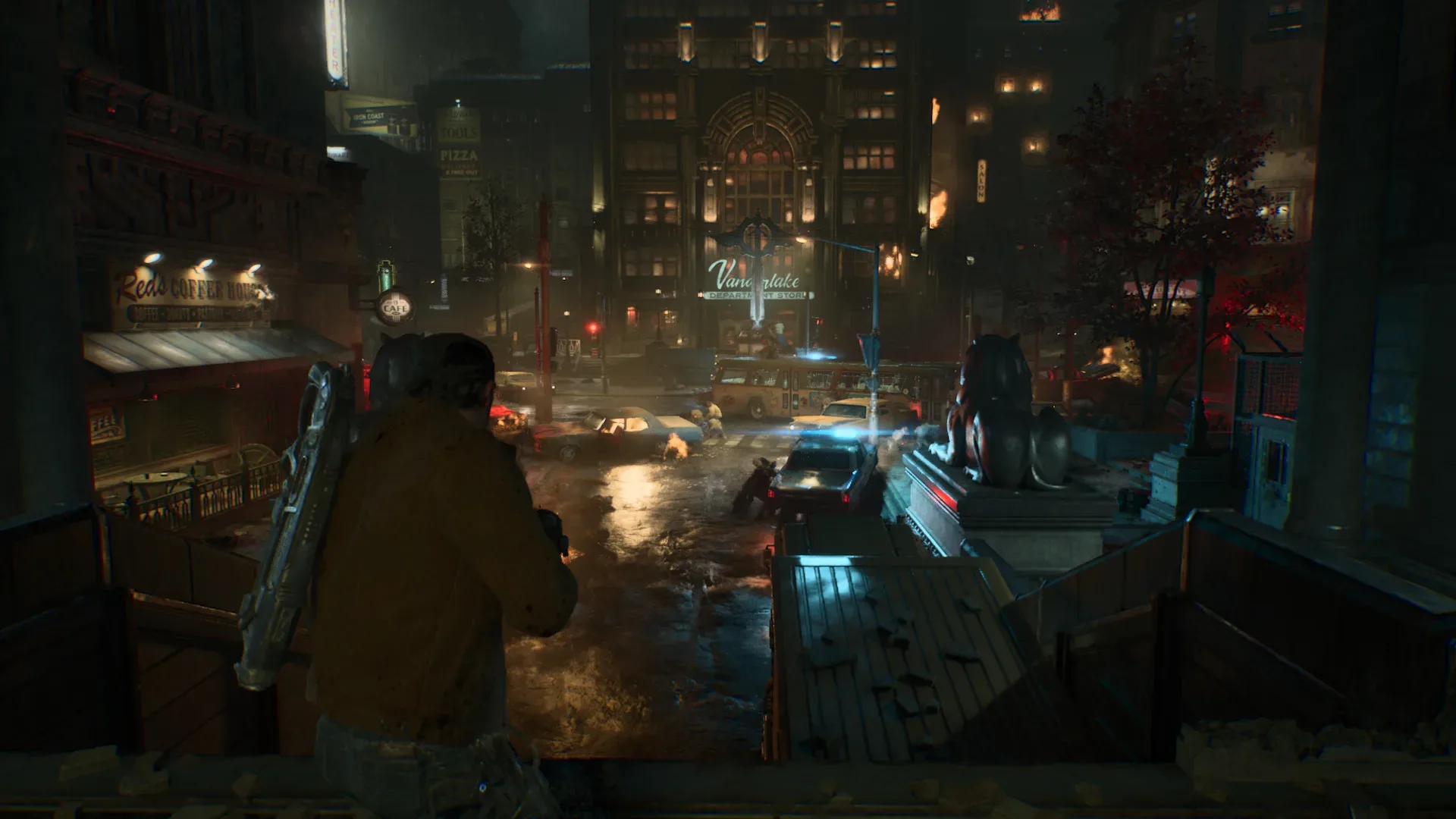
Its setting, the industrial city of Kalona, is the key to that approach. Gothic streets connect dockyards and military installations, while billboards celebrate the end of the war with the Union of Independent Republics. Those details establish a city that has not yet absorbed the visible ruin of war—and therefore has everything to lose when Emergence Day begins.
A prequel built around the moment everything breaks
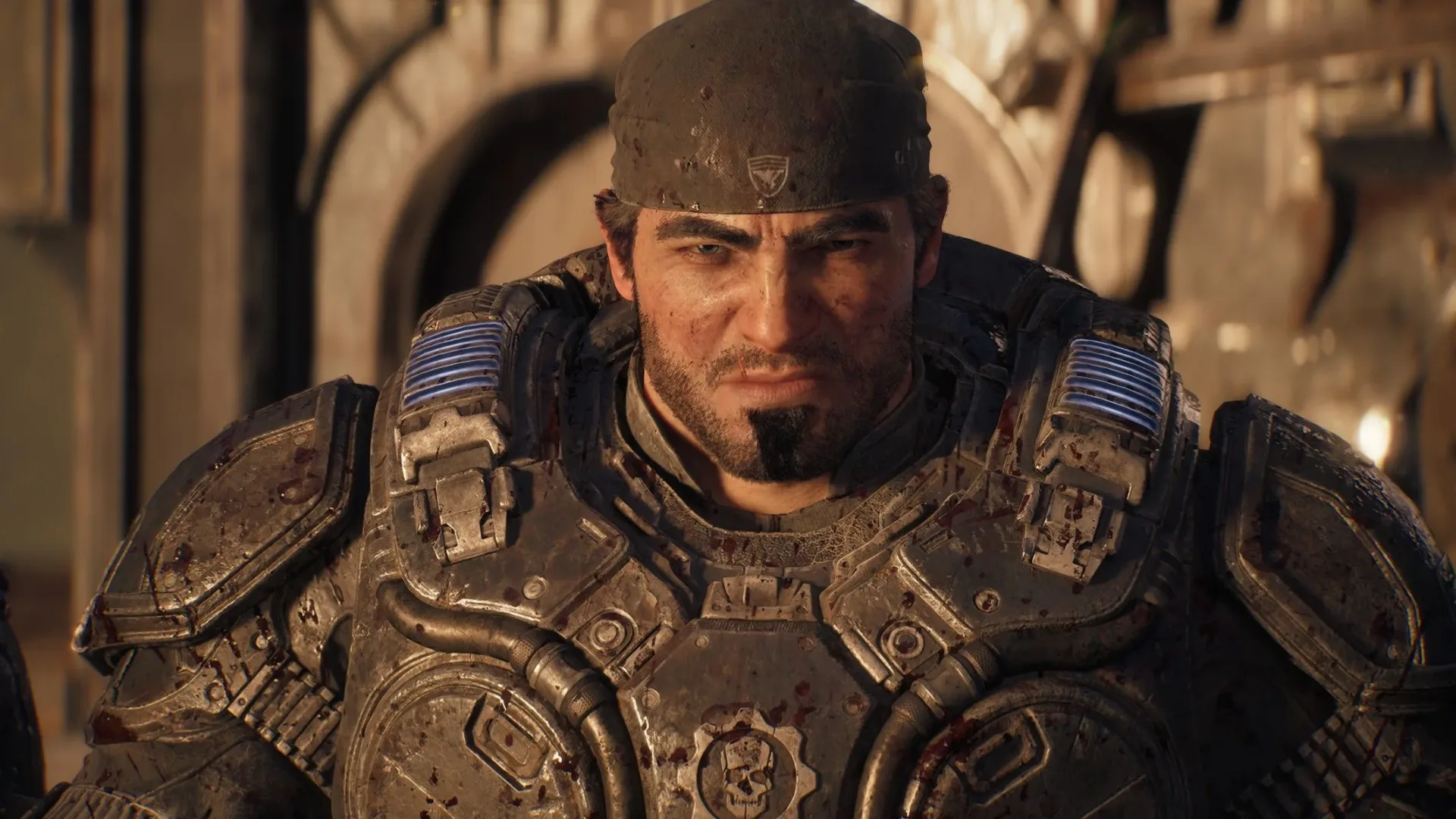
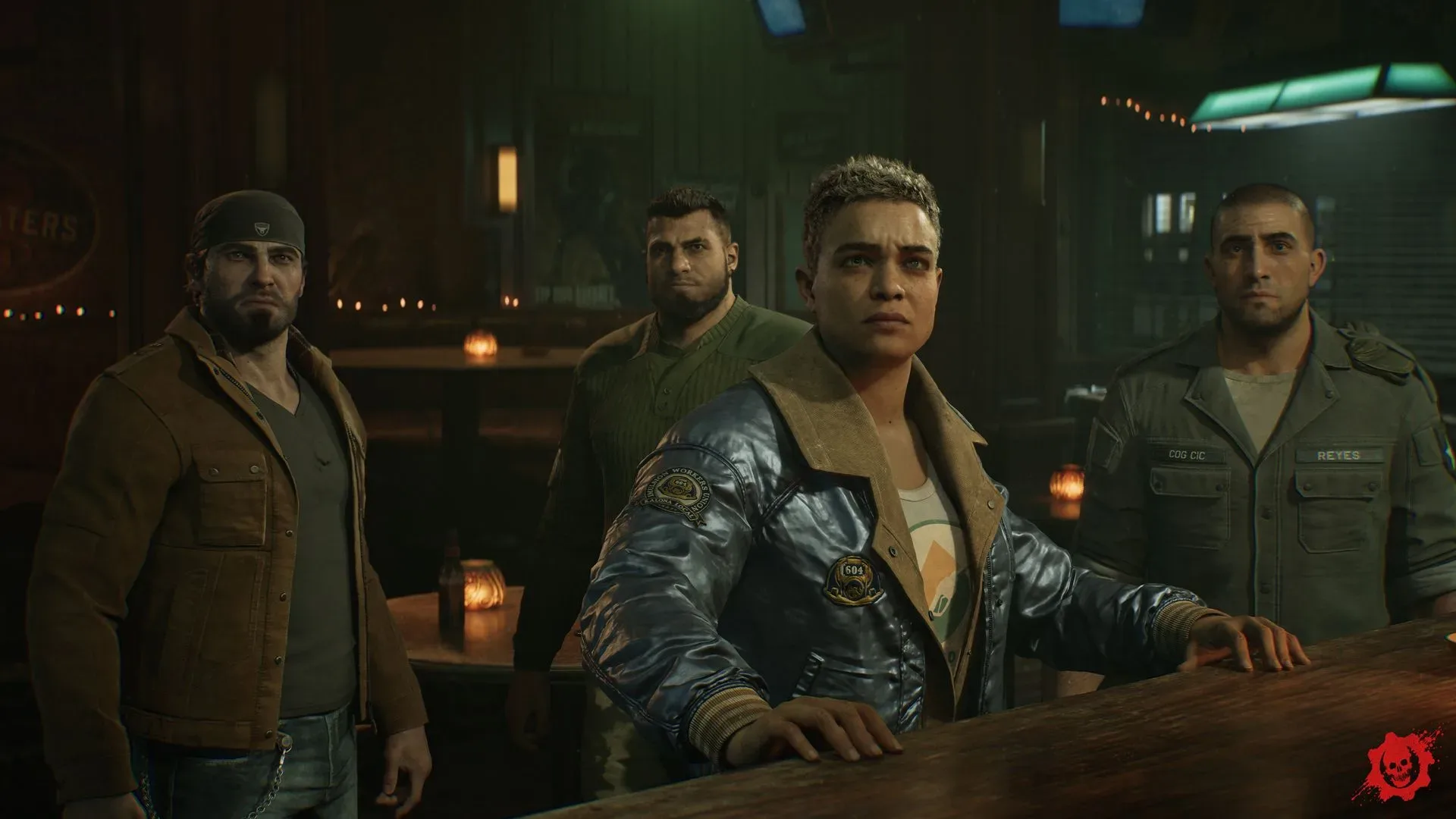
Marcus Fenix and Dominic Santiago return at a much earlier, more immediately traumatic point in Gears history. The pair are already linked by the loss of Dom’s brother and Marcus’ squadmate, Carlos Santiago, during the conflict with the UIR. At the story’s start, they are trying to duck out of a military ceremony for drinks. Then the ground ruptures, the Locust emerge, and the social order of Kalona rapidly disintegrates.
The premise is familiar in broad genre terms—ordinary civic life is shattered by an invasion—but E-Day’s strength seems to be its commitment to staying in the fallout. Civilians flee amid fire and sinkholes. Some Locust rush on all fours, while others arrive equipped with guns and armor. Marcus and Dom join Carter and Reyes as they attempt to support a defense that is already struggling to hold together.
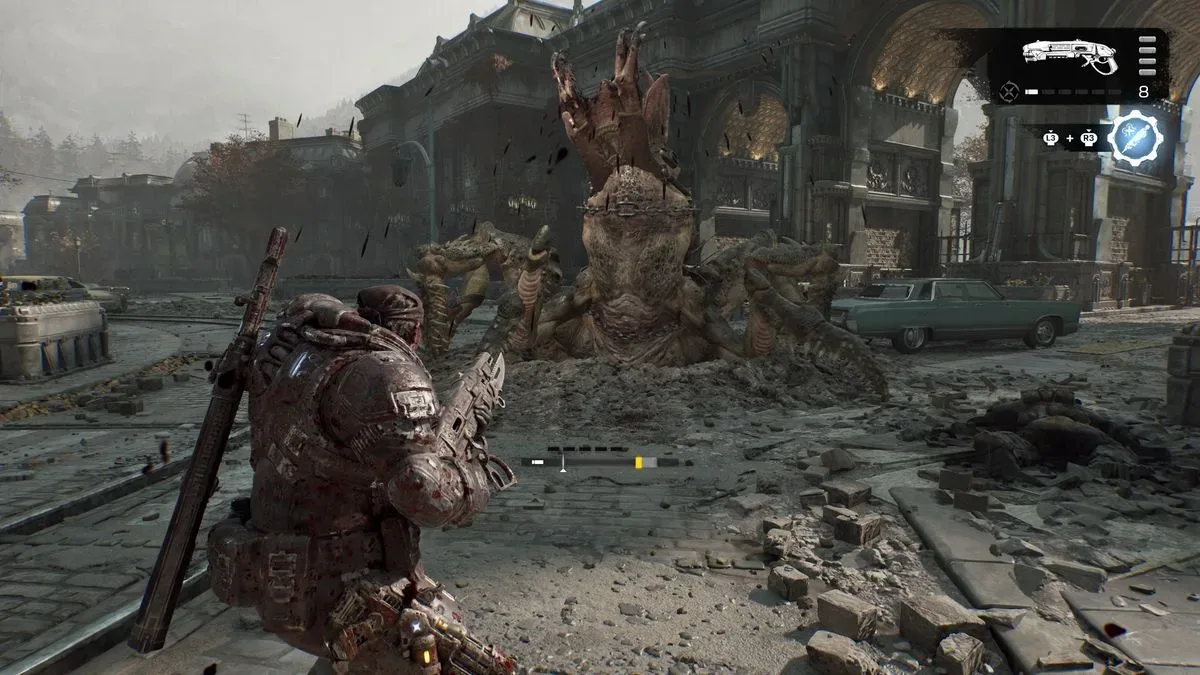
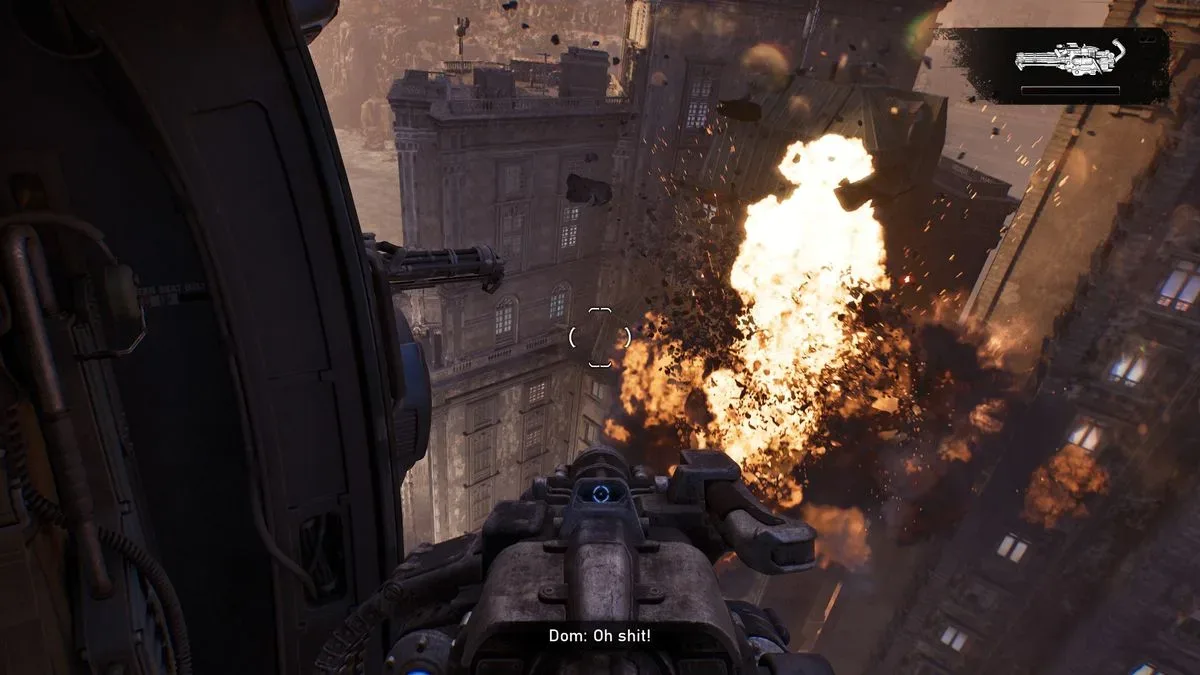
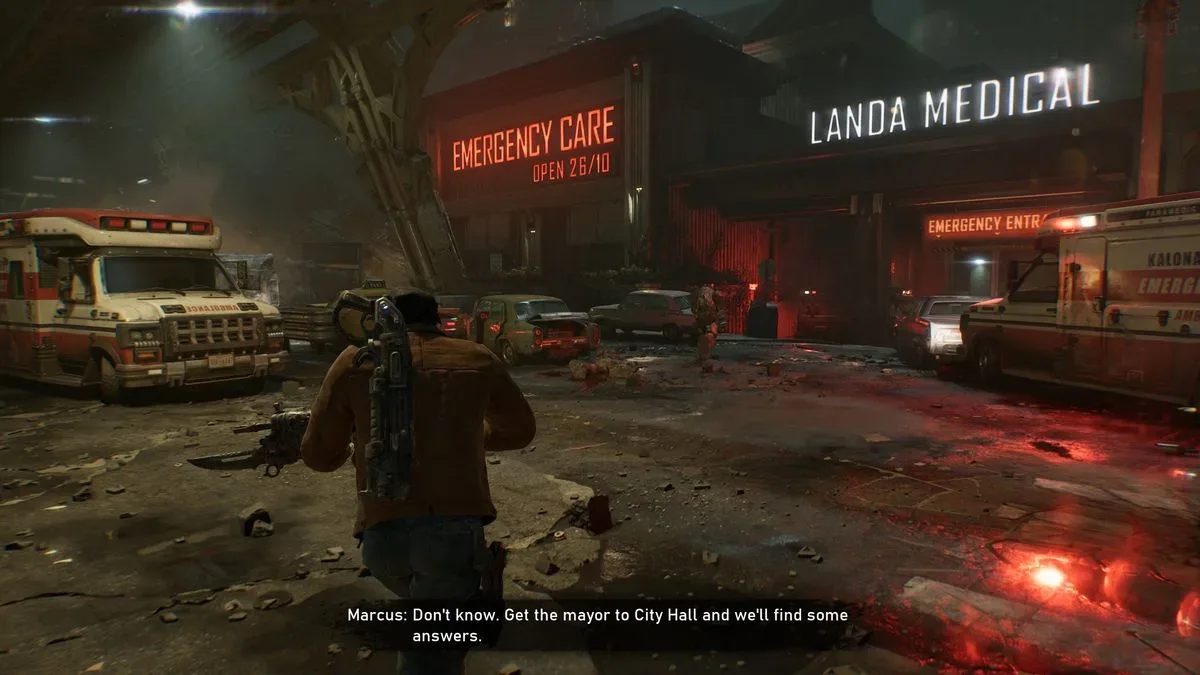
Rather than jumping between distant regions, the campaign remains in Kalona. That decision gives destruction a chronology. A bridge, street, or building can return later with its meaning changed by time, violence, and damage. Legacy Bridge is revisited more than once, and the campaign’s pace makes those visits feel separated by far more than a simple level transition. The city does not function as a neutral backdrop for firefights; it acts as the evidence of what has been lost between them.
That is a useful distinction for a game built around spectacle. Plenty of shooters can demolish scenery, but repeat locations can make that demolition legible. Players are not merely told Kalona is falling. They can recognize portions of it, then see what the invasion has done to them. The campaign reportedly stays close to Fenix rather than frequently cutting away, reinforcing the feeling that events are unfolding in real time rather than being summarized from a safe distance.
There is room for Gears’ famous oversized personalities and profanity amid that bleakness. The prequel’s more interesting dramatic move is reportedly to let bravado coexist with grief, trauma, and survival. In other words, E-Day does not abandon the blunt, muscular identity of Gears; it tries to expose why people might cling to that attitude in an apocalypse.
Related coverage includes Gears of War: E-Day Campaign Review-in-Progress: Kalona’s Fall Revives the Series’ Cover-Shooter Strengths.
Kalona’s repeated locations turn the campaign’s destruction into something players can track rather than simply admire from a distance.
Adaptive cover changes the shape of a firefight
The campaign’s narrative focus would matter less if the shooting did not meet it halfway. E-Day’s major mechanical point of difference is an adaptive cover system. In cover shooters, “cover” traditionally means designated objects—waist-high walls, conveniently placed concrete blocks, vehicle panels, or obvious corners—where a character can snap into a protected position. It is a system that provides readable combat spaces, but it can also make environments resemble carefully disguised obstacle courses.
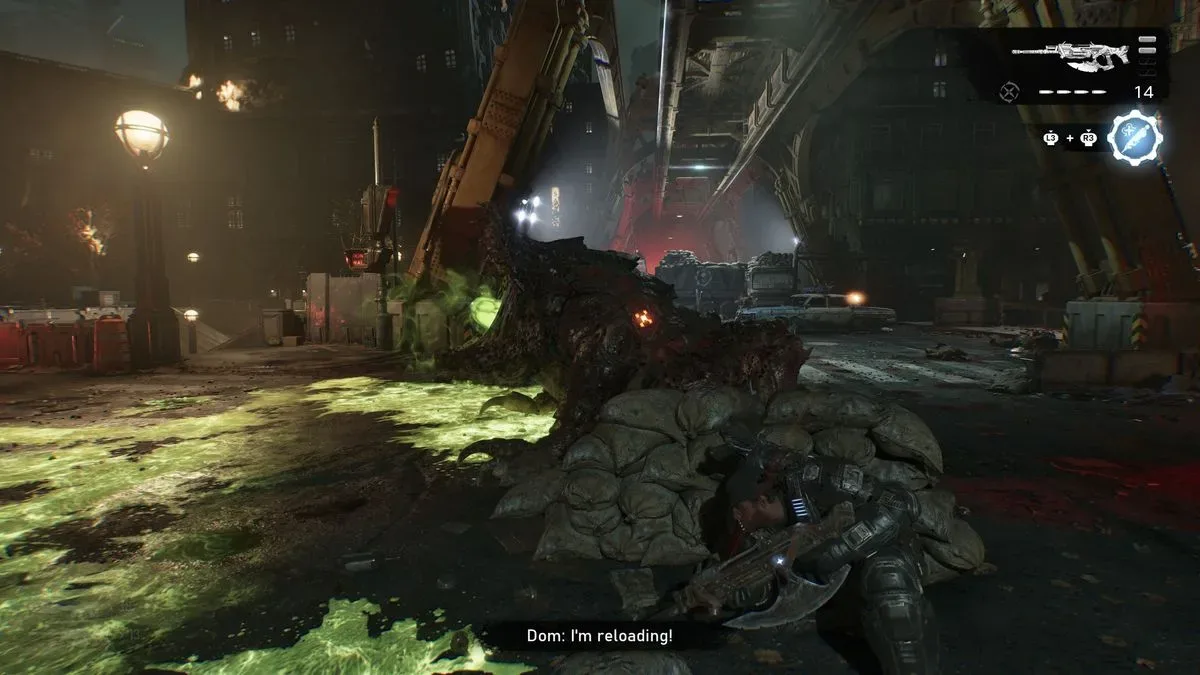
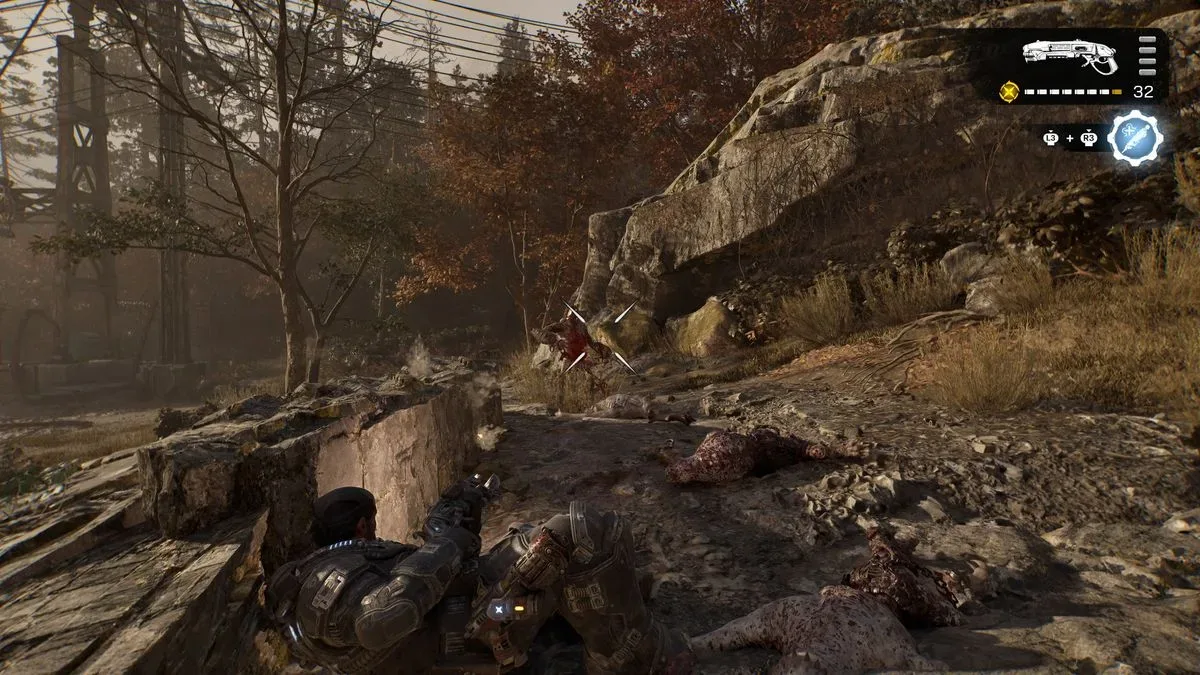
E-Day aims to loosen that convention. More of Kalona’s physical clutter can apparently be used for protection, including low rubble. Fenix can dive behind it and fire while lying on his back. The practical result is not simply more animations. It means that when enemies force a player off a favored position, the next defensive choice may be a piece of wreckage that looks like it belongs in a damaged city rather than an object placed to satisfy a level-design rule.
This has an important knock-on effect. Natural-looking cover makes Kalona feel more like a functioning urban environment before and during its collapse. It also makes fights scrappier. Instead of a clean sequence of advancing from one obvious barrier to the next, players can use whatever remains when a street, station, or fortification goes wrong.
That flexibility is especially relevant because the Locust are described as aggressive and tactically varied even at normal difficulty. Crawling enemies can rapidly close distance, while armed Drones use cover, fire on the player, and attempt flanking maneuvers rather than reliably charging straight forward. New enemy types arrive selectively enough to retain their menace, including acid-spitting creatures and aerial threats that rain fire down on the battlefield.
The implication is that adaptive cover is not an isolated feature list bullet. It is a response to pressure. A player who is being flanked, rushed, or shelled needs a way to improvise, and the city’s debris supplies it. The best cover-shooter systems create a rhythm between holding ground, losing it, and reclaiming it. E-Day appears to understand that a frantic retreat can be as dramatic as a perfectly executed push.
Weapons encourage adaptation, not one fixed loadout
The other promising part of the combat design is the way weapons and modifications appear to reward experimentation. Mid-range precision is viable, including the use of bolt-action rifles to pick targets apart. But limited ammunition can force a change in approach. That is a meaningful constraint in a shooter: it prevents a preferred weapon from becoming an all-purpose answer and turns scavenging into a tactical decision rather than background busywork.
The Gnasher shotgun is a particularly clear example. Its basic buckshot can seem underwhelming at first, yet it becomes devastating at extremely close range, where shooting without carefully aiming is possible. That is classic Gears logic—dangerous proximity can create overwhelming stopping power—but E-Day expands on it with modifications found in hardcases around the city.
A modification is a gameplay alteration attached to a weapon or piece of equipment, rather than a wholly separate gun. E-Day’s mods sound consequential rather than cosmetic. One reported Gnasher upgrade changes its ammunition to slug rounds, enabling more capable headshots from several meters away. Slugs are single solid projectiles rather than a spread of pellets, so the change naturally shifts the shotgun toward greater precision and range.
The Longshot sniper rifle can also be reshaped. Replacing its long-range scope with an over-the-shoulder reticle alters how the weapon is aimed, while another mod reloads a round after each headshot. Together, those changes encourage a faster, more mobile precision style than a conventional long-distance sniper role. The value is not merely that the rifle becomes stronger; it becomes suited to a different combat situation.
That kind of system gives players a reason to reconsider gear they initially dislike. It also supports different roles in the campaign’s one-to-four-player format without promising that everyone must use a predetermined class. One person may lean toward a modified precision rifle, while another takes advantage of shotgun range or a more conventional assault setup. The returning Lancer remains an obvious emblem of Gears thanks to its chainsaw bayonet, and the acid-spitting Incinerator shotgun adds another distinct option.
There is one notable caveat: melee reportedly feels softer and less weighty than the gunplay. That may matter to players who associate the Lancer’s chainsaw with the franchise’s identity. Still, the criticism is revealing in its own way. It suggests that E-Day’s strengths are most pronounced when it embraces tense exchanges of gunfire, movement, ammunition management, and weapon specialization rather than trying to make every close-quarters action equally dominant.
What the current assessment does—and does not—settle
For players primarily interested in a solo or cooperative story campaign, the available picture is very encouraging. The campaign has a defined five-act structure, an estimated 16-hour run with most optional objectives completed, and a setting designed to make its destruction feel cumulative. Optional missions appear to offer extra combat encounters, not just a checklist hunt for collectibles. That distinction matters for anyone deciding whether to explore: the incentive described here is more of the game’s central activity, not merely completion percentage.
It is also worth keeping the review-in-progress status front and center. Multiplayer is part of the full package and has not yet been judged alongside the campaign. No overall score has been assigned. A great campaign does not automatically answer questions about competitive balance, online stability, mode variety, matchmaking, or long-term multiplayer appeal. Those are separate considerations, and they should remain separate until the components are available.
The wider backdrop is difficult as well. The Coalition is reportedly facing further Xbox layoffs at the same time E-Day approaches release. That makes the positive campaign reception feel complicated rather than triumphant in a simple way: the work being praised is arriving amid uncertainty for the people and studio connected to it. The game itself should be evaluated on its merits, but that context cannot be ignored when discussing a major first-party release.
For now, E-Day’s clearest achievement appears to be focus. It takes a defining catastrophe from Gears lore and gives it one city, one sustained viewpoint, and a cover system built to make ruined spaces playable. Kalona’s collapse supplies the drama; adaptive cover supplies the survival instinct; weapon modifications provide the tactical variety. If the eventual multiplayer evaluation lands well too, the full release may be a major restoration of form for Xbox’s signature third-person shooter series.
It also arrives during a period when studios openly weigh new projects against remakes and ports, a resource question explored in this look at development priorities and limited resources. E-Day’s prequel structure offers a different route: returning to an earlier chapter while making a new game centered on its own setting and mechanical ideas.