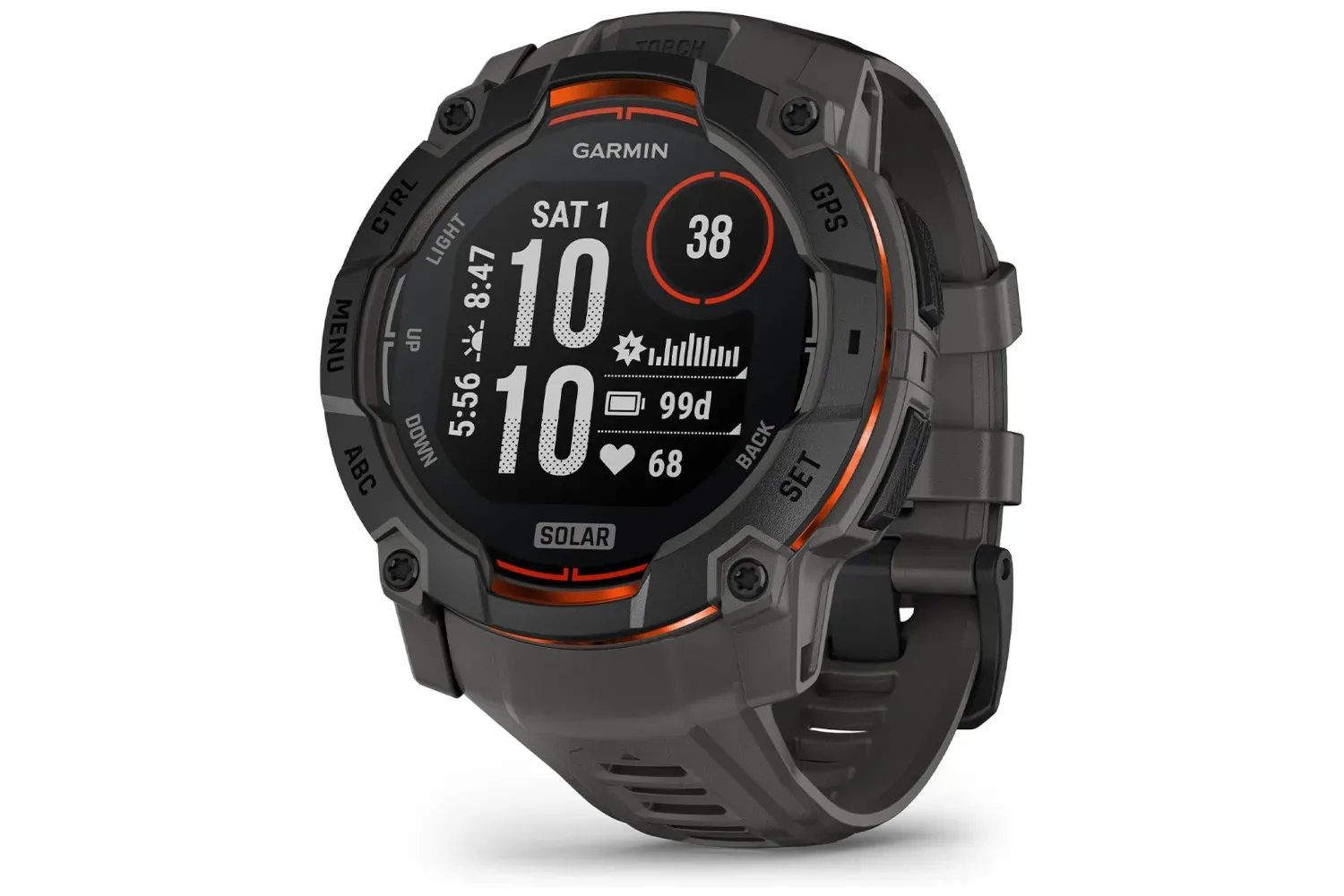
The Garmin Instinct 3 Solar smartwatch has been listed at $300, against a stated regular price of $450. That is a $150 reduction, or roughly 33% off the reference price. It is positioned as a short-term offer, so shoppers should treat the price as a listing rather than a permanent new baseline and confirm it before purchasing.
For people who want a wearable that can handle notifications and weather checks but are more interested in outdoor navigation and long stretches away from a power outlet, the meaningful part is not simply the discount. It is the particular mix of solar charging, GPS, compass, barometric altimeter, health tracking, and a 50mm fiber-reinforced polymer case. Those are the features that distinguish this model’s stated purpose from a smartwatch that is mainly an extension of a phone.
The price: $150 off the stated regular cost
At the listed $300, the Instinct 3 Solar is $150 below the supplied $450 regular price. Percentage discounts can make a deal sound abstract, but the cash difference is clearer: buyers are being asked to spend one-third less than that stated reference price.
That does not automatically make it the right watch for every wrist. The available information supports its credentials as an outdoor-oriented smartwatch, rather than establishing that it is a universal fit. A sensible purchase decision should begin with whether its navigation and battery-focused design solve a real need. Someone who primarily wants a compact notification screen may not get the same value from the watch’s rugged construction and outdoor sensors as someone who expects to use them.
The deal is especially worth examining for a buyer who had already been considering a durable GPS watch. A lower price changes the cost of entry, but it does not change the underlying product: this remains a sizable 50mm watch with an outdoors-first feature set.
Solar charging is about extending time away from an outlet
“Solar” in the product name points to one of the watch’s central practical ideas: it can continue charging while outdoors. The useful takeaway is not that power becomes unlimited. It is that access to daylight can help the watch remain usable for longer without returning to a wall charger.
That matters most when a device is being used in the situations that consume the value of a conventional smartwatch’s convenience: extended time outside, travel, or activities where stopping to recharge is inconvenient. Solar charging is therefore a resilience feature. It is designed to reduce dependence on an outlet rather than replace the need to think about battery status altogether.
For prospective owners, the key question is simple: would more charging flexibility materially improve how they use a watch? If the answer is yes, the Instinct 3 Solar’s proposition is easier to understand. If a wearer routinely charges devices beside a bed or desk and rarely spends substantial time outdoors, solar capability may be less important than the other functions.
Navigation tools explained: GPS, compass and barometric altimeter
The watch includes GPS, a compass, and a barometric altimeter. Together, those features are aimed at orienting a wearer outdoors rather than merely recording that they went for a walk.
GPS
GPS, short for Global Positioning System, is used here to help establish location and assist with finding one’s way. In practical terms, it is the feature most directly connected to the stated use case of avoiding—or recovering from—getting lost. GPS is particularly relevant to walkers, hikers and others whose route can move beyond familiar streets.
Compass
A compass provides directional reference. Its straightforward advantage is situational orientation: knowing which way is north and using that information to keep a chosen heading. A compass does not replace planning, local knowledge, or sound judgment outdoors. It is simply another tool for understanding direction when landmarks are unclear.
Barometric altimeter
A barometric altimeter uses air-pressure information to help indicate altitude. For users moving over varied terrain, altitude is another piece of context that can complement location and direction. The supplied details identify the sensor but do not make broader promises about expedition features, mapping, accuracy conditions, or performance in particular weather. Buyers should keep their expectations tied to the functions confirmed here.
These tools make the Instinct 3 Solar’s outdoor emphasis more concrete. GPS answers the broad question of where a person is; a compass helps establish direction; and an altimeter adds elevation context. None needs to be treated as a magic safety button, but they can be useful components in a more informed outdoor routine.
A rugged case built around outdoor use
The Instinct 3 Solar has a 50mm fiber-reinforced polymer case. Fiber-reinforced polymer is a material choice associated here with durability, and the large 50mm measurement signals that this is not being presented as a discreet, jewelry-like smartwatch.
That has two implications. First, the construction matches the watch’s stated mission: it is meant to be dependable across demanding outdoor conditions. Second, fit matters. A 50mm case is a specification buyers should consider in relation to their preferred watch size and comfort. A rugged tool-watch look can be a strength for someone who wants that presence, and a trade-off for someone seeking an understated everyday device.
Durability is also best understood as a design priority, not permission to be careless. The supplied information describes a hard-wearing case; it does not establish every environmental rating or guarantee survival in every circumstance. That distinction keeps the appeal of a rugged build grounded in what has actually been specified.
Everyday smartwatch functions still matter
The outdoors hardware is only part of the package. The Instinct 3 Solar can also show notifications and weather information, with a customizable standard screen. Those capabilities help it function as a watch for ordinary days, not only an accessory reserved for trips.
Notifications can reduce the need to constantly pull out a phone, while weather information is especially relevant to people already spending time outside. Screen customization, meanwhile, lets users choose which information is most immediately visible. The supplied details do not list all possible layout options, app support, or phone compatibility, so shoppers should verify those specifics if they are decisive.
There is a useful buying principle here: decide which information you want on your wrist before focusing on the number of features. A person who values glanceable weather and alerts may use the core smartwatch functions often. Another may care far more about GPS and the compass. The best value comes from the overlap between the watch’s confirmed tools and the wearer’s routine.
Health tracking adds another layer, with sensible limits
Garmin’s watch is also described as tracking heart rate and sleep quality, alongside additional health features. For users trying to build a clearer picture of activity and rest, that data can be useful as part of regular personal monitoring.
Still, “tracking” should not be confused with medical diagnosis. The details provided identify heart-rate and sleep-related functions, but do not make clinical claims. It is more accurate to view them as wellness-oriented measurements that can help a user notice patterns over time than as a substitute for professional care.
The combined proposition is broad but coherent: the same watch can surface a message during the workday, record health-related information overnight, and provide location, heading, elevation context, and solar-assisted charging while outside. It is the continuity between these roles that makes the $300 listing potentially compelling for its intended audience.
Who should give the deal a closer look?
- Outdoor-focused buyers: The stated GPS, compass, barometric altimeter and solar charging make the strongest case for people who expect to be outside and away from outlets.
- Wearers seeking a tougher build: The 50mm fiber-reinforced polymer case is the relevant specification for anyone prioritizing durability over a more delicate watch style.
- People who want basic smartwatch convenience too: Notifications, weather information and a customizable screen prevent the device from being only a navigation tool.
- Routine health-data users: Heart-rate and sleep-quality tracking may be useful for someone who wants wellness information collected on the wrist.
Conversely, buyers should pause if the 50mm size does not suit their comfort preferences, or if they do not expect to use the outdoor-oriented hardware. A discount is most useful when it lowers the cost of a product that already fits the job.
Anyone refining a wider tech setup may also find it useful to consider how other devices and network choices affect everyday connected use; this guide on better Wi-Fi router placement for more reliable gaming connections covers a separate but similarly practical piece of that puzzle.
For the Garmin Instinct 3 Solar, the headline is straightforward: a stated $450 smartwatch is listed for $300, with the biggest appeal centered on solar-assisted charging, outdoor orientation tools, rugged construction and everyday smartwatch basics. Confirm the live price, color availability, and any purchase details before checking out, then judge the offer on whether those capabilities are ones you will actually use.
Shop the products
Check current price, model and availability at the retailer.