Final Fantasy XIV has built a great deal of its social life around optional activities. The Gold Saucer, the game’s entertainment hub, is where adventurers step away from saving the world to spend gil, try diversions and, crucially, chase cosmetics. That makes the newly revealed Keybound Brawler minigame an unusually revealing flashpoint before players have even had a chance to play it.
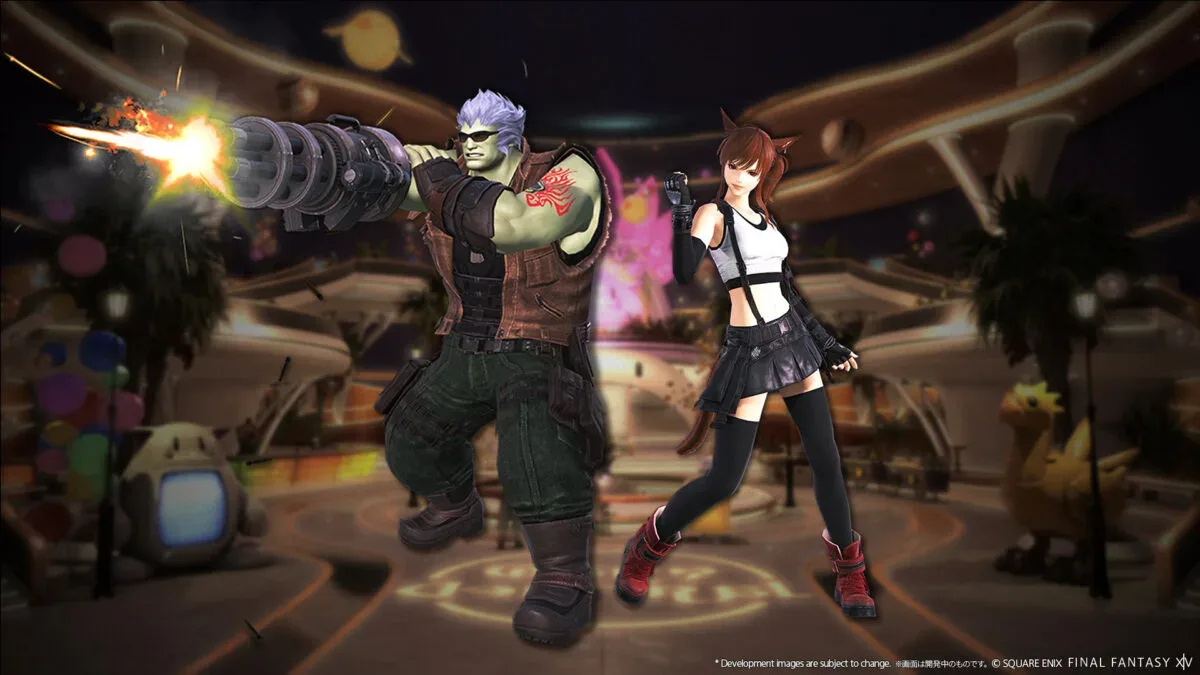
The minigame is part of Final Fantasy XIV’s planned crossover activity with the Final Fantasy VII remake project, alongside a raid series themed around the remake trilogy. Keybound Brawler takes its cue from typing games such as The Typing of the Dead: players need a keyboard to enter prompts and complete the activity. Its initial rewards include outfits based on Barret and Tifa. On paper, that is a very Square Enix sentence: a crossover, a Gold Saucer attraction and immediately recognizable wardrobe prizes.
In practice, the reaction has focused on two restrictions. First, the game requires a keyboard despite Final Fantasy XIV having a substantial console audience. Second, the first set of rewards is gender-locked: male characters can wear the Barret outfit, while female characters can wear the Tifa outfit. Both choices may sound narrow in isolation. Together, they turn an optional diversion into a question of who can comfortably participate and who gets to use the cosmetic prize they earned.
A keyboard-only game in a cross-platform MMO
Keybound Brawler’s basic premise is straightforward. A typing game is designed around text entry, timing and accuracy, so a keyboard is not a decorative peripheral; it is the central input device. “Keyboard-only” here means that a controller alone is not sufficient for the intended play method. Players on PC are likely to see that as unremarkable. For players who have used a controller as their primary Final Fantasy XIV setup for years, it is a different proposition.
That distinction matters because console access is not synonymous with a keyboard already being available. A player may own a wireless keyboard, may be willing to connect one, or may use one for chat. But those are individual arrangements rather than an assumption built into every console play space. Some players may need to buy, borrow or make room for an accessory specifically to access a single minigame.
The objection is therefore not necessarily that a keyboard should never be used in Final Fantasy XIV. The game’s PC heritage and text-heavy communication make keyboards familiar to plenty of players across platforms. The frustration is about a leisure activity becoming conditional on hardware that is not part of the default controller experience. When an MMO adds something with an exclusive reward attached, “optional” can carry less weight than developers expect: players may not need it to progress through the main story, but they may still very much want the activity and its prizes.
The timing sharpens that concern. Final Fantasy XIV has recently launched on Switch 2, creating another path for console players. A typing game may be a clever thematic fit for a Gold Saucer distraction, but it also arrives as the game broadens the set of players for whom a controller-first setup is likely to be the norm.
There is a useful distinction between platform support and feature accessibility. Platform support means the game runs on a system. Feature accessibility asks whether a particular mode, reward or system can be used reasonably with the equipment players normally use on that system. Keybound Brawler’s response has put that second issue under a microscope.
This is not a prediction that the minigame cannot work on console. Players can connect keyboards, and the stated criticism itself recognizes that a keyboard may be a relatively inexpensive solution. The practical concern is more modest and harder to dismiss: a game enjoyed for years with a controller is now offering a new attraction that asks some players to change their setup before they can take part.
The larger dispute is about glamour
The stronger backlash concerns the Barret and Tifa costumes. Final Fantasy XIV players often describe cosmetic customization as “glamour is the endgame.” The phrase is humorous, but the underlying point is serious: appearance is a long-running objective in a game where players gather outfits, coordinate looks and present their characters in shared social spaces.
Glamour is the game’s term for cosmetic appearance. In practical terms, it lets a player’s equipment look like something else, separating visual style from the item’s gameplay function. That separation is why an outfit based on a crossover character can matter even when it provides no combat advantage. It is a form of expression, an incentive to participate in events and a durable reward players may use long after a minigame’s novelty fades.
Under the announced first iteration of Keybound Brawler, that expression is split by character gender. The Barret clothing is limited to male characters; the Tifa clothing is limited to female characters. The response makes sense in a community that sees the ability to mix and match fashion as part of the game’s appeal. A player can appreciate both Final Fantasy VII characters and still feel that being told which outfit their own Warrior of Light is allowed to wear is an unnecessary limitation.
It is also worth separating this complaint from an argument about whether the costumes match their original characters. Players are not demanding that the source material stop having gendered characters. The objection is to carrying that division over into a player avatar system, where the reward is meant to be worn, styled and personalized. A Barret-inspired look and a Tifa-inspired look can remain recognizably rooted in their characters without being limited to one character gender.
Why the restriction feels like a step backward
The reason the restriction has landed especially badly is Final Fantasy XIV’s own recent history. In 2020, director Naoki Yoshida announced that the game’s wedding outfits would have their gender restrictions removed. Before the Endwalker expansion, the game also removed the gender restriction on maid outfits. These changes established a clear expectation: older limitations on cosmetic clothing could be revisited, and players would be given more freedom over how their characters dressed.
That precedent does not prove that every future item must follow identical rules. Different items can have different technical, production or design considerations, and no such explanation has been provided here. But it does explain why the Keybound Brawler rewards are being assessed against more than their own immediate details. Players have already seen the game move toward fewer gender restrictions on attire. Reintroducing the limitation for highly visible crossover outfits looks inconsistent with that direction.
The presence of male Viera in the game’s character options further gives the earlier maid-outfit change symbolic weight for players. It was not merely an isolated wardrobe adjustment. It formed part of a broader sense that Final Fantasy XIV was becoming more flexible about player presentation. That is the expectation Keybound Brawler now collides with.
Consistency is especially important in live-service games because players learn the rules not only from tooltips but from past decisions. Once a system has loosened old restrictions, new restrictions invite immediate questions: is this intentional policy, a temporary implementation choice, or a limitation that can be changed later? Nothing in the available information resolves those questions. The current reaction is to what has been shown, rather than to a confirmed long-term answer from the development team.
Two issues, one shared concern
The keyboard debate and the glamour debate are not identical. One is about input hardware. The other is about cosmetic eligibility. Yet both concern the boundaries around an otherwise appealing piece of optional content.
For a controller player without a keyboard, the barrier is getting into the minigame. For a player who wants the “other” costume, the barrier appears after participating successfully. One says, “bring a different device”; the other says, “your character cannot wear that reward.” Seen together, they create the impression that Keybound Brawler is unusually prescriptive for a Gold Saucer activity, a place associated with side content and playful experimentation.
That mismatch is at the heart of the reaction. The crossover itself has obvious appeal: Final Fantasy VII-themed material arriving in Final Fantasy XIV, with a raid series and a themed minigame, gives players multiple ways to engage with the event. But crossover content also attracts people who care intensely about representation and recognizable rewards. The more desirable the Barret and Tifa looks are, the less likely players are to shrug off a restriction on wearing them.
MMOs regularly face this kind of tension as they add content for a diverse player base. A feature can be mechanically logical while still creating a poor fit for some players’ usual setup. A costume can be faithful to its inspiration while still feeling needlessly narrow in an avatar-driven game. The lesson is not that every activity must use every input method or that every cosmetic design needs to abandon its identity. It is that reward access and player expression are part of the feature, not details to be considered after the activity is designed.
That is also why community reactions can be valuable well before launch. They identify where a small rules decision is likely to have an outsized effect on how welcomed players feel. Other MMO communities have had similar debates about how live games serve long-established and newly arriving audiences; even seemingly limited platform decisions can become a wider conversation about access, as seen in recent MMO beta and reservation discussions.
What is known—and what is not
The known details are narrow but clear. Keybound Brawler is a keyboard-required typing minigame planned for Final Fantasy XIV’s Gold Saucer. It is connected to the Final Fantasy VII remake crossover activity. Its first reward iteration includes Barret- and Tifa-themed outfits, with Barret’s restricted to male characters and Tifa’s to female characters. Players on social media and the game’s community spaces have objected to both the keyboard requirement and the gender-locked clothing.
What is not established is equally important. There is no provided indication that the typing requirement will receive a controller alternative, that the reward restrictions will be removed, or that either design choice is permanent. There is also no stated explanation for why the clothing has been restricted after prior apparel restrictions were lifted. Until further details arrive, the discussion is necessarily about the configuration presently described.
For now, Keybound Brawler has accomplished something no Gold Saucer game should aspire to: it has made players argue about peripherals and wardrobe eligibility before they can even sit down to play. The concept still has a natural home in Final Fantasy XIV’s carnival-like side activity space. Whether it becomes a fondly remembered crossover distraction may depend less on the typing prompts than on whether its access rules feel as playful as the minigame itself.