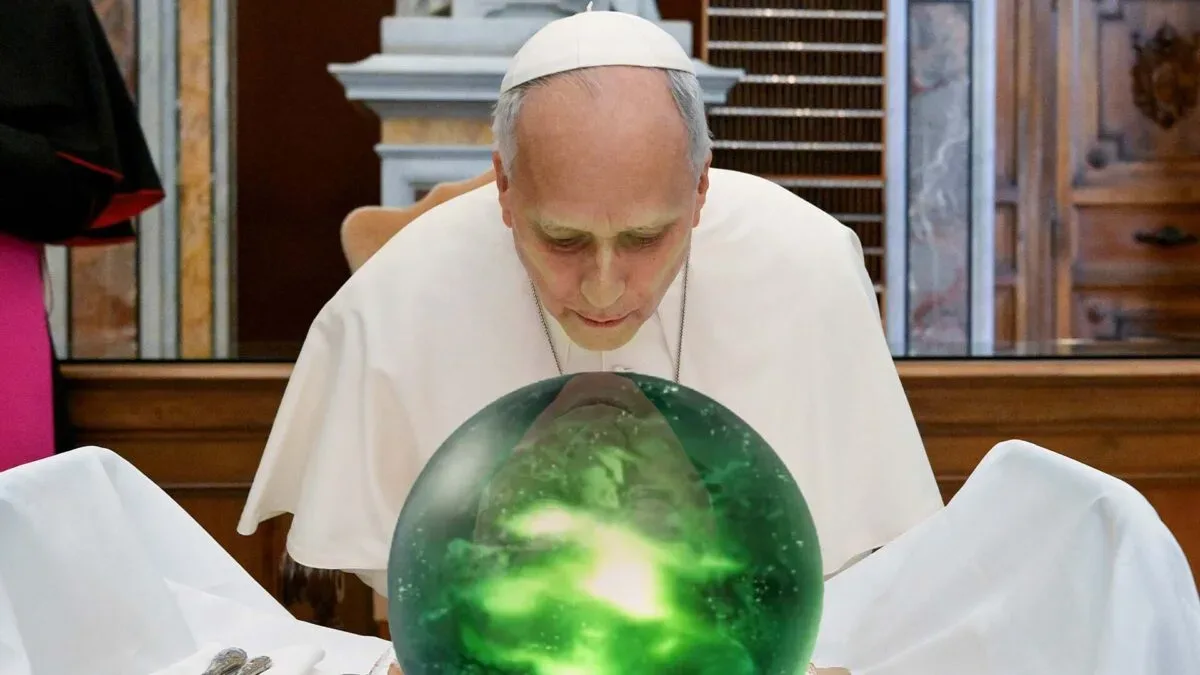
There are ceremonial gifts, there are symbolic works of art, and then there is a large luminous green sphere that looks so much like Final Fantasy VII Materia that the gaming brain immediately starts checking available equipment slots.
Pope Leo XIV has received a hand-blown Murano glass orb from Saint Peter for Humanity, a Vatican-affiliated nonprofit. The organization frames the work as a symbol of retaining humanity in the age of artificial intelligence. Yet for plenty of game players, the first and most persistent reading is much simpler: somebody has presented the Pope with an extremely imposing piece of green Magic Materia.
It is a wonderfully specific collision of visual language. The gift is not being presented as licensed game merchandise, a game prop, or a claim to supernatural power. It is a piece of symbolic glasswork. But its glowing green, spherical form lands squarely in the mental image many players have for Materia—the magical orbs associated with the world of Final Fantasy VII. The resemblance is strong enough that the joke practically equips itself.
Why the Materia comparison is so immediate
In gaming terms, Materia is the name for an equipable orb associated with magical capabilities in Final Fantasy VII. The supplied account identifies the Pope’s green lookalike specifically with Magic Materia, which is connected to casting black and white magic when equipped. That association turns an otherwise formal presentation into an imaginary party-management screen: which weapon gets the slot, which cardinal receives it, and what spell is waiting inside?
The exact spell, of course, is unknown because the glass sphere is not actually identified as Materia. Its makers have offered a different symbolism entirely. Still, color does much of the comic work. The green hue led to speculation that it could be “Wind Materia,” a playful label that evokes spells such as Aero, Aerora, and Aeroga. That is fan interpretation, not a description supplied by the organization, but it explains why the response has centered on magic rather than merely on a green decorative object.
The joke works because Materia has a recognizable visual identity even outside its original game context. A smooth, glowing orb signals potential: an object that could be held, socketed, activated, or guarded in an inventory. The actual work’s scale amplifies that effect. It does not merely resemble a small game collectible; it resembles the kind of unusually consequential item that would make a party stop, inspect it, and wonder whether touching it begins a major quest.
A handmade object arguing for the human touch
Saint Peter for Humanity’s intended message is considerably more grounded. The group says it works to preserve, promote, and share humanity’s cultural, spiritual, and material heritage for the common good. It describes the sphere as symbolic artwork about maintaining humanity amid the growing presence of AI.
Olivier François, the group’s head, described the object as a Murano sphere blown by hand. His explanation emphasizes breath and imperfection: the sphere aims at a perfect geometric form, but is made through a human process that carries the maker’s breath and cannot be mechanically flawless. In that view, the irregularity is not a defect to be eliminated. It is evidence of the person who made the work.
Related coverage includes A Murano Glass Orb Gifted to Pope Leo XIV Has Final Fantasy Fans Seeing Materia.
Murano glass here refers to glass made using the renowned handcraft tradition associated with Murano. The crucial point in the group’s presentation is not simply the object’s material, but its method: it was blown by hand. That makes the object a compact argument for human labor, bodily presence, and creative judgment as values worth keeping visible when technological systems increasingly shape cultural life.
There is an unexpectedly fitting overlap between that message and the Materia gag. Games are deeply technological works, but the meaning players take from a visual object is social and human. Nobody needs an official explanation to see the green orb and think of a role-playing game. Shared memory, genre knowledge, and a little imaginative silliness transform the gift into a joke about casting spells. The technology may carry the image widely, but people supply the connection.
The AI context is more serious than the meme
The presentation arrives alongside Pope Leo XIV’s recent discussion of AI in the encyclical Magnifica Humanitas. His stated position is not a blanket rejection of technology. Rather, he calls for AI to be “disarmed” so it does not dominate humanity, placing the human person ahead of the machine.
That distinction matters. In ordinary usage, an encyclical is a formal papal letter addressing matters of teaching or public concern. The argument described here is therefore larger than an objection to any one device, service, or algorithm. It focuses on the relationship between people and technology: whether tools remain tools, or whether human decisions, creative practice, and dignity are subordinated to systems built to optimize other goals.
The orb is designed as a physical shorthand for that concern. A computer can model a sphere with mathematical perfection. A glassblower works toward a sphere through heat, breath, movement, timing, and material resistance. The resulting form may be imperfect in strict geometric terms, but the organization’s point is that its human origin gives it a different kind of value.
That does not mean technology and craft are natural enemies. The Pope’s formulation explicitly leaves room for technology. The practical question is who directs it, who benefits from it, and whether human agency remains intact. It is also why a deliberately handmade art object can become a useful symbol in an AI conversation: it makes the abstract issue tactile. One can look at the glass, consider how it was shaped, and understand the argument without needing to parse a technical paper.
Games have long understood the power of a charged object
There is a reason the Final Fantasy association is stickier than a generic “nice glass orb” reaction. Games routinely give objects a clear visual role. Potions, keys, quest items, gems, cards, weapons, and magical stones are made readable at a glance because players need to recognize their possible importance. A luminous green sphere arrives with built-in game grammar. It appears to be an item with stats, lore, a menu description, and at least one ominous warning attached.
That grammar also makes the online jokes unusually flexible. One person can imagine a spell list. Another can picture a party member being assigned the orb. A third can suspect that the artifact is cursed and should be handed to an eager researcher rather than equipped immediately. The humor does not require the real gift to be part of a game; it depends on everyone recognizing the fictional rules being borrowed.
For Final Fantasy followers, the timing also gives the reference a little more energy than a random throwback. Interest remains high around the series’ future, including discussion of the announced Final Fantasy 7 Revelation DLC and its still-undisclosed timeline placement. A real-world object that resembles one of the franchise’s most legible icons was always likely to draw attention.
No, it is not a gameplay item—but that is the point
The cleanest way to appreciate the moment is to hold both readings at once. The Murano sphere is a symbolic handmade gift about human creativity and the limits that should govern AI. It is also, visually, an enormous green orb that many players can only process as Materia. Neither reading cancels the other.
If anything, the second reading gives the first a wider cultural route. The comparison makes the object memorable, while the object’s actual purpose gives the joke something substantial to orbit. A meme-friendly image has become a prompt to talk about authorship, craft, technology, and the strange durability of game iconography.
As for the urgent question of whether Pope Leo XIV should equip it: the available evidence supports only a hand-blown glass sphere and a human-centered message, not access to wind magic. Until a menu screen appears, it is probably safest to treat the orb as art rather than as an invitation to cast Aeroga.