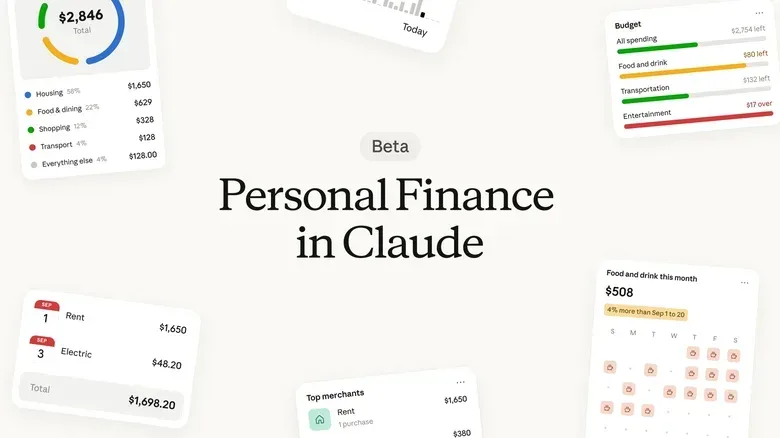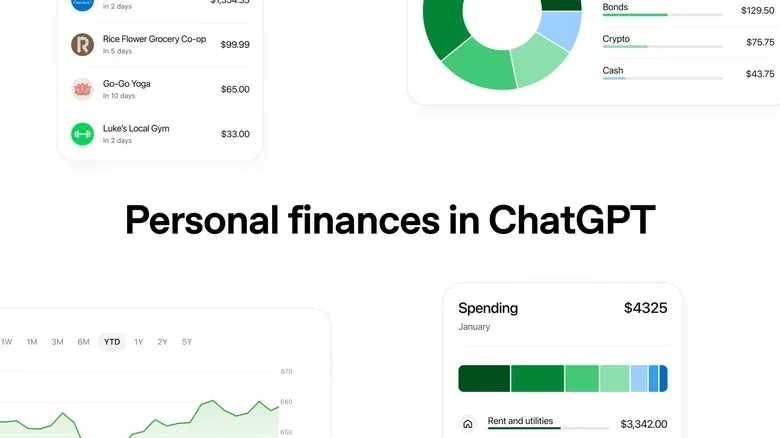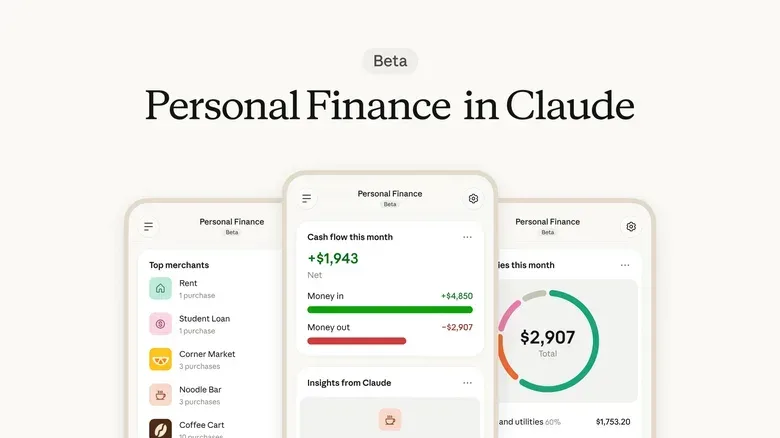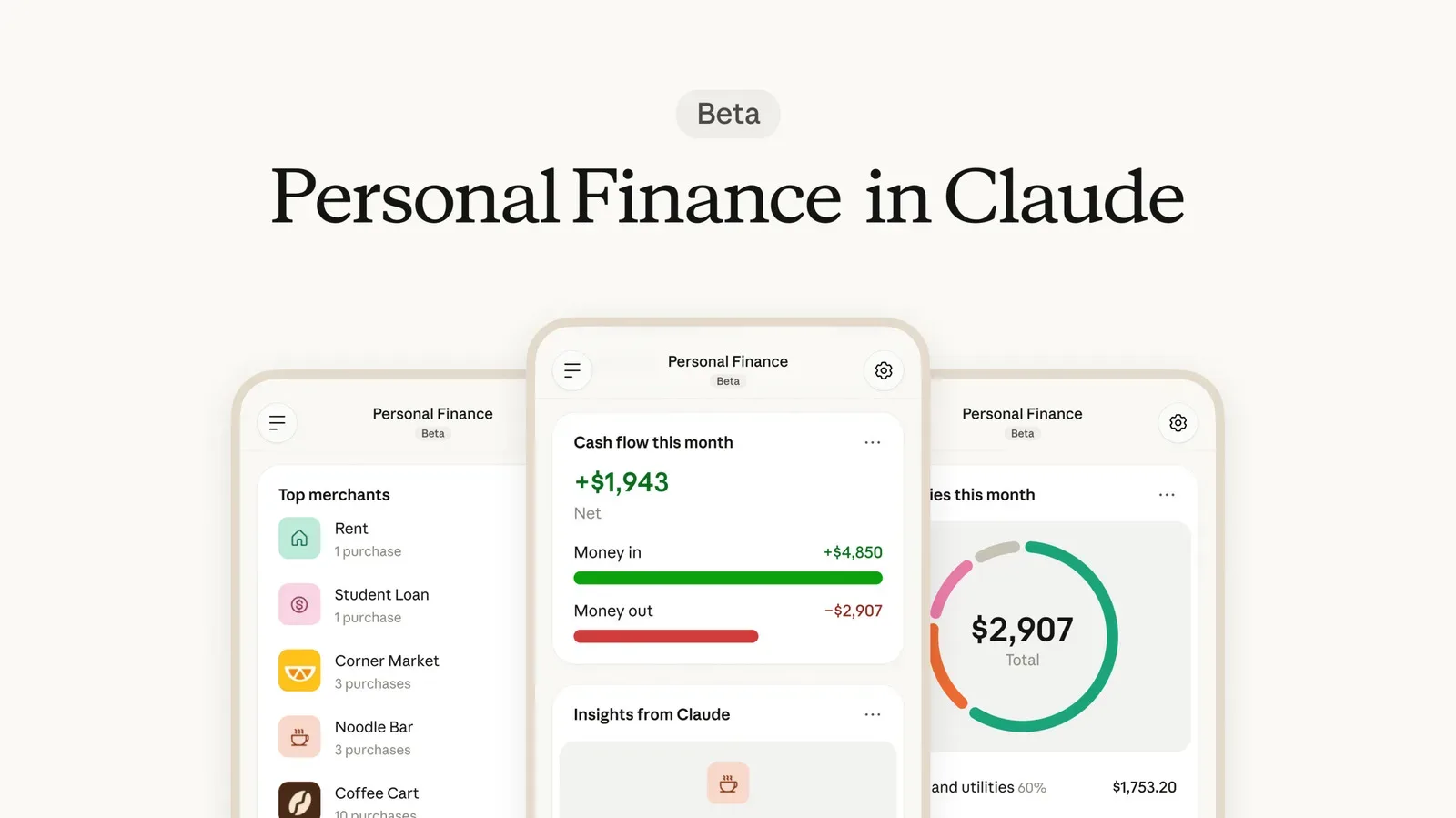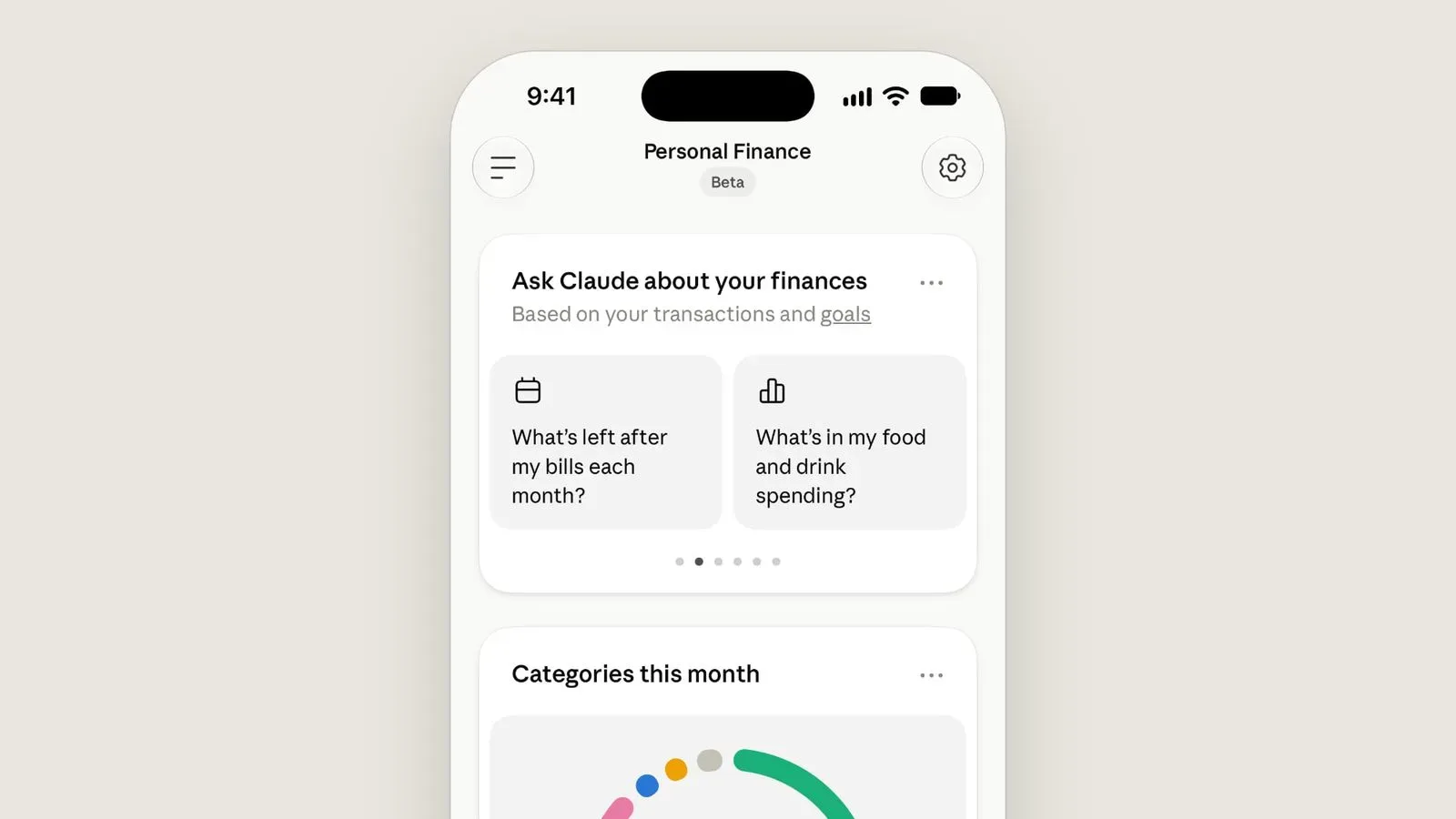
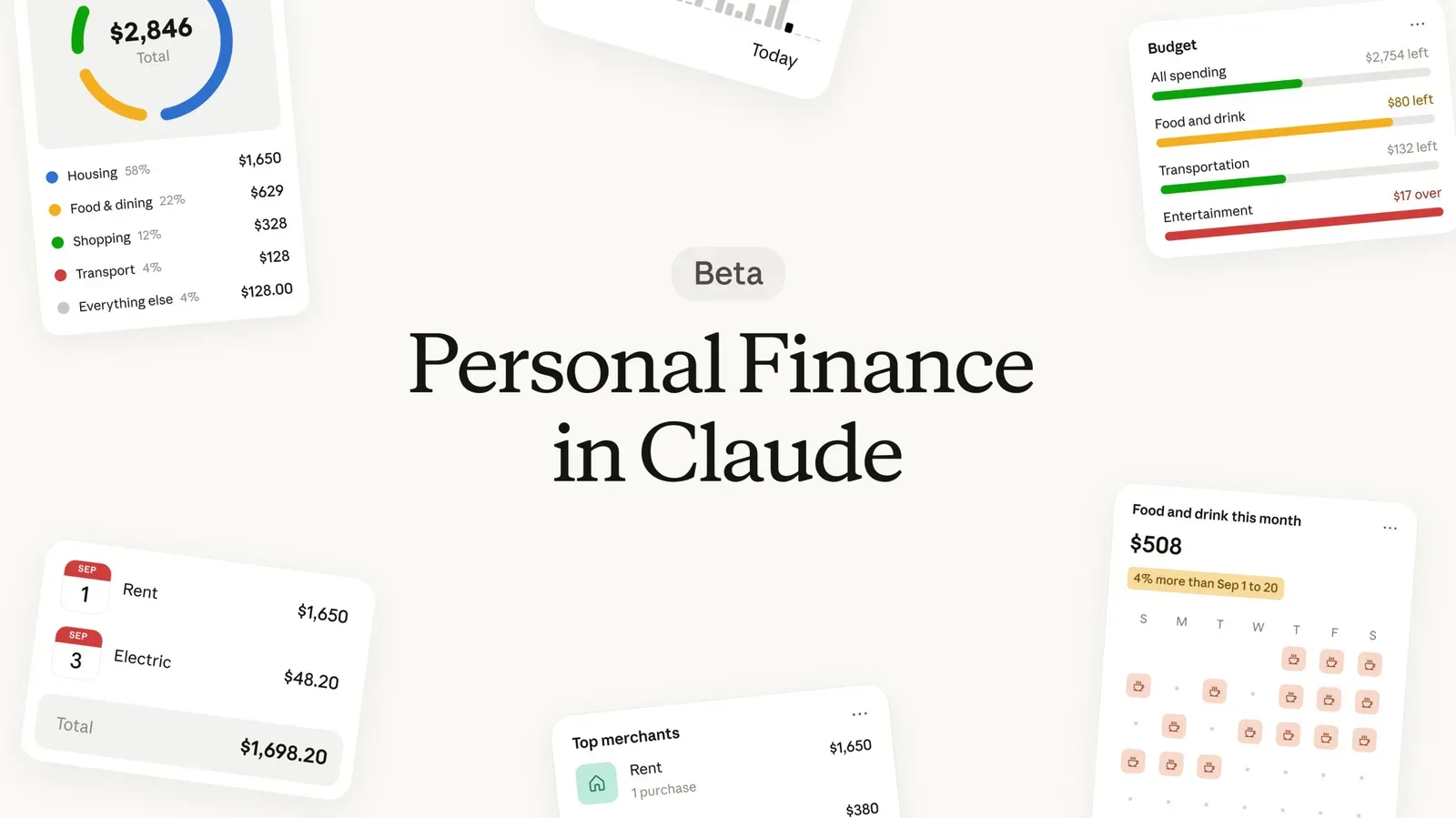
AI finance tools are starting to look less like a novelty prompt box and more like a dashboard sitting on top of a person’s everyday money. Anthropic’s Claude Personal Finance and OpenAI’s ChatGPT Finances take a similar basic route: link a financial account, let the service read account information, then ask questions about spending, saving, investments or a major goal.
That overlap makes the comparison simple at first glance. Both services can help organize a view of monthly expenses, spending habits and investments. Both can discuss goals such as saving for a house or planning a costly family trip. Neither is positioned as expert financial advice. And both use Plaid to connect with major financial institutions, including Bank of America, Capital One and Chase.
The more consequential difference is not the dashboard design or the wording of a suggested savings plan. It is what happens to the conversation around highly sensitive financial data. Claude’s Personal Finance hub does not use those conversations for model training by default. ChatGPT Finances follows the broader ChatGPT model-training preference, where the setting to improve the model for everyone is on by default unless the user turns it off.
For anyone weighing an AI assistant against the intimate record of their finances, that is the setting worth understanding before linking an account.
What the two finance features have in common
Both products are designed to translate raw account activity into something easier to inspect. A bank feed is often a long list of merchant names, deposits, transfers and purchases. A dashboard can make that information more legible by grouping it into broader views of monthly expenditure, investment activity and spending patterns.
That does not mean an AI tool suddenly becomes a financial planner, accountant or fiduciary. A fiduciary is generally expected to act in a client’s best interest; these chat features are not presented as that kind of professional service. Their intended role is closer to helping a user explore the information already present in linked accounts and discuss possible goals.
For example, a user may want to understand whether recurring spending leaves room for a new savings target. Another may want a high-level view before setting aside money for a large purchase. In the gaming world, that could mean getting a clearer picture of whether a PC upgrade belongs in the budget now or later—an especially relevant question when the value of a platform upgrade can involve performance, heat and power as well as the sticker price, as discussed in this look at the complicated PC CPU upgrade decision.
In each case, the useful output is clarity, not a command to spend or invest. A generated dashboard can expose patterns a person had not noticed, but it cannot independently establish whether a recommendation is suitable for that person’s obligations, risk tolerance or future needs.
Read-only access is an important limit
Each service describes the linked access as read-only. In practical terms, the assistant can view the information supplied through the connection but cannot change the account. It should not be able to transfer funds, trade investments, pay a bill or alter an account setting through this access.
That is a meaningful boundary, but it should not be confused with a claim that the information is trivial. Read-only financial data can still reveal a great deal about a person: where money arrives from, regular bills, shopping patterns, debt payments, travel activity and account balances. The inability to move money narrows one kind of risk; it does not erase the privacy importance of the connection.
Plaid is the connection layer used by both companies. The practical takeaway is that linking a bank account is not merely typing a question into a chatbot. It is an account-data connection that enables the assistant to work from actual financial information rather than a manually supplied estimate.
What each service says it can see
Anthropic describes Claude Personal Finance’s visible data as a bank name, account name, account type, the last four digits of an account, balances, credit limits and up to two years of transactions. That combination can support a retrospective review of spending over a substantial period, rather than only a snapshot of the present balance.
OpenAI says ChatGPT Finances can access balances, transactions, investments and liabilities. Liabilities are financial obligations or debts, while investments are assets held with the expectation of a financial return. Including those categories can provide a broader picture than checking-account transactions alone, though what appears will depend on the connected accounts and data available through the connection.
The descriptions are not word-for-word identical, so users should resist assuming that one list proves a feature the other cannot support. The key shared point is that both can receive sensitive account-level data and use it to provide financial views and conversation.
The training-default divide
Claude’s Personal Finance hub is built around a more protective default for finance conversations. Anthropic says chats in that hub are not used to train its models by default. It also says that, after a user unlinks their bank account, Claude no longer sees data previously provided to Personal Finance.
ChatGPT Finances instead follows the model-training choice set for ChatGPT more generally. OpenAI says users who do not want conversations involving connected financial accounts used to improve models need to go to Data Controls and turn off Improve the model for everyone. That option is on by default.
This distinction deserves careful wording. A setting about model training is not the same thing as a complete map of every data-handling practice, retention period or security safeguard. But it is still a direct and practical choice: whether conversations are eligible to help improve the underlying model under the service’s stated setting.
For someone who prefers a finance-specific no-training default, Claude’s approach is the clearer fit on the information available. For someone choosing ChatGPT Finances, reviewing Data Controls before discussing linked financial information is not an optional bit of menu housekeeping. It is part of the setup.
Unlinking is also handled differently
The services also describe different outcomes when an account is disconnected. Anthropic says unlinking means Claude will no longer see the financial data previously supplied to Personal Finance. OpenAI says synced account data will be deleted from its systems within 30 days after disconnection.
The difference is important because people often treat an unlink button as if it means the same thing across every service. It does not necessarily. One description focuses on Claude’s loss of access to previously provided data, while the other specifies a deletion period for synced account data. Anyone for whom timing matters should read the relevant product controls and policies before connecting an account, rather than waiting until after a concern arises.
Advertising and product incentives
Anthropic also draws a line around commercial influence in Claude Personal Finance. It says the feature has no advertisements or sponsored recommendations, and that it does not offer its own credit cards, loans or savings accounts.
That matters because financial assistance can easily blur into product promotion. A tool that helps someone understand cash flow occupies a different role from a tool that guides them toward a financial product it sells or promotes. Claude’s stated position is meant to keep those roles separate within Personal Finance.
OpenAI does not explicitly describe advertising in ChatGPT Finances. It has, however, been testing ads in cheaper tiers of ChatGPT since January. That fact alone does not establish that financial responses are ad-supported or sponsored. It does mean users should avoid filling in gaps with assumptions and pay attention to the experience and disclosures attached to the feature they are actually using.
Where both tools may expand
OpenAI is looking to broaden ChatGPT Finances through an Intuit partnership, with areas such as credit-card applications and tax questions named as potential coverage. Those subjects raise the stakes substantially. Applying for credit and dealing with taxes can involve rules, deadlines, eligibility requirements and personal circumstances that are poorly served by an unverified conversational answer.
Anthropic, meanwhile, is seeking input from banks, wealth managers and financial-services companies to improve Personal Finance. That signals that the feature may continue to develop, but it is not a promise of a particular future capability.
For now, the strongest use case for either product is modest and concrete: use the account data to surface questions, summarize patterns and help prepare for a decision. The user should still verify figures against their bank or brokerage records and consult a qualified professional when a decision depends on tax treatment, credit terms, investment suitability or other individualized advice.
A practical checklist before connecting an account
- Decide what question you want answered. A focused goal, such as reviewing monthly spending or exploring a savings target, limits unnecessary sharing and makes the resulting dashboard more useful.
- Check the training setting first. Claude Personal Finance says its hub conversations are excluded from training by default. ChatGPT users who want the same outcome need to turn off Improve the model for everyone in Data Controls.
- Understand the access scope. Both services say the connection is read-only, but balances, transaction histories, investments and debts remain sensitive information.
- Know how to disconnect. Claude says it will no longer see previously supplied Personal Finance data once the account is unlinked. ChatGPT says synced account data is deleted within 30 days of disconnection.
- Treat outputs as a starting point. Dashboards and chat responses can organize information, but they are not a substitute for checking records or obtaining professional guidance when the decision is consequential.
Claude Personal Finance and ChatGPT Finances are close competitors in the job they propose to do: turn linked financial data into more understandable information. The deciding factor is likely to be preference rather than capability. Claude has the more privacy-forward default for finance conversations and says it avoids ads, sponsorships and its own financial products in the feature. ChatGPT uses the account and conversational framework users may already know, but requires an explicit settings change for those who do not want connected-account chats used to improve models.
That is not a small footnote. When the topic is a person’s bank activity, the default is part of the product.