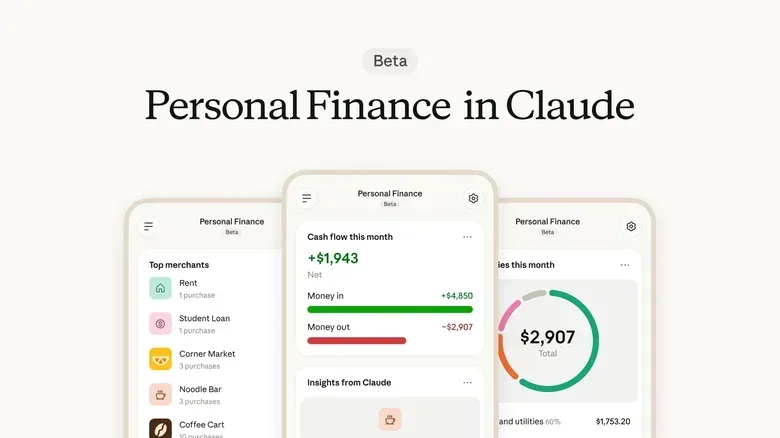
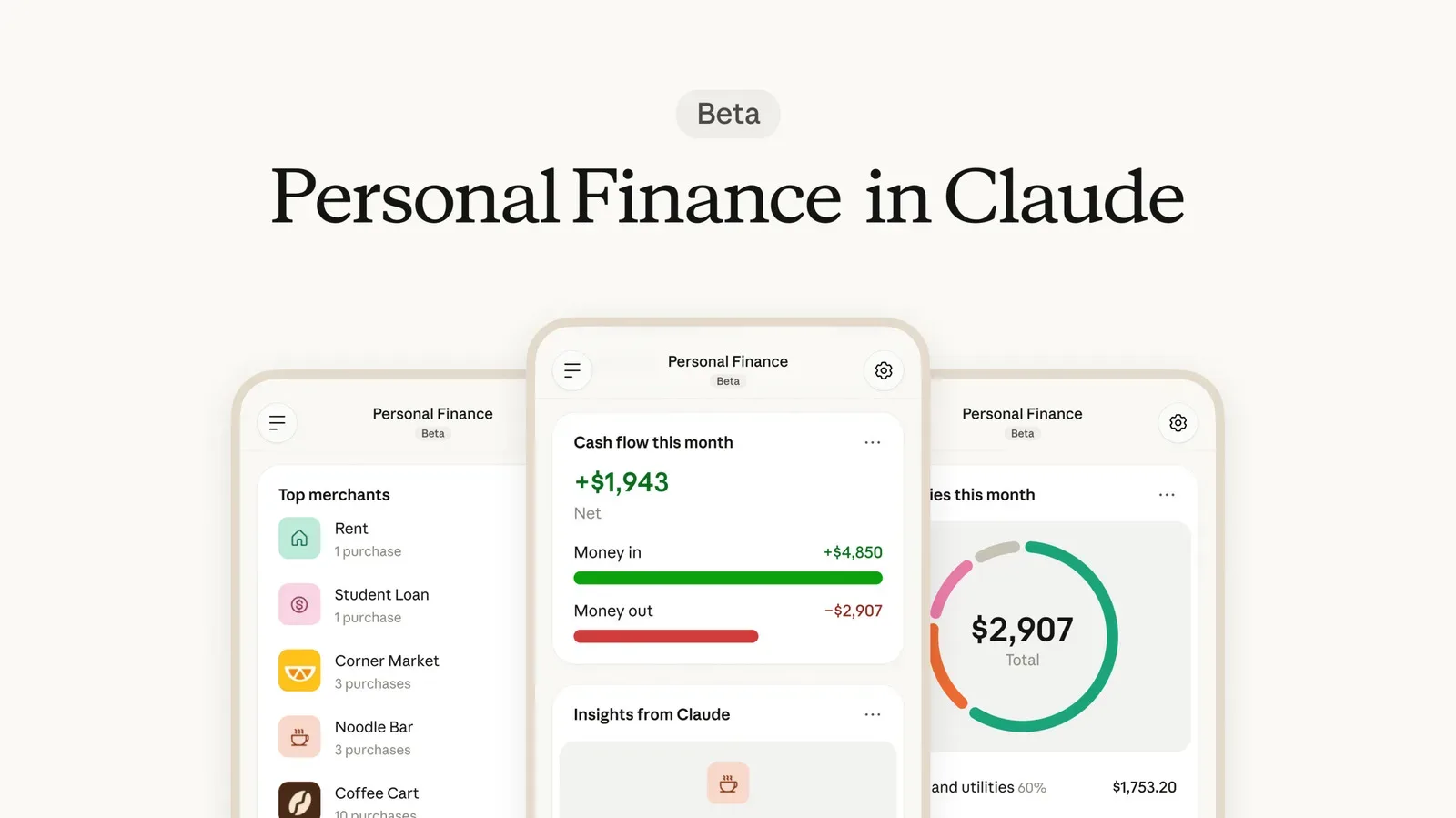
Anthropic has started testing a Personal Finance experience inside Claude that lets eligible US subscribers connect financial accounts and ask the chatbot questions about their money. The feature is available to Claude Pro, Max and Ultra users, and is intended to turn account activity into more approachable summaries, charts and explanations.
It is a significant expansion of the sort of everyday data people may choose to put in front of a general-purpose AI assistant. Claude can review linked accounts for possible unexpected fees, duplicate charges, or bills that have increased over the year. It can also create weekly spending charts, expense calendars and budget breakdowns, as well as explain terms such as APR.
There is an important boundary around what the tool can do: connected accounts are read-only. Claude cannot move money, manage it, or invest it. Anthropic also says the product was not designed to provide investment advice and can access no more than two years of transactions.
What Claude Personal Finance is designed to do
The initial use cases are primarily organizational and explanatory. A user can ask Claude to scan activity for a charge that looks out of place, identify what appears to be a recurring bill, or visualize spending over a particular period. Those are tasks where transaction data can be hard to interpret at a glance, especially when merchant names are abbreviated or repeated purchases blur together.
Budget breakdowns and spending charts are summaries rather than changes to an account. That distinction matters. The system may help surface a pattern a person wants to investigate, but it does not have the ability to act on the finding. If a charge seems duplicated, for example, a user would still need to verify it through their bank or the merchant and decide what to do next.
The feature can also provide plain-language help. APR, or annual percentage rate, is one example of a financial term Claude can explain. Making terminology easier to understand is useful, but an explanation of a term is not the same thing as a recommendation tailored to a person’s broader financial circumstances.
Plaid handles the account connection
Claude’s account-linking system uses Plaid, a service whose backend connects with more than 12,000 financial institutions, including major US banks such as Citi and Chase. That scale potentially gives the feature a broad reach for people whose banks are supported.
In practical terms, Plaid is the connection layer between a user’s financial institution and the assistant. The key limitation described for Claude’s experience is read-only access: it may examine the account information made available to it, but it cannot transfer funds, open transactions, rebalance money, or otherwise operate the account.
Read-only access narrows the immediate risk of an AI assistant directly executing an unwanted payment or trade. It does not make the decision to connect an account trivial. Transaction histories can reveal sensitive habits: recurring bills, purchase patterns, subscription costs and changes in income or spending. Anyone considering the feature should understand what data they are linking and use the service’s controls deliberately.
Privacy claims are central to the pitch
Anthropic says conversations within the Personal Finance hub will not be used for model training. It also says the hub will not show ads or sponsored recommendations, and that it does not offer credit cards, loans, or savings accounts of its own.
Those promises are relevant because a finance assistant can be asked questions at moments when a person is deciding whether to cut costs, borrow, save or change a financial product. A service that does not sell its own cards, loans or accounts presents itself as having fewer direct incentives to steer those decisions toward a particular product.
The company draws a line between the finance hub and the rest of Claude, however. For anything shared outside the hub, a user’s ordinary Claude privacy settings still apply. That means users should not assume that a finance-related question pasted into a normal conversation is governed by the finance hub’s specific training policy. Where a conversation takes place is part of the privacy decision.
Similar tools, different data policies
The launch arrives after OpenAI introduced ChatGPT Finances in May, also using Plaid for bank-account connections. The broad feature set described for Claude is similar: financial activity can be examined for charges and changing bills, then reorganized into useful spending views.
The more consequential differences described here concern advertising, product incentives and model-training treatment. Anthropic says Personal Finance has no ads or sponsored recommendations and will not use conversations from the dedicated hub for training. By contrast, existing data-control settings apply to ChatGPT’s finance experience; users who have not changed those settings are enrolled in model training by default.
That comparison does not settle which product is right for every user. It does make the settings screen more important than the marketing label. Before linking an account, users should establish whether the conversation is covered by a dedicated finance policy, what access is being granted, how much history is visible, and whether their broader account preferences alter the handling of their data.
Useful analysis is not a substitute for financial judgment
Personal Finance is described as a way to obtain personalized financial assistance, but the company separately emphasizes that the tool was not built to give investment advice. That is a sensible distinction to retain when using any chatbot around money.
A chart of rising monthly expenses can be a useful prompt to check subscriptions or review a bill. A suspected double-charge can be a useful prompt to contact a bank or merchant. Neither output should be treated as proof that a transaction is erroneous, nor should a pattern in past spending be mistaken for a complete plan for future financial decisions.
There is also a natural limit to any picture assembled from up to two years of linked transactions. A transaction record can show money entering and leaving an account, but it may not capture every relevant obligation, goal, asset, account or life circumstance. The tool’s best-supported role is therefore as a way to organize and interrogate available account activity, rather than an authority that replaces careful review or qualified advice.
Why the next step matters
Anthropic says it is exploring ways Claude could work alongside licensed professionals and regulated firms to offer financial advice, and has invited banks and wealth managers to get in touch. No detailed model for that work has been provided.
That future-facing statement highlights the divide between the current product and a more formal advisory service. Today’s version is limited to reading data and helping users understand it. Any arrangement involving licensed professionals or regulated firms would raise additional questions about responsibilities, oversight and where a chatbot’s analysis ends and professional advice begins.
The same wider question is emerging across AI products: an assistant can be convenient when it condenses information, but convenience does not remove the need for clear limits, privacy choices and human accountability. In games, the broader creative tension around AI has also drawn attention; concerns about efficiency and the human side of creation illustrate why the role of these systems remains a live debate well beyond finance.
For Claude subscribers in the US, the immediate question is simpler: whether the value of automated transaction summaries, charts and explanations outweighs the sensitivity of connecting financial data. The read-only limit, two-year history cap and dedicated-hub training policy are meaningful guardrails. They are also reasons to use the feature with a clear understanding of what it can do, what it cannot do, and what information a user is comfortable sharing.