Chronovisor makes a convincing case that a library can be more ominous than an abandoned house. Its corridors, pools of lamplight and old volumes do not merely decorate the mystery; they are the machinery that drives it. Jack Auen and Kevin Walker’s first feature turns research into suspense, treating marginal notes, translated passages and half-buried scholarly references with the escalating charge usually reserved for coded diaries and locked doors.
That premise may sound intimidatingly niche. The film follows a philosopher and neuroscientist, it spends substantial time with books, and it draws on a strange piece of alleged religious-technology lore. Yet the result is not a dry lecture disguised as genre cinema. It is a compact, mischievous occult sci-fi puzzle whose fascination comes from the act of chasing knowledge: finding a clue, deciding whether it is trustworthy, then discovering that the next answer has only made the question worse.
At 99 minutes, Chronovisor embraces a low-fi scale without feeling flimsy. Auen and Walker previously made the 2021 short Marblehead, and this feature carries forward a deliberate handmade sensibility. The movie is less interested in selling a sleek, frictionless vision of speculative technology than in making paper, film grain, institutional architecture and degraded video feel tactile. Its atmosphere is academic, but never entirely respectable. Something ridiculous, frightening and possibly profound waits beneath all that scholarship.
A researcher pulled into a very old signal
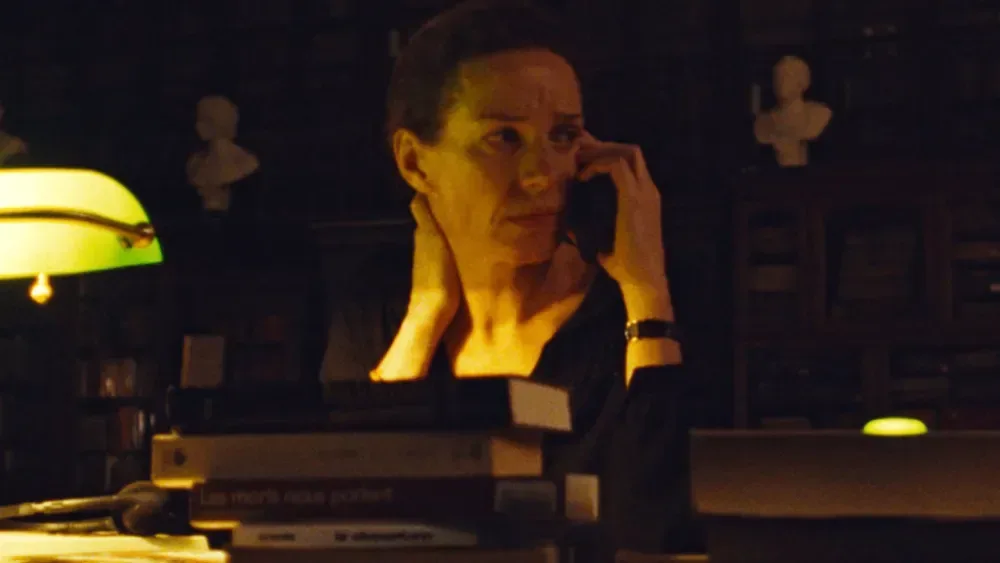
Anne-Laure Sellier plays Beatrice, a French academic at Columbia whose fields include philosophy and neuroscience. Her work centers on memory, and the character is introduced in a New York restaurant conversation that establishes an important tension: she is articulate in ideas but noticeably less at ease in ordinary human connection. The intellectual exchange does not turn into chemistry. Beatrice seems more at home amid papers, archives and the private order of a research problem.
Sellier is herself a behavioral-sciences professor at HEC Paris, and that real academic background helps the role avoid the stock movie-professor problem: dialogue delivered as empty prestigious noise. Beatrice’s fixation feels grounded in a recognizable scholarly temperament. She is not propelled by swagger or a conventional detective’s instinct. She keeps going because a strange contradiction in the material has become impossible to leave alone.
The object of that fixation is the Chronovisor, tied to the real-world claims of Italian Benedictine monk Pellegrino Ernetti. In the story surrounding Ernetti, the device could supposedly retrieve silent visual recordings from any moment in history, including the crucifixion of Christ. The claims were widely dismissed as a hoax, which is precisely why they make such inviting material for a film like this. A debunked idea has two lives: the factual one, where evidence fails, and the imaginative one, where its failure becomes the opening to a much larger maze.
Beatrice pursues Ernetti-linked sources and eventually reaches a European scientist who says he had an overwhelming encounter with the machine. From there, Chronovisor works in the uneasy space between historical curiosity, conspiracy lore and time-travel speculation. It does not require the audience to accept the device as real in order to make the possibility feel contagious. The real subject is the effect of possibility on a person determined to read one document further.
Text on screen becomes part of the investigation
The film’s sharpest formal idea is how it handles the written word. As Beatrice studies old books, important phrases are picked out and translated on screen. Rather than appearing as plain, detached captions, the text is integrated with the pages themselves, conforming to their physical wrinkles and shapes. The approach brings viewers inside the character’s attention. We are not simply told that she has uncovered something important; we look where she looks, register the wording she registers, and experience the small voltage of a line becoming a clue.
Related coverage includes Chronovisor Turns Library Research Into an Occult Sci-Fi Mystery.
That makes Chronovisor unusually alert to the drama of reading. Genre stories often rush through research with a montage, a highlighted file, then a leap to the next set piece. Here, research is the set piece. The stakes rise through definitions, connections and discrepancies. There is an almost game-like pleasure in seeing information assemble into a pathway, even while the film keeps a wink in reserve about the extravagance of the trail.
In that sense, the movie understands something familiar to anyone who has fallen down a rabbit hole of old manuals, forum posts or archival scans: the thrill is not solely in reaching the answer. It is in the deeply specific route there. One term sends you to another reference; a dubious account prompts a search for corroboration; the physical evidence begins to matter as much as the claim. Chronovisor turns that compulsive pattern into its central rhythm.
Its blend of high-minded inquiry and knowingly lurid subject matter is essential. The film is willing to discuss theory and history with straight-faced care, but it also knows that an alleged device for watching the past is inherently wild. Vatican conspiracy material, religious imagery and the promise of forbidden footage could easily become pompous. Instead, Auen and Walker let the premise remain both seductive and a little silly. That balance gives the mystery its personality. The movie can be ominous without asking viewers to forget that there is something gloriously absurd about the entire enterprise.
Analog texture, institutional dread
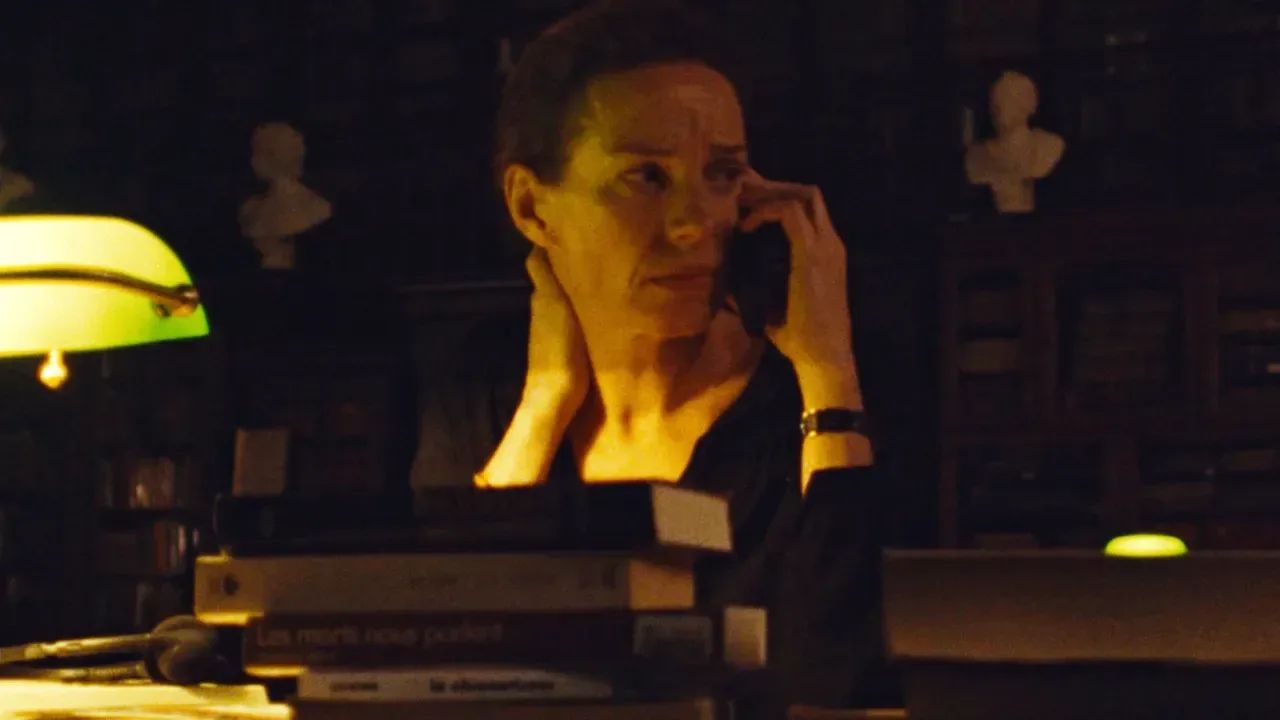
The visual design is a major part of the spell. Cinematographer Leo Zheng shoots on 16mm, lending the film a granular, material quality. Reading rooms emerge from deep shadow. Isolated bulbs glow through darkness. The image gives the sense that knowledge is present but only partially illuminated, like an answer glimpsed at the far end of a shelf after closing time.
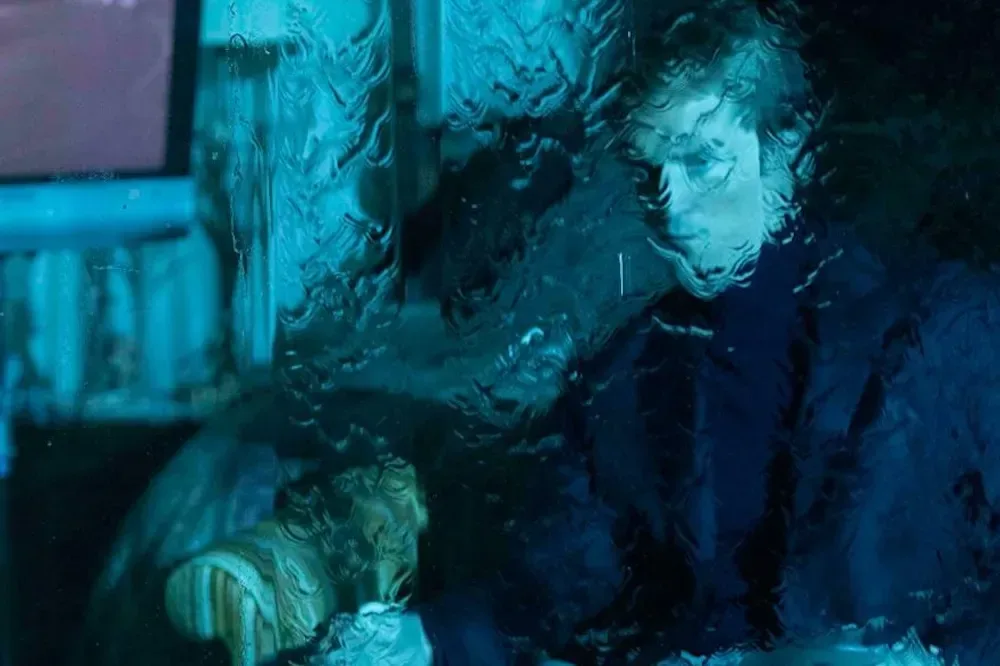
This is not nostalgia used as a filter for its own sake. The grain and darkness belong to the story’s ideas. A tale about imperfect records, contested testimony and imagined access to history should not look immaculate. The film’s analog surfaces make every image feel subject to age, handling and deterioration. When its investigation reaches VHS-like material, the dinginess is especially useful: extraordinary implications collide with a format associated with mundane, badly preserved recordings. Grand revelations are not presented with pristine sci-fi majesty. They arrive with tracking-error energy.
The soundscape plays a similarly slippery game. The use of Gustav Holst’s grand orchestral mysticism alongside Gregorian-chant kitsch gives the movie an alert sense of tonal mischief. Sacred grandeur, old-media eeriness and a faintly comic pomposity occupy the same room. It is a combination that prevents the atmosphere from settling into one predictable register.
For another recent example of a film using horror to examine the systems that shape how people consume unsettling material, see Primetime’s suffocating media-horror premise. Chronovisor operates on a different scale, but it shares an interest in how a medium can turn watching into an ethically and psychologically charged act.
Why the premise has cult-film potential
Chronovisor is not designed as a broad, instantly digestible supernatural thriller. Its pleasures are too particular: libraries rather than laboratories, footnotes rather than firefights, a scholar rather than an action hero. But its specificity is an advantage. The movie has the shape of a film that can inspire devoted advocates, especially among viewers who like their genre stories with dusty research, suspect theology and a formal trick that genuinely serves the narrative.
It also has the good sense to make academic spaces feel like places where dread can take root. University settings in genre work are often reduced to convenient exposition factories. Here, the research environment has emotional and visual weight. The quietness is not empty; it is charged with isolation. The book-lined rooms are not merely picturesque; they are repositories of claims that may be false, incomplete or more dangerous than they initially seem.
That is the essential achievement of Auen and Walker’s film. Chronovisor does not ask viewers to choose between intellectual curiosity and pulp pleasure. It lets both impulses fuel the same mystery. The deeper Beatrice reads, the stranger the world becomes, and the film finds suspense in the simple, ageless fear that some records survive because nobody was meant to understand them.
Chronovisor at a glance
- Directors, writers and editors: Jack Auen and Kevin Walker
- Lead: Anne-Laure Sellier as Beatrice
- Cinematography: Leo Zheng
- Producer: Jason Zuriff
- Runtime: 99 minutes
- Festival screening: Rotterdam Film Festival’s Bright Futures program, February 5, 2026
- Release: Limited U.S. theatrical release through Grasshopper Films