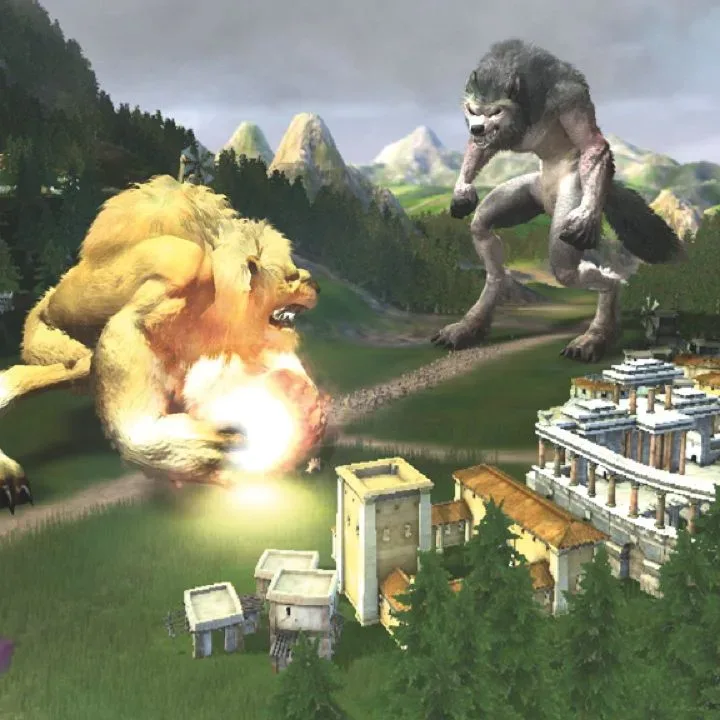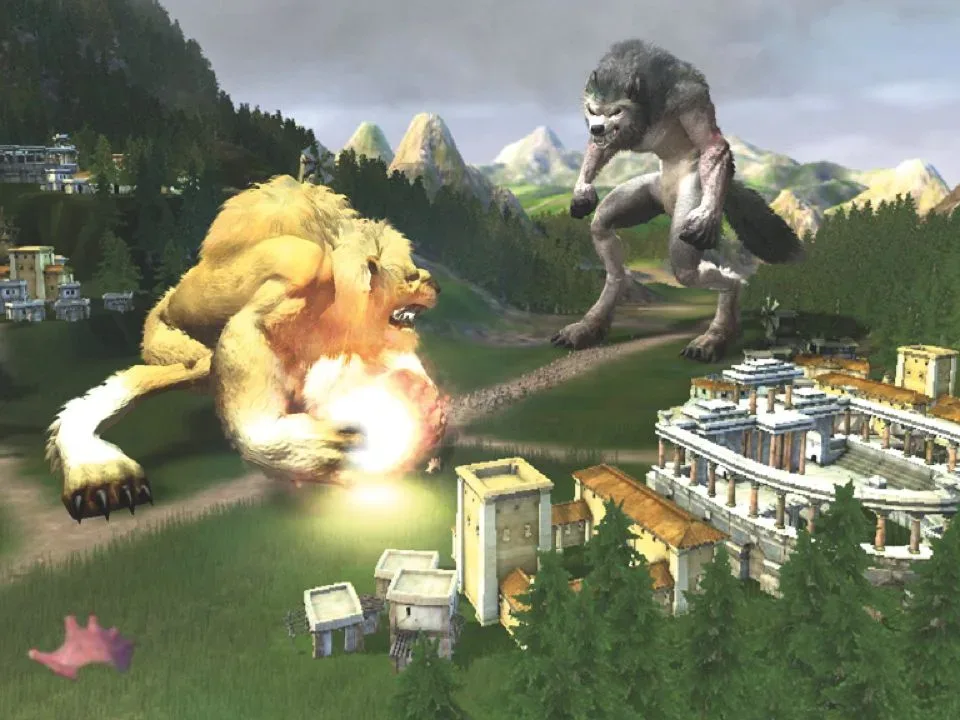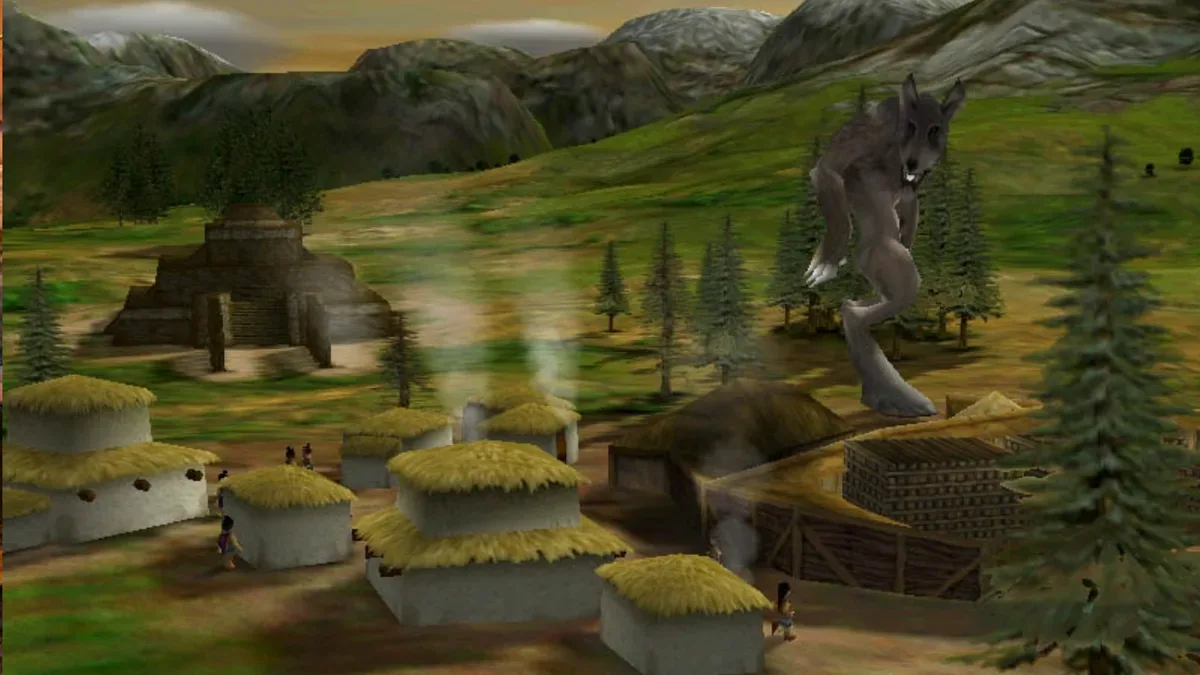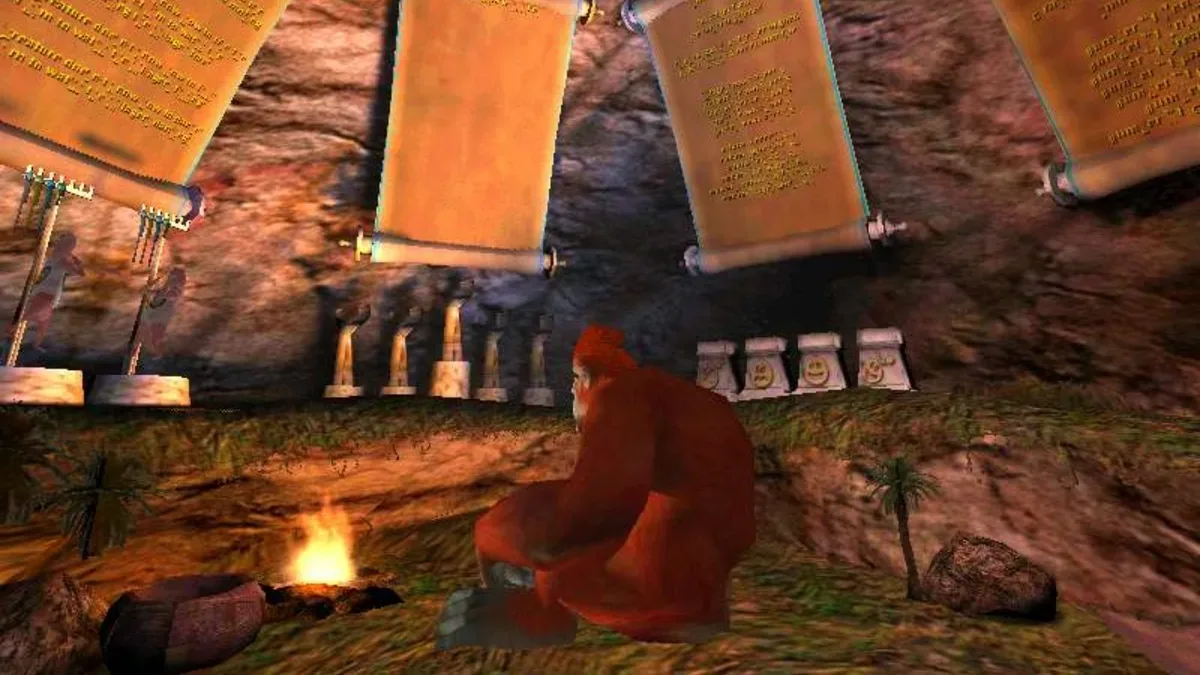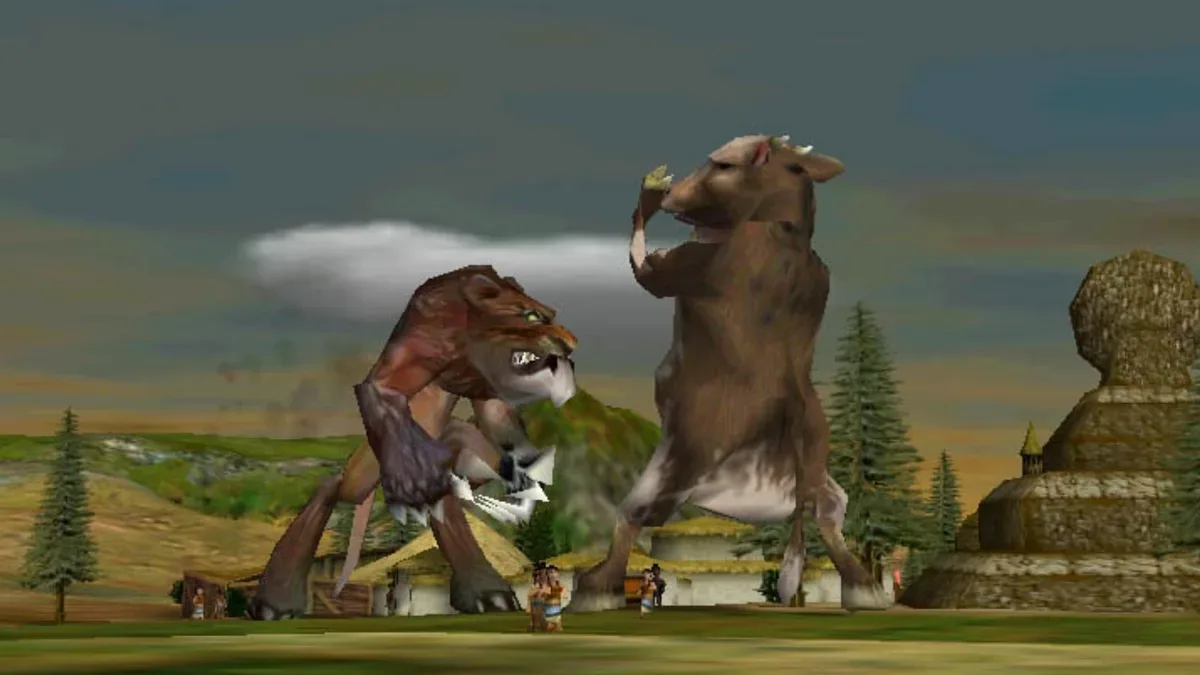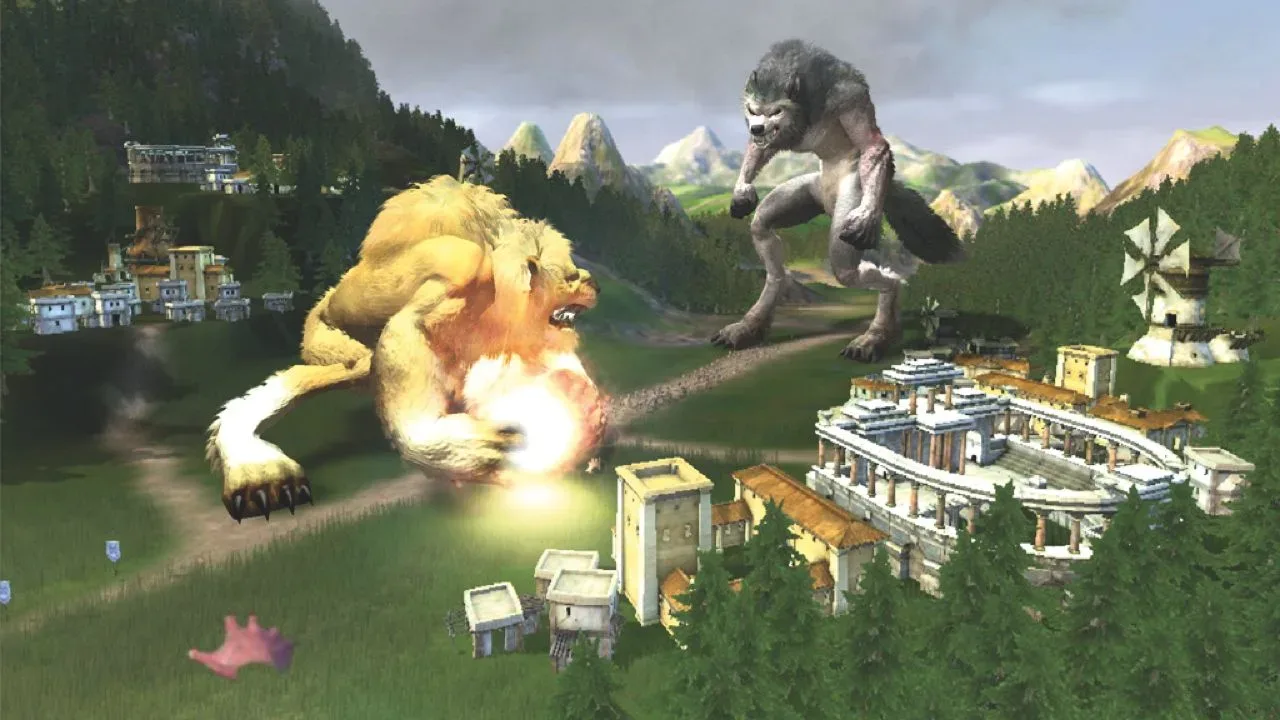
There is an odd modern tension at the heart of Black & White. On paper, it is a game about ruling people, nudging them toward good or evil, and raising a powerful animal through machine learning. That description now carries the weight of surveillance, behavioural prediction and control systems. Yet the game released in 2001 as a bright, playful fantasy: a floating divine hand, tiny worshippers, pastoral villages, miracles, and an enormous animal companion that might learn to help—or learn that throwing villagers around is apparently an acceptable afternoon activity.
Its enduring fascination is not that it anticipated today’s AI conversation in a neat, prophetic way. It did not. It is that Lionhead built its central fantasy around observation, imitation and responsibility, rather than treating artificial intelligence as invisible plumbing. The creature was not merely a unit with a list of upgrade values. It was presented as an apprentice. Players could watch it develop habits, then wonder whether those habits were the animal’s fault, the game’s fault or very much their own.
That is a potent idea for a god game. The player is already being asked to exercise unrestrained power over an island population. Giving that player a giant, trainable proxy turns morality from a menu selection into something more awkward: an example being set in front of a creature that can imitate it.
A god game built on choice before the creature arrives
Black & White came from a creative lineage already interested in letting players test the limits of authority. Peter Molyneux’s earlier work at Bullfrog frequently made control itself the attraction, sometimes with a deliberately amoral edge. Theme Park permitted players to create miserable outcomes for visitors as well as successful attractions. Dungeon Keeper openly placed the player on the monstrous side of a fantasy conflict. Even Populous, ostensibly the more straightforward god-game series, included destruction and human sacrifice amid its tribal warfare.
The common thread was not a single prescribed moral answer. It was permission: players were handed systems and power, then allowed to decide what kind of ruler they would be. When work began on Black & White in February 1998 with a team of nine, the stated ambition was to push that freedom further, creating a toybox that could make the player feel capable of almost anything.
Early ideas were even wider in scope. The project considered allowing players to raise any in-game animal into a giant. Buildings and scenery were intended to change visually in response to good or evil alignment, characters were planned to be lip-synced, and wizards were originally central antagonists battling for the islands. The shipped game narrowed or replaced many of those concepts: the creature selection became limited, lip-syncing was dropped, and rival wizards gave way to opposing gods.
That pruning matters because it clarifies what survived development as the game’s real identity. The showpiece was not an all-encompassing simulation of every living thing. It was the relationship between the player and a chosen creature, surrounded by a tactile god-game interface.
The animal was the interface for the game’s AI
The core technical phrase here is machine learning. In the broad sense relevant to Black & White, it means behaviour that is shaped by examples and feedback rather than being limited to a visibly fixed set of prewritten commands. The game communicated that concept in an unusually legible way. Players could perform a spell and see the creature attempt to learn it. They could model benevolent treatment of villagers or cruelty toward them, and the creature could imitate those actions. They could direct practical habits involving eating, sleeping and where it should relieve itself.
Related coverage includes Black & White's Creature AI Still Feels Like a Gaming Miracle.
The system’s power was not simply that the animal had needs. Games and virtual-pet toys had already made hunger, thirst and growth familiar ideas; the late-1990s Tamagotchi boom had made care routines part of mainstream pop culture. What made Black & White distinctive was the sense that the creature could take what it had seen and apply it. A player was not only maintaining a pet. They were demonstrating conduct to a gigantic, increasingly autonomous being with access to miracles and villagers.
That presentation makes its AI feel personal. If a creature becomes helpful, it reads as a result of care and training. If it becomes a menace, the game leaves room for the player to recognize their own influence. The creature can therefore feel less like an inventory item and more like a record of playstyle.
Two members of the early Lionhead team give that design a striking historical resonance. Richard Evans co-founded Lionhead after working with Molyneux at EA and was part of the early development group, which initially worked from Molyneux’s home. Demis Hassabis joined after leaving Bullfrog and completing a double first in computer science at Cambridge University. Both later worked at DeepMind: Hassabis founded the deep-learning research organization, acquired by Google in 2014, while Evans joined its research team. DeepMind later merged with Google Brain in 2023 to become Google DeepMind.
That later history does not make the game’s creature a modern research system in disguise. It does, however, underline why its animal behaviour remains such an intriguing part of the game’s legacy. Two developers who would go on to contribute to high-profile AI research helped create a fantasy chimp, cow, tiger or other selected creature whose immediate lessons included magic, manners and toilet etiquette. The contrast is funny; the design achievement beneath it is serious.
Why the game makes players wait
What is especially bold is that Black & White does not rush to put its defining feature in front of the player. The opening spends more than an hour establishing the island and the player’s role as its deity before the trainable creature takes centre stage. Villagers worship the hovering hand, make their needs known, and are entirely vulnerable to divine intervention.
That early freedom establishes the game’s moral vocabulary without a lecture. The player can aid people, but can also pick them up and throw them into the sea or smash their homes with rocks. The game offers an extraordinary power fantasy, then puts an impressionable giant animal into the same world. By delaying the creature, it makes the player understand the stakes of their own actions first.
There is charm in the slower opening, too. Its settlements are populated by sheep farmers with West Country accents, villagers searching for lost animals, and beachside groups singing sea shanties while asking for a boat. The British regional voices and Monty Python-style comic sensibility give the game a deliberately storybook quality. That warmth creates a useful, and sometimes uncomfortable, mismatch with an evil route. A player can enact cruel choices amid a world that sounds cheerfully parochial rather than grimly apocalyptic.
When the creature trainer Sable finally introduces the animal, the game notably does not drown the moment in instructions. The player is told it can learn spells through observation and that its appearance can reflect moral alignment, then is given space to find out what that means. In design terms, that is a commitment to discovery over explanation. It also explains why the relationship is memorable: the game wants players to feel less like they received a tutorialized tool and more like they have been entrusted with an unpredictable responsibility.
Godhood is sold through small physical signals
The creature is the headline, but the surrounding interface does much of the work of selling the divine perspective. Black & White keeps its on-screen interface comparatively restrained. It is not entirely HUD-free—gesture prompts for spells can appear later—but vital information is often represented inside the world.
Village store flags show need, for example. When food is scarce, villagers raise the flag higher. Villagers also call out as the player passes overhead. This is a useful example of diegetic feedback: information conveyed through an element that belongs to the game world, rather than only through an abstract meter or menu. A high flag and a shouted request communicate the same basic fact as a resource warning, but they frame it as a plea from worshippers.
The difference is central to the game’s fantasy. Casting a food-producing miracle and physically dropping its result into a village store creates a cause-and-effect performance. The people react to it. The player’s hand moves it. The outcome is not merely a numerical adjustment hidden behind a build interface. The game makes administration feel theatrical, which is exactly what a god game needs.
That simplicity also helps explain why the creature’s learning can land so strongly. The player’s actions are already gestural and visible: pick something up, move it, cast a spell, help a settlement, harm it. The creature observes acts that have clear physical meaning. Whether it copies useful magic or disastrous behaviour, the player can understand the connection without needing a technical readout of the system.
Its greatest quirk is also its pacing problem
Black & White is more committed to sandbox strangeness than smooth strategic progression, and that commitment has consequences. Once players become accustomed to the map, their villages and the loop of using miracles to impress settlements and expand influence, the game disrupts that comfort. It moves them through a portal to another island and, more painfully, separates them from their creature.
This is not a brief interruption. The base game has five islands, while the later Creature Isle expansion adds one more, so the separation occupies a meaningful share of the overall journey. From a conventional pacing perspective, removing the game’s signature companion after making the relationship matter is an unusually risky decision.
But it also reveals an important truth about the design. The separation only hurts if the creature has succeeded as more than a feature bullet point. If players feel anxiety at its absence, then the learning system, care routine and moral modelling have done their job. The game’s awkward structure can dilute its momentum, yet it simultaneously proves how effectively the animal becomes part of the player’s idea of their own godhood.
The legacy is less about prediction than design ambition
It is tempting to treat Black & White as a clean forecast of the AI age because of the subsequent careers of Hassabis and Evans. That would flatten what is more interesting about it. The game is a product of a moment when “AI” in a commercial game could be framed primarily as playful simulation: an animal that watches, learns and surprises. Today, any discussion of systems that shape behaviour arrives with sharper questions about power, accountability and data.
Those questions make the game newly complicated without changing what it accomplished. Its creature design put the consequences of teaching at the center of a joyous, often silly fantasy. It also raised questions that remain useful for designers: Should a game’s most intelligent system be visible enough for players to understand? Is the best way to teach a system through explicit commands, examples, rewards, or some blend of all three? And can an unpredictable companion make a sandbox feel more alive than a perfectly obedient one?
The industry context is also worth considering. Discussions about what games can afford to pursue, and what kinds of technical leaps audiences will value, continue to shape the medium; recent debate around the economics of future hardware is one reminder that technical ambition does not exist outside business reality. Black & White stands out because its technical idea was inseparable from its fantasy. The creature was not there to advertise a system. The system was there to make the player question what their enormous pet had learned from them.
That is why the game remains so difficult to file away as a period curiosity. Its tone is whimsical, its structure can be exasperating, and some of its ideas were altered or abandoned long before release. Still, the central encounter retains its force: a player performs an action, a creature watches, and later it does something that makes the player recognize their own influence. For a game about playing god, that is a far more incisive miracle than another lightning bolt.