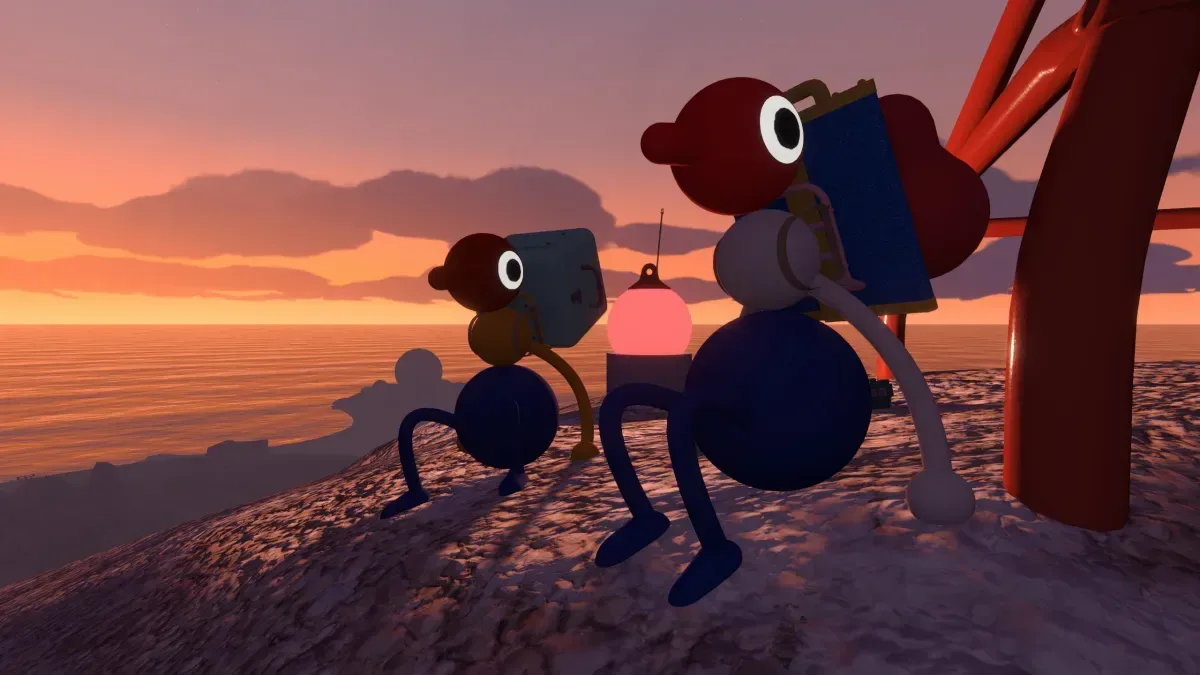
Big Walk is less interested in making a group of players efficient than in making them feel present with one another. House House’s cooperative adventure has puzzles, physical comedy, collectable objectives and island mysteries, but the key activity is right there in its name: moving through a place together, slowly enough for distractions, mistakes and sudden discoveries to matter.
That premise could sound almost aggressively modest. Plenty of games include long hikes between objectives; many multiplayer games turn travel time into something to minimize. Big Walk instead treats the distance between attractions as an essential ingredient. A journey across the island can become a conversation, an argument over equipment, a search party for a misplaced tool, or a completely avoidable detour caused by somebody spotting an odd structure on a hill. The game’s real achievement is making that unstructured space feel like part of the adventure rather than dead air.
It is also unusually firm about the social setup it wants. Big Walk cannot be played solo. It supports lobbies of up to 12 people, though its puzzles scale around groups of two, three, or four and above rather than expanding indefinitely. House House encourages players to use the game’s proximity voice chat rather than substitute an outside voice call or local split-screen. That may make organizing a session feel closer to arranging a board-game evening than casually launching a standard co-op title. Yet the restriction has a purpose: it lets separation, reunion and the imperfect reach of a human voice become mechanics.
For players who enjoy the spontaneous negotiations and minor betrayals of shared-screen games, Big Walk is an interesting counterpart to the traditions explored in the unwritten rules of couch multiplayer. It is not built around everyone seeing the same screen. Instead, it asks everyone to inhabit the same virtual terrain while dealing with incomplete information, physical distance and a gloriously unreliable ability to explain what they mean.
A co-op game built around being apart sometimes
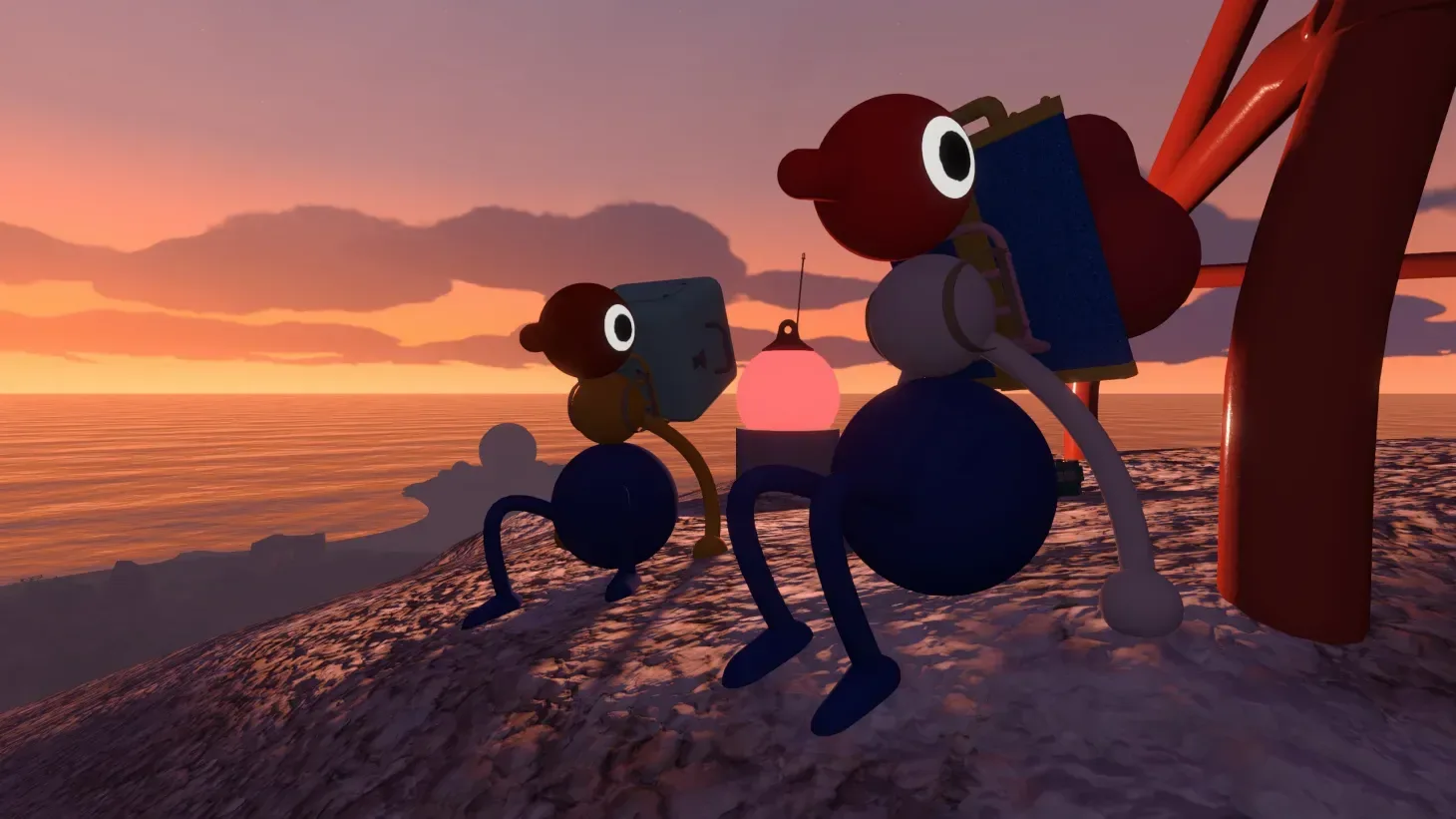
Each participant controls a rounded, bird-like character. The early area supplies tools for customization and introduces the vocabulary of movement and interaction. These avatars are expressive in a useful, physical way. Players can lift their arms, point, spread their arms outward, sit down, jump, crouch, pick objects up and kick them. Sitting can mean stopping for a moment, but on a slope it can also send a character sliding. Even a successful puzzle can earn an exaggerated arms-up celebration.
Those gestures are not merely decorative. They give the group a means of communicating when words are unavailable or insufficient. Pointing at a route, waving someone toward a gadget, holding up an object, or silently giving a yes-or-no response can all become meaningful. Big Walk understands that people playing together often communicate with movement as much as dialogue. Its characters make that instinct legible without trying to turn them into polished action heroes.
Voice is similarly embodied. Talk close to another player and they hear you clearly; wander away and your volume diminishes with the distance. The island provides alternatives, including walkie-talkies, radios and whiteboards. A flashlight can seem like needless clutter in daylight, then become essential once darkness arrives. Because a character initially carries only one item at a time, the group must decide what comes along and what gets left behind.
That inventory rule creates tradeoffs. A radio or walkie-talkie is often practical, while a whiteboard is more situational. But “practical” is not the only measure of a good multiplayer tool. A board can enable silent problem-solving, ridiculous signage, or a prank aimed squarely at a companion’s backpack. Big Walk’s strongest moments come from letting useful systems coexist with toy-box nonsense. There is room to be organized, but there is also room to be a nuisance in a harmless, affectionate way.
The island’s puzzles ask groups to invent a language
The main goals are small red objects that resemble squat rubber chew toys. Players may end up with a nickname for them, but their mechanical role is clearer: they are the island’s guiding collectibles, usually earned by working through environmental puzzle spaces. The challenges cover a varied range of setups, including mazes, timed devices, lights, images, wooden blocks marked with symbols, pitching machines and blindfolded obstacle courses.
What distinguishes these puzzles is their interest in communication itself. A soundproof room changes a normal coordination task into a nonverbal one. A helmet that obstructs sight and muffles speech forces teammates to give instructions to someone who can neither see nor answer clearly. Symbol blocks encourage the group to build quick shared shorthands. Before long, teams can develop their own improvised language of arm poses, nods, object positions and partial directions.
That makes the puzzles feel closer to camp activities than to a conventional sequence of locks and keys. The goal is not simply for one clever player to identify an answer and dictate it to everyone else. The group needs to establish a process for passing information around. Someone may become the person who interprets symbols, another may act as a guide, and another may accidentally make the entire process harder by enthusiastically carrying the wrong thing. Big Walk gives all of those roles space.
Collect enough of the red objects and they can be placed at designated spots. Reaching certain thresholds opens further puzzles, which in turn unlock new island features. The game’s later revelations are better encountered without a roadmap, because these additions can change how players understand an area they have already crossed. The structure gives exploration a sense of momentum without reducing the island to a checklist.
This emphasis on mediated connection also fits a broader fascination with virtual shared environments. Recent conversations around immersive shared spaces often focus on the technologies that bring people together. Big Walk takes a more playful route: it recognizes that a little friction can make togetherness more tangible. A radio is interesting because it is not a flawless omniscient party channel. A distant voice matters because somebody had to travel far enough for it to become distant.
Walking is the feature, until it becomes the problem
The willingness to make real travel time part of the design is Big Walk’s central gamble. Players are not spending a resource named “time”; they are spending actual minutes walking from one place to another. That creates downtime, and downtime creates opportunities for conversation and silliness. Finding a new gadget can provoke a squabble over who gets to use it. Losing a key item at night can turn a simple task into a noisy, disorganized expedition. The rhythm evokes a childhood ramble where the destination matters, but so does every strange detour along the route.
The approach will not suit everyone. Anyone seeking a rapid stream of tightly curated puzzle rooms may find the travel deliberate to a fault. There is a further irony in a game founded on walking: the movement can be finicky. Jumping onto terrain and ledges can be frustrating, particularly when the group is eager to press on. These rough edges matter because mobility is not an occasional utility in Big Walk; it is the connective tissue between nearly every good idea.
The pace can also shift once the group becomes focused on unlocking more, solving more, and reaching the ultimate destination. As the island’s systems and secrets accumulate, the simple pleasure of wandering risks moving into the background. A larger puzzle trail after the credits offers additional material for players who want to keep digging, but the appetite may be for more lightweight places to fool around rather than another layer of formal mystery.
A journey measured in stories, not only solutions
For a three-person group, reaching the end took roughly nine hours. That is not a promise of a universal completion time: puzzle-solving styles, exploration habits and lobby composition will shape any group’s pace. It does, however, suggest the scale of the journey. Big Walk has enough room for an evening’s session to feel like one chapter in a longer expedition rather than a disposable match.
Its finale reportedly gives the experience’s central idea an effective send-off, but the larger point arrives long before then. Groups will remember their peculiar solutions, the moments when instructions went disastrously wrong, the long walks that turned into conversations, and the tools used in ways their designers probably did not prioritize. House House has made a game where the anecdote afterward is as important as the puzzle answer.
Big Walk’s demands are also its recommendation. It asks players to find companions, commit some time, accept proximity chat, and occasionally tolerate logistical awkwardness. In return, it offers an island designed not just for cooperative problem-solving but for the loose, messy social experience around it. People can pursue the ending, hunt oddities, climb into unknown corners, or simply get distracted. However the group proceeds, the point is that it proceeds together.