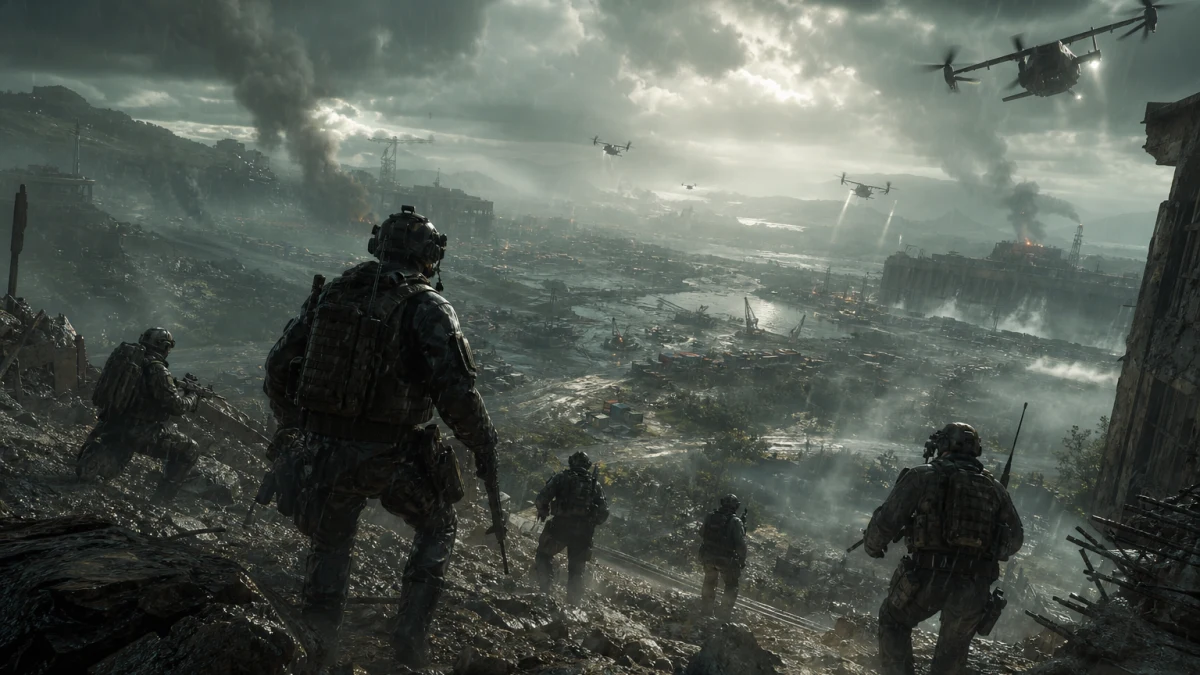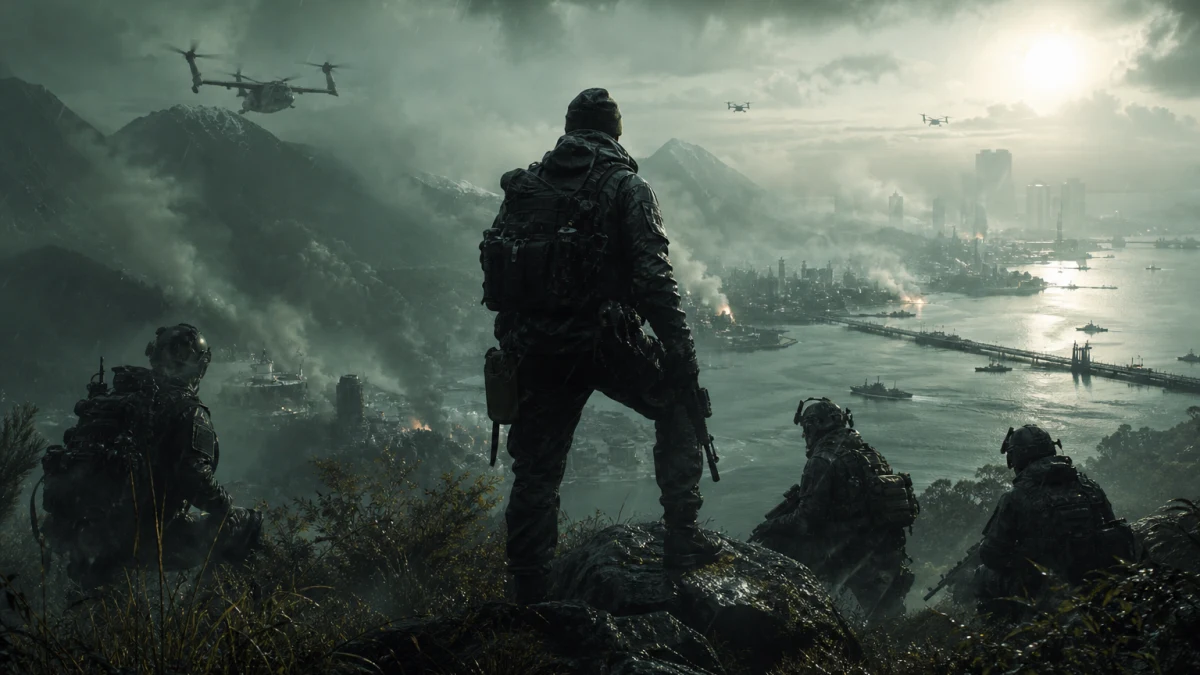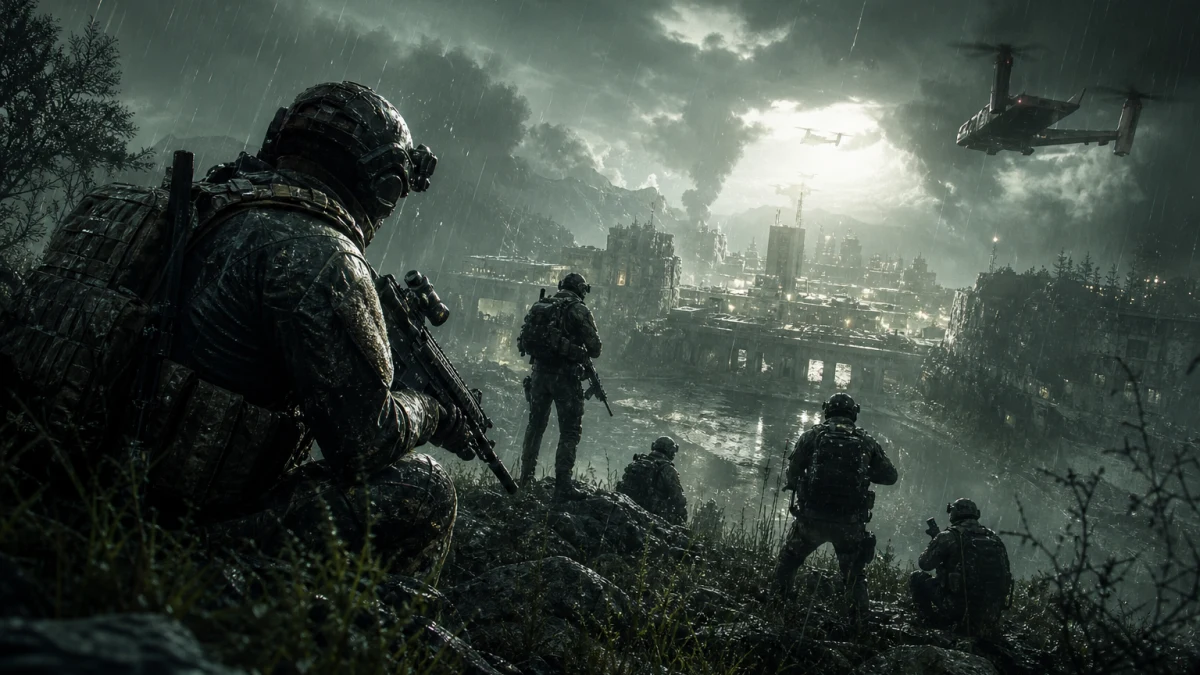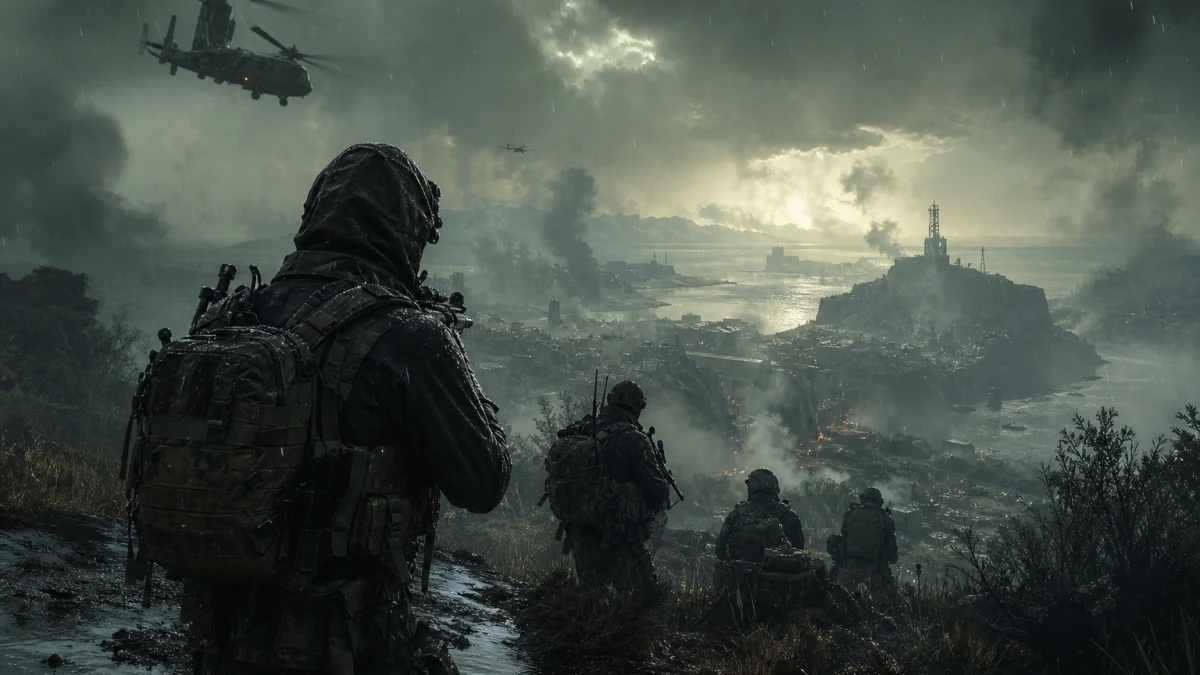
Modern Warfare 4’s version of DMZ is an extraction mode built around an accumulating decision: entering Hajin creates opportunities to improve a player’s persistent position, but every additional objective exposes equipment, collected Cash and developed Operators to greater danger. Hostile AI, rival players, shifting weather, rising local Threat levels and an intensifying radiation storm complicate the journey from infiltration to extraction. The important decisions therefore begin at the Forward Operating Base, before the first shot is fired.
This guide is a prelaunch reference published under the Darryl Polo byline. It does not claim hands-on testing, optimal routes, solved Trait builds or knowledge of the final launch balance. Digital Standard and Vault Edition preorders are scheduled to receive DMZ Early Access beginning October 20, 2026, subject to platform availability, time-zone differences and service conditions. Activision lists the worldwide Modern Warfare 4 launch for October 23. Steam’s October 22 display is best understood as a likely regional unlock-time presentation unless Activision announces a separate PC schedule.
That timing matters because the name DMZ carries expectations from the 2022 Beta. Deployment, scavenging, PvPvE conflict and extraction return as broad ideas, but familiar concepts do not prove that old mechanical details return unchanged. Modern Warfare 4 has a Forward Operating Base, individual Active Duty Operators, MIA recovery, Trait trees, paid insertion choices, Secure Slots and persistent PvP bounties. Its Ping Wheel can also request a Truce or assimilation with another squad. Maximum combined-squad size, plea behavior, extraction capacity, insurance rules, exact timers and reset policies still require confirmation.
The practical aim is not to predict a launch meta. It is to provide a durable decision framework: decide why the squad is entering, identify what it can afford to lose, divide responsibilities, monitor how exposure changes during the deployment and leave before a completed objective becomes an avoidable failure. Where the official material stops, this guide does too.
Evidence note: This is a prelaunch reference prepared before DMZ Early Access on October 20, 2026. Confirmed systems come from official Activision, Call of Duty, platform-holder, support and storefront material. Ping Wheel actions for requesting a Truce and assimilating with another squad are confirmed, but combined-squad limits, acceptance flow, friendly-fire behavior, identification rules and plea mechanics remain unknown. Skyhook-style extraction is treated as officially shown rather than a fully documented method. Squad-planning recommendations are editorial inferences, not hands-on findings. Exact deployment timing, final-exfil rules, insurance and rescue-item functions, seasonal resets, cross-play settings and launch balance remained unresolved at the research cutoff.
What This Guide Can Confirm Before Launch
The publication schedule defines the limits of this reference. Its planned date is October 13, one week before DMZ Early Access begins for eligible digital preorders on October 20 and ten days before the worldwide Modern Warfare 4 launch on October 23. No final public build was available for reproducible testing at the research cutoff. This is therefore a rules reference and preparation guide, not a walkthrough, route guide, weapon ranking or report of first-hand play.
A confirmed detail is one stated directly in official developer, publisher, support, storefront or platform-holder material. The two starting Active Duty slots, 70-level DMZ progression track, MIA recovery with DMZ Cash, initial Stash capacities and listed insertion prices belong in that category. The Ping Wheel’s ability to request a Truce or assimilate with another squad is also confirmed. The existence of those actions does not automatically confirm every rule governing them.
An officially shown feature has appeared in first-party footage or imagery without receiving a complete public rules explanation. A skyhook-like extraction sequence falls into this category. It is reasonable to say that Activision has depicted it, but not that it is a separately selectable method with a known cost, capacity or activation item. A trailer animation can identify an idea the publisher intends to communicate; it cannot establish all of that idea’s mechanical boundaries.
An inference is a planning conclusion built from confirmed rules. Setting a maximum acceptable loss is sensible because equipment, insertion fees, collected Cash and Operator development create different forms of exposure. Activision does not require squads to use that framework. Recommending a fallback extraction likewise follows from variable exfil sites and visible extraction signals, but it is advice rather than a hidden game rule.
An unknown is a rule the official material has not defined sufficiently. Squad Fill creates a starting group of three, while assimilation is possible after infiltration, but the absolute maximum combined-squad size remains unpublished. The final exfil is confirmed, yet its complete timing, capacity, overtime behavior and failure conditions remain unknown. Plea-for-help behavior has not been explained in the reviewed primary material.
Officially documented numbers can still change. Economy prices, crafting requirements, loot frequency, AI durability and recovery costs are especially susceptible to launch tuning. Structural systems can also behave differently after a patch or on a particular platform. Players entering on October 20 should compare the live menus, tutorials and update notes with this reference before making expensive commitments.
Activision’s worldwide release date is Friday, October 23, while Steam currently displays October 22. That discrepancy should not be presented as evidence of two conflicting global release plans. A coordinated unlock can appear on the prior calendar date in some regions. Players should follow the countdown and local availability information on the platform where they purchased the game. DMZ requires a continuous internet connection, so nominal access may also be affected by maintenance, outages or staged service availability.
- Confirmed details come directly from official sources.
- Officially shown does not mean mechanically documented.
- Truce and assimilation actions are confirmed.
- Combined-squad limits and plea behavior remain unknown.
- Recheck live menus and update notes on October 20.
- Follow the purchased platform’s local unlock timer.
The Core DMZ Loop, Without Importing Old Rules
A deployment begins at the Forward Operating Base, or FOB. This persistent hub is where players select an Active Duty Operator, inspect the shared Stash, prepare equipment, review objectives and decide what kind of deployment to attempt. Each Active Duty Operator maintains an individual loadout, backpack state, Dog Tag progression and Traits. Character selection therefore changes the amount and type of value being exposed before the player reaches Hajin.
The FOB contains more than a loadout screen. Officially documented stations cover Operators, Orders, Stash and Loadout, a Firing Range, Survival Kits, the Bounty Leaderboard, 3D Printer, Boss Board, Vendor, Gunsmith, Dog Tag Case, progression and deployment. Some stations unlock through DMZ progress. Together, they connect storage, crafting, character development, bounties, weapon preparation and mission selection to what happens during a deployment.
Players choose among Story Missions, Dynamic Operations and Free Roam. Story Missions provide structured narrative objectives in live DMZ servers. Dynamic Operations award DMZ XP and Cash and generate Supply Drops whose rarity increases as further Operations are completed during the same deployment. Free Roam allows entry without selecting a mission. All three occur within a world containing hostile AI and rival human Operators.
Inside Hajin, the squad travels, scavenges and completes objectives while watching supplies, time, weather and local Threat. Loot tendencies are connected to location type: police facilities favor tactical gear, clinics and medical sites favor medical supplies, and residential areas favor crafting materials. These are broad tendencies rather than guaranteed container routes. Moving hostile forces and changing weather can invalidate a route that appeared sensible during preparation.
The dedicated Mission Item slot automatically holds important Story Mission or Dynamic Operation objects without consuming ordinary backpack space. That convenience removes one inventory conflict, but it does not make the mission private or the object automatically safe. Other squads can still enter the area, and the team may still need to extract or perform another delivery step. The live objective text must determine what counts as completion.
Human encounters may lead to combat, negotiation, a requested Truce or assimilation. The Ping Wheel formally supports both social actions, but the public documentation does not yet define the maximum assimilated size, exact acceptance sequence, duration of a Truce, friendly-fire treatment or every HUD consequence. Players should read the live prompts instead of assuming the 2022 implementation returns unchanged.
Extraction converts exposed physical value into persistent value. Equipment and ordinary backpack items generally must leave Hajin successfully to be retained, while designated objects in Secure Slots are protected from a failed exfil. DMZ XP still counts after failure. An eliminated Active Duty Operator becomes MIA, however, and collected Cash is added to the persistent Bank after a successful exfil. A failed run can therefore advance progression while still damaging the roster, inventory and economy.
The loop is best understood as conversion rather than a binary win-or-loss screen. Persistent Bank funds can purchase an insertion or recover an Operator. Equipment can increase the likelihood of completing an objective but becomes exposed when carried into Hajin. A completed activity may award XP, Cash or physical objects, yet some rewards remain vulnerable until extraction. The next FOB visit determines how much of the result is banked and how much is risked again.
- Prepare an Operator and loadout at the FOB.
- Choose Story Mission, Dynamic Operation or Free Roam.
- Track supplies, threat, weather and time during deployment.
- Treat Truce and assimilation prompts according to live rules.
- Extract physical value before counting it as persistent.
- Bank useful equipment before beginning another deployment.
What Is Confirmed About Squads and Other Players
Players can enter Hajin alone or as part of a squad. Activision’s Ready Up guidance says Squad Fill can place a solo entrant with two allied players, creating a standard filled starting group of three. That does not prove that three is the absolute maximum in every circumstance. The confirmed assimilation action means starting squad configuration and possible post-infiltration group size must be treated as separate questions.
DMZ is a PvPvE environment. Hostile AI forces and human Operators occupy the same live space, and Story Missions occur on servers where other players may be pursuing unrelated goals. A narrative objective is not a protected cooperative instance. Rivals can appear while the squad is collecting an item, fighting a Lieutenant, repairing a vehicle or preparing to extract.
Official descriptions allow cooperation, negotiation, betrayal and direct conflict. Activision’s Hajin guide identifies Ping Wheel actions for requesting a Truce and assimilating with another squad. Those are formal interaction tools rather than agreements supported only by proximity chat. Any prelaunch guide that calls assimilation itself unconfirmed is outdated. What remains uncertain is how the request is received, accepted, rejected or mechanically enforced.
A Truce and assimilation should be treated as different actions unless the public build demonstrates that one automatically becomes the other. A Truce suggests a temporary suspension of hostility, whereas assimilation changes squad affiliation. The reviewed documentation does not fully define duration, cancellation, friendly-fire protection or identification behavior. A sent request is not the same thing as acceptance, and acceptance should not be assumed to provide protections the interface has not displayed.
The maximum assimilated squad size is unknown. Activision has not publicly established whether a squad can absorb another full group, whether assimilation can occur repeatedly, whether solos face different limits or whether deployment type affects capacity. It is accurate to say that assimilation exists. It is not accurate to infer a four-, five- or six-player ceiling from the earlier DMZ Beta or from one promotional scene.
Plea behavior remains a separate unknown. The existence of assimilation does not prove that a wounded, downed or eliminated Operator can request aid from an enemy, be revived by that enemy or join the rescuer’s squad. Official material identifies wounded, downed and death states and names several medical mechanics, but it has not provided a complete public explanation of the route from incapacitation to MIA status.
Squad Fill creates a practical planning problem even before another team is involved. Three matched players may have different missions, available time and loss tolerance. A brief opening check can prevent immediate fragmentation: each person states the selected objective, reports any critical item requirement and identifies whether an early exit is necessary. If priorities cannot be aligned completely, the group can still choose a shared first task and a rendezvous point.
Assimilation requires another coordination reset. Before sending or accepting a request, consider whether the other group’s movement and objective are compatible with the current plan. After the HUD confirms a merger, restate the primary objective, critical-item ownership, extraction preference and disengagement authority. Additional players can improve coverage, but more voices do not automatically produce a coherent team.
- Solo and squad deployment are confirmed.
- Squad Fill adds two allied players.
- AI and rival Operators share live deployments.
- The Ping Wheel supports Truce and assimilation requests.
- Maximum assimilated size remains unknown.
- Plea and complete friendly-fire rules remain unconfirmed.
- Reset the plan after any confirmed assimilation.
Choosing the Right Deployment Type
Story Missions are the clearest choice when the squad wants structured progress tied to DMZ’s narrative, Orders or milestone rewards. Because these missions occur on live servers, they should not be mistaken for isolated campaign episodes. The preparation question is not merely whether the team understands the stated task. It is whether everyone can afford to expose the chosen Operators and equipment while unrelated players, moving AI and weather may interrupt the attempt.
A Story Mission needs a shared completion definition. Reaching an area, collecting an object, delivering it and extracting may be separate requirements. The live mission briefing and objective tracker must establish which steps count. Read those conditions before buying an insertion or equipping scarce items. If a mission spans several deployments, divide it into manageable attempts rather than preparing for an imagined final stage that the live text does not require yet.
Dynamic Operations suit squads seeking repeatable Cash and XP opportunities with an escalating reward loop. Completing an Operation provides a Supply Drop, and additional completed Operations during the deployment improve its rarity. That structure creates a deliberate temptation to continue after success, at precisely the point when armor, medicine, ammunition and time may already have been consumed.
The increasing Supply Drop rarity is an offer, not an obligation. It describes the reward progression but says nothing about the squad’s current probability of surviving another objective. Establish a maximum number of Operations or a minimum resource floor before entering. When the limit is reached, compare the next potential reward with existing damage and accumulated loot rather than continuing automatically.
Free Roam permits entry without selecting a mission. It can support rebuilding, collection, exploration, Lieutenant hunts, bounty activity or learning the live interface. Flexibility does not make it inherently safe. A group without a stated purpose can drift toward every gunfight and marker it encounters. Give the deployment a practical target, such as collecting specified Ingredients, restoring a standard kit or reaching a Cash threshold, and leave when that purpose is complete.
Free Roam will also be useful for learning systems after Early Access begins. Players can observe how the Tac-Map communicates exfils, radiation, weather, bounties and moving threats without committing a priority Story Mission. That is different from claiming a solved loot route. Official material documents location tendencies, but container density, player traffic and enemy placement can vary or be changed through updates.
Select the deployment type using three inputs: available time, committed equipment and acceptable loss. Choose Story Missions when structured progress justifies the necessary kit. Choose Dynamic Operations when the squad has time and discipline to reassess compounding risk. Choose Free Roam when flexible collection or rebuilding matters more than a fixed objective. If the group lacks time or cannot afford to lose the selected Operator, reduce the deployment’s ambition.
- State the deployment’s purpose in one sentence.
- Read live Story Mission completion conditions.
- Set a stopping rule for Dynamic Operations.
- Give Free Roam a collection or rebuilding target.
- Match ambition to time, equipment and acceptable loss.
- Do not treat Story Missions as private instances.
Risk Begins Before Infiltration
Modern Warfare 4 makes insertion part of the DMZ economy. Dynamic Operations and Free Roam offer a free random ground insertion as well as paid alternatives. Officially listed choices are a Polaris Dagor A1 light vehicle for 5,000 DMZ Cash, an LTV for 25,000, a helicopter for 50,000 and cargo-plane insertion for 100,000. These are prelaunch values and may be adjusted.
A higher price does not establish a universally better or safer opening. The light vehicle and LTV provide mobility after a random ground placement. Helicopter insertion begins with the squad aboard an aircraft over a random part of Hajin. Cargo-plane insertion allows the team to identify a drop location more precisely. Each option changes opening capability, but none guarantees uncontested access to an objective.
An expensive insertion should answer a specific operational need. A vehicle may support a distant objective, while the cargo plane may justify its cost when precise placement materially improves the plan. Paying 100,000 Cash merely because the option appears prestigious is not strategy. The expected advantage should support a defined objective and exceed the value of keeping those funds for recovery, crafting, equipment or another deployment.
Every paid entry needs a failure branch. The vehicle may be damaged, the helicopter may draw attention, the intended route may be blocked or contact may make the opening objective obsolete. Decide whether the squad will continue on foot, switch to a secondary objective or withdraw from the original plan. The insertion fee is already spent once deployment begins, but sunk cost does not require the team to compound the loss.
Operator selection adds another layer of exposure. A developed character brings accumulated Traits and Dog Tag progress, but elimination sends that Operator MIA and makes recovery more expensive as standard Trait Points increase. A lightly developed Operator limits that character-level risk. Players can use separate roster slots for priority missions, higher-variance PvP and lower-cost collection without declaring any particular character disposable.
Equipment should be valued by replacement difficulty and mission relevance rather than rarity alone. A strong Plate Carrier may be justified on a difficult mission, but deploying every best item together concentrates losses. Under-equipping can also waste the Operator development being exposed. The goal is enough capability to make the objective plausible without carrying valuable objects that do not contribute to the plan.
The free basic loadout is a rebuilding tool. Official guidance identifies a Plate Carrier, Backpack, weapon and Medkit as the basic preparation package, and a successfully extracted free loadout can be kept. A low-entry-cost run should still have an objective and abort line. Lower material exposure does not make the player’s time or newly collected items worthless.
Before pressing deploy, separate exposure into four categories: insertion Cash, physical equipment, Operator development and scarce mission requirements. The squad does not need a precise currency value for every object. It needs to know which category is hardest to replace. If every category is at maximum exposure, move some value back to the Stash or choose a less developed Operator.
- Random ground insertion has no listed Cash cost.
- Dagor A1 insertion costs 5,000 DMZ Cash.
- LTV insertion costs 25,000 DMZ Cash.
- Helicopter insertion costs 50,000 DMZ Cash.
- Cargo-plane insertion costs 100,000 DMZ Cash.
- Give every paid insertion a defined purpose.
- Prepare a fallback if the opening advantage is lost.
Active Duty Operators and MIA Consequences
Players begin with two Active Duty Operator slots. Another slot can be unlocked through DMZ progression, while Vault Edition owners begin with a third. The edition benefit increases starting roster flexibility but does not remove extraction risk. Each active character maintains an individual loadout, backpack state, Dog Tag progression and Traits, allowing players to spread equipment and development across separate operational profiles.
Successful exfils provide the DMZ XP used to improve the deployed Operator’s Dog Tag level and earn standard Trait Points. Operator development is separate from the dedicated 70-level DMZ Player Progression, general player progression and DMZ Operator Prestige. These layers should not be compressed into one generic level. A deployment can advance one layer, preserve another and damage the player’s usable inventory at the same time.
An Operator can earn 18 standard Trait Points before reaching the highest normal Dog Tag level. The more developed the Operator becomes, the more expensive MIA recovery becomes. That makes a preferred character economically meaningful. Using the same highly developed Operator for every routine collection run creates recovery exposure without necessarily taking advantage of the Traits that justify the risk.
When an Operator is eliminated during a deployment, that character becomes MIA and cannot deploy again until recovered or dismissed. Recovery uses DMZ Cash and preserves the Operator’s Traits. The price scales with standard Trait Points, and the returned Operator does not regain equipment lost during the failed deployment. Recovery therefore protects development, not the physical loadout.
Dismissal is the alternative to paying for recovery. It allows the slot to start again with another Operator but abandons the MIA character’s current ordinary development rather than restoring it. One important exception requires precise wording: Permanent Prestige Traits already earned for that Operator remain tied to the character even if the Operator is dismissed, moved to another slot or displayed with a different skin. Dismissal must not be described as erasing those permanent rewards.
The recovery decision should compare the fee with the value of the retained Traits and the player’s remaining Bank. Recovering every MIA character immediately may consume funds needed for equipment, crafting or an important insertion. Dismissing every MIA character can repeatedly sacrifice useful standard development. Maintaining a recovery reserve turns that decision into account planning rather than a reaction to frustration.
Recovery timing also matters. If paying for a highly developed Operator would empty the Bank, a lower-risk run with another available character may be preferable first. Shared Stash items, Resources, Ingredients and Bank funds allow one roster member’s successful deployment to support another. The player can rebuild supplies and then recover the MIA character without immediately sending the restored Operator back into Hajin under-equipped.
Roster depth protects against a single failed session immobilizing every useful character. Keep at least one available Operator suitable for rebuilding. Record each character’s intended responsibility, important equipment and current development direction. When an Operator becomes MIA, compare recovery cost, standard Trait value, permanent Prestige Traits and current account needs before choosing recovery or dismissal.
- Players begin with two Active Duty slots.
- A third slot can be unlocked through progression.
- Vault Edition starts with an additional slot.
- Recovery preserves Traits but not lost equipment.
- Recovery cost rises with standard Trait Points.
- Dismissal forfeits current ordinary development.
- Permanent Prestige Traits remain tied to the Operator.
How Traits Should Shape Team Roles
Each Operator can earn up to 18 standard Trait Points across Warfighter, Scout and Survivalist trees. The complete standard pool contains 66 Traits, divided evenly among the three trees. One Operator cannot acquire all of them. These confirmed totals establish specialization and opportunity cost, but they do not establish a solved prelaunch build or universally optimal tree.
Trait selection is also less reversible than a casual loadout choice. Official guidance says selected standard Traits are locked rather than freely exchanged. Minor Trait availability includes randomized elements, while progressing through branches determines what becomes reachable. A theoretical build copied from a menu image may therefore be unavailable or inappropriate for a particular Operator. Players should plan around their actual live choices.
Roles should describe responsibilities instead of forcing rigid weapon classes. A combat role might control space while an objective is completed. A reconnaissance role can watch routes, weather and contact reports. A scavenging role can track Ingredient and inventory priorities. A medical coordinator can monitor treatment supplies and disengagement floors. A mission-item or Cash carrier can receive additional protection during movement.
Responsibility-based roles remain useful when weapons change. Scavenged guns can contain damaged optics, broken attachments or unstable components that affect their handling and appearance. A route lead can continue navigating after replacing a weapon. A medical coordinator can keep counting supplies even if another player carries most of them. A rigid identity built around one firearm may collapse after looting; an information responsibility survives.
Operator-specific progression makes continuity valuable. A character developed toward reconnaissance can repeatedly serve that purpose, creating a coherent use for its Traits. Specialization must not become dependency, however. An MIA scout cannot deploy until recovered or dismissed, so every teammate should understand basic navigation, medical reporting and extraction procedure. Roles divide attention; they should not make the squad incapable of functioning when one specialist is absent.
The 18-point limit means every Trait choice has an opportunity cost. Read the live activation requirements and whether the benefit helps only the Operator or supports the entire squad. A powerful-looking effect may duplicate equipment or another player’s responsibility. A less dramatic Trait that fills an uncovered need may provide greater operational value. Exact combinations should be evaluated only after the public build can be tested.
Assimilation should trigger role reassignment rather than erase the original plan. Once the HUD confirms the larger squad, restate who tracks medicine, navigation, mission objects and extraction. The unknown maximum combined-squad size makes fixed templates especially unreliable. Responsibilities must expand, contract or be reassigned according to the actual live roster.
Review roles after extraction. Identify which responsibility went uncovered, which was duplicated and whether the selected Operator’s Traits supported the objective. Change procedures before assuming another weapon will solve the problem. If a specialist becomes MIA, assign the missing responsibility to a player during the next run rather than trying to recreate the entire build immediately.
- Assign responsibilities rather than weapon stereotypes.
- Remember that standard Trait choices are consequential.
- Keep essential knowledge distributed across the squad.
- Use Traits to support the deployment’s objective.
- Reassign roles after confirmed assimilation.
- Avoid declaring a universal best build before testing.
- Review role performance after every deployment.
What You Keep, What You Lose and What Still Progresses
Successful extraction preserves the ordinary equipment and physical loot carried out of Hajin. Those items can support another deployment, enter the shared Stash or be used through FOB systems. A failed exfil normally removes backpack items that are not protected by Secure Slots. It is therefore inaccurate to say either that failure destroys everything or that completing an objective automatically banks every reward.
Secure Slots are the documented exception for designated physical objects. Upgraded backpacks can provide these protected positions, and items placed in them survive a failed exfil. The exact number and distribution depend on the backpack rather than one universal rule. A Secure Slot protects its assigned item; it does not prevent equipment loss, MIA status or other consequences affecting the deployment.
An eliminated Active Duty Operator becomes MIA. Recovery can preserve that character’s Traits, but the recovered Operator returns without the equipment lost during the failed run. Operator status and item persistence are separate ledgers. A player might preserve an Ingredient through a Secure Slot while still losing ordinary gear and sending the Operator MIA.
DMZ XP survives a failed extraction. It advances the dedicated 70-level DMZ track and also contributes to general Modern Warfare 4 player progression. Multiplayer and Warzone XP do not advance the dedicated DMZ level. Individual Operator Dog Tag development and Trait acquisition form another progression layer, while Operator Prestige is separate again. Progress always needs a qualifier explaining which system moved.
Cash also requires precise handling. The persistent Bank funds FOB purchases, paid insertions and MIA recovery. Cash shown during a deployment represents what the Operator is currently carrying, and collected deployment Cash is added to the Bank after a successful exfil. Squads should not treat a large in-field Cash total as secured spending power while they are still inside Hajin.
Synthetics, Electronics, Chemicals and Metals are automatically dismantled into Resources and do not occupy ordinary Stash slots. They use a dedicated resource system rather than competing one-for-one with weapons, medicine or Ingredients. The official prelaunch material does not justify telling players that newly gathered Resources are immune to every failure consequence, so extraction should remain the safe assumption until the public build demonstrates otherwise.
3D Printer Ingredients remain physical backpack items and must be extracted intact before they can be moved to the Stash or used at the FOB. Mission objects use their dedicated slot, but the objective text must establish whether possession, delivery or extraction is required. Automatic placement in the Mission Item slot solves capacity; it does not guarantee mission completion.
After a major pickup, ask what system governs it. Is it an ordinary physical item, a Secure-Slot item, an automatically dismantled Resource, a mission object, in-field Cash, account XP or Operator progress? What requires exfil, and what remains after failure? This classification is more useful than treating every reward as generic loot.
After failure, inspect outcomes in order. Check which XP advanced, which protected objects survived, whether the Operator became MIA and what disappeared from the physical loadout. Then decide whether recovery is affordable. This prevents lost equipment from obscuring retained progression while avoiding the opposite mistake of calling the run profitable merely because some XP survived.
- Ordinary physical gear generally requires successful extraction.
- Secure Slots preserve their designated items.
- DMZ XP still counts after failed exfil.
- Collected Cash reaches the Bank after successful exfil.
- Elimination places the deployed Operator in MIA status.
- Recovered Operators retain Traits but not lost equipment.
- Printer Ingredients must be extracted intact.
Stash, Backpack and Secure-Slot Planning
The initial shared Stash holds 40 general items and 12 weapons, with the categories counted separately. These limits make extraction only the first inventory decision. Keeping every marginal object can fill storage and leave no room for equipment tied to an upcoming mission. Classify extracted items as next-run gear, emergency reserve, crafting input, mission requirement, sale candidate or surplus.
Separate weapon and general-item capacities create different bottlenecks. Removing medicine does not create another weapon slot, and discarding a gun does not expand the general-item allocation. Before selling or dropping anything, identify which category is actually constrained. Maintain a practical reserve of commonly needed equipment rather than filling every space with unusual items whose purpose has not been established.
Without a proper upgraded backpack, the Operator uses a Basic Pack with eight available slots. Other backpacks expand capacity, and some provide Secure Slots or extra weapon storage. The public rules do not support assuming that every upgraded pack has the same protection. Inspect the live backpack description before deciding how much rare physical value it can safeguard.
Secure Slots demand active priority decisions. The object that was most important at the start may be displaced by a rare Ingredient or mission requirement found later. If the live interface allows reassignment during deployment, review the slot after every high-consequence pickup. If reassignment is restricted, that limitation becomes part of planning. In either case, know which exact object is protected.
Resources and Ingredients must not be managed as if they occupy identical space. The four basic Resources are automatically dismantled and tracked outside ordinary Stash slots. Printer Ingredients remain physical objects until extracted. When an important Ingredient is found, announce who carries it and whether it occupies a Secure Slot. Do not assume automatic dismantling rules apply to it.
Shared storage allows one Operator’s lower-risk success to support another character’s difficult mission attempt. A Free Roam collection run can supply an Operator reserved for Story Missions. That is a reason to bank newly extracted surplus rather than redeploy immediately with everything still equipped. Carrying unnecessary gear back into Hajin exposes it again without adding value to the objective.
Inventory ownership should be repeated when squads assimilate. Confirm who carries each mission object, Lieutenant Dog Tag Case, rare Ingredient and extraction tool. A larger squad does not make the loss of a critical carrier irrelevant. Confusion can cause the group to extract without the player holding the actual objective.
Use priority tiers while looting. Mission requirements and rare needed Ingredients come first, immediate survival equipment second, planned Stash replacements third and speculative value last. When the backpack fills, compare the consequence of losing each object rather than relying on rarity color alone. Sorting under pressure consumes time and attention.
At the FOB, perform an inventory reset. Move Ingredients to storage, unload weapons not needed for the next objective and verify that every Active Duty Operator carries only its assigned kit. If the Stash is near capacity, designate expendable surplus before another deployment. Deciding what may be discarded in advance is safer than debating around an open backpack while Threat rises.
- Initial Stash capacity is 40 items and 12 weapons.
- The Basic Pack starts with eight available slots.
- Secure-Slot availability depends on the backpack.
- Resources and Ingredients use different inventory rules.
- Bank surplus rather than exposing it unnecessarily.
- Assign a named carrier to every critical object.
- Reset inventory before beginning another deployment.
A Practical Loadout Budget
Activision’s baseline Ready Up guidance recommends a Plate Carrier, Backpack, weapon and Medkit. This is a starting package, not a complete universal build. A squad should budget across protection, treatment, movement or navigation, and mission-specific needs. Exact item quantities cannot be responsibly prescribed before the live build establishes damage tuning, loot frequency, stack sizes and objective requirements.
A rebuilding kit minimizes what can be lost. It can use the free loadout and modest Stash support while pursuing supplies, Resources, Ingredients or a limited Free Roam goal. A high-investment kit is appropriate when a Story Mission or planned Operation sequence provides enough value to justify stronger equipment and perhaps a paid insertion. The difference is purpose and exposure, not courage.
Between those extremes is a standard working kit. It should cover the official baseline and a small number of objective-specific needs without concentrating every premium item in storage. Naming three budget levels—rebuild, standard and priority—gives teammates a clearer way to discuss risk than vague labels such as geared or under-geared.
Medical planning needs particular care. The Tourniquet can help an Operator reach a temporary wounded state when no self-revive is equipped, but additional medical treatment is required to restore full health. The wider relationships among wounds, Last Stand, downs, revives, death and rescue have more detail than one item description can settle. Follow the live medical prompts rather than importing an old revive sequence.
Armor planning should use an agreed operating floor rather than an invented universal count. A Plate Carrier is part of the baseline guidance, but exact reserve needs depend on the carrier, objective, squad and live damage model. The group should decide when low armor triggers resupply, a route change or extraction. That threshold can become more specific after repeatable public testing.
DMZ Field Upgrades do not recharge like their Multiplayer counterparts. Treating one as a repeating ability can leave the squad without its expected tool during extraction. Before using a Field Upgrade, ask whether the current problem blocks the main objective, threatens immediate survival or can be solved through movement and patience. Launch balance will determine how scarce individual upgrades feel.
Scavenged weapons can have damaged optics, broken attachments and unstable components. Weapon condition therefore matters alongside rarity and attachment count. Use the FOB Firing Range and live stat screens to inspect equipment after access begins. Until then, do not substitute attachment folklore for evidence or stake a priority Operator on an untested expensive build.
The final budget check asks whether every carried item has a purpose. If no player can explain why a scarce tool is being taken, store it. Preserve space for mission objects and physical Ingredients. Identify which medical or armor supplies may be consumed during normal contact and which are being reserved for extraction. A loadout should be an operational plan, not a display of everything the Stash contains.
- Cover armor, carrying capacity, offense and medicine first.
- Choose rebuild, standard or priority investment deliberately.
- Add mission equipment only for a defined purpose.
- Remember that DMZ Field Upgrades do not recharge.
- Do not assume old revive or plea procedures.
- Inspect scavenged weapon condition in the live build.
- Reserve supplies and space for the extraction phase.
Threat Escalation and the Cost of Noise
Every Point of Interest in Hajin has a local Threat level shown on the HUD. As Operators create disruption through combat, the level rises and the hostile response becomes more numerous and dangerous. Official material describes armored soldiers, drones, road convoys, helicopters, Lieutenants and Commanders among the possible threats. Human Operators are not included in the Threat indicator.
A firefight cannot be judged only by whether the squad wins. A prolonged victory can consume armor, medicine, ammunition and time while revealing the team’s position. It can also escalate the local response before the squad reaches its actual objective. Tactical success and deployment success are therefore different measurements.
Noise is a budget. Spending it may be justified to complete a Story Mission, defeat a Lieutenant or break out of an immediate threat. Spending it on every visible patrol can turn ordinary movement into a chain of reinforcements. Ask whether contact blocks the route, threatens detection or protects something required. If not, avoidance may preserve more useful capability than another elimination.
Threat is geographical rather than one global meter that resolves the entire match. A location can become more dangerous as the squad acts, while moving hostile forces can change nearby routes. Official guidance says reducing aggression, breaking visual or audible contact and moving away can lower local pressure. Returning along the same path still does not guarantee that the route remains unchanged.
The Stealth Meter provides HUD and audio warnings as AI approaches detection. It is particularly useful to solo players, who cannot delegate observation, inventory and medical responsibilities. Squads should also communicate its warnings. Report the direction and urgency rather than silently changing course, especially when fog, rain or terrain prevents teammates from seeing the same threat.
Solo players need a narrower exposure policy. The Stealth Meter can warn of detection but cannot provide another person to cover movement, revive, navigate or carry a second critical object. A solo plan should use conservative inventory priorities, clear abort conditions and routes with more than one exit. Solo deployment is supported; the planning burden is simply concentrated in one player.
After a loud engagement, count armor, treatment supplies, Field Upgrades, vehicle condition and remaining time. Determine whether the local objective is complete and whether stronger responses are arriving. If the squad already has the required object, continuing to defend an emptied position may add exposure without advancing the plan. Break contact while multiple routes remain.
A successful Truce or assimilation with another squad does not erase AI pressure. The local Threat level, damaged armor and depleted medicine still exist. After any social agreement, leave the noisy position if practical, recount supplies and restate the objective. Social de-escalation and environmental de-escalation solve different problems.
Vehicles provide mobility but have finite armor and fuel. Ground, water and airborne vehicles can be repaired and refueled at suitable gas stations. A damaged or nearly empty vehicle should not remain the unquestioned extraction plan. Track its condition and maintain a route that still works if the squad must abandon it.
- Ask whether a fight advances the objective.
- Remember that human players are outside the Threat meter.
- Recount supplies after major contact.
- Report Stealth Meter warnings to the squad.
- Break contact before every route closes.
- Do not confuse a Truce with reduced AI pressure.
- Maintain a fallback when vehicle mobility becomes unreliable.
When to Continue and When to Leave
Continue only when the next objective justifies additional exposure. That comparison should include current armor, medicine, remaining time, selected Operator value, physical loot, collected Cash and insertion spending. A healthy squad carrying little vulnerable value may reasonably attempt another Dynamic Operation. The same objective can become a poor decision after a rare Ingredient is found or medical reserves are depleted.
Certain pickups should trigger an immediate review. These include rare needed Printer Ingredients, mission objects, valuable weapons, Lieutenant Dog Tag Cases and player Dog Tags connected to bounties. The review does not always end in extraction. It asks whether the new object is more important than the remaining objective, whether it can enter a Secure Slot and whether the carrier now needs additional protection.
Use marginal value rather than total excitement. The success already achieved does not make the next objective safer; it makes failure more expensive. Estimate what one additional activity may add, then compare it with travel, expected combat, storm pressure and the consequences of losing current possessions. If it mainly duplicates supplies already held, extraction becomes more attractive.
Before infiltration, agree on operating floors for medicine, armor, mobility and time. Exact numbers should wait for public testing, but the procedure is useful immediately. Falling below the medical floor triggers a detour or extraction. Losing reliable transportation forces a route change. Reaching the time threshold ends an optional objective even if the destination appears close.
The operating floor must include the journey and extraction, not only the next fight. Armor sufficient to reach an objective may be insufficient to hold a Twin Heli site while pressure increases. Medicine spent defeating a Lieutenant is unavailable for the departure. Reserve an escape margin rather than consuming everything and assuming exfil will be quiet.
The HUD displays the time before the radiation storm intensifies, and the Tac-Map identifies spreading radiation. A final exfil is confirmed, but the complete public rules for timing, capacity, route and overtime are not. Do not build a launch plan around remembered final-helicopter behavior from the 2022 Beta. Treat final exfil as a contingency until the live system has been tested.
Sunk-cost thinking is most dangerous immediately after the primary objective succeeds. Armor and medicine already spent cannot be recovered by taking another fight. Ask one question: if the squad were entering now with its current supplies and carried value, would it choose the next objective? If the answer is no, begin extraction.
Assimilation may improve coverage, but it can also add different objectives, depleted players, bounty exposure or tighter extraction-capacity questions. Conduct the same continue-or-leave review after a merger that follows a rare pickup. Additional bodies should not automatically erase the original loss limit.
Leaving is a sequence, not a menu selection. The squad must choose a method, travel, observe the approach and survive activation or boarding. Build travel time and one fallback into the exit threshold. A decision made only after supplies reach their absolute minimum may come too late to preserve anything.
- Reassess after every high-consequence pickup.
- Compare marginal reward with current exposure.
- Set medical, armor, mobility and time floors.
- Reserve supplies for travel and extraction.
- Do not rely on undocumented final-exfil behavior.
- Review the plan after assimilation.
- Treat primary-objective completion as a natural exit point.
Confirmed Extraction Methods
Standard exfil locations are enabled from a pool of sites around Hajin and marked by green smoke. This wording establishes variability rather than a fixed set active in every deployment. The exact number of standard sites available at once has not been publicly confirmed. Check the current Tac-Map rather than navigating toward a location remembered from another run.
At a standard site, the squad calls a Twin Heli and holds the location while enemy pressure intensifies. Boarding the helicopter completes the extraction. The call is therefore a commitment rather than instant departure. Reaching the smoke does not mean the squad has already secured its equipment or collected Cash.
Fulton balloons and flares are the confirmed named alternate extraction methods. Their complete acquisition rules, costs, capacity, availability and restrictions have not been published. An alternate method should not be treated as guaranteed until the relevant item or interaction is present in the current deployment.
Official imagery has also shown a skyhook-like extraction sequence. That establishes an officially depicted concept, not a complete standalone ruleset. It may be connected to another named method, a mission, an item or a context not yet explained. Do not present it as a universally selectable extraction with a known capacity.
Flares carry a documented information cost. They are loud and visible from long distances, allowing rival squads to identify extraction activity. An alternate method can change the route problem without eliminating danger. Before activation, consolidate the group, inspect nearby approaches and decide what contact will cause an abort.
A final exfil exists as conditions worsen, but essential details remain unknown. Activision has not publicly established the complete timing, capacity, overtime behavior, eligibility or result of several squads arriving together. Players should follow the live HUD and instructions rather than remembered countdowns from the earlier DMZ.
Assimilation makes capacity particularly important. A squad may begin with three players and become larger in the field, but prelaunch material does not say how each extraction method handles every possible combined group. After assimilation, inspect the live extraction interface and preserve enough time to choose another method if restrictions appear.
Extraction succeeds through method, approach and timing together. Choose from what is actually available, mark a primary and fallback, and identify the carrier of any required extraction item. Standard exfil means preparing for increasing pressure. A flare means accounting for its signal. Final exfil may remain after other plans collapse, but it is not a risk-free reset.
After Early Access begins, each method should be documented through repeatable questions: how it is acquired, what activates it, whether an item is consumed, how many players it carries, how visible it is and what interrupts the process. One successful use cannot prove universal availability, and launch updates may alter requirements.
- Standard exfils are selected from a location pool.
- Green smoke identifies a standard site.
- Twin Heli extraction requires a call and defensive hold.
- Fulton balloons and flares are confirmed alternatives.
- Flares reveal extraction activity over long distances.
- Skyhook-like extraction is shown but not fully documented.
- Final-exfil capacity and timing remain unknown.
Why Extraction Sites Are Dangerous
Extraction creates predictable traffic. Standard sites are useful because players know departure can occur there, but the same visibility helps rivals anticipate movement. Another squad may arrive to leave, investigate a call, pursue a bounty, request cooperation or attack a team carrying valuable items. No universal camping position or safe approach can be identified before repeatable public testing.
Danger begins on the routes leading to green smoke. As radiation intensifies or alternatives become less practical, travel can converge around remaining options. Avoid driving directly into the activation point without observing what lies ahead. Excessive scouting also spends time, so the purpose is to answer operational questions rather than guarantee that every concealed opponent has been found.
The Twin Heli sequence creates a waiting period under increasing pressure. Winning the approach does not secure the site for the entire process. One player can track the helicopter and boarding status while the others watch approaches, but the squad must remain close enough to leave together. Terrain and live timings will determine the exact spacing.
Observe before activation when circumstances permit. Look for recent combat, moving vehicles, AI attention and another extraction call. Weather may reduce visibility, so a quiet sightline is not proof of safety. Reports should separate observed facts from recommendations: movement and direction first, then whether the squad should proceed.
Conditions change after activation. AI already fighting another team may hide player movement. A quiet site may become dangerous when the call raises pressure. A nearby Wanted alert or Lieutenant-tag broadcast can draw squads that were not initially interested in the exfil. Continue reassessing instead of treating the initial scout as a permanent safety certificate.
The Ping Wheel provides alternatives to immediate PvP, but an extraction site is a poor place to assume a Truce or assimilation request will be accepted. Another team may refuse, may have incompatible goals or may be unable to assimilate because of an unpublished limit. Maintain the boarding plan until the live HUD confirms a changed relationship.
Every extraction plan requires an abort condition. It might be the arrival of several Operators, a separated critical-item carrier, armor dropping below the agreed floor or the approach becoming trapped between AI pressure and player contact. Aborting can mean moving to the fallback site, delaying to break pursuit or using an alternate method rather than abandoning extraction entirely.
Boarding discipline remains important without exact timings. Confirm who carries the mission object, Dog Tag Case or rare protected Ingredient. Do not leave that person isolated while others chase a final elimination. Announce when every teammate is committed to boarding. If the squad assimilated, recount the full group instead of defaulting to the original three.
A fallback also needs an expiry point. A secondary site across Hajin is not useful after time or radiation makes travel impossible. Identify the route and latest departure point while approaching the primary. Once that point passes, the squad must consciously commit to the current site or accept final-exfil uncertainty.
- Observe the approach before activating extraction.
- Keep the squad close enough to board together.
- Name the critical-item carrier.
- Do not depend on a Truce request being accepted.
- Set an abort condition before the call.
- Maintain a fallback while it remains reachable.
- Recount the full squad before boarding.
Dog Tags, Lieutenants and Bounty Exposure
Lieutenants can award a weapon, Cash, XP, access to a special loot room and a Dog Tag Case. The Dog Tag Case creates a documented trade-off. Its location appears on the Tac-Map, and picking it up broadcasts the carrier’s position to other Operators. The squad must decide whether Boss Board progress justifies becoming a moving target.
Leaving the Lieutenant tag behind sacrifices that particular progress opportunity but reduces its broadcast exposure. A team already low on armor or far from extraction may take the other rewards and decline the Case. If it is collected, name the carrier, assign protection and choose a route with a fallback. The pickup changes the deployment from ordinary looting into conspicuous transport.
The carrier’s route should avoid unnecessary stops. Every detour creates more time for alerted Operators to respond, while loud contact makes interception easier. The squad does not need to sprint blindly toward the nearest exfil, but it should resolve the tag’s purpose quickly. Continuing unrelated scavenging combines two different risk profiles without a clear benefit.
PvP creates a separate persistent exposure system. Killing another Operator immediately produces a Bounty on the killer’s Dog Tag. Continued player kills raise that Bounty, and four Operator kills across deployments produce Wanted status. The calculation also considers contextual factors such as who fired first and whether the killer was outnumbered, although the complete formula is not public.
Because the system tracks activity across deployments, a successful exfil does not necessarily clear notoriety. A priority Story Mission may begin with an Operator already carrying a Bounty. Check the selected character’s Dog Tag before deployment. A different roster member may be preferable when the group wants to separate structured mission risk from accumulated PvP attention.
Nearby Operators receive an alert when a Wanted player approaches. Hunters can buy intel at Bounty Stations to narrow a target’s position, with greater Wanted status increasing visibility and potential payout. At the highest level, a killer’s general vicinity may become visible much more broadly. Aggressive play can therefore change the conditions of future deployments.
A Hunter must do more than win the firefight. The target must be killed, the Dog Tag collected and the hunter must successfully extract to receive the payout. Spending every medical and armor resource on the elimination can still produce a failed objective at exfil. The tag becomes another vulnerable physical object requiring an exit plan.
Bounty status can be removed through documented routes, including death followed by failure to exfil, losing the Dog Tag to another player who extracts with it, or paying the Bounty off at an in-field Bounty Station. A Truce or assimilation request is not listed as an automatic clearance method. Treat the status as active until the live interface says otherwise.
Decide whether PvP exposure is an objective or a cost. A squad deliberately pursuing bounties can select an appropriate Operator and budget. A squad focused on a rare Story Mission may avoid optional kills when disengagement or negotiation is practical. This is not a moral distinction; it is recognition that player kills can affect later deployments.
- Lieutenant Dog Tag Cases broadcast their carrier.
- Choose extraction before taking a conspicuous Case.
- One Operator kill immediately creates a Bounty.
- Four kills across deployments produce Wanted status.
- Nearby players are alerted to Wanted Operators.
- Hunters must extract with the target’s Dog Tag.
- Do not assume Truce or assimilation clears notoriety.
Team Communication That Survives Changing Maps and Metas
Effective communication should work after map routes and weapon balance change. Begin by naming one player to make final disengagement calls. This does not make that person commander of every action. It prevents three conflicting decisions when the team must choose between another objective and extraction. If that player becomes separated, designate a replacement.
The decision-maker must operate within the agreed loss budget. Risk cannot be assessed if one teammate has not disclosed a rare Ingredient or another has almost no medicine. Every player remains responsible for reporting changes that affect the plan. Authority resolves simultaneous disagreement; it does not replace information from the rest of the squad.
Use short labels with stable meanings. Regroup means stop extending and return to the marked point. Contact reports a threat without authorizing a chase. Objective secure means the completion state or required object has been verified. Extract primary and extract fallback identify separate plans. Abort means a previously agreed threshold has been crossed.
Add precise social-interaction labels. Truce request means one player is opening the Ping Wheel; it does not mean the other squad accepted. Assimilation offered means the request has been sent. Joined means the HUD has visibly updated to confirm the merger. Plea should not be part of standard procedure until the live game establishes whether that action exists and when it can be used.
Distinguish human contacts from AI when possible because bounty consequences, negotiation and likely behavior differ. If identification is uncertain, say so. A useful report includes type, direction, movement and whether the contact appears aware of the squad. Consistent language matters more than one universal vocabulary.
Separate observation from recommendation. Vehicle, two Operators, moving east is information. Attack them is a proposal. Combining the two can cause teammates to fire before understanding the situation. Apply the same discipline to Threat escalation: report armor loss, reinforcements or aircraft, then recommend whether the route should change.
Critical inventory requires explicit ownership. Confirm who holds mission objects, Lieutenant Cases, bounty tags, rare Ingredients and Secure-Slot items. Announce transfers. This prevents the squad from arriving at extraction without the required carrier and helps medical protection follow the highest-consequence asset.
Assimilation requires a full communication reset. State the combined objective, extraction preference, critical carriers, loss threshold and disengagement caller. Do not assume new players heard the original briefing. If the live game permits a larger group, divide communication responsibilities so every contact does not create overlapping reports.
Time checks should occur after objective completion, major contact, assimilation, route changes and valuable pickups. One player states remaining time and the current extraction plan; another confirms whether the fallback remains reachable. This routine reduces dependence on one person noticing the storm indicator during combat.
Finally, establish a rendezvous for separation. Use a marked location or obvious current landmark and define how long the squad will wait. If the missing player cannot return, switch to the fallback rather than having every teammate search independently. Weather and moving forces can make a familiar route unreliable.
- Name a disengagement caller and backup.
- Use concise commands with agreed meanings.
- Separate sent requests from confirmed acceptance.
- Report observations before recommendations.
- Track every critical item’s owner.
- Reset communication after assimilation.
- Use regular time and fallback checks.
- Set a marked rendezvous for separation.
A Three-Phase Team Plan
Before infiltration, define the primary objective, completion condition, maximum acceptable loss, Operator roles, insertion and extraction fallback. The loss budget should include equipment, insertion Cash and the selected Operator’s recovery exposure. Identify whether the run is a rebuilding deployment, standard operation or priority attempt. Reserve Secure Slots for the most consequential physical objects.
The briefing should remain short. State the objective, insertion choice, first route intention and extraction threshold. Confirm whether anyone has a personal time limit or Order that can be completed without disrupting the group. Add a policy for human contact: avoid, negotiate, request a Truce, consider assimilation or accept PvP according to the situation.
During the operation, update the route whenever weather, hostile movement or player contact changes its cost. Check armor, medicine, Field Upgrades, vehicle condition, collected Cash and time after major engagements. Report whether the objective is incomplete, in progress or secured. If Threat rises, ask whether another fight advances the plan.
Use decision gates instead of continuous debate. The main gates are after insertion, first contact, objective completion, a high-value pickup, confirmed assimilation and before extraction. At each gate, ask what changed, what is most valuable now, whether the squad remains above its operating floors and which exit remains viable.
When another squad is encountered, one player handles the Ping Wheel while the others observe. A sent request is not acceptance. If assimilation succeeds, recount the group, restate the objective, identify critical carriers and check whether the planned extraction can accommodate the new roster. Do not infer a universal size limit from one interaction.
Before extraction, consolidate valuable items and choose a method that is actually available. Scout the approach, assess AI pressure and watch for rival traffic. Reconfirm the abort condition and fallback. Standard extraction requires preparation for the Twin Heli hold. A flare requires accepting its long-range visibility.
The squad should enter the extraction phase as a unit. Finish optional sorting before approaching, redistribute medicine or armor if possible and protect the most consequential object in an available Secure Slot. Confirm vehicle fuel and damage if it supports the fallback. Once extraction is active, optional pursuits end unless necessary for survival.
After extraction, offload equipment not needed for the next deployment. Sort general items and weapons within their separate capacities and verify that extracted Ingredients reached the Stash. Review the Bank before buying another insertion or recovering an MIA Operator. Do not automatically redeploy the same high-value kit simply because the prior run succeeded.
The post-run review should be brief and practical. What completed the objective? What caused avoidable exposure? Did the squad leave at its planned threshold? Did a Truce attempt, assimilation, role or communication label fail? Change one or two procedures instead of declaring a complete meta from one deployment.
- Before: objective, loss budget, roles and fallback.
- Set a human-contact policy.
- During: check route, supplies, Threat and time.
- After assimilation: recount and restate the plan.
- Before exfil: consolidate, scout and set abort conditions.
- After: offload, manage Cash and address MIA Operators.
- Change procedures only when evidence supports the change.
Confirmed Facts Versus Carryovers From Earlier DMZ
Modern Warfare 4 definitively includes Active Duty Operator slots, standard Traits, MIA lockout and Cash recovery. It has the FOB, a shared Stash, a dedicated 70-level progression track, paid insertion options and Secure Slots. Persistent PvP bounties, Lieutenant-tag broadcasts, standard Twin Heli extraction, Fulton balloons, flares and a final exfil are also documented.
Formal Truce and assimilation requests are confirmed. Activision’s Hajin guide says the Ping Wheel can request a Truce and assimilate with another squad. Players can plan for the existence of those actions. Guides should not continue grouping assimilation itself with wholly undocumented mechanics.
The boundaries remain unknown. Official material does not establish the maximum assimilated size, whether mergers can repeat, exact acceptance flow, identification changes, friendly-fire treatment, cancellation or extraction-capacity consequences. Squad Fill creating a starting group of three answers none of those questions. Three is a documented starting configuration, not a proven final ceiling.
Plea-for-help remains unconfirmed and must be separated from assimilation. A command joining active squads does not prove that a wounded, downed or eliminated player can request help, be revived by an enemy or assimilate after defeat. Medical states, death, revival and MIA conversion should be documented separately once the public build is available.
Weapon Insurance Contracts are named in Vault Edition contents, but their full operation and relationship to the 2022 insured-slot system have not been publicly defined in the reviewed material. The word insurance does not prove identical cooldowns, slot behavior, penalties or recovery procedures. Risk decisions should follow the live contract description.
Operator Rescue Beacons are likewise named without a complete public mechanical explanation. Their title does not establish whether rescue occurs during a deployment, through the FOB or through another process. Do not use the item name to fill gaps in the downed, death or MIA rules.
No seasonal wipe policy has been announced for the Bank, Stash, standard Traits, Dog Tags or FOB upgrades. The earlier mode’s reset cadence cannot establish Modern Warfare 4’s long-term economy. Both everything is permanent and everything resets each season remain unsupported until Activision publishes a policy.
Old maps, spawn logic, missions, exfil timings and economy values are not evidence for Hajin. Broad similarities can hide major differences created by weather, paid insertions, MIA recovery, assimilation, persistent bounties and new extraction methods. Historical experience may identify questions to test; it cannot answer them automatically.
The safest transferable skills are procedural: clear communication, inventory ownership, flexible routing, loss budgeting and timely extraction. Memorized values such as an old assimilation ceiling, revive window or final-exfil timer are far less reliable. When memory and the public Modern Warfare 4 interface disagree, the current game takes precedence.
- Confirmed: FOB, Active Duty slots, Traits and MIA recovery.
- Confirmed: paid insertions, Secure Slots and bounties.
- Confirmed: Truce and assimilation requests.
- Unknown: assimilation ceiling and detailed protections.
- Unconfirmed: plea and complete rescue behavior.
- Unconfirmed: old insured-slot rules and seasonal wipes.
- Never transfer old maps, timers or economy values automatically.
What to Recheck at Early Access and Launch
The first checkpoint is October 20, when eligible digital Standard and Vault Edition preorders are scheduled to receive DMZ Early Access. Verify whether time zones, service conditions or platform rollout affect local availability. Compare the live tutorial with prelaunch documentation and read any update notes. Repeat the process at general launch on October 23.
Squad rules need immediate verification. Record the normal party maximum, Squad Fill behavior, maximum assimilated size, whether assimilation can repeat and how a Truce differs from a merger. Document acceptance and rejection prompts, HUD identification, pings, voice channels, friendly-fire behavior and what happens when an assimilated player disconnects.
Plea and rescue mechanics require separate tests. Determine whether a wounded, downed or eliminated Operator can request help, whether an enemy can respond and whether assistance requires assimilation. Confirm whether any private, restricted or PvE-only option exists; none was established by the prelaunch sources reviewed here.
Revive testing should distinguish wounds, Last Stand, ordinary downs, death, squad wipe and MIA conversion if the live game uses each as a separate state. Record what teammates can do, what items are consumed and when the character becomes unavailable at the FOB. Describe Operator Rescue Beacons only after their actual menus and effects are visible.
Timing is another major gap. Measure the deployment timer, radiation phases, standard-exfil availability and complete final-exfil sequence. Capacity, boarding conditions, overtime and failure behavior should be observed more than once before being described as universal. Test Fulton balloons, flares and any skyhook-like process separately.
Environmental testing must distinguish spreading storm pressure from fixed radiation hazards. Hajin includes hazardous radiation connected to particular areas as well as the worsening deployment condition shown on the HUD and Tac-Map. Calling every radiation risk a generic closing circle would conceal route-specific requirements and protective equipment.
Audit the economy and progression. Recheck paid insertion prices, MIA recovery scaling, Stash capacities, crafting recipes, loot frequency, Dynamic Operation rewards and Supply Drop escalation. Verify the 70-level track, standard Trait totals, slot unlocks and Permanent Prestige behavior against the live version.
Inspect the dismissal screen carefully. Confirm which standard progress will be abandoned and how Permanent Prestige Traits are presented afterward. Do not report a refund, replacement bonus or other side effect unless the interface establishes it. The important documented distinction is that recovery preserves current Traits while dismissal starts the ordinary development cycle over.
Balance findings require repeated observation. One recovery fee does not establish the complete scaling formula, and one police station cannot define every tactical-loot result. Record the Operator’s Trait Points, relevant FOB upgrades, platform and patch version alongside any measured cost or behavior.
Finally, separate platform presentation from global policy. Activision lists October 23 as the worldwide launch, while Steam displays October 22, likely because of regional unlock timing. Check local availability through the purchased platform. DMZ requires continuous internet access, so outages can affect entry even after the nominal unlock. Label cross-play, performance and interface findings by platform.
- Read updates on October 20 and October 23.
- Measure assimilation limits and Truce behavior.
- Test plea mechanics separately from assimilation.
- Verify wound, revive, death and MIA transitions.
- Measure radiation and final-exfil timing.
- Audit alternate-exfil capacity and restrictions.
- Check economy, dismissal, insurance and rescue items.
- Record the patch and platform with every tested rule.
Modern Warfare 4 DMZ already has enough documented structure to support careful preparation. Players will manage individual Active Duty Operators, shared storage, persistent Bank funds, character Traits, MIA recovery, paid insertions and multiple extraction choices. Failure preserves earned DMZ XP but can remove equipment and lock an Operator, while success converts vulnerable physical items and collected Cash into persistent resources.
The social rules are partly clear. The Ping Wheel can request a Truce and assimilation, so both actions are confirmed. Their limits are not. Maximum combined-squad size, acceptance flow, friendly-fire protection, identification behavior, exfil capacity and plea mechanics all require verification in the public build. Those gaps must not be filled with rules from the 2022 DMZ Beta.
The strongest prelaunch preparation is procedural. Choose a purpose, cap acceptable loss, assign responsibilities, monitor supplies and Threat, and establish an extraction plan with an abort condition. Reassess whenever valuable loot, a bounty, a Lieutenant Dog Tag Case or assimilation changes the squad’s exposure. A won firefight or successful negotiation is not the same thing as a successful deployment.
Early Access on October 20 should settle many remaining questions, with the October 23 general launch providing another checkpoint for updates and tuning. Until then, Hajin should be approached through confirmed Modern Warfare 4 rules, clearly labeled official demonstrations and cautious planning—not assumed timings, economies or rescue procedures inherited from an earlier mode.
Sources
- DMZ Deep Dive, Part 1: Tour of Duty – Hajin Environments and Threats, Full Intel Guide
- DMZ Deep Dive, Part 2: How to Play – Forward Operating Base Full Intel Guide
- Modern Warfare 4 DMZ Deep Dive: Explore the Hajin Exclusion Zone
- Call of Duty: Modern Warfare 4 Editions
- DMZ – New Intel on Call of Duty’s Extraction Shooter Experience
- DMZ — 5 Features to Get Excited for in Call of Duty’s New Mode
- Everything You Need to Know About DMZ Mode in Call of Duty: Modern Warfare 4
- Call of Duty: Modern Warfare 4 Steam Store Page