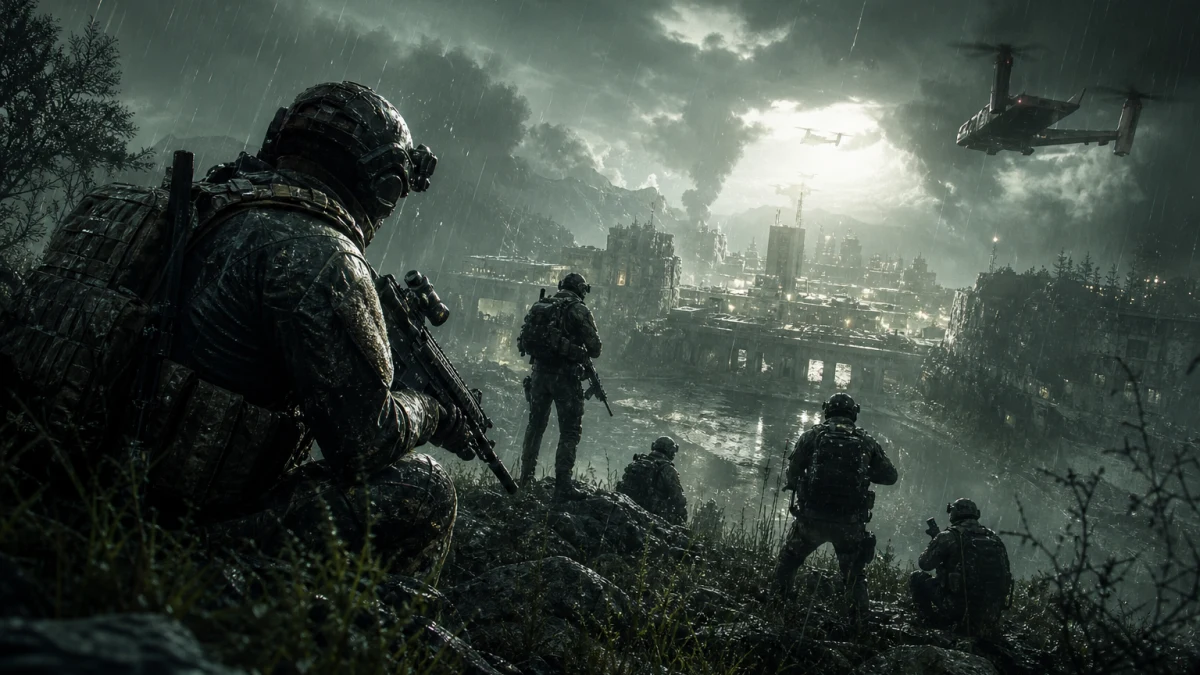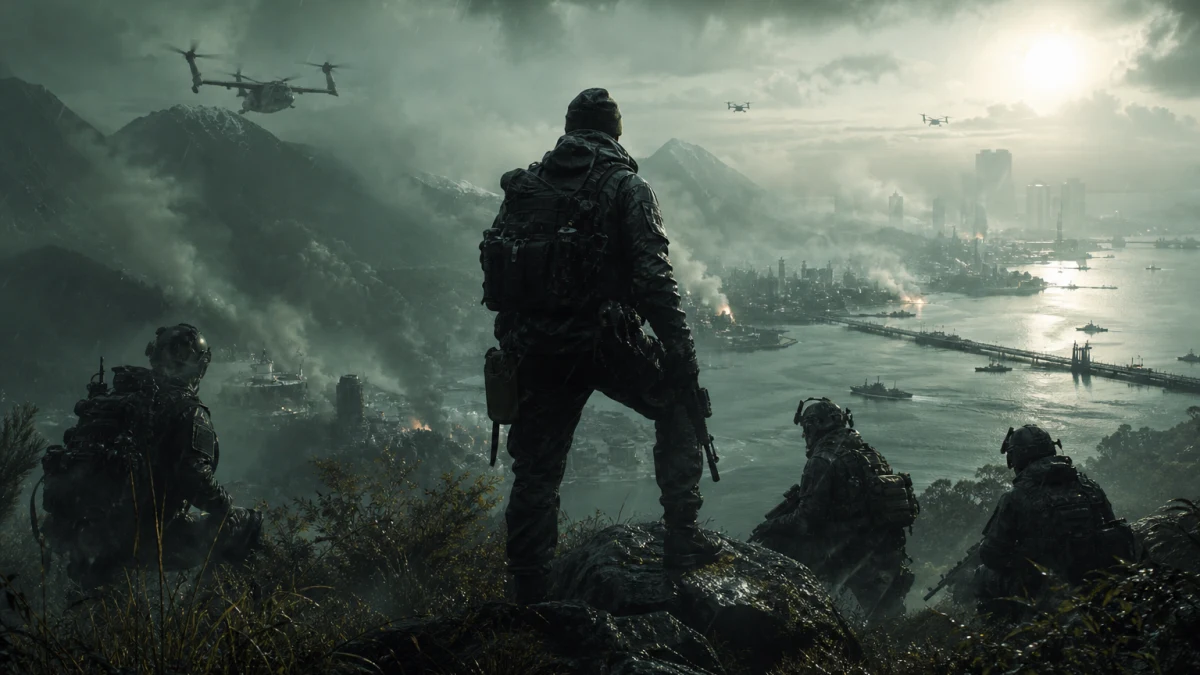
Modern Warfare 4 begins from two sharply different positions. Private Park Hyun Jun is a young South Korean soldier whose routine patrol is overturned by a fictional invasion. Captain Price is an experienced operator whose assassination of General Shepherd has forced him outside the system he once served. Park enters a war he did not choose; Price continues a personal campaign that has cost him his official standing and divided his former team.
Infinity Ward and Activision have disclosed enough to establish how those perspectives belong to one campaign. The fictional invasion of South Korea, the effort to hunt Price and the movement of an unidentified weapon toward an enemy called the Archer are presented as connected parts of a wider threat. What has not been disclosed is equally important: there is no confirmed mission order, complete playable-character list, precise Park-Price meeting point or revealed ending.
This primer was fact-checked through October 10 for publication on October 11, 2026. That places it five days before Campaign Early Access is scheduled to begin on October 16 and 12 days before the announced October 23 release. It is a source-led explanation of characters, continuity and premise, not a walkthrough, review or prediction. Necessary spoilers for Modern Warfare III are clearly contained in the continuity sections.
Evidence note: This prelaunch primer was fact-checked through October 10, 2026, for publication on October 11. Campaign Early Access was scheduled for October 16 and full release for October 23. It uses official prerelease material, developer statements, established reporting and the limited evidence supplied by the publicly playable beta version of Entrenched. GAME Watch’s Tokyo Game Show reporting is the basis for the description of the Archer as connected to North Korea and positioned behind Makarov. The same report separately identifies Mads Mikkelsen as portraying a target pursued by Price, but the retrieved evidence does not explicitly establish that this target is the Archer. The weapon type, final mission order, precise Park-Price convergence, ending and character fates remained undisclosed.
What This Primer Can Establish Before Launch
The publication date creates the most important evidence boundary. Modern Warfare 4’s complete campaign was not publicly available when this primer was prepared. Campaign Early Access is scheduled for October 16 for qualifying digital preorders or prepurchases of the Standard Digital Edition or Vault Edition, followed by the announced full release on October 23. The available material supports a detailed account of the setup, characters and advertised conflict, but not a definitive reconstruction of the full story.
There is nevertheless a substantial authorized record. Activision has published campaign briefings, trailers, beta information and a continuity recap. Infinity Ward developers have explained the intended contrast between Park and Price, named Park’s immediate companions and discussed the creative goals behind the Korean setting. Those disclosures establish more than a one-line synopsis, provided official plot facts, developer intentions and outside reporting are not treated as interchangeable forms of evidence.
Official summaries confirm how the publisher currently describes the fiction. Developer interviews establish creative intentions, not proof that the completed campaign realizes every intention. Established reporting can preserve information disclosed during presentations or interviews, but it still requires careful attribution. Promotional editing is narrower evidence: it can show that a character or setting appears, yet it cannot reliably establish mission chronology, player control, hidden allegiances or character deaths.
The distinction matters because campaign promotion is designed to create questions as well as answer them. A voice placed over footage from a different scene may suggest a connection without confirming that both elements occur together. A recognizable character appearing beside an unfamiliar location does not establish who the player controls there. Even an official description can deliberately omit chronology, motive or outcome while remaining accurate at the broadest level.
Entrenched provides a different kind of prelaunch evidence because a complete campaign mission was included during the August open beta. Its broad scenario involved a large assault by allied infantry and armored vehicles to stop a strategically important nuclear power station from falling into enemy hands. That public sample demonstrates one expression of the conventional war. It does not reveal how representative the mission is, where it appears in the final sequence or whether every detail remains unchanged at release.
The same caution applies to Infinity Ward’s statements about authenticity, representation and mission variety. The studio says it drew on cast input, advisers and dialect coaching, and that it wants adjacent missions to differ substantially. Those are meaningful production details, but a prelaunch primer cannot independently judge the complete result. They should be understood as goals that the released campaign must eventually demonstrate.
This approach also separates premise from quality. A confirmed character, location or conflict can be described accurately before launch, but that does not determine whether its eventual treatment is convincing. Conversely, withholding judgment does not require ignoring the detailed information already available. The useful middle ground is to explain what each disclosure establishes, identify the questions it leaves open and avoid extending it through genre convention or fan expectation.
The reliable boundary is straightforward. Park anchors a ground-level South Korean perspective during a fictional invasion. Price operates as a hunted outlaw after killing Shepherd. Task Force 141 has fractured, Valeria Garza has become an uneasy ally, Makarov remains part of Price’s hunt, and an unidentified weapon is being moved toward the Archer. The mission order, campaign length, ending, character fates, exact point of convergence and full nature of the wider plot remain undisclosed.
- Established before launch: the fictional premise, principal characters, broad conflicts and named environments.
- Stated development goals: a junior soldier’s restricted viewpoint, companions characterized during action, informed cultural input and substantial mission variety.
- Publicly sampled: the beta version of the complete campaign mission Entrenched.
- Not established: the final mission order, campaign length, ending, full playable roster, character fates or precise Park-Price convergence.
The Campaign in One Clear Premise
Within Modern Warfare 4’s fictional scenario, North Korea launches a full-scale invasion of South Korea. The official continuity recap identifies Hajin City as the place where the attack begins. Private Park Hyun Jun is on what had been a routine patrol when the situation becomes his first experience of live combat. His strand follows the crisis from inside a conventional military force rather than through an elite multinational unit that already possesses the strategic picture.
Park’s immediate problems are practical: survive, understand the orders reaching his squad and function with the people around him while defensive positions and cities come under pressure. Campaign descriptions broaden that path beyond the initial shock into trench warfare, collapsing urban environments and counteroffensives intended to reclaim occupied territory. That establishes an escalation from surprise attack to sustained conflict without revealing the order or outcome of individual operations.
Price starts from a completely different position. At the end of Modern Warfare III, he assassinates General Shepherd. Modern Warfare 4 presents the consequences directly: Price is an outlaw working outside the authority he once served, Task Force 141 has been disbanded, and former teammates are involved in an effort to capture or kill him. His personal campaign also continues the unresolved pursuit of Vladimir Makarov after Soap’s death.
That pursuit draws Price toward a strategic threat beyond revenge. Official material describes an unspecified weapon powerful enough to change the balance of power and identifies the Archer as its intended recipient. The weapon’s form, operating principle and destination have not been disclosed, and the Archer’s complete identity and motive remain protected story questions.
The announced connective premise is that the invasion, the Price manhunt and the weapon transfer are parallel pressures inside one larger plot. Price’s off-book operation is said to collide with forces connected to the invasion. That confirms convergence at the level of the wider crisis. It does not confirm that Park immediately meets Price, joins him or shares a particular mission with him.
The shortest dependable synopsis is therefore simple. Park fights through the immediate consequences of a fictional invasion with fellow South Korean soldiers and embedded American Marines. Price works outside official channels while pursuing Makarov, revenge and a wider threat involving an unidentified weapon destined for the Archer. Their paths belong to one campaign, but the mechanism and result of their convergence remain unrevealed.
Two Perspectives, Not Two Unrelated Campaigns
The purpose of the dual perspective is not merely to provide two recognizable protagonists. Park and Price occupy different distances from the same crisis. Park is caught inside its immediate military consequences. Price pursues the concealed people, relationships and transfers that may explain more of the wider threat. One strand can show what the conflict does to soldiers and territory while the other investigates forces operating beyond the visible front.
Park represents imposed circumstances. The fighting reaches him during routine duty, and his early responsibilities are shaped by orders, nearby danger and the needs of his squad. His viewpoint can make lost ground, damaged cities and changing defensive positions meaningful without requiring him to understand the entire conspiracy. The player can know why an immediate objective matters even when Park lacks the information needed to explain the war’s hidden architecture.
Price represents chosen escalation and continuity. He killed Shepherd, went underground and continued pursuing his enemies despite losing sanctioned authority. His strand can address the consequences of Soap’s death, the breakup of Task Force 141, Makarov’s continuing role and the unidentified weapon. Unlike Park, Price begins with years of experience and sensitive contacts, but those advantages are compromised by his fugitive status.
This division avoids forcing both protagonists to perform the same narrative job. If Price were the only center, the invasion would largely be filtered through an established elite operator. If Park carried the entire plot, the campaign would need to deliver extensive exposition about Shepherd, Makarov and Task Force 141 through a character who has no established relationship with them. Two perspectives let a new frontline crisis and older continuity develop without making either one purely explanatory.
The distinction can also control what different parts of the audience know. Returning players bring context to Price’s grief and broken relationships, while newcomers can recognize Park’s immediate danger without a trilogy recap. The campaign can reveal hidden connections through Price without requiring Park to become an intelligence expert. It can likewise use Park’s experience to show consequences that would remain abstract if the story stayed exclusively with clandestine operators.
Nothing in the supporting sources establishes a fixed alternation pattern. Two narrative anchors do not guarantee equal screen time, matching numbers of missions or switches after every chapter. Additional playable perspectives may exist, but promotional appearances cannot confirm them. The same restraint applies to locations: Korea, New York, Paris and Mumbai are announced environments, not a chart allocating one city to each protagonist.
Nor does the dual structure establish two completely separate mechanical templates. Park’s association with conventional combat does not prove every one of his sequences is a large battle. Price’s clandestine position does not prove all his missions are stealth operations. The announced contrast concerns narrative position and authority; the complete range of objectives, pacing and mechanics remains undisclosed.
The useful expectation is thematic rather than mathematical. Park’s strand concerns conventional forces, restricted information and immediate survival. Price’s concerns outlaw methods, broken loyalties and a private hunt expanding into a strategic danger. Official material says those strands form one larger plot. How frequently the campaign changes control, how information passes between them and where the decisive convergence occurs remain unknown.
Private Park Hyun Jun: What Is Confirmed
Private Park Hyun Jun is the named protagonist attached to Modern Warfare 4’s South Korean frontline perspective. Official descriptions introduce him as a young soldier encountering live combat for the first time. They do not identify him as a veteran, special operator or senior commander. His stated rank places him close to immediate orders and battlefield consequences while leaving him far from the level at which the full strategic picture would normally be assembled.
Park’s first battle develops from a routine patrol disrupted by the fictional invasion. That gives his introduction a clear threshold. He is not presented as someone seeking a place in an elite organization or undertaking a mission because of an established reputation. His surroundings change suddenly, and he must respond using the training, relationships and incomplete information available to him.
The official recap places the opening of the invasion in Hajin City. Other campaign descriptions broaden Park’s experience to trenches, collapsing cities and counteroffensives intended to retake occupied areas. Those details show that his strand extends beyond one defensive encounter. They do not establish how much time passes, which operations Park controls or whether every Korean battle shown in promotional material uses his perspective.
Park’s lack of prior live combat is important, but it should not be exaggerated into total helplessness. He is a trained soldier rather than an unprepared civilian. The dramatic distinction is between training and experience under actual fire. The campaign may explore where his preparation proves useful, where it falls short and how he adapts, but the exact shape of that development has not been disclosed.
Infinity Ward has described Park’s intended arc in broad zero-to-hero terms. That phrase is thematic framing, not an ending. It suggests growth from an inexperienced starting position toward greater ability, confidence or responsibility. It does not confirm a promotion, transfer into special operations, public recognition, survival through the final mission or any specific achievement.
The label should not flatten Park into a generic audience surrogate either. A restricted viewpoint can coexist with a defined personality, social context and set of relationships. Infinity Ward’s emphasis on companions suggests that Park’s characterization is intended to emerge through how he responds to Jay, Cho, Moon, West and Dunn. Exactly what he believes, fears or wants beyond surviving the opening crisis has not yet been established.
Park should also be distinguished from Helen Park in the Black Ops continuity. A shared surname does not establish a family, organizational or narrative connection. Modern Warfare 4’s Park is a newly introduced South Korean private in the rebooted Modern Warfare continuity.
The available material does not provide an extensive personal biography. It does not establish Park’s hometown, family circumstances, military specialty, politics or long-term ambitions. What it does establish is sufficient to define his starting position: he is trained but untested in live combat, surrounded by a young South Korean squad and embedded American Marines, and forced to adapt as an invasion overturns routine duty.
Park is therefore confirmed as a principal campaign figure and the center of its ground-level strand. His beginning is clear, as is the broad movement into a larger counteroffensive. His defining choices, later authority, relationship to Price and eventual fate remain for the completed campaign to reveal.
Why Park’s Rank and Viewpoint Matter
Park’s rank provides a natural way to limit what he knows without making his immediate objectives incomprehensible. A private can receive a clear tactical instruction while remaining unaware of the political, intelligence and clandestine forces behind it. Park may understand where his squad must go or which position must be protected without knowing how Makarov, Price, the Archer or the unknown weapon fits into the wider emergency.
Infinity Ward co-head Jack O’Hara described the intended perspective as that of young soldiers receiving incomplete orders and trying to survive what is directly in front of them. That goal distinguishes Park from the elite operators who dominate much of the reboot continuity. Price and his established associates routinely work with sensitive intelligence, senior contacts and broad operational discretion. Park starts as one soldier in a conventional force reacting to a front that is changing around him.
Restricted knowledge does not require permanent confusion. A unit can understand that a route must be opened, an installation protected or an occupied district retaken without knowing every reason behind the conflict. The campaign can preserve a strategic mystery while still giving Park clear short-term stakes. His squad’s survival and the condition of nearby territory are meaningful even before the larger antagonist plot becomes visible.
Price offers the opposite relationship with authority. Park begins inside a military structure and must act on instructions passed through it. Price possesses far more experience and freedom of action, but he has placed himself beyond sanctioned command by killing Shepherd. Park has institutional legitimacy with limited access to information; Price has knowledge and clandestine contacts without legitimacy or dependable protection.
Neither position determines the morality of every decision. Park’s place in a chain of command does not prove that every order will be wise. Price’s fugitive status does not prove every action he takes is wrong, just as the danger posed by his enemies cannot automatically justify his methods. The announced setup creates pressures that the campaign can examine rather than delivering a final judgment in advance.
Ground-level is a narrative description, not a promise of documentary realism. Modern Warfare 4 remains a fictional military shooter built around designed objectives, dramatic pacing and large action sequences. Park’s proximity to infantry combat may make consequences more immediate, but it does not turn the story into a literal simulation of warfare or make its scenario a forecast.
It also does not mean Park’s strand must be small in physical scale. Entrenched demonstrates that a junior soldier can occupy the center of a battle involving armored vehicles and numerous friendly troops. Ground-level describes the character’s place inside that operation: he experiences its immediate demands rather than directing the entire battlefield from above. Scale and restricted knowledge can therefore coexist.
The viewpoint also places particular weight on companions. Price enters with years of characterization already attached to him. Park can instead be defined by how he behaves around Jay, Cho, Moon, West and Dunn. How he listens, adapts, disagrees or responds to pressure can establish his personality while the action continues.
Park’s starting lens may also help newcomers. He does not need to understand Shepherd’s history or Ghost’s disagreement with Price for the invasion to make immediate sense. Returning players can recognize the continuity underlying Price’s strand, while new players learn the current crisis alongside Park. That distributes the continuity burden rather than placing all of it in a recap.
None of this predicts Park’s destination. Beginning with incomplete information does not prove that he remains uninformed throughout the campaign. Conversely, thematic growth does not prove that he receives a promotion, joins an elite unit or gains strategic command. His rank and first-combat status define the opening viewpoint, not the ending.
Park’s Squad and the Embedded Marines
Narrative Director Jeff Negus has identified Park, Jay, Cho and Moon as the South Korean soldiers forming the core new squad. The group has broadly been described as conscripted characters thrust into a battlefield. That establishes a shared circumstance, but it does not mean all four have identical backgrounds, personalities, experience or attitudes toward military service.
The ensemble gives Park’s strand a social structure that contrasts with Price’s isolation. Park is surrounded by peers confronting the same immediate crisis. Their limited access to strategic information makes uncertainty about orders and changing battlefield conditions a natural part of the group’s experience. Their different responses can also provide a personal measure of events when the campaign expands to armor, amphibious action and citywide assaults.
West and Dunn are American Marines embedded with the Korean squad. Infinity Ward has identified the interaction between the South Korean soldiers and the Americans as a source of culture shock, tension and cooperation. Embedded does not automatically mean that West and Dunn command the group, and it does not reveal how long the characters have known one another. The confirmed relationship is sustained operational proximity between members of two forces.
Culture shock should not be simplified into constant hostility. Differences in language, expectations, procedure or behavior can produce friction while the soldiers remain dependent on one another. Shared danger does not guarantee instant friendship either. Infinity Ward’s description establishes room for trust and disagreement to develop without disclosing the final state of every relationship.
Associate Design Director Alex Norris has said the studio wants campaign companions beside the player on the front line instead of developing them only through detached dialogue. Battlefield conduct can therefore contribute to characterization. A companion’s response to pressure, a confusing order or another soldier can convey priorities more directly than a biography delivered during a briefing.
That goal is especially relevant during large battles. Recurring companions can preserve immediate personal stakes while vehicles and larger formations fill the scene. They can also provide reference points for Park’s development. This describes the intended narrative function of the squad, not a confirmed companion-command system or a promise that players directly control squad tactics.
Companion presence also should not be converted into guarantees about persistence. A developer goal to keep characters near the action does not establish that all six accompany Park through every operation, appear in every location or remain available for the entire campaign. Units can separate, receive different assignments or temporarily disappear from a sequence without contradicting the broader intention.
The prelaunch record does not support detailed individual biographies. A weapon carried in one trailer shot does not establish a permanent specialty. Position in promotional art does not confirm rank or authority. Nothing available establishes romances, family connections, betrayals, rivalries, casualties or a fixed succession of command among the six characters.
Infinity Ward says it used cast input and a dialect coach to inform dialogue and representation. Those measures are relevant to a group built around Korean characters and embedded Americans, but they remain production choices rather than proof of the final execution. Consultation can influence wording, delivery and cultural details without guaranteeing that every scene meets the studio’s stated ambition.
The dependable map of the ensemble is therefore limited but useful. Park, Jay, Cho and Moon are the identified South Korean group. West and Dunn are the embedded American Marines. Infinity Ward wants their cooperation and differences to emerge while they operate together under fire. Exact ranks beyond Park’s stated rank, detailed backgrounds, personal relationships and fates remain undisclosed.
- South Korean squad members named by Infinity Ward: Park, Jay, Cho and Moon.
- Embedded American Marines: West and Dunn.
- Stated dramatic focus: battlefield cooperation, cultural difference and companions present during action.
- Not established: detailed biographies, most specialties, exact ranks, personal relationships or fates.
Captain Price After Modern Warfare III
This section contains necessary Modern Warfare III story spoilers. Price’s opening circumstances depend on the reboot continuity that began with Modern Warfare in 2019 and continued through Modern Warfare II and Modern Warfare III. That continuity is separate from the original trilogy that began with Call of Duty 4: Modern Warfare. Events from the original games cannot be treated as advance knowledge of what will happen here.
Only a small portion of the preceding story is essential. In Modern Warfare III, Vladimir Makarov kills John “Soap” MacTavish. Price survives the loss of his teammate and continues hunting Makarov. That gives the revenge-driven framing around his Modern Warfare 4 strand a specific emotional foundation rather than presenting the pursuit as another impersonal assignment.
Price subsequently assassinates General Shepherd. The earlier games provide broader context for their history, but the immediate consequence is institutional. Price personally kills a senior military figure and cannot simply return to ordinary sanctioned operations afterward. Negus has characterized the action as a line the character cannot readily step back across. Modern Warfare 4 treats its repercussions as a defining change in Price’s status.
Price therefore enters the new campaign as an operator turned outlaw. His experience, contacts and tactical ability remain, but he no longer possesses the legitimacy or dependable infrastructure associated with Task Force 141. The continued use of Captain Price as his familiar name should not be mistaken for proof that he still formally commands an intact official team.
Makarov remains part of Price’s continuing hunt. The introduction of the Archer does not erase that unresolved antagonist or make Makarov irrelevant. What remains unclear is how Makarov relates to the new figure, the unidentified weapon and the invasion. The available summaries establish overlapping threats without supplying a complete hierarchy.
Price’s outlaw status changes the practical meaning of his competence. The important question is not whether he still knows how to fight. It is how he operates without institutional cover when former teammates know his habits, contacts may be endangered by helping him and assistance depends on people whose interests may be hostile or conditional.
Revenge is central but not exclusive. The weapon introduces a danger larger than Price’s private reckoning. Preventing its delivery may overlap with his pursuit of Makarov and his response to Soap’s death, but official material has not disclosed exactly how Price balances personal loss against the wider threat.
The shortest useful recap contains four beats. Soap dies at Makarov’s hands. Makarov survives and remains part of the threat. Price assassinates Shepherd. That action forces Price underground and fractures his relationship with the organization and people who previously supported him.
Keeping the recap focused preserves Modern Warfare 4’s identity as more than an epilogue. Park, his squad, the fictional invasion, the Archer and the weapon establish a new crisis. Prior continuity explains Price’s emotional and institutional position; it does not reveal how the new plot ends.
Task Force 141 Has Fractured
Official campaign material says Task Force 141 has been disbanded after Price goes on the run. That is the announced opening condition, not merely an inference from the team’s absence in one operation. Price is not returning as the uncontested commander of a functioning unit with Ghost, Gaz and Kate Laswell automatically supporting every choice he makes.
Ghost questions Price’s unlawful methods. The disagreement is grounded in conduct rather than a simple personality clash: Price assassinated Shepherd and continued operating outside recognized authority. The campaign can therefore distinguish personal loyalty from approval. A former teammate may understand Price’s grief without accepting what he did or believing he should remain free to continue.
Ghost and Gaz are assigned to capture or kill their former captain. That turns the fracture into an immediate operational threat. People who know Price and his methods are involved in the effort to stop him. The order does not reveal whether Ghost and Gaz interpret it identically, how much discretion they possess or what happens when they encounter Price.
Calling the assignment a definitive betrayal would settle its moral meaning too early. Ghost and Gaz are responding to a situation in which Price killed Shepherd and fled. Duty, institutional pressure, incomplete information, disagreement and lingering loyalty could all influence their conduct. Their order does not erase their shared history, just as that history does not erase Price’s action.
Laswell remains in contact with Price despite his fugitive status. Continued communication distinguishes her position from a complete break, but official material also presents her as wary of his methods. Contact is not endorsement. Laswell may recognize the value of Price’s information or the seriousness of the threat without approving his conduct.
The result is a fractured network rather than two simple camps. Price is isolated but not completely disconnected. Ghost objects to his behavior while carrying a severe assignment. Gaz participates in the manhunt but has an established bond with him. Laswell keeps a channel open without restoring the old arrangement. Personal and institutional obligations overlap.
Disbandment also changes what Price can plausibly rely upon. He cannot be assumed to possess a full operations center, unrestricted logistics or an official chain of command whenever he needs support. Assistance may be conditional, incomplete or dangerous to the person providing it. That loss helps explain why cooperation with a former enemy becomes possible.
The manhunt and the larger threat need not remain separate. Ghost, Gaz and Laswell may encounter information that changes their understanding of Price’s actions, while Price may discover that avoiding capture interferes with his pursuit of the weapon. Those are structural possibilities, not confirmed events. Official material establishes simultaneous pressure without revealing which relationship changes first.
Disbanded describes the beginning, not the conclusion. Task Force 141 could reconcile, remain divided, reorganize or cease to exist in its familiar form. Marketing language about a breaking point does not prove permanent destruction, while franchise familiarity does not guarantee a reunion.
The capture-or-kill order establishes no casualty or outcome. It does not prove that Price attacks Ghost or Gaz, that either refuses the assignment or that Price is captured. Trailer confrontations lack the context needed to answer those questions. The dependable point is that Price’s old relationships now create danger as well as possible routes to help.
Valeria and Price’s Unlikely Alliance
Valeria Garza, also known as El Sin Nombre, is identified as the leader of the Las Almas Cartel. Her established role in the reboot continuity is adversarial: she previously opposed Price and Task Force 141 rather than serving as a trusted partner. Modern Warfare 4’s announced alliance between Valeria and Price therefore demonstrates how sharply his available relationships have changed.
Price turns to a former enemy while former allies pursue him. Valeria operates outside the institutions that now regard him as a fugitive and may possess access to people, information or routes unavailable through official channels. Activision has not disclosed their complete bargain, what Valeria expects in return or how much either person initially understands about the wider threat.
Alliance is the supported description, but friendship and trust are not. Two hostile figures can cooperate because their interests overlap temporarily. Price’s acceptance of assistance does not erase Valeria’s prior conduct. Valeria’s cooperation does not place her under Price’s command or make her a member of a restored Task Force 141.
The arrangement communicates Price’s changed position more effectively than a simple briefing could. When he had official backing, Valeria was an adversary pursued from a position of institutional strength. Without that structure, Price must negotiate. Their relationship can expose both the compromises he is prepared to accept and the leverage Valeria possesses.
Valeria must still be treated as an actor with independent interests. Nothing establishes that she adopts Price’s revenge as her cause or accepts his priorities as her own. Their cooperation could involve information, introductions, transport or practical support, but the precise terms have not been confirmed.
Her presence is not evidence that she caused the invasion or controls the unidentified weapon. A cartel leader may appear plausible in a thriller involving clandestine movement, but plausibility does not establish responsibility. Official material identifies the Archer as the intended recipient of the weapon and Price as someone drawn into the plot surrounding it. It does not identify Valeria as its creator, owner or courier.
A betrayal should not be treated as inevitable. Their history supplies tension, but it does not dictate an outcome. Valeria could honor a narrow bargain, pursue a parallel interest, conceal information or enter another conflict with Price. The duration and result of the alliance remain undisclosed.
The partnership also contrasts with Park’s situation. Park works beside assigned squad members and embedded Marines inside a conventional structure. Price builds provisional cooperation among people whose interests may be conditional or openly hostile. Park’s interpersonal tension exists within an official force; Price’s is intensified by the absence of one.
Four continuity facts are enough before launch. Valeria is El Sin Nombre, she leads the Las Almas Cartel, she has previously been an enemy of Price and Task Force 141, and she now forms an uneasy alliance with Price while his former teammates pursue him. The bargain’s terms, duration and consequences belong to the campaign.
The Archer and the Unknown Weapon
The largest unresolved component of the announced plot is an unspecified weapon being moved toward an enemy called the Archer. Activision describes the weapon as powerful enough to alter the balance of power. That establishes strategic importance and explains why Price’s attention expands beyond personal revenge, but it supplies little technical information.
The official campaign briefings supporting this primer do not identify the weapon’s type. It should not be called nuclear, chemical, biological, cybernetic, autonomous or experimental merely because those categories are familiar to military thrillers. A statement about potential consequence is not evidence of mechanism. No disclosed range, target, delivery system or operating principle supports a more precise classification.
Entrenched’s nuclear power station does not fill the gap. A power station is strategically important infrastructure, and preventing its capture is a comprehensible objective within the fictional invasion. Its presence does not prove that the site manufactures, stores or powers Price’s mystery weapon. Connecting the two would transform thematic proximity into an unsupported plot claim.
The weapon’s physical form is similarly unknown. Official summaries do not say whether it is portable, fixed, vehicle-mounted, networked or divided among several components. They do not establish who built it, where it originated, who currently possesses it or whether it has already been tested. Calling it an unidentified weapon preserves the announced stakes without inventing properties.
The Archer’s confirmed outline is also limited. Activision identifies the Archer as a dangerous enemy and the intended recipient of the weapon. The campaign-focused sources retrieved for this primer do not disclose the figure’s full identity, organization, motive, nationality, title or exact relationship to the invasion.
Specialist reporting from Tokyo Game Show adds that the Archer was presented as a mysterious figure behind Makarov with a connection to North Korea. That provides useful context, but its wording does not establish the precise relationship. Being behind Makarov might imply influence, concealment, sponsorship or a higher position; it does not by itself prove a formal chain of command.
The same reporting confirms Mads Mikkelsen’s involvement as a target pursued by Price. It does not explicitly identify Mikkelsen’s character as the Archer. Casting, visual resemblance and trailer editing cannot close that evidentiary gap. Until an official identification or equally explicit reporting supplies it, the actor’s target and the Archer must not be merged into one confirmed character description.
The Archer’s motive remains open. The weapon transfer suggests an objective with strategic consequences, but the desired political or military outcome is not stated. It is not known whether the Archer initiated the invasion, supports it, exploits it or is pursuing a related plan. A connection to North Korea within the fiction does not establish the complete causal chain.
Makarov’s position requires the same restraint. He remains part of Price’s manhunt, and reporting places the Archer behind him, but that does not establish whether Makarov is a subordinate, partner, intermediary, beneficiary or manipulated asset. It also does not reveal how much Makarov knows about the Archer’s intentions.
The balance-of-power description is narrative framing rather than a measurable military assessment. It tells the audience that successful delivery would matter within the campaign. It does not identify which faction currently holds an advantage, which political outcome would change or how quickly the weapon could be used.
The deliberate lack of technical detail also means the weapon should not become the organizing explanation for every campaign image. A damaged city, power facility, convoy or pursuit might be connected to it, but visual proximity in advertising is insufficient. Until the story supplies a direct link, each confirmed setting and objective should retain its own evidentiary boundary.
The dependable outline is consequently specific but incomplete. A strategically consequential weapon is being moved toward the Archer. Price’s personal pursuit draws him into that wider plot. The Archer has a reported North Korean connection and is positioned in some unexplained way behind Makarov. The weapon’s mechanism and the Archer’s identity, organization, motive and exact authority remain unrevealed.
- Established: an unidentified weapon is being moved toward the Archer.
- Established: Price’s personal hunt expands into the wider weapon plot.
- Reported from Tokyo Game Show: the Archer has a North Korean connection and is framed as a figure behind Makarov.
- Separately reported: Mads Mikkelsen portrays a target pursued by Price.
- Not established: that Mikkelsen’s target is the Archer, the weapon’s type and capabilities, or the Archer’s complete motive and organization.
How the Two Story Strands Are Said to Connect
The firmest official description of the connection is that Price’s off-book operation collides with forces behind the invasion. This confirms a shared narrative framework while preserving the campaign’s central mystery. It does not confirm that Park and Price immediately meet, fight side by side or understand the same portion of the crisis when their actions first begin to overlap.
The disclosed connective tissue consists of three pressures. Park experiences the invasion and military response through South Korean conventional forces. Price is hunted while continuing a personal campaign involving Makarov. An unidentified weapon is being moved toward the Archer. Official material presents these pressures in parallel rather than as unrelated stories sharing a title.
That structure permits information to travel asymmetrically. Park can encounter consequences on the front without knowing which concealed actors helped produce them. Price can pursue people and transfers whose strategic importance is already visible through fighting elsewhere. The audience may understand links before either protagonist does, or each strand may reveal a different part of the same explanation.
A plot connection should be distinguished from a personal meeting. Protagonists may be linked through a shared adversary, an intelligence trail, a weapon or a sequence of consequences without appearing together immediately. Direct contact remains possible, but it has not been established. Saying that their stories converge is supported; saying that Park joins Price on a named operation is not.
The announced international locations cannot be used to reverse-engineer the sequence. Korea, New York, Paris and Mumbai show geographic breadth, but they do not prove that Price discovers one clue in a particular city and delivers it to Park in another. Nor do they establish which protagonist controls every operation.
The causal hierarchy is equally protected. No retrieved source establishes which individual planned the invasion, whether the weapon is intended for use on the peninsula or whether one event serves as a diversion for another. Valeria’s assistance to Price does not make her responsible for the transfer. Makarov’s involvement does not automatically make him the architect of every event.
The two leads may also retain different priorities after their stories overlap. Park can remain concerned with his squad, orders and occupied territory. Price may focus on Makarov, the Archer, the weapon or survival during the manhunt. Opposition to a common threat would not automatically settle disagreements about methods, authority or acceptable risk.
Convergence can therefore occur at several levels. The stories are already connected thematically through contrasting relationships with authority. They are connected strategically by the wider threat described in official material. Whether they become personally connected through a meeting, shared mission or direct exchange remains unknown. Keeping those levels separate prevents a broad synopsis from becoming a fabricated scene.
The responsible conclusion is bounded. Park’s war and Price’s hunt form one announced plot, and the invasion, manhunt and weapon transfer supply the bridge. The specific mission, discovery or confrontation that creates a direct convergence has not been disclosed.
The Korean Peninsula Setting Is Fictionalized
Modern Warfare 4 depicts a fictional North Korean invasion of South Korea. Every reference to that invasion here concerns the campaign’s premise, not a current event, military forecast or claim about the intentions of real governments. Maintaining that qualifier is essential because military-thriller language can resemble news reporting when removed from its fictional context.
Infinity Ward has explained that it draws inspiration from contemporary events and then fictionalizes those elements around its characters and intended player experience. That describes a creative process, not an attempt to reproduce a real operational scenario. The campaign conflict exists to support a scripted action story with designed objectives, dramatic reversals and playable spectacle.
Hajin City illustrates the boundary. The official recap assigns it a particular role as the place where the invasion begins within the game. It should not be casually mapped onto an assumed real counterpart or treated as evidence for a plausible invasion route. Its verified significance is internal to the story: Park’s routine patrol there becomes his first live combat.
The same limitation applies to trenches, amphibious action and citywide counteroffensives. These are announced combat frames, not analyses of actual military readiness, likely tactics or political decision-making. Those real-world subjects would require entirely different evidence and specialist expertise, and they still would not transform a Call of Duty scenario into a forecast.
The Archer’s reported connection to North Korea must remain inside the fictional boundary as well. It concerns a fictional antagonist’s association within the campaign, not a claim about a real person, agency or plan. Because the character’s organization and office have not been disclosed, attaching the Archer to a real institution would be particularly irresponsible.
Fictional framing also prevents the cast from being treated as universal representatives. Park, Jay, Cho and Moon are constructed individuals within one squad. West and Dunn are fictional American Marines. Their behavior may be informed by consultation and cast input, but it cannot stand as a comprehensive account of Korean or American service members.
Authenticity and fiction are not opposites, but they answer different questions. A production can research language, equipment, military practice and cultural details while placing them inside an invented conflict. Accuracy in one detail does not make the larger scenario documentary. Fictionalization means research serves a dramatic construction rather than predictive reporting.
Infinity Ward says it used cast input, advisers and dialect coaching. Those measures suggest an intention to avoid using Korea as interchangeable scenery. They do not guarantee the final result. Evaluation must eventually consider how much agency Korean characters receive, how cultural difference is handled and whether spectacle supports or overwhelms Park’s viewpoint.
The distinction remains necessary even when promotional material uses familiar institutions, terminology or equipment. Recognizable details can make an invented scenario legible, but they do not authenticate its political assumptions. A real place name, military designation or bilateral relationship can be placed inside a wholly fictional causal chain.
Neutral phrasing is more useful than sensational geopolitical framing. The game’s premise can be explained without speculating about real leaders, current diplomacy, invasion routes or the actual capabilities of national militaries. That keeps the primer focused on verified story information and prevents fictional marketing from acquiring the appearance of intelligence reporting.
After release, criticism can assess whether Park and his squad receive meaningful characterization, whether the invented conflict is internally coherent and whether cultural specificity survives the demands of blockbuster action. Before the complete campaign is available, those remain evaluative questions rather than established judgments.
What Infinity Ward Says It Wanted From Korea
Infinity Ward selected Korea partly because it wanted to depict Asia at a scale it had not previously attempted in its Modern Warfare work. Jack O’Hara told The Washington Post that the studio had settled on the setting roughly four years before the May 2026 reveal. That reported timeline indicates that Korea was a foundational production choice rather than a battlefield attached shortly before announcement.
A long planning period provides context, not proof of quality. Choosing a setting early can allow it to shape environment design, scenario planning, casting and dialogue across production. It cannot guarantee that every resulting decision is nuanced or effective. The finished campaign remains the necessary evidence for judging whether the setting matters beyond spectacle.
The studio has identified the relationship between Korean and American forces as a storytelling opportunity. Rather than representing that relationship only through governments and commanders, the campaign places West and Dunn alongside Park, Jay, Cho and Moon. Cooperation and misunderstanding can therefore develop through recurring characters required to function together under pressure.
This squad-level approach can keep a large conflict legible. An invasion may involve cities, armor and amphibious operations, but Park’s immediate understanding can stay tied to the people beside him. Changes in trust, morale and communication offer a human scale for developments that might otherwise appear only through maps, broadcasts or exposition.
Infinity Ward says its cast, advisers and a dialect coach informed dialogue and representation. Those resources address different production needs. Cast members can contribute to how dialogue feels in performance, advisers can provide context, and dialect coaching can support linguistic consistency. The confirmed fact is that the studio describes using these processes.
Their effect cannot be certified from prelaunch statements alone. Consultation may inform a project without controlling every creative decision, while a fast-moving action campaign may simplify communication or institutions for pacing. The defensible formulation is that Infinity Ward sought relevant input. Whether the completed writing fulfills that goal requires assessment of the complete work.
Korea also supports the return to a less fully informed soldier perspective. Park begins inside the affected front instead of arriving as an internationally recognized operator. The setting is consequently not just another destination on Price’s itinerary. It is the home context for a new cast intended to anchor a major campaign strand.
At the same time, Infinity Ward is using the setting for blockbuster scale. Announced material includes trenches, collapsing cities, armored movement, amphibious action and counteroffensives. The creative challenge is preserving Park’s perspective when the frame expands. Large action could reinforce his vulnerability, or it could make his squad feel peripheral. Prelaunch material establishes the ambition but not the outcome.
Infinity Ward has also said it wants individual missions to differ significantly from the ones immediately before and after them. Korea supplies several possible combat frames within that goal, from entrenched battles to urban recovery operations. The recurring squad is intended to provide character continuity while situations change. Mission variety and companion presence remain stated directions rather than independently verified achievements.
The fair prelaunch account is specific without becoming an endorsement. Infinity Ward wanted to depict Asia at a new scale for Modern Warfare, use Korean-American interaction as recurring character material, seek informed input for language and representation, and ground a major part of the campaign in a young South Korean soldier’s restricted experience. The released story must demonstrate how successfully those aims coexist.
Confirmed Campaign Locations and Combat Frames
Official summaries name Korea, New York, Paris and Mumbai. They associate those environments with broad forms of action: trench warfare in Korea, close-quarters combat in New York, high-speed chases in Paris and SAS night raids in Mumbai. These descriptions establish intended variety, but they do not form a complete mission list or chronology.
Hajin City has the clearest announced narrative placement. The official story recap identifies it as the place where the fictional invasion begins. Park’s routine patrol is overtaken by the attack there, making Hajin the setting most firmly associated with the opening of his arc. The summaries do not establish how long the campaign remains in the city or identify every objective surrounding the attack.
Korea is associated with fighting beyond that beginning. Promotional material refers to trenches, collapsing cities, counteroffensives and citywide assaults intended to retake occupied territory. Joint United States and Republic of Korea Marines participate in ground combat and an amphibious assault. Those elements establish conventional military scale and a broad movement from immediate defense toward efforts to recover ground.
New York is linked to close-quarters combat, but few narrative details accompany that description. Close quarters might involve interiors, constrained streets or another compact environment. The phrase does not establish an objective, enemy, mission length or controlled character. It is best understood as an advertised combat frame rather than a synopsis.
Paris is associated with high-speed chase action. That confirms a contrast in movement and pace, not the route, vehicles, target or control scheme. Promotional shorthand differentiates environments; it should not be expanded into a detailed mission account without supporting information.
Mumbai is associated with SAS night raids. Price’s background makes him an intuitive candidate for such an operation, but intuition does not establish player-character allocation. The description confirms a location and broad operational style. It does not reveal who leads the raid, how many sequences occur there or what the operation contributes to the weapon plot.
The contrast among these settings fits Infinity Ward’s stated mission-variety goal. Trench fighting, close-quarter action, pursuit and night operations suggest different rhythms. Whether the campaign transitions among them effectively remains unknown. Their order in a promotional summary also need not match their order in the story.
The international scope establishes that the Korean conflict is central without being the campaign’s only geographical component. Park’s perspective anchors the invasion, while Price’s pursuit supplies a route into wider networks and locations. Even so, there is no safe basis for assigning every Korean operation to Park and every overseas mission to Price.
Named locations should be treated as environments rather than chapters. One city could contain several missions, and one mission could move across multiple areas. Additional settings may exist. The four announced regions do not establish equal campaign time, act boundaries or a total mission count.
The amphibious assault warrants the same restraint. Official material depicts joint forces participating in that type of operation. It does not reveal the sequence’s chronological position, lasting territorial result or controlled character. Its dependable significance is that it communicates the scale of the fictional conventional conflict.
Likewise, references to citywide assaults describe the size and purpose of combat without settling territorial outcomes. An operation intended to retake occupied ground may succeed, fail or achieve only part of its objective. Promotional language about an assault cannot be converted into a confirmed victory or a map of how the front changes afterward.
No location can yet be assigned to a specific antagonist. Trailer editing may place a target, voice or piece of dialogue over images from one city without proving that the related scene occurs there. The available material does not establish where the Archer appears, where the weapon changes hands or where Price’s most important discoveries occur.
For prelaunch preparation, the location list promises geographic and operational range rather than a chapter guide. Korea supplies invasion fighting and counteroffensives; New York, Paris and Mumbai widen the campaign through distinct advertised action styles. Their order and complete relationship to Park, Price and the wider threat remain unrevealed.
- Korea: invasion fighting, trenches, joint operations and counteroffensives.
- Hajin City: the stated opening location of the fictional invasion.
- New York: close-quarters combat.
- Paris: high-speed chase action.
- Mumbai: SAS night raids.
- Not disclosed: chronological order, complete mission count, antagonist allocation or full playable-character allocation.
What Entrenched Adds—and What It Does Not
Entrenched holds an unusual place in the prelaunch evidence because a complete campaign mission appeared during the August open beta. Unlike a trailer assembled from brief shots, it gave players access to a sustained scenario with an objective, allied forces and a large battle. It is the clearest public sample of the campaign, but it remains only one sample.
The mission centers on an assault intended to prevent a strategically important nuclear power station from falling into enemy hands. Allied infantry and armored vehicles participate. That broad setup confirms at least one campaign battle in which the player advances as part of a larger conventional force rather than operating solely as an isolated covert specialist.
Entrenched consequently supports Infinity Ward’s frontline framing. The conventional conflict associated with Park’s side is not represented only through cutscenes or distant radio reports. The mission demonstrates how a larger battle can surround the player, with infantry and armor making the immediate objective feel like part of an operation extending beyond one squad.
The power station supplies a clear territorial stake without explaining the wider conspiracy. Critical infrastructure can matter for several reasons within the fiction. A junior soldier can receive an urgent instruction to prevent its capture without knowing everything about Makarov, the Archer or the unidentified weapon. That relationship between tactical clarity and incomplete strategic information fits Park’s announced perspective.
Nuclear power generation is not synonymous with a nuclear weapon. No official source supporting this primer states that the facility creates, stores or powers the unidentified device in Price’s story. Combining the two because they are both strategically important would manufacture a connection that the announced material does not establish.
The mission likewise does not explain the Archer’s role. An enemy assault on a power station does not prove the Archer ordered it, intends to use it or appears in the operation. Nor does the mission establish how Makarov relates to the facility. Those questions belong to the larger plot and cannot be answered by attaching every unresolved threat to one setting.
One large assault cannot define the campaign’s average pace. Infinity Ward has emphasized variation, while other announced environments involve close-quarters action, chases and night raids. Entrenched proves that conventional battle at this scale exists. It does not prove that every Park mission includes armor, large formations or a similarly broad advance.
It also cannot establish the campaign’s overall difficulty, artificial intelligence behavior or balance. Beta players experienced one version under specific prelaunch conditions. Enemy density, allied behavior and checkpoint placement in that sample may not describe other missions, and they may not remain identical in the final build.
Beta availability does not reveal the mission’s place in the final chronology. A playable sample cannot determine how many operations precede it, how often the perspective changes or where acts begin and end. Entrenched may have been selected because it demonstrates a particular style rather than because it serves as the opening or midpoint.
Exact equivalence with the final build is uncertain. The durable evidence is the mission title, broad objective and large-assault presentation. Checkpoints, dialogue, balance, encounter composition or visual details could change before release. Precise tactical guidance should therefore be verified against the final public version.
A step-by-step walkthrough would not serve this primer’s purpose. Routes, enemy placements and optimal tactics answer how to finish Entrenched. The relevant narrative point is that it supplies one concrete expression of the conventional war associated with the young-soldier perspective.
Entrenched should consequently be neither dismissed nor generalized beyond its reach. It is stronger evidence than a montage for the scenario it presents. It is not evidence for unseen missions, the whole campaign’s pacing or the story’s ultimate quality. It establishes one battle, one strategic objective and one example of the scale Infinity Ward intends to place around its frontline cast.
How Much Prior Modern Warfare Knowledge Is Needed
Modern Warfare 4 continues the reboot continuity established by Modern Warfare in 2019, Modern Warfare II and Modern Warfare III. Its dual perspectives create different entry requirements. Park’s crisis and supporting cast are largely new, while Price’s position is a direct consequence of previous events. A newcomer can understand the invasion immediately but needs limited context to appreciate why familiar allies are hunting Price.
The shortest recap begins with Soap. Makarov kills John “Soap” MacTavish in Modern Warfare III, leaving Price with a personal reason to continue the hunt. Makarov survives and remains part of the developing threat. That is enough to explain the revenge element without reconstructing every operation from the earlier campaigns.
The second essential event is Price’s assassination of General Shepherd. Shepherd’s earlier conduct and relationship with Task Force 141 supply fuller context, but the immediate consequence is simple. Price kills a senior military figure and becomes a fugitive. Task Force 141 is disbanded, and the action cannot be absorbed as ordinary mission discretion.
The third point is the old team’s response. Ghost questions Price’s unlawful conduct, while Ghost and Gaz are assigned to capture or kill him. Laswell remains in communication but is wary. These facts explain why Price is isolated despite his history with them and why any encounter between the former teammates carries more than ordinary operational tension.
Valeria’s background is useful but can be summarized quickly. She is El Sin Nombre, leads the Las Almas Cartel and has previously been an enemy of Price and Task Force 141. Knowing that much is enough to understand why their cooperation is extraordinary. A complete retelling of her prior story is optional.
The Archer does not require remembered knowledge from an older campaign. Modern Warfare 4’s prelaunch material introduces the designation in connection with the unidentified weapon and wider threat. The character’s identity, organization and motive are new mysteries rather than facts players were expected to learn in a previous installment.
Park’s strand lowers the barrier to entry. Park, Jay, Cho, Moon, West and Dunn are introduced around a new crisis. Their immediate danger does not require recognition of Makarov or detailed memory of Shepherd. Players can learn their relationships and the changing conflict as events unfold.
Official recap material says newcomers can enter Modern Warfare 4 without completing all three preceding campaigns. Playing them can deepen the emotional context surrounding Soap, Ghost, Gaz, Laswell and Price, but declaring them mandatory would overstate the barrier and ignore Park’s function as a new point of entry.
A practical preparation plan has three levels. The fastest route is to know four core beats: Soap dies, Makarov survives, Price kills Shepherd and Price becomes a hunted outlaw. A middle route adds Price’s relationships with Task Force 141, Laswell and Valeria. The fullest route is to play the three reboot campaigns in release order.
Players must distinguish the reboot from the original Modern Warfare trilogy. The original games contain alternate versions of familiar characters and events. They cannot be used to predict deaths, alliances or revelations in Modern Warfare 4. Shared names and recurring themes do not mean history must repeat.
Returning players should not confuse familiarity with advance knowledge either. Makarov’s previous conduct does not explain his complete relationship with the Archer. Task Force 141’s history does not guarantee a reunion. Prior campaigns explain Price’s emotional and institutional stakes; they do not resolve the new plot.
The ideal minimum preparation is character-centered rather than encyclopedic. Understand why Price is grieving, why he is outside the law, why his former teammates have cause to oppose him and why Valeria is an uncomfortable partner. Park’s strand can introduce the invasion and new cast on its own terms.
- Minimum context: Soap’s death, Makarov’s survival, Shepherd’s assassination and Price’s outlaw status.
- Useful context: Price’s relationships with Ghost, Gaz and Laswell, plus Valeria’s previous role.
- Optional fullest route: play the three reboot campaigns beginning with Modern Warfare from 2019.
- Continuity warning: the original Modern Warfare trilogy is a separate version of events.
- Unresolved new material: the Archer’s identity, the unknown weapon and their relationship to the invasion.
Questions the Prelaunch Material Intentionally Leaves Open
The unidentified weapon remains the clearest technical mystery. Official briefings establish its strategic importance and movement toward the Archer, but they do not identify its type, form, origin or precise capabilities. Its eventual destination and intended use are also unclear. Entrenched’s power station does not provide a supported answer.
The Archer’s central identity questions remain unanswered. Specialist reporting adds a North Korean connection and a position behind Makarov, but it does not supply a complete fictional name, formal role, organization, history or objective. The available evidence also does not conclusively identify the Archer with Mads Mikkelsen’s reported target character.
Makarov’s exact relationship to the Archer is open. Being placed behind Makarov indicates influence, position or concealed importance, but it is not a full explanation. It does not reveal whether Makarov takes orders, receives support, works as a partner, serves as an intermediary or is being manipulated without complete knowledge.
The causal relationship among the Archer, the weapon and the invasion is similarly incomplete. Their connections are stronger than coincidence in the announced premise, but the campaign has not established which actor initiated each event. It remains unknown whether the invasion enables the transfer, whether the weapon is intended to alter the war or whether both serve another plan.
Park’s and Price’s exact convergence has not been identified. Their stories are said to collide through forces associated with the wider conflict. That could ultimately include direct contact, but it does not guarantee a meeting at any particular stage. The campaign may first connect them through intelligence, shared adversaries or consequences of separate operations.
Playable-character allocation remains incomplete. Park and Price are the two announced narrative anchors, but official summaries do not prove they are the only controlled characters. Nor do they identify who is playable during every sequence in Korea, New York, Paris or Mumbai. Appearance in footage and player control are separate claims.
The campaign’s structure is also undisclosed. The primary sources supporting this article do not establish a dependable total mission count, complete chapter order, running time or exact pattern of perspective switches. Entrenched confirms one mission, not the number surrounding it. A mission-variety goal says nothing about total length.
Character fates remain protected. There is no reliable basis for saying whether every member of Park’s squad survives, whether Ghost or Gaz follows through on the order against Price, whether Laswell maintains contact throughout the story or whether Valeria’s alliance ends peacefully. Trailer presence and absence cannot settle those outcomes.
Park’s broad development remains open as well. The zero-to-hero description establishes intended growth, but not its form. He may gain confidence, responsibility or recognition, yet none of those possibilities has been attached to a confirmed promotion, special-operations role or final achievement. Even the survival implied by casual use of the phrase cannot be treated as a guaranteed ending.
Task Force 141’s long-term condition is unknown. The unit is disbanded when the campaign begins, but it could reunite, remain fractured, reorganize or end in another form. The opening condition is not an ending, and franchise familiarity should not be used to guarantee reconciliation.
Promotional language involving a breaking point or conclusion remains bounded. It can indicate severe pressure on Price, his relationships and the reboot’s ongoing conflict. It does not independently establish Price’s death, the permanent end of Modern Warfare or the impossibility of a later story in this continuity.
Entrenched requires a final-build comparison as well. Its beta appearance establishes its broad scenario and objective, but it cannot guarantee that every encounter, line, checkpoint or technical detail remains unchanged. Tactical guidance should be based on the released version rather than assumptions carried over from the beta.
Infinity Ward’s creative objectives remain to be evaluated. The studio intends to ground part of the story in Park’s restricted viewpoint, develop companions during frontline action, handle cultural interaction with informed input and make adjacent missions meaningfully different. Only the complete campaign can demonstrate whether those ambitions reinforce one another.
These gaps form a useful stopping point rather than an invitation to invent answers. The supported premise already provides substantial orientation: Park faces a fictional invasion with a young South Korean squad, Price is hunted after killing Shepherd, Task Force 141 is fractured, Valeria becomes an uneasy ally, and an unidentified weapon is headed toward the Archer. Identity, exact causality, convergence and resolution remain protected.
- What is the weapon, and what can it do?
- Who or what is the Archer, and what is the figure trying to achieve?
- How does Makarov relate to the Archer and the invasion?
- When and how do Park’s and Price’s stories converge?
- Which characters are playable in each announced environment?
- What are the complete mission order, length, ending and character fates?
- Does Task Force 141 reunite, remain fractured or become something else?
- Does the advertised breaking point resolve the reboot storyline or extend it?
Modern Warfare 4’s announced campaign is clearest when its two perspectives remain distinct. Private Park Hyun Jun begins close to the immediate consequences of war: routine duty becomes his first live combat, and his understanding is shaped by orders, squad members and a deteriorating front. Captain Price begins with experience but without legitimacy, hunted after assassinating Shepherd and driven by unresolved loss.
The fictional invasion, Price manhunt and transfer of an unidentified weapon provide the confirmed connective framework. The Archer sits at the unresolved center of that wider threat, while Makarov remains part of Price’s pursuit. Their exact relationship, the nature of the weapon and the event that directly joins Park’s and Price’s paths have not been disclosed.
For players preparing before Campaign Early Access, the central contrast is enough: war arrives around Park, while the consequences of past choices close around Price. Modern Warfare 4 is designed to draw those starting points into the same larger crisis. Its complete structure, execution and resolution can only be assessed after the full campaign becomes publicly available.
Sources
- Modern Warfare 4: Tokyo Games Show Campaign Trailer
- Call of Duty: Modern Warfare 4: The Story So Far
- Modern Warfare 4: Campaign Early Access Confirmed
- Modern Warfare 4: Latest Official Intel Here
- Modern Warfare 4 Open Beta: Everything You Need to Know
- Call of Duty: NEXT and Modern Warfare 4 Early Access Beta: Weekend One Initial Intel
- Call of Duty: Modern Warfare 4 – First Details on the Next Epic Call of Duty Campaign
- Call of Duty: Modern Warfare 4 Has Korea Campaign, Multiplayer Changes
- Captain Price Returns in Modern Warfare 4 for a Campaign Grounded in Authenticity
- Modern Warfare 4 Developer Interview at Tokyo Game Show 2026