Escaping may sound like the obvious civilian objective in Halloween the Game, but a successful detention of Michael demands a different kind of teamwork. It is not a simple matter of surrounding him and attacking: the group must first get a playable law-enforcement character into the match, build Michael’s arrest meter through proximity, knock him down, then complete a demanding interaction before he recovers.
That chain of requirements explains why a detention can go wrong even when several civilians find Michael at once. A crowd without Loomis or a player police officer cannot make the arrest. A downed Michael without a full meter is still dangerous. And a full meter is not the finish line if the required player gets eliminated or the team fails to protect the arrest attempt.
This guide breaks down the sequence, the status indicators that matter, and the practical choices that can make the attempt less chaotic.
The short version: what a Michael detention needs
- A player must be Loomis or a police officer. NPC police presence can help, but it does not replace a player in one of these roles for the actual detention.
- Keep Michael near Loomis or a player officer. This fills the handcuff-shaped arrest meter.
- Wait for the meter’s pink-and-purple glow. That is the indication that Michael is eligible to be detained.
- Down Michael. Attacking from range is the safer approach where possible.
- Have Loomis or a player officer start the detention. They must complete difficult skill checks; other civilians can join after the interaction begins and speed it up.
The order is important. Trying to swarm Michael before the arrest meter is ready exposes the team to his attacks without advancing the detention. Treat the glowing meter as the go signal, not merely as a visual flourish.
Step 1: Get Loomis or a player police officer into the game
The arrest system has a strict role requirement: only Loomis or a player-controlled police officer can detain Michael. If neither is present, there is no arrest route for that match at that moment. Additional non-player police officers are still beneficial, but they cannot independently complete the player action.
Returning as Loomis through the CB radio
A civilian can return as Loomis only after dying as their original character. Escaping does not provide the Loomis return option. Once a player has died, the Reinforcements call becomes available after 30 seconds. The CB radio is marked on the map, and its icon communicates whether a call can be made:
- White icon: Reinforcements can be called. Use the CB radio and Loomis spawns immediately; a player who is dead at that time can be selected to return.
- Green icon: Another player is already making the call. There is no need to begin a duplicate effort.
- Red icon: Michael has interrupted the power. The team must restore it before calling in Loomis.
For a red icon, check around the building’s exterior walls for the lever or power box; at least one will be switched off. If Michael has damaged the power box rather than merely shut it down, a repair kit is required before the radio can function.
This makes the radio a key pressure point. A team hoping to arrest Michael should recognize that losing a civilian can create the Loomis opportunity, but it also creates an immediate coordination job: reach the radio, interpret its status, restore power if necessary, and decide which dead player takes the role.
Returning as a police officer
Police officer respawns follow a different route. A player who has died or escaped may have the chance to return as an officer, but only when police presence is sufficiently high. Civilians can contribute before escaping by calling police repeatedly and asking NPC residents to do the same.
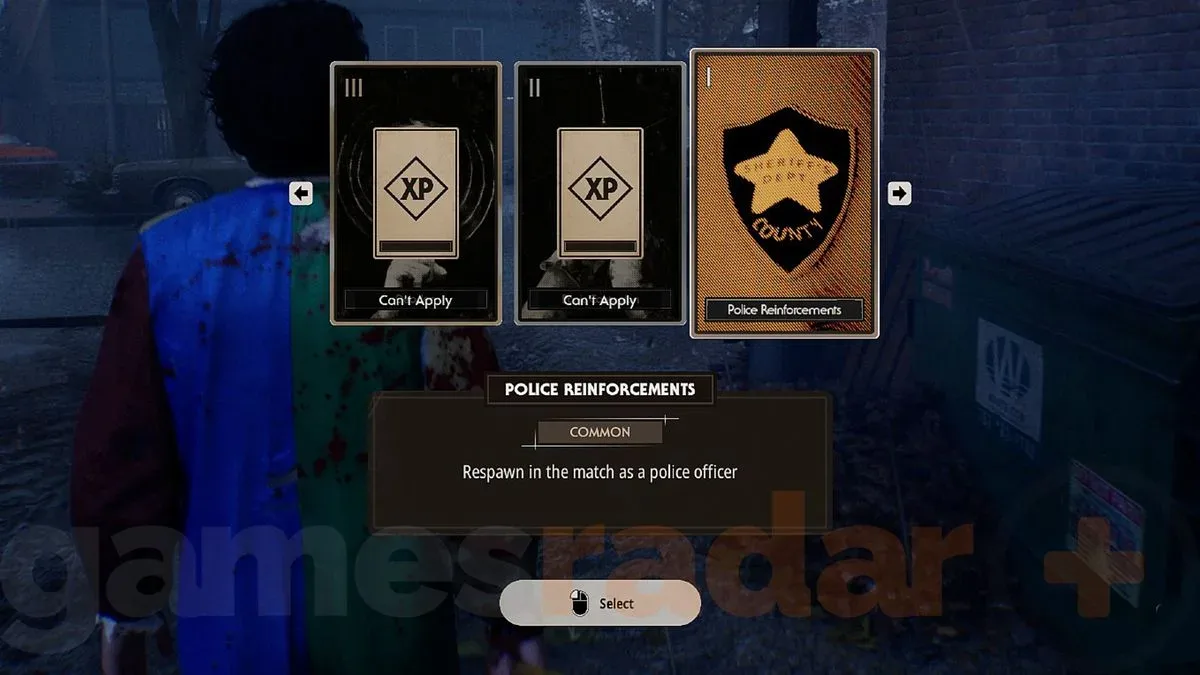
After escape, complete the available mini-games for a chance at a set of three perk cards. One possible card is Police Reinforcements, which immediately returns the player to the match as an officer. It is a chance-based outcome, not a guaranteed selection, so players should continue attempting the mini-games while monitoring the top-of-screen indicator for police reinforcement availability.
The distinction between the two comeback paths has major tactical consequences. Death is required for a Loomis return, while an escape can still lead to a police officer. Neither route guarantees an immediate arrest specialist: the radio may be disabled in Loomis’s case, and Police Reinforcements may simply not appear among the offered cards in the officer route.
Step 2: Fill the arrest meter before committing to the fight
Once Loomis or a player police officer has arrived, the group should gather and locate Michael. A sensible location is near an already-open exit, providing an escape route if the encounter turns against the civilians.
Michael’s arrest meter is represented by a handcuff icon and fills while he is close to Loomis or player-controlled police. In practical terms, the role player needs to remain near the killer long enough for the system to register the arrest opportunity, while the rest of the group must avoid turning that proximity into an easy elimination.
The important visual threshold is a pink-and-purple glow on the handcuff icon. Only then is Michael ready for detention. This is the moment to shift from tracking and positioning to an organized takedown.
The group should not confuse “the meter is visible” with “the meter is full.” A partially filled meter means the decisive approach is premature. Since Michael can kill players nearby, closing distance before the glow appears risks reducing the number of people available for the eventual skill-check phase.
Downing Michael safely
After the arrest meter is full, attack Michael and put him down. Ranged weapons are preferable because they let civilians contribute without standing directly within his reach. The aim is not simply damage; it is creating a short, controlled window for the eligible law-enforcement player to begin the detention interaction.
Two options can extend that window:
- Fragile Hourglass: If found during the match, this item keeps Michael down longer.
- Knockout: This perk also extends the time Michael remains down. It can be selected in a loadout, and Laurie has it as part of her base kit.
There is a role trade-off with Laurie. Her built-in Knockout perk can be useful during the takedown, but Laurie cannot simultaneously be the player serving as Loomis or the police officer. That means her value is in extending the downed state and supporting the arrest specialist rather than initiating the actual detention.
For the same reason, it helps to separate the team’s jobs clearly. The law-enforcement player must survive and remain close enough to activate the arrest mechanics. Other civilians can focus on ranged pressure, items that prolong the knockdown, and being ready to join the mini-game instead of all rushing in at the first sight of Michael.
Step 3: Start the detention mini-game and bring in the team
With Michael downed and the arrest meter fully lit, Loomis or a player police officer needs to move in and initiate detention. The arrest itself uses difficult skill checks: timed player inputs that must be completed successfully. This is the final mechanical barrier between a promising takedown and a completed detention.
The eligible role player must begin this process. Other civilians cannot do it alone, but they can join after Loomis or the officer engages Michael. Their participation makes the process faster, so a coordinated group has a tangible advantage over an isolated officer trying to finish the interaction under pressure.
Timing remains crucial. Michael is still capable of killing nearby players, which is why everyone should verify the full arrest meter before collapsing onto his position. The safest pattern is therefore:
- Confirm that Loomis or a player officer is present.
- Keep Michael in that character’s proximity until the handcuff icon glows pink and purple.
- Down him, ideally with the group operating at range.
- Use Fragile Hourglass or Knockout support if available to enlarge the opening.
- Let Loomis or the officer start the skill checks.
- Have nearby civilians join promptly to shorten the process.
How to coordinate in random lobbies
A premade group has the easiest time assigning duties, but random-lobby teams can still make the attempt work. The core information to share is limited and immediate: whether a role player exists, whether the CB radio is usable, whether police reinforcement availability is high enough, and whether the arrest meter is actually full.
Proximity chat can help organize those calls, although it carries a serious drawback: Michael can hear it too. Keep messages concise and centered on visible game states. Announcing that the radio is red, that a repair kit is needed, or that the meter is glowing gives teammates actionable direction without requiring a complicated plan in the middle of a chase.
Players who intend to escape but still want to support a later detention should remember the police route. Calling police and encouraging NPC residents to do the same raises the possibility that an escaped player can later pull Police Reinforcements and return as an officer. It remains conditional and card-dependent, but it gives an escape-focused civilian a way to remain relevant to an arrest strategy.
Common reasons a detention attempt fails
- No eligible player role: NPC police do not substitute for Loomis or a player officer when it is time to detain Michael.
- The CB radio is blocked: A red icon means power restoration is required. A damaged power box additionally needs a repair kit.
- The wrong expectation for Loomis: Escaped players cannot return as Loomis; that option is tied to a player character’s death and the 30-second reinforcement delay.
- Premature close-range pressure: Michael can kill civilians standing near him. Wait until the handcuff icon is pink and purple.
- Starting the final interaction with too little support: The officer or Loomis can begin the detention, but teammates should join once it starts to speed the tough skill-check sequence.
The broader lesson is that detaining Michael is a staged objective, not a brawl. Build the right personnel, read the status indicators, create a knockdown window, then let the required role player lead the final interaction. Players looking for more guide-focused coverage elsewhere on the site can also see this Wardogs Driver XP guide for another example of planning around game progression systems.