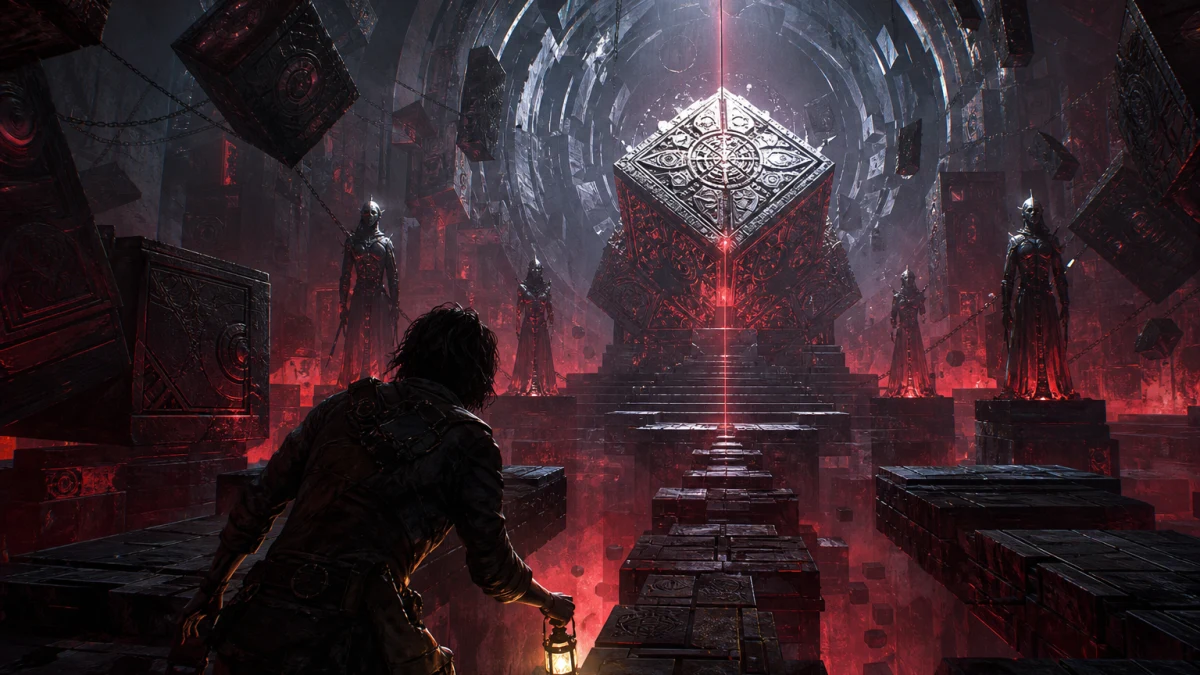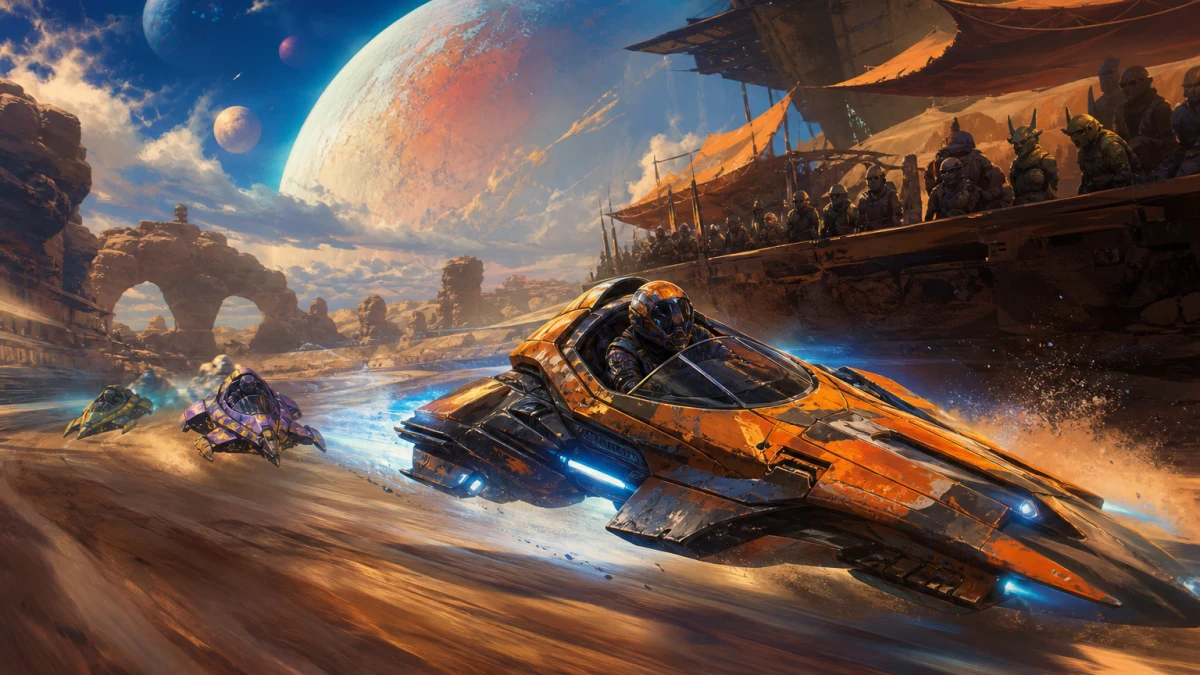
Star Wars: Galactic Racer, released on October 6, 2026, is built around a comparatively small Star Wars conflict. There is no struggle over the fate of the Force at the center of its story. Instead, racers, mechanics, investors and spectators are trying to establish a new sport while the New Republic begins rebuilding a galaxy left exhausted by Imperial rule. That narrower focus does not make the setting politically empty. The Galactic League exists because authority, money and opportunity are being redistributed after the Empire’s fall.
The League’s founder, Darius Pax, wants an enduring and eventually legitimate racing championship. Achieving that ambition requires money, however, and his financiers include syndicates, pirates and other wealthy enthusiasts. The resulting circuit is neither a conventional public sporting authority nor a single criminal organization. It is an unsanctioned institution whose participants do not all share Pax’s vision. That distinction is essential to understanding how reigning champion Kestar Bool converts family investment and personal popularity into influence over the competition.
This spoiler-conscious primer explains what official material establishes about the League, its principal characters and its worlds. It also identifies where developer interviews describe creative intent rather than in-universe history, and where broader conclusions about class, private power or the New Republic remain interpretation. It does not disclose the resolution of Shade and Kestar’s campaign conflict. Because Galactic Racer uses a repeatable, runs-based structure, it also avoids treating every possible attempt, failure or randomized encounter as a separately documented event in the fixed chronology of Shade’s life.
Evidence note: This article distinguishes direct official story information from trailer appearances, developer descriptions of creative intent, specialist reporting and editorial interpretation. Official sources do not specify an exact in-universe year, provide a comprehensive named roster of syndicate backers or fully explain the League’s status under New Republic law. Jakku’s Graveyard of Giants establishes that the featured Jakku racing occurs after the battle that created the wreckage, but the official material reviewed does not state the exact interval or campaign year. Griff Halloran’s participation is supported here by specialist reporting; Ben Quadinaros is officially shown, but his complete campaign role is not established by the cited material. Official sources use both Sentinel I and Sentinel One; the article follows the official game site’s current Sentinel I roster spelling. Interpretations concerning class, privatization, institutional capture and postwar culture are identified as analysis rather than official labels.
The Galactic League in one clear definition
The Galactic League is an unsanctioned repulsorcraft racing circuit operating primarily across the Outer Rim after the Empire’s fall. Darius Pax founded it during the New Republic’s early rebuilding period, financing its beginnings with his own credits before seeking help from old contacts. Racers undertake tours through multiple worlds, develop their machines and compete for the opportunity to challenge the reigning champion on Derven Acos. Gambling, entertainment, reputation and private profit all help sustain the enterprise.
“Unsanctioned” is the most useful word in that definition. The League is not presented as a New Republic department, licensed championship or public service. Its legality under the young government is uncertain. That differs from saying every race is explicitly outlawed everywhere or that the entire competition belongs to one criminal faction. Local rules, New Republic jurisdiction and the legal status of particular events are not comprehensively explained in the official public material.
The League consequently sits between an underground scene and an emerging institution. It possesses recognizable sporting structures: tours, backers, paddocks, vehicle development, finalists and a champion. It attracts fans and talented competitors rather than functioning merely as cover for another crime. Yet it also relies on private actors whose wealth and methods would not necessarily survive close regulatory scrutiny. Remote venues help it operate with limited interruption while its founder pursues wider acceptance.
Backers form one of its defining pillars. A competitor begins a tour with a sponsor and a repulsorcraft, and the sponsor has a financial reason to want that racer to win. Official background identifies syndicates, pirates and racing enthusiasts among the categories of people or organizations Pax approached. Those categories may overlap, but they are not interchangeable. An enthusiast could be wealthy without belonging to a syndicate; a pirate could invest independently; and “syndicate” does not automatically identify one of the familiar criminal groups from another Star Wars story.
Spectacle is another pillar. The galaxy emerging from war contains populations hungry for entertainment, competitors searching for a new use for dangerous skills and investors seeking returns. Racing can satisfy all three groups. It offers public heroes and villains, supplies gambling markets and turns repulsor technology into civilian spectacle. The League’s instability is part of its attraction as well as a threat to its future.
The sporting and financial systems cannot be cleanly separated. A victory advances a racer, strengthens a backer’s position, increases the appeal of the spectacle and potentially changes who holds influence inside the organization. The championship is therefore not merely a prize awarded after neutral contests. It is a source of status with consequences for the League’s direction. Kestar’s continued success reinforces the network of money and attention already supporting him.
That framework explains why Pax and Kestar Bool can disagree so profoundly while remaining attached to the same competition. Pax regards the League as the seed of a legitimate golden age. Kestar treats success within it as a source of acclaim, leverage and family power. Both need the races to grow, but growth does not resolve who should control them. It intensifies that struggle.
The safest concise description is therefore neither “official New Republic sport” nor “criminal syndicate tournament.” The Galactic League is an unsanctioned, privately financed racing institution operating in a region where government reach and legal standards remain unsettled. Some of its supporters come from the underworld, others are identified only as enthusiasts, and its founder hopes eventually to move it toward legitimacy.
- Confirmed: The League is an unsanctioned Outer Rim racing circuit.
- Confirmed: Backers include broad categories such as syndicates, pirates and enthusiasts.
- Confirmed: Pax hopes to obtain eventual New Republic support.
- Not established: A blanket New Republic ban covering every League event.
- Not established: Control of the whole League by one named criminal syndicate.
Where Galactic Racer sits in the Star Wars timeline
Galactic Racer takes place after the Empire’s fall, in the early era of the New Republic. Developer discussion places its premise after the events of Return of the Jedi, while official setting material emphasizes a galaxy beginning to rebuild. The Rebel Alliance’s victory at Endor led to the formation of the New Republic, but changing a government did not instantly repair institutions, extend authority across remote systems or erase the networks that flourished under Imperial rule.
The official sources used for this primer do not provide a precise calendar year. It would therefore be misleading to assign the story a definitive date in the “after the Battle of Yavin” system merely by comparing returning characters or broad historical descriptions. “Early New Republic era” is the supported level of precision for the wider premise.
Jakku provides one useful chronological boundary. Galactic Racer includes courses through the Graveyard of Giants, where wreckage from the Battle of Jakku remains embedded in the desert. The Jakku racing shown by official material must therefore occur after the battle that created that wreckage. What the sources do not provide is an exact interval between the battle and Shade’s League tour, or a precise ABY year for the campaign.
The relevant chronological fact is institutional rather than numerical: Imperial suppression is recent enough to shape the League’s founders and competitors, while New Republic authority is new enough that the circuit’s legal status remains unresolved. Pax remembers the racing culture that existed before Imperial domination. Shade was imprisoned through Imperial power and released when the new government emptied the cells. Kestar’s family can use the transition to extend influence through a new form of spectacle.
This temporal position lets the game draw on older Star Wars periods without moving its central story into them. Veterans, machines and traditions carry history forward. Sebulba and Ben Quadinaros evoke an established podracing culture; former military personnel can bring wartime experience into sport; and repurposed technology can appear beside vehicles developed specifically for competition. Those connections demonstrate cultural continuity, not time travel or proof that every earlier institution survived unchanged.
The lack of an exact year also limits claims about what the New Republic should already have accomplished. Different points within the reconstruction era could involve different military, administrative and diplomatic conditions. Because the official material does not resolve the date at that level, conclusions about precise Senate policy, enforcement capacity or the League’s relationship to other campaigns would be speculative.
Characters’ biographies supply relative order without furnishing a complete galactic calendar. Pax’s pre-Imperial racing work comes before his luxury-vehicle period and his founding of the League. Shade’s protest, collision and imprisonment precede liberation and recruitment. Kestar’s entry helps transform the young circuit before Shade begins the central championship effort. That sequence is enough to understand the rivalry even when exact dates remain unstated.
Repeatable or runs-based campaign structures should not be mistaken for a detailed canonical calendar. A failed tour followed by another attempt is part of the game’s structure, but official material does not establish that every restart and randomized event occurs as a separate, literal sequence in Shade’s biography. The secure narrative spine is simpler: Pax recruits Shade, Shade enters the League, and the championship route leads toward Kestar on Derven Acos.
- Supported placement: after Return of the Jedi and the Empire’s fall.
- Supported political era: the early rebuilding period of the New Republic.
- Supported boundary: the Jakku courses use the post-battle Graveyard of Giants.
- Not provided: a precise ABY date or an exact interval after the Battle of Jakku.
- Not established: every repeated run as a separate canonical tour.
Why the Empire’s fall creates room for racing
Darius Pax’s biography ties the condition of racing directly to political change. He entered the sport as a mechanic for the Hutts before the Empire’s reign and eventually managed racers for Jabba the Hutt. When Imperial rule forced racing underground, Pax adapted by modifying luxury vehicles. His later decision to risk everything on the Galactic League is consequently not the discovery of a new interest. It is an attempt to revive and reshape a culture that authoritarian rule had constrained.
The Empire’s defeat removes an overwhelming centralized obstacle, but the New Republic does not immediately replace it with settled sporting regulation across the galaxy. That interval creates room for experimentation. Pax can organize events on distant worlds and approach financiers who already understand racing, smuggling, gambling or dangerous logistics. Competitors can move between planets before a uniform regulatory system has decided exactly what their activity is.
The premise places that expansion in a war-weary galaxy. Official descriptions connect the boom to entertainment, gambling, glory and fortunes. Spectators who have lived through years of conflict can invest emotionally in a contest that is dangerous without being another campaign for galactic conquest. Racers become celebrities because their victories offer drama with comprehensible stakes: speed, survival, money, pride and rivalry.
The change also releases personal ambitions that Imperial rule delayed or crushed. Pax can again imagine himself as the organizer of a major sport. Shade can pursue a racing dream after leaving Imperial custody. Hibi can seek a reputation as an engineer in an expanding competitive scene. The new political era does not hand any of them success, but it makes previously blocked paths imaginable.
Developer interviews add a creative explanation. Fuse Games looked to the expansion of real-world motorsport after the Second World War, when people with military experience and technical knowledge moved into racing. That was an inspiration for the fictional setup, not an event that occurred inside Star Wars history. It helps explain why the developers saw the immediate postwar period as fertile ground for a racing story.
The same framework allows former pilots and wartime machinery to acquire civilian functions. Specialist reporting identifies former TIE pilot Griff Halloran among the racers, making him a particularly direct example. More broadly, the designers have described the era as a way to draw machines and influences from several periods of Star Wars. A recovering galaxy contains veterans of different causes, old vehicles, scavenged parts and technical traditions that did not vanish with the Emperor.
Racing also channels risk rather than eliminating it. The skills valued during conflict—fast reactions, mechanical improvisation, navigation and tolerance for danger—remain marketable when the battlefield changes into a course. That transformation can be socially constructive, but Galactic Racer does not portray it as safe or institutionally settled. Competition still produces crashes, financial pressure and opportunities for coercion.
There is an uncomfortable side to the transition. Peace creates opportunity, but the people best positioned to exploit it may be those who already possess capital, transport networks or coercive power. Pax needs such people to build the League. The Bool family can contribute resources on a scale that transforms it. Former underworld connections can do what weak public institutions cannot yet accomplish. The sport’s revival is therefore both a sign of normal life returning and a contest over who gets to define that normality.
Why the story belongs in the Outer Rim
The Outer Rim gives the League physical and political room. Official background says remote planets allow races to proceed with limited interruption. Distance complicates oversight, especially when a new government is restoring representative institutions and trying to win the confidence of a population exhausted by war. A race organizer can move personnel, vehicles and spectators through regions where authority is uneven without requiring the whole galaxy to be completely lawless.
That qualification matters. “Outer Rim” is not a synonym for an absolute absence of law. Planets can have local governments, owners, industrial interests and security arrangements. The League’s legality is uncertain, not universally adjudicated as criminal. Some venues may welcome the commerce and attention; others may simply lack the capacity or desire to interfere. Official material does not provide a planet-by-planet legal code.
Geography also helps Galactic Racer tell a local story. The central dispute concerns control of a racing institution and the consequences of one family’s economic power, not command of the New Republic. Shade’s history matters intensely to Gathleon and to the people affected by Bool mining rule, even though it does not determine the destiny of every system. The Outer Rim allows that scale to feel consequential without manufacturing another galaxy-ending threat.
For Pax, remoteness is both protection and limitation. It lets him stage events, cultivate a fan base and prove that the format can work before obtaining formal recognition. At the same time, operating far from political centers leaves him dependent on private transport, local relationships and investor money. The independence that makes the League possible also exposes it to capture by whoever supplies those resources.
Investors benefit from the same distance. A backer can sponsor a racer, profit from victories and exercise influence without first persuading a mature sporting regulator. Pirates and syndicates are accustomed to routes and relationships beyond straightforward governmental control. Wealthy enthusiasts may possess legitimate motives but still enjoy a system with few established restrictions.
The circuit’s mobility reinforces that freedom. Rather than relying on one permanent stadium and its single jurisdiction, a tour passes through multiple worlds. That offers variety and a larger audience, but it also distributes responsibility. Official sources do not explain who inspects each vehicle, approves each course or adjudicates every dispute. The absence of those details should not be filled with an invented regulator.
The Outer Rim also contains histories that do not fit neatly into a simple Empire-to-Republic transition. Tatooine already has a deeply rooted racing identity. Sentinel I bears the effects of extraction and large-scale infrastructure. Jakku is scarred by war. Gathleon’s population has lived under the Bool conglomerate’s work-town regime. The League crosses environments shaped by different forms of power rather than one uniform frontier culture.
This makes the League an institution of the frontier in a political rather than merely aesthetic sense. Its founders are testing what can exist in the gaps between a fallen order and a developing one. The story’s dust, wreckage, mines and hazardous waterways are memorable, but the deeper function of the setting is jurisdictional. These are places where Pax can build quickly, Kestar can consolidate power and Shade can pursue redress that established systems previously denied.
The real-world postwar racing inspiration
Fuse Games’ developers have described a real-world creative reference for Galactic Racer: the growth of motorsport after the Second World War. Former pilots, mechanics and other military personnel possessed technical abilities, tolerance for risk and access to machinery that could be redirected toward organized competition. The developers recognized a comparable dramatic opportunity in Star Wars after Return of the Jedi.
This should be understood as design intent, not in-universe lore. No Galactic Racer character is said to have studied twentieth-century Earth, and the New Republic is not a direct substitute for one historical government. The analogy explains why a postwar setting supports a racing narrative. It does not establish a one-to-one correspondence between factions, economic conditions or personalities.
The inspiration supports the game’s sports-film structure. A sports story needs an institution, an aspirant, a champion, a technical partner and escalating contests. Galactic Racer supplies those elements through Pax’s League, Shade’s return to a lost ambition, Kestar’s entrenched position and Hibi’s engineering. Star Wars history gives each role additional pressure: the aspirant is a former Imperial prisoner, the champion belongs to a powerful industrial family, and the institution depends on underworld money.
A sports-film framework also concentrates the emotional stakes. The future of the galaxy does not need to depend on the final race for Shade’s effort to matter. Reaching the champion can vindicate years of work, restore a stolen ambition, challenge a public idol and test whether Pax’s institution still permits genuine competition. The structure translates large political changes into relationships that can be understood through a season or tour.
Postwar racing offers a way to present continuity amid upheaval. Skills developed for transport, combat or survival can persist after political conditions change. People who once flew for military organizations do not cease being pilots. Mechanics do not lose their expertise. Manufacturers, scavengers and investors look for new markets. Competition becomes a channel through which those capabilities are displayed and commercialized.
The comparison also clarifies why the developers can pull from several Star Wars eras. A postwar scene naturally inherits old machines and experienced racers. Podracing veterans can share the wider sporting world with newer entrants and former military pilots. The result is not evidence that all forms of racing follow identical rules. Galactic Racer expressly separates podracers from the combined competition involving landspeeders, speeder bikes and skim speeders because pods are larger and faster.
The analogy is most useful at the level of social movement: wartime expertise enters civilian spectacle, audiences seek excitement after deprivation, and organizers convert scattered talent into institutions. It becomes less reliable when used to assign exact historical counterparts. Pax is not documented as a fictional version of one particular promoter, and Kestar is not officially modeled as a direct counterpart to a named real-world champion.
Finally, the comparison distinguishes tone from canon. Calling Galactic Racer a sports story communicates its dramatic grammar: ambition, mentorship, rivalry, preparation, setbacks and a champion to overcome. It does not settle the precise chronology, identify every sponsor or prove what the New Republic thinks about each race. Developer interviews are strong evidence for why the creators made their choices, but direct claims about the fictional world still require official story material.
- Developer intent: postwar motorsport helped inspire the premise.
- In-universe fact: the League grows after the Empire’s fall.
- Interpretation: wartime expertise is being commercialized through sport.
- Not supported: a one-to-one allegory for a specific Earth championship or government.
Darius Pax before the Galactic League
Darius Pax is a Besalisk entrepreneur whose history makes him a bridge between older racing culture, the underworld and the New Republic era. He did not approach the sport as a distant financier. He began as a mechanic for the Hutts before Imperial rule and rose to manage racers for Jabba the Hutt. That experience gave him practical knowledge of machines, competitors, patrons and the economics surrounding dangerous spectacle.
His employment history should not be transformed into a claim that the Hutts control the Galactic League. Official material establishes an earlier relationship with Hutt racing operations. It does not identify Jabba or the Hutt clans as current League sponsors. Pax later calls upon old underworld contacts, but the public sources describe broad categories rather than a complete roster of named factions.
Pax’s progression from mechanic to manager is important because it shows two kinds of expertise. He understands the technical labor that keeps a racer moving, but he also understands how personalities, money and presentation fit around the machine. The League demands both. Courses and competitors alone do not create a sustainable circuit; someone must assemble patrons, audiences, venues and a championship narrative.
Imperial suppression forced Pax to redirect his talents. With racing driven underground, he moved into modifying luxury vehicles. This part of his biography demonstrates both adaptability and loss. He remained connected to machines and wealthy clients, but the public competition he valued could not flourish under the same conditions. The Empire did not simply interrupt his pastime; it diverted his career.
The luxury-vehicle period may also explain why Pax can later move between respectable aspiration and questionable capital, although that connection is interpretive rather than explicitly stated. His work would have kept him near affluent clients and specialized machinery while public racing declined. It preserved useful skills without delivering the sporting institution he wanted.
The arrival of the New Republic gives Pax an opening. He invests every credit he has in creating the Galactic League. The scale of that commitment distinguishes him from an organizer pursuing a disposable scheme. His ambition is to inaugurate a golden age of racing and eventually obtain New Republic support, turning an uncertain underground circuit into something sustainable and legitimate.
That aspiration contains a built-in contradiction. Pax cannot reach legitimacy using personal savings alone, so he seeks money from people whose interests may conflict with it. Syndicates and pirates are useful precisely because they possess resources, networks and appetites for risk outside conventional institutions. Racing enthusiasts may be less compromised, but they still expect the structure to function. Pax’s dream depends on investors he cannot fully control.
His later conflict with Kestar is partly a consequence of his own strategy. Pax encourages Kestar to participate because the Bool family’s resources could secure the League’s future. The gamble works in a narrow sense: the circuit expands and viewership grows. It fails in another sense because Kestar’s influence grows with it. Pax discovers that the methods used to build the League have changed who can command it.
Pax’s role is most interesting when neither romanticized nor reduced to hypocrisy. He genuinely wants a better sporting future, and he knowingly works with dangerous capital to produce it. Galactic Racer uses that tension to make the founder more than a quest giver. His recruitment of Shade is an attempt to correct a power imbalance that his own choices helped create.
How Pax built the League
The Galactic League begins as a personal risk. Pax commits his credits to an enterprise whose legality, audience and long-term standing are not guaranteed. Its early years are modest, but they attract dedicated fans and talented racers. That base matters because investors are not being asked to manufacture interest from nothing; they are being shown the possibility of a growing sport.
Pax then approaches old contacts for backing. Official background names syndicates, pirates and racing enthusiasts as categories involved in financing. Their reasons can differ, but profit is central to the backer model. A sponsor’s racer can generate substantial credit returns through victories. Gambling and viewership give sporting outcomes value beyond trophies.
This arrangement distributes power. Pax may have conceived the League and established its ambitions, but financiers provide vehicles, access, logistical capacity or money. A racer’s success benefits the associated backer, making every entry part of a wider economic contest. The institution is not merely a neutral ladder on which independent athletes meet under equal conditions.
The early fan community gives the League cultural leverage. Fans produce attention, and attention makes races more valuable to backers. Talented competitors improve the spectacle, which brings more viewers and potentially more investment. That cycle can turn a modest underground circuit into a recognizable institution without formal government sponsorship.
The model carries a basic incentive problem. A backer benefits when its own racer wins, but the public value of the sport depends on spectators believing the contest is meaningful. If investors can manipulate outcomes too visibly, they may undermine the spectacle from which their profits arise. Pax’s wish for legitimacy therefore has practical as well as moral importance: credible competition is part of the product.
It can also magnify inequality. An investor with greater resources can support stronger machinery, gain access to more venues or shape the presentation of the competition. The Bool family’s involvement is the clearest established example. Its resources help move races to affiliated planets and increase viewership, while Kestar accumulates control over the institution Pax founded.
Official sources do not provide a complete ownership chart. It is not established how much formal equity Pax retains, whether backers possess votes or how revenue is divided. Kestar’s influence is clear, but the mechanism should not be embellished into an invented boardroom procedure. Institutional capture can occur through dependency and leverage even when formal corporate documents remain unknown.
The League’s economic contradiction is structural rather than incidental. Pax needs private capital to grow sufficiently that formal recognition might become possible. Yet the more indispensable a private patron becomes, the harder it is for Pax to preserve independent authority. Kestar does not need to destroy the League to exploit it. He needs it to thrive under conditions favorable to him.
The result resembles an emerging sport before stable governance has caught up. Rules and competitive rituals exist, but the ownership and accountability structure remains vulnerable. This is an interpretation of the confirmed financing model, not an official legal classification. The story never requires readers to pretend that every investor has the same motive or that all private backing is inherently criminal. It asks what happens when sporting ambition grows faster than its safeguards.
What “syndicates sponsor pilots” actually means
The clearest official description is that a League entrant begins a tour with a backer and a repulsorcraft. The racer competes across planets, modifies the machine and tries to advance toward the champion challenge. Because victories can produce large returns, the backer possesses a direct financial stake in performance.
Some backers come from syndicates. Others are pirates or racing enthusiasts. The wording describes categories, not a complete named list. Public official material does not establish that the Pykes, Black Sun, Crimson Dawn or the Hutts currently sponsor particular tour entrants. Their broader prominence elsewhere in Star Wars cannot fill this gap.
Pax’s former employment with Jabba is similarly insufficient. It demonstrates that he knows Hutt racing culture and has underworld contacts. It does not prove that Jabba finances the League in this era, that every old contact answers to the Hutts or that Pax remains under Hutt authority. Past association is part of his credibility, not evidence of present ownership.
The Bool family requires a separate distinction. Official material describes the Caskadag Bool family as powerful and presents its economic influence through a conglomerate, mining interests and affiliated worlds. The sources used here do not formally identify that conglomerate as one of the League’s criminal syndicates. Its conduct can be coercive and exploitative without making “syndicate” the verified organizational label.
“Sponsor” also should not be interpreted as a complete explanation of every contract. The public material does not enumerate payment percentages, ownership rights, gambling arrangements, debt terms or the consequences of abandoning a backer. It establishes the essential relationship: racers receive support, and backers seek value from successful results.
The language of sponsorship can sound benign because regulated sports commonly display commercial patrons. Galactic Racer complicates that familiarity by placing the arrangement in an unsanctioned Outer Rim circuit. Some capital comes from actors already described in underworld terms, and there is no fully explained independent authority separating a sponsor’s financial interest from the administration of competition.
That does not establish that every race is fixed. The existence of financially interested backers creates the possibility of conflicts, while Kestar is separately established as someone willing to cheat and remove threats. Those facts should not be expanded into a universal assertion that all results are predetermined. The League still attracts talented racers, committed fans and people who believe victory matters.
The limited definition is narratively important. Shade’s championship effort is not only an individual athletic campaign. Each rival may represent resources and interests extending beyond the cockpit. Kestar’s position is exceptionally powerful because his family’s contribution affects the League itself, not merely one machine. Economic and sporting competition occupy the same space.
A careful reader can discuss privatized sport, conflicts of interest and investor influence as interpretations. What a careful reader should not do is convert familiar franchise names into confirmed participants. Galactic Racer deliberately leaves parts of its financial ecosystem broad. Unknown backers remain unknown until official story material identifies them.
- Use “backer” when the exact type of sponsor is not identified.
- Do not assume every backer belongs to a criminal organization.
- Do not treat Pax’s Hutt history as current Hutt control.
- Do not relabel the Bool conglomerate a syndicate without explicit evidence.
- Keep financial interpretations separate from unprovided contract details.
How a Galactic League tour works in the fiction
A League tour sends a racer through a sequence of planets. The entrant begins with a backer and repulsorcraft, then develops the vehicle during the journey. This gives progression an in-world meaning: a racing machine changes as its team responds to new courses, damage, opportunities and competitive demands.
Official launch material identifies four broad vehicle categories: landspeeders, speeder bikes, skim speeders and podracers. Landspeeders, bikes and skim speeders can compete together. Podracers race separately because their greater size and speed make direct combination unsuitable. The League is therefore a shared institution containing more than one competitive format, not one undifferentiated grid.
Skim speeders illustrate Pax’s influence on the sport. These machines had an association with smuggling before he introduced them to organized League racing. Their inclusion reflects his ability to convert knowledge from less formal vehicle cultures into public spectacle. It also fits a circuit assembled from Outer Rim practices rather than inherited from a mature regulator.
Vehicle modification is more than an abstract menu convention within this premise. The official League background explicitly makes development during a tour part of a racer’s path. Hibi’s work therefore belongs to the fiction of the campaign: the machine reaching a later destination need not be identical to the one with which Shade began.
Each planet has a paddock serving as a social and technical hub. Hibi operates her workshop from these paddock areas, ensuring that Shade’s engineering partner remains part of the journey rather than waiting at a fixed home base. Racers, mechanics, financiers and other personalities can meet around events, making the League a traveling community as well as a set of courses.
The paddock is also where the institution becomes visible at human scale. On a course, competitors may appear primarily as machines moving at extreme speed. Between races, their dependencies become clearer: mechanics repair craft, backers monitor investments, veterans assess newcomers and personalities negotiate status. The League is built as much in these relationships as in formal results.
The ladder culminates narrowly. Only one tour finalist earns the opportunity to challenge reigning champion Kestar Bool on Derven Acos. This creates a hierarchy with the champion positioned above ordinary tour competition. Derven Acos is not merely another stop; it is the destination attached to the right to confront the titleholder.
Official material does not provide every regulation needed to reconstruct a complete sporting rulebook. It does not settle all questions about qualifying, officiating, replacement vehicles or how every mixed-category contest is balanced. A world primer should describe the supported ladder without presenting inferred gameplay conventions as universal League law.
Runs-based play complicates how literally every event should be read. Mechanical repetition, variable choices and failed attempts do not necessarily constitute an exhaustive canon in which Shade repeatedly experiences every possible version. Official material supports the tour framework and central rivalry, but it does not assign fixed historical status to every randomized occurrence.
This primer also avoids revealing how the challenge ends. The important world-building point is that access to Kestar is institutionally controlled. Shade cannot simply demand a private rematch over Gathleon. Shade must enter the champion’s arena, survive the League’s economic and sporting structure and become the single finalist entitled to meet him.
Kestar Bool and the takeover from within
Kestar Bool is the reigning Galactic League Champion when Shade enters the circuit. He is also the youngest son of Kedron Bool, patriarch of the Caskadag Bool family. His position combines genuine competitive ability with inherited access to extraordinary resources. Developer discussion presents him as an intentionally detestable sports antagonist, but not as an incompetent fraud who wins only because of his surname.
Kestar discovered his talent during a tournament hosted by his family. Pax saw an opportunity and encouraged him to join the developing League, believing Bool resources could secure its future. That judgment was not unreasonable. A young championship needed investment, venues and attention, all of which a powerful family could help provide.
The partnership produces growth. Bool resources allow racing to expand onto planets associated with the family and help increase viewership. Kestar becomes a star while the League becomes a larger spectacle. From an investor’s perspective, those outcomes can be presented as proof that family involvement works.
The cost is control. As Kestar’s value to the League increases, so does his influence over Pax’s creation. The champion is no longer merely the athlete who happens to hold the title. He sits at the intersection of sporting success, family capital, venue access and audience appeal. Pax cannot easily oppose him without jeopardizing the growth he wanted.
Kestar’s emotional motive makes that institutional power personal. Official background describes his pursuit of public acclaim and the paternal respect he believes he has been denied. Winning supplies recognition, but recognition must be continually defended. A threat to his championship is also a threat to the identity and approval he has built around it.
This motive does not excuse his behavior, but it explains why ordinary success fails to satisfy him. A secure athlete could accept that defeat is part of competition. Kestar instead treats the title and public popularity as assets that must be protected from uncertainty. The League’s weak safeguards give that insecurity room to become policy and coercion.
He is willing to cheat and remove threats to preserve his popularity and position. That conduct does not negate his skill; it shows that skill alone is not enough for him. He wants certainty in a sport defined by risk. His resources give him methods unavailable to an ordinary racer, turning competitive insecurity into institutional danger.
Pax eventually sees Kestar’s ringers, cheating and expanding influence as a corruption of the original purpose. “Takeover” is best understood as capture from within, not a single documented transfer of ownership. Kestar and his family become indispensable enough to shape the League while retaining the legitimacy conferred by its championship structure.
That distinction matters because Kestar benefits from appearing to be the natural product of competition. He is champion, a proven talent and a popular figure, not an external conqueror who openly shuts the circuit down. His dominance is more durable when personal achievement, family patronage and control of opportunity can be presented as the same success story.
Shade threatens that arrangement on several levels. Shade possesses the ability to race, a personal reason to resist the Bool family and a history that can expose the violence beneath Kestar’s public image. Defeating him would challenge more than a leaderboard. It would contest the story the champion tells about deserving his place.
- Confirmed: Kestar is genuinely talented.
- Confirmed: Bool resources helped the League expand.
- Confirmed: His influence grew alongside that expansion.
- Confirmed: He is willing to cheat and eliminate threats.
- Interpretation: His position amounts to institutional capture from within.
The Bool family’s power beyond racing
Kestar’s leverage cannot be understood solely through his conduct on the course. The Caskadag Bool family possesses major economic power, including control of Gathleon’s valuable mines. Its influence reaches workers and communities whose lives have nothing to do with League fandom.
On Gathleon, Bool control is expressed through a strict system of work towns. The planet is known for purple quartz, and its varied inhabitants are collectively called the Gathii. The family’s extractive interests shape daily life around valuable resources, creating the conditions against which Shade and others protest.
This background connects the glamorous League to an industrial base. Family wealth generated or sustained through wider business activity can finance sporting expansion, move events to affiliated planets and elevate Kestar’s profile. Racing provides the family with visibility and cultural influence beyond mines and work towns.
That does not mean every action undertaken by the conglomerate is Kestar’s personal order. Official background establishes his family position, championship behavior and conflict with Shade. It does not justify assigning him direct operational responsibility for every mine, manager or work-town policy. Distinguishing family power from individual command keeps the account accurate.
Nor should “conglomerate” be casually replaced with “syndicate.” A conglomerate can exercise harsh, dangerous or exploitative power without sharing the formal identity of a criminal syndicate. The League already includes syndicate investors as a broad category; merging every influential organization into that category would obscure the different routes by which private actors gain power.
The distinction does not make the Bool family harmless or politically neutral. Corporate organization can dominate workers, territory and access to resources even without the verified label of a syndicate. Galactic Racer’s material links the family to strict rule on Gathleon and links Kestar to Imperial imprisonment, cheating and the removal of threats. Those are substantial facts without an additional classification.
Kestar’s championship nevertheless serves family interests. His celebrity makes Bool influence entertaining and aspirational. Venues associated with the family become part of a growing galactic spectacle. The League can make concentrated wealth appear as sporting patronage, especially to spectators who see expansion and excitement rather than conditions on Gathleon.
Sport also gives the family a different relationship with the public. Workers may experience Bool power through extraction and discipline; viewers elsewhere may encounter the same name through a champion, famous courses and profitable entertainment. The two images do not cancel each other. They show how economic power can produce both coercion and prestige.
This is where an interpretation about class becomes useful, provided it is labeled. Galactic Racer can be read as a story about unequal access to institutions: Kestar enters with a family capable of transforming the sport, while Shade arrives after imprisonment and cargo work. Official material establishes those histories. The conclusion that their rivalry dramatizes class conflict is analysis, not a formal genre label supplied by the story.
The League thus gives the Bool family a new kind of reach. Industrial control governs production; sporting control shapes attention, loyalty and reputation. Kestar’s position combines both. Pax’s attempt to reclaim his competition consequently intersects with a struggle over what the family’s wealth is allowed to purchase.
Shade’s history with Gathleon and the Empire
Shade is a human cargo pilot from Gathleon who grew up among the planet’s diverse Gathii population. Long before entering the League, Shade dreamed of becoming a racing legend. Cargo work kept Shade behind the controls of vehicles, but it did not fulfill that ambition.
Describing Shade simply as human should not erase the importance of Gathleon’s collective identity. The inhabitants are called the Gathii despite their variety, and Shade’s origin places the protagonist within that community. The conflict with the Bools is therefore rooted in a home and population, not only a private dispute between two pilots.
Gathleon’s political economy turned Shade’s life toward resistance. The Bool conglomerate controlled the valuable mines and imposed its strict work-town system. Shade participated in protests against that rule, making the eventual rivalry with Kestar part of a broader conflict rather than an isolated clash between competitive personalities.
During one protest, Shade collided with Kestar’s speeder. The incident caused injuries serious enough to require a specialized helmet, which Shade received while in Imperial custody. The helmet is tied to a specific history of protest, injury and repression; it is not simply a mysterious costume element.
Kestar responded by having Shade placed in an Imperial prison. This point connects corporate influence to authoritarian enforcement. The Bool heir could turn a collision arising from resistance into Imperial custody for his opponent. Shade then remained imprisoned until the Empire fell and the New Republic emptied the cells.
Official material does not require the conclusion that the Empire invented the Bool family’s power or personally administered every aspect of Gathleon’s economy. What it establishes is a usable relationship between private influence and Imperial punishment. Kestar could call upon the ruling order to remove someone who had become a threat or affront.
Release does not restore the lost years or automatically create justice. Shade returns to cargo work rather than immediately receiving a public platform, compensation or racing career. The new government’s action removes the direct condition of imprisonment, but the Bool family remains powerful and Kestar has become the League Champion.
That contrast is central to the post-Empire setting. A prison door can open faster than economic and cultural power can be redistributed. Shade is legally free, yet the person connected to the imprisonment enjoys wealth, fame and authority within the galaxy’s rising sport. Liberation begins the story’s possibilities without resolving its grievance.
Shade eventually partners with Hibi Esuufa, an Ardennian mechanic whose father had previously worked on Shade’s ship. That partnership joins two ambitions: Shade wants another chance at racing greatness, and Hibi wants to prove she can build the galaxy’s finest machines. Their path into the League is personal before Pax makes it political.
Pax recruits Shade because ability and motivation coincide. Shade can plausibly challenge Kestar and has reason not to be absorbed by his celebrity or intimidated by his influence. The founder needs more than a fast entrant. He needs someone for whom displacing Kestar matters beyond prize money.
This history prevents Shade from becoming a generic revenge protagonist. Revenge is present, but it grows from mining rule, protest, physical injury and Imperial imprisonment. Racing offers a way to confront the person who benefited from those systems in the arena where he now draws legitimacy. It cannot by itself solve every problem on Gathleon, but it can challenge Kestar’s supposedly unassailable public position.
Why Shade agrees to race
Shade’s decision combines several motives that should not be collapsed into one. There is revenge against Kestar and the Bool family, a second chance at a childhood dream, the pursuit of glory and the practical attraction of credits. Galactic Racer’s sports story works because these motives reinforce and complicate one another.
Pax supplies the institutional opportunity. He believes Shade has the skill and personal drive necessary to defeat Kestar. His recruitment is also an effort to reclaim the League from the champion’s expanding influence. Shade consequently enters as both an aspirant and an intervention in a power struggle already underway.
The racing dream matters because Shade wanted this life before the protest collision and imprisonment. Competing is not merely a strategy Pax invents for revenge. It restores a possibility that political repression interrupted. Victory would represent something recovered as well as something taken from Kestar.
That distinction preserves Shade’s agency. Pax has his own reasons for selecting a challenger, but Shade is not merely a tool placed into the League by its founder. Racing answers an older personal ambition. The interests of founder and pilot overlap without becoming identical.
Glory is not a shallow addition. The League’s audience creates public recognition, which Kestar values intensely and Shade was denied. To become a racing legend means gaining a voice within the same spectacle that currently magnifies the Bool name. Fame can become a form of counter-power, even if it remains dependent on the League’s unstable structures.
Credits matter for equally grounded reasons. Racing is an economic system, and Shade enters it after returning to cargo work rather than inheriting a family fortune. Official descriptions place personal fortunes among the forces driving the postwar boom. Wanting financial reward does not cancel the political grievance or sporting ambition.
Revenge supplies urgency but also risk. A racer focused only on Kestar could be manipulated by the champion’s control over the competition. The tour requires Shade to work with Hibi, deal with backers, earn respect and advance through an institution larger than a single feud. That structure keeps the campaign from becoming a simple chase.
Shade also offers Pax a chance to test his own ideals. If a talented outsider can rise through the tour and challenge a champion protected by wealth and influence, the League might still support the competitive opportunity Pax imagined. If Kestar can prevent that challenge through cheating and control, the institution has already become something else.
None of this means a single sporting victory can repair Gathleon. Official material supports the connection between the rivalry and the planet’s history, but it does not establish the championship as a comprehensive program of political reform. Racing can expose, challenge and symbolically reverse a hierarchy without automatically dismantling its economic foundation.
The campaign’s outcome is outside this spoiler-conscious primer. Its premise is enough to clarify Shade’s role: the protagonist does not enter merely to entertain Pax’s audience. Shade races to reclaim a future, confront an old oppressor, earn material rewards and force the League to decide whether its championship can be more than an instrument of Bool power.
Hibi Esuufa and the mechanic’s place in the story
Hibi Esuufa is an Ardennian engineer whose goal is to build the finest racing vehicles in the galaxy. She is not simply an interface attached to vehicle modification. Her ambition gives the technical side of the League a character perspective equal to Shade’s aspiration behind the controls.
Hibi grew up in a supportive household and taught herself engineering by taking toys and gadgets apart. Her background differs sharply from Shade’s experience of work-town rule and Imperial imprisonment. That difference expands the story’s picture of people entering the postwar racing boom: not every participant arrives through trauma, and opportunity can grow from encouragement as well as escape.
Her father was a mechanic who had worked on Shade’s ship at a discounted price, providing an existing connection before the League campaign. When Shade later arrived needing repairs, Hibi took the opportunity to leave home and join the pilot. The partnership is therefore not an arbitrary pairing created by Pax.
Hibi operates a workshop from each planet’s paddock. Fictionally, that arrangement makes engineering part of the traveling tour. Machines must be maintained and modified as the team encounters different worlds. Socially, the workshop gives Shade a recurring point of continuity amid shifting venues, rivals and backers.
Vehicle development also expresses Hibi’s authorship. A modified repulsorcraft is evidence of her decisions and labor, not only the racer’s skill. The League creates a public arena in which an engineer can build a reputation. That opportunity mirrors the wider postwar movement of technical knowledge from military, industrial or informal environments into sport.
The tour’s planetary range makes that ambition demanding. A machine used across environments associated with desert heat, salt flats, acidic waterways or frozen terrain cannot be understood only as a showpiece. Although official material does not document every fictional engineering calculation, the structure makes adaptability part of Hibi’s professional challenge.
Her Ardennian identity is relevant without needing to dictate a stereotype. Official material emphasizes engineering talent, family support and ambition. Four arms may be visually and practically distinctive, but Hibi’s narrative function comes from what she wants and the partnership she builds, not from anatomy alone.
Hibi complicates the idea that glory belongs only to the person named in results. The League’s backers may capture profits and its racers may become celebrities, but mechanics make sustained competition possible. Pax himself began as a mechanic, creating a thematic line between the founder’s early career and Hibi’s emerging one.
That parallel also marks a possible generational change. Pax’s technical skill eventually led him through management, private business and institution-building. Hibi is entering a sport that now offers a larger stage than the one available during Imperial suppression. The League may be compromised, but it can still create professional paths that the Empire had restricted.
Seen this way, Hibi represents one of the League’s most constructive possibilities. The institution can be exploited by financiers and manipulated by its champion, yet it can also give a young engineer the resources, audience and problems needed to demonstrate extraordinary work. The story’s conflict concerns who controls opportunity, not whether opportunity exists at all.
Veterans and returning racers
Galactic Racer uses familiar competitors to show that the League emerges from an older racing culture. Sebulba appears as an experienced veteran whose respect and support Shade can earn. That phrasing establishes a meaningful relationship without requiring the assumption that he becomes a permanent mentor in every sense of the word.
Sebulba’s presence connects the League to podracing history, but it should not erase the new cast. The central conflict belongs to Shade, Kestar, Pax and Hibi. A famous veteran can validate the sporting world and serve as a measure of Shade’s growing standing without becoming the cause of the protagonist’s success.
The requirement that Shade earn his respect is significant. Pax can provide entry and Hibi can build the machine, but standing within racing culture cannot be conferred entirely by sponsorship. Recognition from a veteran offers another form of legitimacy—one grounded in experience rather than Bool money or the founder’s immediate political need.
Ben Quadinaros is also officially shown in game promotional material. His appearance confirms participation in Galactic Racer’s wider racing world. The retrieved official sources do not fully define his campaign role, allegiance, backer or amount of screen time. A trailer image supports presence, not a complete biography for this period.
Griff Halloran occupies a different evidence category. Specialist reporting identifies the former TIE pilot from Star Wars Resistance among the racers and connects him to the developers’ postwar theme. That makes him an apt example of military flying experience moving into competitive sport. In the evidence available for this primer, however, his role is supported by reporting rather than a dedicated official Galactic Racer character page.
These distinctions matter because returning characters invite overstatement. A recognizable face in a trailer can lead viewers to infer a major alliance, rivalry or story arc. Until official material supplies that context, the correct conclusion is narrower: the character is shown participating in the setting.
Veterans demonstrate that the Galactic League is not inventing racing from nothing. Pax is organizing inherited traditions, experienced personalities and varied machines into a new post-Imperial circuit. Podracing has an established history, while skim speeders enter organized racing through Pax’s intervention. The League combines continuity with experimentation.
Not all these vehicles share a race. Podracers operate separately from the combined events for landspeeders, speeder bikes and skim speeders. That separation prevents the presence of famous podracers from defining every aspect of the League. The institution is broader than podracing even though podracing remains one of its most visible traditions.
Returning figures also support the developers’ desire to draw from several eras. A postwar setting can contain veterans whose careers began long before Endor and pilots whose identities were formed by the recently ended conflict. Their coexistence makes the League a gathering place for different layers of galactic history without changing its central story into a parade of cameos.
The familiar racers finally help establish scale. Shade is not competing in a vacuum against invented obstacles; the protagonist enters a culture with established reputations. Earning a veteran’s respect matters because that veteran embodies standards predating Kestar’s dominance. It gives Shade another route to legitimacy besides Pax’s sponsorship or the Bool-influenced spectacle.
- Confirmed narrative information: Sebulba is a veteran whose respect and support can be earned.
- Officially shown: Ben Quadinaros participates in the game’s racing world.
- Credible specialist reporting: Griff Halloran appears among the racers.
- Unknown: every returning character’s complete role, backer and screen time.
The planets as evidence of a recovering galaxy
The League’s official location roster includes Derven Acos, Ando Prime, Tatooine, Lantaana, Sentinel I, Crait and Jakku. Together they let the circuit display different layers of galactic history: old racing traditions, industrial extraction, military wreckage and new venues not burdened by extensive prior storytelling.
Jakku makes the postwar theme visible most directly. Courses pass through the Graveyard of Giants, where enormous wrecks from galactic conflict remain embedded in the desert. Racers turn the remnants of warfare into the landscape of entertainment. That juxtaposition suggests a society repurposing, commercializing or simply living among debris it has not yet cleared.
The imagery does not prove that every wreck has acquired a new economic use or that the New Republic endorses racing through the site. It establishes a course through a known post-battle environment. Broader ideas about memory, salvage and spectacle are interpretations supported by the visual contrast.
Jakku is especially useful because it prevents “postwar” from becoming an abstract label. The old conflict occupies physical space. Competitors do not race in a galaxy scrubbed clean for a new political era; they navigate around evidence that recovery is incomplete. Entertainment and ruin can coexist on the same horizon.
Sentinel I presents a different aftermath. It is a toxic world damaged by mineral extraction, dominated by a planet-scale Skakoan listening station and cut by acidic waterways. The environment connects industrial plunder and infrastructure to racing danger. Yet individual hazards should not automatically be treated as revelations about galactic policy; some exist principally because the location must function as a course.
Some official StarWars.com promotional copy renders the location’s name as “Sentinel One,” while the game’s official site lists it as “Sentinel I.” This primer follows the game site’s current location roster. The naming variation does not change the established description of the world, but it is worth preserving rather than silently treating the sources as perfectly uniform.
The combination of a listening station, extraction damage and hostile waterways gives Sentinel I a history larger than the race, but official descriptions do not provide a full political biography of the world. It is better to retain that boundary than to invent the identity of every operator, victim or government connected to its infrastructure.
Tatooine brings established racing heritage. Its inclusion places Pax’s League in conversation with a world already associated with high-risk competition and Outer Rim commerce. It supports continuity without proving that every older organizer, rule or patron remains active in the new circuit.
Crait’s salt flats provide another distinctive racing surface while carrying the visual identity of a known world. Ando Prime similarly broadens the environmental range. Lantaana and Derven Acos give Galactic Racer space to establish locations around its own cast and competition. Derven Acos has the clearest structural role because it hosts the champion challenge awaiting the tour’s sole finalist.
The newer locations are important precisely because not every course needs to carry the burden of a famous film history. The League is supposed to be creating a contemporary sporting geography. As it visits and elevates different worlds, those places acquire meaning through the circuit itself rather than solely through an earlier battle or character.
The route can be read as a map of uneven recovery. Some worlds bear military scars, others show extraction damage, and others possess long-standing cultures that survive regime change. The League links them through commerce and spectacle before the New Republic has necessarily integrated them through strong public institutions.
That reading should remain proportionate. A track’s scenery can establish atmosphere and confirmed landmarks, but not every ramp, obstacle or shortcut is a major canonical statement. The strongest world-building conclusions come from details official material explicitly connects to the location: Jakku’s wreckage, Sentinel I’s toxic extraction history, Tatooine’s racing tradition and Derven Acos’s championship status.
What the League says about the New Republic
Official background presents the New Republic as restoring the Senate and trying to win over a war-weary galaxy. The Galactic League exists in the difficult early stage of that project. Its remote events and uncertain legality show that replacing Imperial leadership does not instantly produce uniform administration across the Outer Rim.
The League should not be used as proof that the new government endorses unsanctioned racing. Pax wants eventual New Republic support, which implies that he does not already possess the recognition he seeks. Official material leaves the applicable laws and enforcement boundaries unresolved.
It is safer to say the government has limited reach or competing priorities in these regions. Remote planets allow the League to operate with less interruption. That may reflect distance, local autonomy, weak enforcement, legal ambiguity or some combination of factors. The evidence does not reduce those possibilities to one universal explanation.
The uncertainty may concern more than a simple permitted-or-forbidden distinction. A multi-world circuit raises questions about local authority, vehicle safety, gambling, financing and responsibility for accidents. Official material does not specify which of those issues drive the League’s ambiguous position, so none should be promoted into the definitive legal answer.
The public appetite for racing says something different about reconstruction. Peace is not only the absence of military conflict. People seek entertainment, heroes, communal events and opportunities to make money. A racing boom can therefore represent a return to ordinary aspiration, even when its events remain dangerous and its finances questionable.
This demand can be read as a desire for stories smaller than war. Spectators can choose favorites, argue over champions and follow a tour without treating every result as a verdict on galactic survival. Galactic Racer’s local scale is consequently part of its account of recovery. Normal life includes contests that matter greatly to participants without deciding the fate of the Republic.
Private capital fills an institutional vacuum. Pax’s savings begin the project, while syndicates, pirates, enthusiasts and eventually Bool resources help it grow. This is a confirmed description of financing. Interpreting it as privatization is reasonable analysis: functions that a mature sporting authority might regulate are being organized by investors with direct stakes in results.
That arrangement exposes a weakness in the transitional era. The New Republic may liberate prisoners such as Shade without immediately dismantling every private power structure that profited under the Empire. The Bool family retains wealth, Kestar gains celebrity, and Gathleon’s history follows Shade into the new age. Political transition opens doors without guaranteeing equal access through them.
At the same time, the League is not evidence that nothing has changed. Pax can openly attempt a revival that Imperial suppression had driven underground. Shade leaves prison. Competitors and engineers can pursue public careers. The post-Imperial order creates real freedom even when it lacks the reach or safeguards to distribute that freedom evenly.
Pax embodies guarded optimism about the government. He believes recognition is possible and wants the League to become a legitimate golden age rather than remain permanently underground. His aspiration distinguishes the circuit from an organization committed to opposing all public authority.
The League therefore reflects neither simple New Republic failure nor completed recovery. It occupies an intermediate space. Citizens and entrepreneurs use newfound freedom to build something culturally alive, but weak safeguards permit concentrated wealth to shape it. Whether that institution can mature without surrendering to its most powerful backers is the political question beneath the racing story.
- The League’s existence does not prove New Republic endorsement.
- Its uncertain legality does not prove a universal ban.
- Pax seeks future recognition rather than claiming current sanction.
- Limited reach, local authority and competing priorities remain possible explanations.
- Privatization and institutional vacuum are interpretations grounded in the financing model.
Official fact, developer intent and interpretation
Claims about Galactic Racer’s setting are easiest to evaluate by separating evidence types. Official Databank entries and game-site descriptions provide direct story facts: Pax founded the League; Kestar is champion; Shade was imprisoned; Hibi is an engineer; and backers have financial interests in racers. These sources are the strongest basis for a world primer.
Official sources can still differ in purpose. A Databank biography condenses a character’s established history. A launch announcement confirms platforms, release information and broad features. A game site introduces the premise and principal cast. Reading them together is useful, but a marketing summary should not be stretched into details it never supplies.
Official sources can also contain minor naming variations. Sentinel I and Sentinel One are used on different official pages, while the official game site currently presents Sentinel I in its location roster. Recognizing that variation is more accurate than pretending it does not exist, and it does not justify importing unrelated secondary spellings.
Trailers are official but narrower than a Databank biography. They can establish that Ben Quadinaros is shown, that a location or vehicle appears and that promotional material emphasizes a rivalry. They do not automatically reveal a character’s complete campaign role, the duration of an appearance or the final context of an edited scene.
Developer interviews provide evidence of creative intent. They explain the post-Second World War motorsport inspiration, the sports-film structure and the desire to tell a local Outer Rim story while drawing from multiple Star Wars periods. They should not be rewritten as dialogue spoken by characters or historical facts known inside the fictional galaxy.
Specialist reporting can fill identified gaps. Griff Halloran’s participation is an example in this primer. The attribution matters because reporting and a dedicated official character profile do not carry precisely the same evidentiary status, even when the report is credible.
Gameplay structure requires another distinction. Official material supports tours, backers, vehicle modification and a final champion challenge as parts of the League’s fiction. It does not follow that every generated choice, crash, failed run or restarted sequence has an individually fixed place in canon. Mechanical repeatability and narrative chronology are related without being identical.
Interpretation begins when established details are connected to broader themes. Calling the League an example of private capital filling a public vacuum, reading Shade and Kestar’s rivalry through class, or describing racing as a way to commercialize postwar technology are defensible conclusions. They are not direct official labels. Another reader could emphasize celebrity, institutional capture or personal revenge while using the same facts.
Inference can sometimes clarify a structure, but it should remain visible. Describing the League as closer to an emerging underground institution than a conventional regulated championship follows from its uncertain legality, private financing and remote venues. It does not amount to an official legal category supplied by the New Republic.
Unknowns should remain unknown. There is no supported exact year in the reviewed material, no complete list of named syndicate sponsors and no full explanation of New Republic racing law. The Bool conglomerate is not explicitly classified as a syndicate. Ben Quadinaros’s complete role is not established by his appearance alone. The canonical meaning of every repeated run is unresolved.
The same caution applies to franchise familiarity. The Hutts, Pykes, Black Sun and Crimson Dawn are recognizable names, but recognition is not evidence of participation in this League. Pax’s past and the circuit’s Outer Rim location may make some guesses feel plausible. Plausibility does not elevate them to story fact.
This discipline does not weaken the setting. The verified picture is already substantial: an entrepreneur revives racing with compromised money; a gifted champion uses family resources to dominate it; a former prisoner enters with an engineer to challenge him; and the young New Republic remains distant from an Outer Rim institution seeking legitimacy.
That is the most reliable way to understand the Galactic League. Start with what its organizers, racers and worlds are officially said to be. Use developer commentary to understand why the creators selected this era. Then make thematic arguments openly as interpretation rather than disguising familiar franchise assumptions as missing facts.
- Direct official story copy: strongest basis for character and institution facts.
- Official trailer imagery: confirms what is shown, not every surrounding circumstance.
- Developer interviews: evidence of design goals and inspiration.
- Specialist reporting: useful when clearly identified by evidence status.
- Interpretation: valid when labeled and grounded in established details.
- Unknown information: left unresolved rather than supplied from other Star Wars stories.
The Galactic League is a product of transition. Imperial suppression has ended, but New Republic institutions have not fully defined or reached the remote places where Pax stages his races. That gives competitors and engineers new opportunities while allowing financiers to acquire extraordinary leverage. The same conditions that permit Pax to revive the sport permit Kestar Bool to bend it around family wealth and personal acclaim.
Shade’s entry turns that institutional conflict into a personal one. Gathleon’s mines, anti-Bool protests, Imperial imprisonment and a lost racing dream all converge in the effort to reach Kestar on Derven Acos. Hibi’s engineering and Pax’s compromised idealism ensure that the contest concerns more than two pilots. It asks whether an emerging sport can become legitimate without belonging to those rich enough to make themselves indispensable.
The returning veterans, varied vehicle traditions and scarred worlds reinforce that question. Galactic Racer’s postwar galaxy has not discarded its past; it races through it. Wartime pilots enter civilian competition, older sporting figures join a new institution, and courses cross landscapes marked by extraction or battle. That continuity gives the League cultural energy while preserving the inequalities and unresolved grievances that survived the Empire.
The supported facts stop short of a precise year, a complete sponsor roster or a comprehensive New Republic legal code. Those absences should not be filled with famous syndicates or assumed chronology. Galactic Racer’s confirmed story is already clear: in the vacuum after empire, racing becomes a stage on which freedom, profit, reputation and old power compete to define the peace.
Sources
- Official Star Wars: Galactic Racer Site
- Star Wars: Galactic Racer Is Out Now
- Star Wars: Galactic Racer on Steam
- The Galactic League — Star Wars Databank
- Darius Pax — Star Wars Databank
- Kestar Bool — Star Wars Databank
- Shade — Star Wars Databank
- Hibi Esuufa — Star Wars Databank
- The New Republic — Star Wars Databank
- Star Wars: Galactic Racer Reveal and Release Date Interview
- Star Wars: Galactic Racer Story Trailer
- Star Wars: Galactic Racer Gameplay Trailer
- Star Wars: Galactic Racer Vehicle Guide
- Post-War Outer Rim Setting Developer Interview
- Sports-Movie and Postwar Motorsport Developer Interview
- Fuse Games Interview with Matt Webster
- Crashing with Consequence in Runs-Based Racing