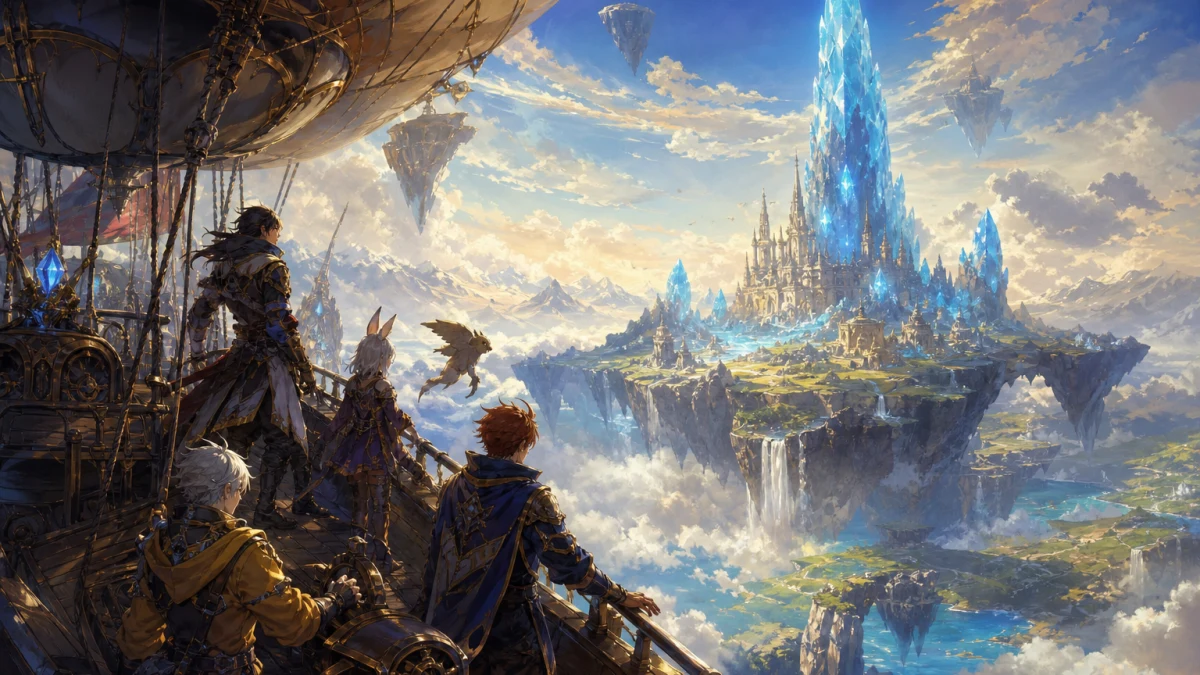
Final Fantasy Resonance is scheduled to launch as a single-player, turn-based RPG for PlayStation 5, Xbox Series X|S, Nintendo Switch 2, Nintendo Switch and Windows PC. Square Enix describes it as the first Final Fantasy project in its HD-2D line and an extensive reconstruction of the first story arc from Final Fantasy Brave Exvius rather than a direct port of the mobile game.
This guide records information confirmed by Square Enix, Steam and the platform holders as of October 10, 2026. That date falls before launch, so prices, countdowns, collector stock, promotional eligibility, estimated downloads and preload notices can still change. Storefront capability badges are presented according to their published wording without turning them into unsupported technical guarantees.
The principal North American release date is October 22, 2026. Steam requires a regional qualification: its US storefront displays October 22, while Square Enix’s Japanese and Asian schedules list October 23. Buyers should rely on the date and countdown attached to the account and region through which they intend to purchase.
This is a factual launch reference rather than a platform recommendation, strategy guide or review. Its purpose is to distinguish permanent edition contents from temporary bonuses, identify meaningful ownership restrictions and mark everything that Square Enix has not confirmed.
Evidence note: This is a prelaunch reference dated October 10, 2026. Regional timing, prices, collector stock, estimated file sizes, promotional eligibility and storefront information may change before release. Steam’s October 22 US date and October 23 dates in some official regional schedules are retained as a documented regional difference rather than resolved by assumption. Steam Deck Verified is the current formal compatibility classification, but it is not a guarantee of identical performance or battery life in every scene and configuration. Unpublished console performance modes, universal cross-save, final patch sizes, Nintendo physical-media details and future platforms remain unconfirmed.
Launch Status at a Glance
Final Fantasy Resonance remains a prelaunch title as of October 10, 2026. Square Enix lists October 22, 2026 for Nintendo Switch 2, Nintendo Switch, PlayStation 5, Xbox Series X|S and Xbox on PC. The US Steam page displays the same date, although official Japanese and Asian schedules list Steam for October 23. Square Enix also cautions that release timing and product availability can vary by region.
The console lineup consists of Switch 2, Switch, PS5 and Xbox Series X|S. PC distribution is split between Steam and Microsoft’s Windows storefront, identified in Square Enix materials as Xbox on PC. No PlayStation 4 or Xbox One edition appears in the publisher’s current supported-platform table.
Square Enix classifies the game as a single-player RPG. Confirmed systems include turn-based command battles, an upcoming-action timeline, enemy stagger gauges, equippable Visions, learned abilities that can remain available after changing Visions, an ability-cost limit and Resonance attacks. No cooperative campaign, competitive mode or online party system has been announced.
The reviewed US listings put the Standard Edition at $49.99. Steam, PlayStation and Xbox list a $59.99 Digital Deluxe Edition, while Nintendo offers a separately priced Digital Deluxe Upgrade. Physical Standard and Collector’s Edition options are available through the North American Square Enix Store for selected platforms. Prices, inventory and taxes must be checked at the live storefront before purchase.
A free demo covers the entire first chapter subject to level and progression limits. An eligible demo save can be imported into the corresponding full version, but experience earned beyond the demo cap is not stored. Importing must occur before a separate full-game save is created unless that retail save is deleted first.
Steam currently marks Final Fantasy Resonance as Steam Deck Verified. That is Valve’s formal compatibility classification for the Steam product, not merely confirmation that the demo can launch on the handheld. The badge still should not be interpreted as a promise of identical frame rates, battery life or image quality in every scene, configuration or future patch.
Some launch information remains incomplete. Nintendo’s published file sizes are estimates, most regional unlock times are unknown, a universal preload schedule has not been issued and the platform holders have not provided comprehensive performance-mode tables. Collector inventory is also dynamic. Stable product facts should therefore be separated from checkout and launch-day details that can change without a new announcement.
- Status: Prelaunch as of October 10, 2026
- Principal console and Microsoft Store date: October 22, 2026
- Steam: October 22 on the US store; October 23 in some official regional schedules
- Consoles: Nintendo Switch 2, Nintendo Switch, PlayStation 5 and Xbox Series X|S
- PC stores: Steam and Microsoft Store or Xbox on PC
- Classification: Single-player RPG
- Reviewed US Standard Edition price: $49.99
- Steam Deck status: Verified
- Free first-chapter demo with eligible save transfer confirmed
Release Date and Regional Timing
October 22, 2026 is the headline North American release date. Square Enix assigns it to Nintendo Switch 2, Nintendo Switch, PlayStation 5, Xbox Series X|S and Xbox on PC, and the US Steam storefront displays October 22 as well. That establishes the advertised date on those pages, but it does not prove that every territory and store will unlock at local midnight.
Steam is the source of the apparent one-day discrepancy. Square Enix’s Japanese and Asian schedules place the Steam release on October 23. Both dates can coexist if a shared launch instant crosses regional calendar boundaries or if Valve applies territory-specific timing. A time-zone distinction is a reasonable explanation, but the reviewed official material does not publish one worldwide Steam timestamp that settles the issue for every account region.
The countdown shown in the purchaser’s own Steam client is therefore more useful than a converted date copied from another territory. A US page showing October 22 does not invalidate Square Enix’s official October 23 listing elsewhere. Customers changing store regions, traveling at launch or purchasing through an overseas account should be particularly careful not to assume that another country’s date governs their license.
The US PlayStation Store supplies one precise reference point: it currently lists an unlock at 04:00 UTC on October 22. In some North American time zones, that instant falls on the evening of October 21. This is not an advertised early-access privilege. It is how one PlayStation timestamp appears when converted to local time, and it cannot be applied to Nintendo, Xbox, Microsoft Store or Steam.
Release, preload and delivery are separate events. A preload can make encrypted files available before the software becomes playable, but no universal Final Fantasy Resonance preload schedule has been established. The Digital Deluxe Edition has no confirmed early-access period. Physical orders follow retailer dispatch and delivery schedules rather than digital unlock clocks, and an October 22 product date does not guarantee arrival that day.
Timing differences can accompany other regional differences, including prices, language combinations, bonus-code terms and collector products. Importing can also complicate downloadable-content redemption when the physical base game, upgrade code and platform account come from different regions. Before launch, buyers should verify the title, edition, hardware generation, account region, displayed countdown and any preload notice on the actual product page they will use.
A converted timestamp should always preserve its source. The 04:00 UTC listing is useful for understanding the US PlayStation page, but it is not a master launch clock issued for every version. Likewise, a retailer’s estimated shipping date or a console dashboard’s provisional timer cannot override the publisher’s warning that availability varies by region.
Unless Square Enix publishes a comprehensive unlock table, October 22 should be understood as the principal North American launch date, not a promise of local-midnight access worldwide. October 23 remains the correct documented Steam date wherever Square Enix’s regional schedule displays it.
- Use October 22 as the principal North American launch date
- Expect October 23 on some official regional Steam schedules
- Use the purchaser’s live Steam countdown as the final Steam reference
- US PlayStation currently displays 04:00 UTC on October 22
- Do not apply the PlayStation timestamp to another platform
- No universal preload timetable is confirmed
- Physical delivery is independent of digital unlocking
Every Confirmed Platform
The confirmed launch hardware is Nintendo Switch 2, Nintendo Switch, PlayStation 5, Xbox Series X|S and Windows PC. PC distribution is divided between Steam and Microsoft’s storefront. Square Enix calls the Microsoft product Xbox on PC, while Microsoft presents it within the wider Xbox and Windows environment.
Store choice matters even when two versions run on the same computer. Steam ownership, Steam Cloud and Steam achievements belong to Valve’s ecosystem. A qualifying Microsoft purchase carries the Xbox Play Anywhere label and uses an Xbox account. Buying either PC version does not automatically grant the other storefront’s license.
Nintendo sells separate Switch and native Switch 2 editions. The original Switch product can run on Switch 2 through backward compatibility, but that does not turn it into the separately sold Switch 2 edition. Buyers using newer Nintendo hardware should inspect the product title and platform field rather than assuming every compatible listing represents the native release.
Nintendo states that no upgrade pack from the Switch edition to the Switch 2 edition is planned. It also says save data cannot move between those editions in either direction. Those restrictions make the initial generation choice more consequential than it would be for a game with a paid upgrade or cross-generation save migration.
PlayStation 5 is the only announced PlayStation platform. No PS4 product, PS4 entitlement or cross-generation PlayStation upgrade appears in the reviewed official material. The PS5 listing also does not advertise a dedicated PS5 Pro enhancement, so one should not be inferred from general PS5 support.
Xbox Series X and Series S are supported under the Xbox Series X|S designation. No Xbox One edition has been announced. The Microsoft listing’s Play Anywhere designation connects a qualifying Xbox and Windows purchase, but it does not extend ownership to Steam, PlayStation or Nintendo.
On PC, the published requirements specify Windows 11. No native macOS or Linux edition has been announced. The Steam edition is, however, formally classified as Steam Deck Verified on its current storefront. Verified status is distinct from native Linux support: it indicates Valve’s compatibility assessment for Steam Deck, while Windows 11 remains the listed desktop operating-system requirement.
Physical availability is narrower than digital availability. The North American Square Enix Store documents physical Standard Edition selections for Switch 2, Switch and PS5. The reviewed first-party material does not establish a North American physical Xbox or PC release. Digital confirmation should not be used as evidence that a boxed equivalent exists.
Platform labels should not be expanded beyond their ordinary scope. Xbox Series X|S confirms both current Xbox models, but not Xbox One. Switch compatibility on Switch 2 confirms that the older edition can run on newer hardware, but not that it becomes the native product. Steam Deck Verified confirms Valve’s current compatibility category, but not one fixed performance result across all settings and scenes.
No additional launch systems are currently listed. A later port is always possible in principle, but future-platform speculation does not create an ownership entitlement or justify describing an unannounced edition as planned.
- Nintendo Switch 2: Separate native edition confirmed
- Nintendo Switch: Original-system edition confirmed
- PlayStation 5: Confirmed
- Xbox Series X|S: Confirmed
- Windows PC through Steam: Confirmed
- Steam Deck: Verified on Steam
- Windows PC through Microsoft Store or Xbox on PC: Confirmed
- PlayStation 4 and Xbox One: No announced editions
- macOS and native Linux: No announced editions
- North American physical selections: Switch 2, Switch and PS5
Where the Digital Version Is Sold
Nintendo customers can buy the digital game through the Nintendo eShop or the applicable regional My Nintendo Store. Because Nintendo offers separate Switch and Switch 2 products, customers should confirm the platform name in the product header, cart and receipt. Compatibility with Switch 2 hardware does not mean the original Switch listing supplies the native Switch 2 edition.
The Nintendo page is also the primary official reference for supported play configurations, estimated download size and Nintendo-specific offer language. Those details may differ between the two editions. Customers should not rely on a search-result card or a general coming-soon catalog when the final product page contains a more precise generation label.
PlayStation 5 purchases are made through the PlayStation Store. The reviewed US listing provides Standard and Digital Deluxe choices, its current unlock timestamp, offline single-player information, accessibility categories and US promotional terms. Those features and dates belong to the PlayStation listing and cannot automatically be projected onto another store.
Xbox Series X|S and Microsoft’s Windows edition are sold through the Xbox and Microsoft Store environment. This is the relevant route for Xbox Play Anywhere. Someone seeking the Microsoft console-and-PC entitlement must purchase the qualifying Microsoft product rather than the independent Steam version.
Steam sells its own Windows license. Its page contains the PC requirements, Denuvo disclosure, Steam Cloud and achievement support, language table, Steam Deck Verified badge, regional release display and available editions. Because official regional schedules show different Steam calendar dates, the live countdown connected to the purchaser’s account is the most reliable final timing reference.
The North American Square Enix Store serves a different function. It sells physical Standard Edition configurations, complete Collector’s Edition bundles and the standalone Collector’s Goods Box. Its inventory, shipping, cancellation and emailed-code terms are distinct from the rules governing digital purchases through a platform holder.
An upgrade or bonus code must match the relevant base product, platform and region. This matters especially for the Collector’s Edition, which pairs a physical game with an emailed Digital Deluxe Upgrade. It also matters on PC: Steam and Xbox on PC remain separate products despite running on the same operating system.
Social profiles, streaming directories, trailers, search snippets and general game databases are not sellers. Buyers should use the applicable platform holder, Steam, Square Enix’s regional store or another clearly identified authorized retailer. Wishlisting an item does not create ownership, reserve collector inventory or establish promotional eligibility.
A store page can contain more than one product under a shared marketing banner. Standard, Digital Deluxe, a deluxe upgrade, a collector bundle and a merchandise-only box are not interchangeable listings. Before payment, the cart should show both the intended hardware and intended entitlement. This is especially important where search results shorten product names or omit the words upgrade and goods box.
A sensible checkout sequence is to choose the hardware and account region first, verify the edition second, inspect permanent contents third and consider temporary bonuses last. That order reduces the risk of selecting the wrong Nintendo generation, PC ecosystem or region merely to secure a small starter incentive.
- Switch 2 and Switch: Nintendo eShop or My Nintendo Store
- PS5: PlayStation Store
- Xbox Series X|S: Xbox Store
- Microsoft PC: Microsoft Store or Xbox on PC
- Steam PC and Steam Deck: Steam
- Physical and collector products: Applicable Square Enix regional store
- Match downloadable content to the base game’s platform and region
- Do not treat a wishlist, social page or directory as a completed purchase
US Pricing Snapshot
As of October 10, 2026, the reviewed US listings display the Standard Edition at $49.99. The amount appears on the US PlayStation Store, Nintendo’s US catalog and the current US Steam listing. It is a dated prelaunch snapshot rather than a worldwide guarantee.
Steam, PlayStation and Xbox list a $59.99 Digital Deluxe Edition in the United States. The permanent difference is the inclusion of the Magitek & Grimoire Deluxe Pack with the base game. Time-limited preorder and early-purchase incentives should not be added to the edition definition because they depend on transaction date, store and region.
Nintendo lists a Digital Deluxe Upgrade separately for $14.99. This product adds the deluxe pack to a compatible base game; it does not supply another copy of Final Fantasy Resonance. Buyers should use the current cart total rather than assume that combining Standard with an upgrade will always equal another storefront’s complete Digital Deluxe price after promotions or taxes.
The separately listed North American Collector’s Goods Box was priced at $150 when checked. This is the merchandise-only product and includes neither the game nor a Digital Deluxe Upgrade code. It was marked sold out at retrieval time, although that inventory status may change through cancellations or restocks.
The $150 figure must not be used to construct a price for the complete Collector’s Edition. The complete bundle adds a selected physical Standard Edition and an emailed deluxe upgrade, and the Square Enix Store uses dynamic platform selectors. A stable full-bundle price was not exposed in the retrieved page text, so the reliable amount is the live total presented for the chosen configuration.
Physical purchases may also incur shipping and tax. International orders can add currency conversion, customs charges or forwarding fees. None of those costs is represented by a headline US product price, and paying for expedited delivery does not establish that a package will arrive on launch day.
The edition structure is clearest when expressed as entitlements. Standard supplies the base game. Digital Deluxe supplies the base game and Magitek & Grimoire Deluxe Pack. The standalone Digital Deluxe Upgrade supplies the pack without another base-game license. The complete Collector’s Edition combines physical Standard software, an emailed upgrade and collector merchandise. The standalone Goods Box contains only that merchandise.
A temporary bonus does not alter those permanent definitions. An eligible Standard preorder can receive a starter pack without becoming Digital Deluxe. Conversely, a Digital Deluxe purchase made after an early-purchase offer closes still includes its permanent deluxe pack even if the temporary incentive is unavailable.
Price comparisons should use like-for-like products. Comparing the $49.99 Standard Edition directly with the $150 Goods Box would compare software against merchandise, while comparing the $59.99 Digital Deluxe Edition with a complete Collector’s Edition would omit the latter’s physical goods and shipping conditions.
Digital refunds, physical returns and collector-order cancellations can follow different policies, particularly after an emailed code has been issued or redeemed. Buyers should check the seller’s current terms before finalizing an uncertain platform or edition choice. All listed amounts are US prices recorded before launch and remain subject to regional pricing, taxes and promotional changes.
- Standard Edition: $49.99 on reviewed US listings
- Digital Deluxe Edition: $59.99 on US Steam, PlayStation and Xbox listings
- Nintendo Digital Deluxe Upgrade: $14.99; compatible base game required
- Complete Collector’s Edition: Stable full-bundle price not retrieved
- Collector’s Goods Box: $150 when checked; merchandise only
- Prices recorded October 10, 2026 and subject to change
Standard Edition Contents
The Standard Edition is the base game. It includes the campaign, turn-based combat, Vision progression and the optional activities Square Enix has identified as part of Final Fantasy Resonance. The official descriptions do not place a central story chapter, ending, permanent party member or promoted side activity behind the Digital Deluxe Pack.
Digital Standard Editions are announced for Switch 2, Switch, PS5, Xbox Series X|S, Steam and Xbox on PC. Each is licensed through its respective ecosystem. Buying Standard on one platform does not create ownership on another, except for the console-and-Windows entitlement Microsoft associates with a qualifying Play Anywhere purchase.
The North American Square Enix Store offers physical Standard selections for Switch 2, Switch and PS5. No North American physical Xbox or PC product is established by the official pages reviewed here. The existence of a digital edition should not be treated as evidence that a matching boxed release is available.
The word physical does not establish how every game file is supplied. The available official pages do not confirm whether either Nintendo package uses a full conventional cartridge, a game-key-card configuration, a download code or another arrangement. Product images and broad retailer categories are not sufficient evidence for that distinction.
That unresolved format can matter to buyers concerned about lending, offline installation, resale or long-term storage. Such customers should inspect final packaging disclosures and updated official listings before opening the product. Until explicit information appears, neither a complete on-card installation nor a mandatory full-game download should be asserted.
A physical copy may still need free storage for patches or additional data. Conversely, uncertainty about the package does not justify claiming that the entire game must be downloaded. Final update requirements, package capacity and physical-media behavior are separate questions.
The PS5 listing confirms offline play for one player. That supports offline use of the game itself, but it does not make initial downloads, patches, cloud backup or downloadable-content redemption offline processes. Collector’s Edition customers will need access to the relevant online service to redeem their emailed deluxe upgrade.
A compatible Standard Edition can receive the Magitek & Grimoire Deluxe Pack through the separately offered Digital Deluxe Upgrade. That upgrade must match the base game’s platform, product and region. No universal cross-platform upgrade entitlement has been announced.
The Collector’s Edition contains physical Standard software rather than a unique deluxe disc or cartridge. Its deluxe content comes through a separate emailed code. That distinction can affect code redemption, resale value and regional compatibility even though the complete bundle is marketed as one collector product.
Standard Edition ownership should also be kept separate from promotional eligibility. A preorder code or early-purchase pack can be attached to a qualifying Standard transaction, but that does not permanently redefine every Standard copy. Used physical copies, late purchases and purchases from nonparticipating sellers may not include those temporary extras even though they contain the same base RPG.
Standard should therefore be understood as the complete base RPG without the optional deluxe pack or any temporary bonus for which the transaction does not qualify. Square Enix has not described it as a shortened or restricted campaign.
- Base game included
- Digital Standard Edition announced on every confirmed platform
- Physical Standard selections confirmed for Switch 2, Switch and PS5 in North America
- No North American physical Xbox or PC edition confirmed
- Compatible deluxe pack sold separately where listed
- Promotional packs are separate entitlements
- Nintendo physical storage format remains unconfirmed
Digital Deluxe Edition and Upgrade
The Digital Deluxe Edition contains the base game and the Magitek & Grimoire Deluxe Pack. The separately sold Digital Deluxe Upgrade adds that pack to a compatible Standard Edition without supplying a second base-game license. Collector’s Edition customers are promised the same upgrade by email and should account for that entitlement before purchasing it independently.
The pack contains one Magitek Armor Key, one Archwitch’s Grimoire, one Mastery Ring, five Tents, five Mist Potions, five Mist Ethers, five Phoenix Downs and three Remedies. Those are eight listed item types, with the consumable categories supplied in the stated quantities.
The Magitek Armor Key unlocks a chocobo cosmetic. Its name does not establish a controllable Magitek vehicle, exclusive traversal feature, quest or dungeon. The confirmed benefit is limited to the cosmetic identified by Square Enix.
The Archwitch’s Grimoire unlocks a particular character’s Fel Meteor Limit Burst. Square Enix’s English storefront deliberately leaves that character unidentified. The gap should not be filled with assumptions based on Brave Exvius, promotional editing, unofficial databases or datamined information.
The Mastery Ring is confirmed equipment, but the retail description does not provide enough final detail to judge its statistics, upgrade potential or long-term usefulness. The same restraint applies to the consumables: their inclusion and quantities are confirmed, while balance claims and optimal uses are not.
Five Tents, five Mist Potions, five Mist Ethers, five Phoenix Downs and three Remedies make up the finite supply portion. Nothing in the pack description identifies an unlimited resource generator, new campaign area or separate story route. These are convenience items rather than evidence of a deluxe-exclusive expansion.
Square Enix says bonus items become collectible from the postbox outside the inn in the Town of Mitra after sufficient story progress. Redeemed content may therefore be unavailable during the opening sequence. Reaching the collection point and confirming that the downloadable entitlement is installed are appropriate first checks if an item does not appear immediately.
The product structure creates a duplicate-purchase risk. Digital Deluxe owners already possess the pack. Collector’s Edition owners receive an emailed code for it. A Standard owner may buy a compatible upgrade, but should not accidentally purchase both a complete Digital Deluxe Edition and the standalone add-on.
Compatibility remains storefront-specific. A Steam add-on should not be expected to recognize Xbox on PC software merely because both run on Windows. PlayStation, Microsoft and Nintendo content must likewise match the applicable account region and base product.
The distinction between an item and an unlock is useful here. Consumables enter the player’s inventory in stated quantities, while the two named keys or books confer the advertised cosmetic or Limit Burst access. Neither wording supports a claim that the pack adds a separate playable campaign. It also does not establish whether individual items can be obtained through ordinary play unless Square Enix expressly says so.
The permanent comparison is simple: Standard includes the game; Digital Deluxe includes the game and pack; the standalone upgrade contains the pack only; and Collector’s Edition combines physical Standard software with the pack through an emailed code. None of the official descriptions identifies the pack as necessary to complete the campaign.
- Magitek Armor Key x1: Chocobo cosmetic
- Archwitch’s Grimoire x1: Fel Meteor for an officially undisclosed character
- Mastery Ring x1
- Tent x5
- Mist Potion x5
- Mist Ether x5
- Phoenix Down x5
- Remedy x3
- Collection point: Postbox outside the Town of Mitra inn after sufficient progress
- Check existing entitlements before purchasing the upgrade
Collector’s Edition and Goods Box
The North American Collector’s Edition has three components: a selected physical Standard Edition, an emailed Digital Deluxe Upgrade code and a Collector’s Goods Box. The documented platform choices are Switch 2, Switch and PS5. No complete North American Xbox or PC collector configuration is established by the reviewed listing.
The physical game ships alongside the Goods Box rather than being packed inside it. Finding no game case inside the merchandise box is therefore consistent with the advertised construction. Customers should compare every received component with the complete order record before concluding that the software is missing.
Although components may generate separate fulfillment information, the official description does not establish how many parcels every order will use or guarantee that all pieces arrive simultaneously. A launch date is not a delivery promise. Once dispatch begins, the order page and carrier records become the relevant references for timing.
The Goods Box includes an acrylic block set, a 120-page hardcover pixel-art book, an original soundtrack on four CDs and a Final Fantasy Trading Card Game promotional card. These are physical collector items rather than downloadable characters, Visions or gameplay systems.
The book’s confirmed characteristics are its hardcover format, pixel-art focus and 120-page length. The store does not publish a complete contents list, so buyers should not assume it contains particular interviews, unrevealed environments, production documents or every piece of game artwork.
The included soundtrack consists of four CDs containing 120 tracks. This description applies to the collector set. A separately marketed soundtrack has its own product details and release arrangements and should not be used to rewrite the contents of the Collector’s Edition.
The promotional card is Dark Fina, numbered PR-233/8-042L. Square Enix describes it as a physical Final Fantasy Trading Card Game card. The listing does not assign it a digital redemption function, so it should not be represented as a code that unlocks Dark Fina in Resonance.
Because the included game is Standard, the Digital Deluxe entitlement is delivered separately by email. Customers should retain access to the order email address, preserve the confirmation and check filtered-message folders before buying another upgrade or reporting that the code was omitted.
Regional compatibility still applies to the emailed add-on. Importing the bundle does not make its downloadable-content code region-free. The selected physical game, code and receiving platform account need to be compatible with one another.
Square Enix separately listed a standalone Collector’s Goods Box for $150. It contains the acrylic set, art book, soundtrack and promotional card, but no game and no Digital Deluxe Upgrade. Similar product art and naming do not make it equivalent to the complete Collector’s Edition.
The standalone box was marked sold out and unavailable when checked. That status can change through restocks, cancellations or reallocated inventory, and availability of the complete Collector’s Edition can move independently. The live regional store must be consulted before assuming either product can still be ordered.
Stock status should not be confused with production status. A sold-out listing means the reviewed storefront was not accepting that order configuration at the time checked; it does not prove that every regional allocation is exhausted. Conversely, an active product page does not guarantee inventory until an order is accepted.
The complete bundle’s price should not be reverse-engineered from the $150 merchandise box. Dynamic platform selection prevented a stable complete-bundle price from being documented in the retrieved page text. Merchandise dimensions, individual-component replacement procedures and release-day delivery guarantees also remain outside the confirmed product description.
- Physical Standard Edition for Switch 2, Switch or PS5
- Digital Deluxe Upgrade code delivered by email
- Acrylic block set
- 120-page hardcover pixel-art book
- Four-CD soundtrack containing 120 tracks
- Dark Fina promotional card PR-233/8-042L
- Game shipped alongside, not inside, the Goods Box
- Standalone Goods Box: $150 when checked
- Standalone Goods Box excludes the game and deluxe upgrade
- Standalone Goods Box was sold out when checked
Preorder Bonus
The advertised preorder incentive is the Magitek Airship & Squire Starter Pack. It is separate from both the permanent Magitek & Grimoire Deluxe Pack and the Squire Kickstart Pack offered to eligible early purchasers. The overlapping references to Magitek and Squire should not be used to merge three distinct products.
The preorder pack contains one Magitek Airship Passkey, one Knight’s Greatsword, one Chestplate of Preparation, one Magicite Shard, three Tents and three Mist Potions. Square Enix does not identify an exclusive character, Vision, chapter, dungeon or ending as part of this offer.
The Magitek Airship Passkey provides an airship cosmetic. Its name does not demonstrate that the pack contains an exclusive flight system, controllable vehicle or traversal mechanic. It is also different from the Digital Deluxe Pack’s Magitek Armor Key, which unlocks a chocobo cosmetic.
The Knight’s Greatsword is equipment, but its inclusion does not establish final attack values, upgrade paths or how long it remains useful. The Chestplate of Preparation provides an experience-related benefit. That makes it a progression convenience, not evidence that ordinary leveling requires preorder equipment.
One Magicite Shard, three Tents and three Mist Potions complete the pack. These are finite quantities rather than permanent production systems. Their presence may provide an early convenience, but nothing in the official description makes them necessary for completing the single-player RPG.
Like the deluxe items, eligible bonus content is collected from the postbox outside the inn in the Town of Mitra after sufficient story progress. A purchaser should not expect the items to appear in the opening inventory immediately. Reaching the postbox, confirming code redemption and checking installed downloadable content are the practical first steps.
Eligibility depends on the seller, platform, region and transaction time. An authorized retailer may sell the game without participating in every publisher promotion. Depending on the seller, a code or entitlement could be communicated through email, a receipt, an account page or packaging according to that retailer’s terms.
Customers should preserve the order confirmation and any bonus communication. Useful support information includes the precise edition, platform, seller, purchase timestamp, account region, code-redemption status and whether the Mitra collection point has become available.
Cancellation and reordering can affect qualification, particularly when a replacement order is made after a preorder deadline. A wishlist, stock alert or abandoned cart is not a completed preorder unless the seller explicitly states otherwise.
The pack’s name can create two avoidable misunderstandings. Its Magitek Airship item is a cosmetic unlock rather than proof of exclusive transportation, and its use of Squire does not make it the same offer as the post-launch Squire Kickstart Pack. Reading the item list is more reliable than matching a repeated word in the promotion names.
The starter pack should remain secondary to the underlying ownership decision. A temporary cosmetic or small set of supplies is not a sound reason to purchase the wrong platform, region or edition. The permanent license and compatibility of the base game matter after the promotional items have been consumed.
- Magitek Airship Passkey x1: Airship cosmetic
- Knight’s Greatsword x1
- Chestplate of Preparation x1: Experience-related benefit
- Magicite Shard x1
- Tent x3
- Mist Potion x3
- Offer type: Preorder incentive
- Collection point: Mitra inn postbox after sufficient progress
- Separate from the Deluxe Pack and Squire Kickstart Pack
Early-Purchase Bonus and Deadlines
The early-purchase incentive is the Squire Kickstart Pack. Its advertised contents are the gil-boosting Blessed Cuirass and one Mist Ether. It is not the preorder Magitek Airship & Squire Starter Pack and is not a permanent component of either the Standard or Digital Deluxe Edition.
A preorder may satisfy an early-purchase window when the applicable storefront’s terms say so, but the promotions remain separate entitlements. A transaction must meet each offer’s conditions. Buyers should inspect the product page, cart and receipt rather than assume that receiving one pack automatically guarantees the other.
The US Steam listing places its early-purchase cutoff on November 6, 2026 at 8:59 a.m. Pacific Time. That timestamp belongs to Steam’s US offer. It should not be converted into a universal worldwide deadline or assigned to Microsoft, Nintendo or PlayStation.
The US Xbox listing uses November 5, 2026 at 11:59 p.m. local time. Nintendo’s US page gives November 5 at 11:59 p.m. PST. The US PlayStation Store states that qualifying purchases must be made by November 5 at 11:59 p.m. local time. The differing wording is why buyers should follow their own store rather than a generalized calendar reminder.
Because these windows continue beyond launch, the Squire Kickstart Pack is an early-purchase offer rather than a preorder-only benefit. Buying within an eligible period does not turn it into permanent Standard Edition content. A purchase after the applicable cutoff should not be expected to include it.
The Blessed Cuirass is a convenience item that increases gil obtained by a stated amount. Its advertised effect does not prove that the normal economy is restrictive or that the equipment is required for reasonable progression. The single Mist Ether is a finite inventory item, not a permanent source of resources.
The pack becomes available through the postbox outside the Town of Mitra inn after sufficient progress. A qualifying customer should confirm entitlement redemption, check downloadable-content management and reach that collection point before treating the pack as missing.
Someone buying near a cutoff should preserve a timestamped order confirmation and, where practical, the terms displayed during checkout. Store pages can change after an offer closes, while the receipt records when and where the transaction occurred.
Time-zone wording should be read literally. Pacific Time, PST and local time are not interchangeable labels even if several deadlines appear close after conversion. The safest approach near a boundary is to complete the transaction well in advance and use the wording displayed by the selected regional storefront.
The date on which payment is captured may not always be the only timestamp a retailer uses, especially for a physical preorder placed earlier or an order later modified. Customers making changes near the deadline should consult that seller’s terms rather than assume an original reservation, replacement order and completed transaction are treated identically.
These are documented US terms, not a global promotion chart. Another country may use a different closing time, different participating retailers or no equivalent offer. The regional product page remains the final eligibility check.
- Squire Kickstart Pack: Gil-boosting Blessed Cuirass and one Mist Ether
- Steam US: Through November 6, 2026 at 8:59 a.m. PT
- Xbox US: Through November 5, 2026 at 11:59 p.m. local time
- Nintendo US: Through November 5, 2026 at 11:59 p.m. PST
- PlayStation US: Through November 5, 2026 at 11:59 p.m. local time
- Offer type: Early purchase, not preorder
- Recheck the selected regional storefront before buying
Free Demo and Save Transfer
The free Final Fantasy Resonance demo covers the entire first chapter. That statement describes its story boundary, not unrestricted character development. Level and progression limits apply, preventing the demo from being used to accumulate unlimited advancement before the full game is released.
Eligible save data can be imported into the corresponding full version. Corresponding should be interpreted conservatively as the matching platform, storefront, account and regional product. Square Enix has not announced a universal transfer system that moves demo progress among unrelated ecosystems.
Square Enix’s official support guidance states that experience earned beyond the demo’s caps is not stored. Continuing to battle after reaching a limit does not build a hidden pool that will be granted when the save is imported. Players interested in carrying progress forward should complete available content and preserve the eligible save rather than attempting to bank capped experience.
Importing also requires that no full-game save already exist. If a player starts the retail version and creates a save before using the import process, that existing retail data blocks the transfer. This is an important practical restriction for anyone tempted to open the full version first and import later.
A later import becomes possible if the existing full-game save is deleted, but deletion is destructive. Players should confirm what retail progress will be lost, preserve any appropriate backup allowed by the platform and consult current storage instructions before removing a save.
The safest order is to retain the demo save, install the matching full game and use the import process before beginning an independent retail playthrough. If a full-game save has already been created, the player must decide whether retaining that progress matters more than importing the chapter-one record.
Eligible Chapter 1 trophies or achievements unlock automatically once the imported save is recognized. The player should not need to replay every qualifying first-chapter event solely to trigger those milestones. Only conditions actually satisfied by the imported progress should be expected to register.
Automatic milestone recognition does not establish cross-platform trophy transfer. PlayStation trophies remain within PlayStation, Steam achievements within Steam and Microsoft achievements within Microsoft’s environment. The feature concerns a corresponding demo and full game in the same ecosystem.
Steam Deck has a specific cloud-save requirement for the transfer process. Steam Cloud must be enabled for both the demo and complete game so the relevant data can be exchanged. Players should allow the demo to finish synchronizing before opening the full version and should resolve any cloud conflict carefully before selecting which file to keep.
Final Fantasy Resonance is Steam Deck Verified, but the compatibility badge and the cloud-transfer requirement answer different questions. Verified is Valve’s compatibility classification for the Steam game. Enabling Steam Cloud is still required for the documented demo-to-full-game transfer workflow on Steam Deck; the badge does not remove that save-management step.
The Steam Cloud procedure does not create a route from Steam to Xbox on PC, even when both products are installed on one Windows computer. They remain separate storefronts. No transfer between those PC ecosystems has been confirmed.
Account identity can matter as much as local storage. A demo save created under one console profile or storefront account should not be presumed available to another profile on the same device. Shared-system users should open both applications with the account intended to own and play the full version.
The words entire first chapter do not remove every limitation. The demo can contain the chapter’s narrative sequence while still capping levels, progression or other systems. It also does not guarantee that a demo installation will transform directly into the retail application; the save-transfer feature concerns eligible progress, not necessarily reuse of every installed file.
If import fails, useful troubleshooting information includes the platform, store, account region, demo version, retail edition, cloud status and whether any full-game save already exists. Players should consult Square Enix’s current support guidance before repeatedly creating or deleting data.
The demo remains a limited first-chapter build. Its progression cap, opening roster and available Visions do not establish the full game’s endgame balance, optional-boss difficulty, complete ability selection or final progression curve.
- Content: Entire first chapter
- Restrictions: Level and progression limits apply
- Transfer: Eligible save imports into the corresponding full game
- Overflow experience: Experience beyond demo caps is not stored
- Existing-save rule: Import requires that no full-game save exist
- Later import: Deleting the full-game save restores import eligibility
- Milestones: Eligible Chapter 1 trophies or achievements unlock automatically
- Steam Deck transfer: Enable Steam Cloud for both demo and full game
- Cross-store and cross-platform demo transfer: Not confirmed
What Final Fantasy Resonance Is
Square Enix describes Final Fantasy Resonance as the first Final Fantasy project in its HD-2D line. Its visual presentation combines high-definition pixel art, three-dimensional staging, dynamic camera angles and pixelized 3D models. That places it within Square Enix’s established HD-2D approach without reducing it to a flat recreation of an older console release.
The game is based on the first story arc of Final Fantasy Brave Exvius. Rain and Lasswell occupy central roles in a premise involving kingdoms, crystals and a growing threat. A detailed plot retelling is unnecessary for a launch reference and would reveal more of the reconstructed story than readers need when comparing products.
Square Enix says the material has been extensively rebuilt as a console-quality RPG rather than directly ported from the mobile game. Shared characters and broad narrative foundations therefore do not prove that individual maps, dialogue scenes, encounters, progression systems or optional activities remain unchanged.
The phrase console-quality is publisher positioning, not a technical specification. It does not establish campaign length, resolution, frame rate, installation size, physical-media format or performance consistency. Each of those subjects needs its own official data or reproducible testing of the public build.
Prior Brave Exvius account progress and purchases are not presented as requirements. Resonance is sold as a premium single-player game with its own products and save data. No reviewed official source says that a mobile account must be linked before the campaign can be played.
Square Enix has named recurring series elements including crystals, chocobos, airships, espers and moogles. Their presence ties the game to familiar Final Fantasy imagery, but does not make Resonance a remake of a numbered installment or a direct continuation of every game represented through its Vision system.
Legacy heroes appear as Visions. That category is important because it does not automatically make every cameo a conventional permanent party member with a full exploration and dialogue role. Cloud, Tidus and the Warrior of Light are confirmed examples, but their official Vision status should be retained when describing them.
The documented structure includes exploration, story events, turn-based commands, enemy staggering, Vision-based ability learning, an ability-cost limit, Resonance attacks and optional combat activities. Square Enix identifies the game as single-player and has not announced cooperative or competitive modes.
The rebuilt status places a boundary around comparisons with Brave Exvius. Familiar names may help returning players recognize the premise, but old mobile event schedules, monetization assumptions, character statistics and progression guides cannot be imported as facts about Resonance.
Similarly, HD-2D identifies the presentation line rather than a guarantee that every previous HD-2D game’s systems are present. It does not establish job mechanics, encounter rates, map structures or graphical options by analogy. Resonance must be described through its own confirmed features.
The concise description is a standalone single-player HD-2D reconstruction of Brave Exvius’s opening story arc, designed around turn-based combat and Vision-based customization. Prior Final Fantasy familiarity may provide context, but it is not presented as an entry requirement.
- First Final Fantasy project in the HD-2D line
- Based on the first Brave Exvius story arc
- Extensively rebuilt rather than directly ported
- High-definition pixel art combined with 3D staging
- Single-player RPG
- Crystals, chocobos, airships, espers and moogles confirmed
- Previous mobile ownership not listed as a requirement
Confirmed Combat and Progression Features
Battles use turn-based commands. An on-screen timeline displays upcoming actions for allies and enemies, giving players a forecast of the current order. Official descriptions establish the interface but do not provide a complete formula for speed, priority, delays or every effect capable of moving an action on the timeline.
That distinction matters before release. A visible turn forecast can support planning, but it is not enough to build a final optimization model. Skills, status effects and encounter rules may alter the sequence. The confirmed feature is the displayed order information, not an exhaustive initiative formula.
Enemies have a stagger gauge. Depleting it prevents the affected enemy from acting on its turn and reduces its defense. Stagger therefore combines a lost action with increased vulnerability rather than serving only as a decorative break meter.
Encounter-specific values remain unpublished. Gauge size, recovery, resistance, duration and boss exceptions may vary. Confirmation of the general system does not support a claim that every opponent follows identical rules or that one damage sequence will always be optimal.
Visions are obtained through story-related character events and sanctums distributed around the world. Legacy Final Fantasy heroes appear through this framework. Those acquisition routes are officially documented, although they do not prove that every Vision is earned in exactly the same way.
Equipping a Vision allows a character to learn abilities. Once learned, an ability can remain equipped after another Vision becomes active, subject to an ability-cost limit. This creates customization beyond using only the moves attached to the currently selected Vision.
The cost ceiling restricts the combination of inherited abilities. Square Enix has confirmed the tradeoff but has not published a complete table of ability costs, capacity increases or endgame combinations. Values visible during the first chapter should not be assumed to represent the entire progression system.
Legacy figures should continue to be identified as Visions unless Square Enix documents another role. Seeing Cloud, Tidus or the Warrior of Light participate in battle does not independently establish that each receives the equipment, exploration and dialogue structure of a conventional permanent party member.
Resonance attacks are also confirmed. The reviewed official information establishes their presence but does not provide enough final detail for a universal trigger formula, damage ranking or optimal party setup. Those questions require the released build and an identified patch version.
Together, the action timeline, stagger gauge, Vision learning, retained abilities, ability-cost limit and Resonance attacks define a command-based system concerned with timing and party construction. That is enough for a launch overview without presenting provisional footage or a limited demo as a complete strategy manual.
The relationship among those systems is confirmed only at a broad level. Players can inspect turn order, work toward stagger and customize learned abilities, but official material does not establish that every Resonance attack depends on stagger or that every Vision ability manipulates the timeline.
The demo can demonstrate portions of these mechanics, but its caps restrict what it proves. Opening statistics and available Visions should not be projected onto late-game encounters, optional bosses or launch-version balance adjustments. A complete Vision roster, every ability cost and the final difficulty curve remain post-launch documentation subjects.
- Turn-based command battles
- Upcoming-action timeline for allies and enemies
- Enemy stagger gauge
- Stagger prevents the affected turn and reduces defense
- Visions obtained through events and world sanctums
- Equipped Visions teach abilities
- Learned abilities can remain equipped after changing Visions
- Ability-cost limit restricts loadouts
- Resonance attacks confirmed
- Complete formulas and balance values remain unpublished
Confirmed Final Fantasy Characters and Side Content
Moderate content notice: this section names officially promoted legacy characters, opponents and optional activities. It does not reveal story outcomes, puzzle solutions or the reward attached to the Sephiroth challenge, but readers avoiding all cameo information may prefer to skip it.
Cloud, Tidus and the Warrior of Light are confirmed legacy characters represented as Visions. Their presence demonstrates the wider-series scope of that system. It does not establish that all three join Rain and Lasswell as conventional permanent party members.
A Vision can provide combat representation and teach abilities without recreating the original character’s narrative role. Promotional battle footage should therefore not be treated as proof of extensive dialogue, independent exploration sequences or permanent central-cast status.
Sephiroth appears in an optional challenge that can yield a special reward. Square Enix has not identified that reward in the official material used for this guide. The encounter also should not be reframed as evidence that Sephiroth is the campaign’s principal antagonist.
Optional means the challenge is not advertised as an unavoidable main-story battle. It does not reveal the recommended level, location, entry requirements, number of phases or difficulty relative to other bosses. Those details remain outside a prelaunch factual reference.
Gilgamesh is another confirmed piece of side content. His many appearances throughout the series do not determine this version’s dialogue, allegiance, weapons or encounter structure. Only his presence has been firmly established.
A Colosseum is officially named as a combat activity. Square Enix has not supplied a complete opponent ladder, reward table, currency structure or repeatability rules. It should be listed as confirmed content rather than described as a fully documented mode.
The Chamber of Arms is also confirmed. Its precedent in Brave Exvius cannot prove that Resonance reproduces all of its original rules, bosses or rewards. Square Enix’s description of the project as an extensive rebuild is a reason to avoid treating the mobile version as a one-to-one guide.
Ultima Weapon is named as a battle. That confirmation does not identify its weaknesses, phases, level requirement or relative place in the challenge hierarchy. Previous versions of Ultima Weapon in other Final Fantasy games cannot substitute for Resonance-specific evidence.
These announcements establish optional combat beyond the main route: recognizable Visions, a Sephiroth challenge, Gilgamesh, a Colosseum, the Chamber of Arms and an Ultima Weapon encounter. They do not establish that every Brave Exvius event, collaboration or summon has been reconstructed.
The named examples are not a complete roster. Square Enix may reveal more characters or activities, but a handful of famous appearances does not support extrapolating every numbered protagonist, villain or mobile collaboration into the game.
The term special reward should remain equally bounded. It confirms that completing the Sephiroth challenge can produce a distinct reward, but not whether that reward is a Vision, weapon, cosmetic, ability or another item category. Guessing its identity would go beyond the official prelaunch description.
- Cloud: Confirmed Vision
- Tidus: Confirmed Vision
- Warrior of Light: Confirmed Vision
- Sephiroth: Optional challenge with an unidentified special reward
- Gilgamesh: Confirmed side content
- Colosseum: Confirmed activity; full structure unpublished
- Chamber of Arms: Confirmed; mobile-era rules should not be assumed
- Ultima Weapon: Confirmed battle; strategy details unverified
Platform-Specific Features and Restrictions
Microsoft lists Xbox Play Anywhere for Final Fantasy Resonance. A qualifying purchase through Microsoft participates in the shared-ownership framework covering Xbox console and Windows PC. The label does not grant a Steam, PlayStation or Nintendo license.
Play Anywhere is relevant to entitlement, but the product page does not provide a Resonance-specific explanation of every synchronization scenario. Customers who plan to alternate between Xbox and PC should review Microsoft’s current terms. The designation should not be expanded into a promise of save exchange with Steam or unrelated accounts.
The Xbox Store also displays 4K Ultra HD and 60 fps-plus capability badges. These are advertised capabilities, not proof that every scene renders simultaneously at native 4K and more than 60 frames per second. They also do not demonstrate identical settings or behavior on Series X and Series S.
No model-by-model Xbox performance table has been supplied. Resolution scaling, quality modes, frame-rate targets and sustained results require more precise official specifications or reproducible testing of the final public build. Store badges alone cannot settle those questions.
The US PlayStation Store lists offline play for one player, consistent with the single-player classification. That label concerns play after the necessary software and license conditions are met; it does not mean downloading, updating, cloud backup and downloadable-content redemption can all occur without an internet connection.
PlayStation lists 12 accessibility features. The displayed categories include color alternatives, a basic visual-comfort option, separate volume controls and basic subtitles. Those are useful confirmations, but they do not answer every question about adjustment ranges, subtitle presentation, control remapping or assistive feedback.
Players who depend on a precise accessibility function should inspect the released settings or updated official documentation. A broad store category should not be translated into a more specific feature that the page does not name. The same caution applies to an option shown in promotional footage but not documented for the final build.
Nintendo lists TV, tabletop and handheld play for the Switch edition, with one player on a single system. These configurations establish supported ways to use the console; they do not reveal resolution, frame rate, image quality or battery duration in each mode.
Nintendo’s estimated download sizes are 8.8 GB for Switch and 12.7 GB for Switch 2. The figures are explicitly estimates. A launch update can change the practical storage requirement, and installation may need temporary free space beyond the displayed download amount.
The Switch edition can operate on Switch 2 with behavior consistent with the original Switch version. That is backward compatibility, not equivalence to the separately sold native Switch 2 product. Nintendo does not provide a complete technical comparison between the two editions in the reviewed listing.
For ownership planning, Nintendo confirms two restrictions: no upgrade pack from the Switch edition to the Switch 2 edition is planned, and saves cannot transfer between the editions in either direction. Buyers who care about native-version ownership or long-term progress should choose the intended edition before starting.
Beginning a long playthrough in the original Switch edition on Switch 2 does not create a path to move that progress into the native Switch 2 edition later. Backward compatibility lets the older product run; it does not merge the two products’ save environments.
Steam’s platform-specific storefront label is Steam Deck Verified. That is a formal Valve compatibility classification and replaces any earlier uncertainty about whether the game had received a Deck category. It does not guarantee identical performance in every scene, a fixed battery-life result or parity with a desktop running the recommended specification.
- Xbox: Play Anywhere listed
- Xbox: 4K Ultra HD and 60 fps-plus capability badges listed
- Xbox: No Series X versus Series S mode breakdown
- PS5: Offline play for one player listed
- PS5: 12 accessibility features listed
- PS5 information includes color alternatives, visual comfort, volume controls and basic subtitles
- Nintendo Switch: TV, tabletop and handheld modes
- Switch estimated size: 8.8 GB
- Switch 2 estimated size: 12.7 GB
- Nintendo: No planned Switch-to-Switch 2 upgrade pack
- Nintendo: No save transfer between the two editions
- Steam Deck: Verified
PC Requirements and Features
The Steam requirements specify Windows 11. Windows 10, native macOS and native Linux support are not listed. Community compatibility layers and unofficial workarounds cannot be represented as operating systems supported by Square Enix.
The requirements list 8 GB of RAM and 15 GB of available storage. Buyers should preserve additional free space because patches and temporary installation data can raise the practical requirement. Available storage is also not necessarily identical to the compressed network-download size.
The minimum target is 1920 by 1080 at 30 frames per second using the Low graphics preset under Steam’s listed minimum specification. The recommended target is 1920 by 1080 at 60 frames per second using the Highest preset under the recommended hardware tier. Those targets apply to the complete requirement rows, not to the memory and storage figures in isolation.
The live Steam table should be consulted for the exact processor and graphics tiers. Prospective buyers should compare the complete model names rather than rely only on the resolution target. Laptop chips can operate under different power and thermal limits from similarly named desktop parts, while integrated graphics should not be treated as equivalent to a listed discrete GPU without supporting evidence.
A storefront performance target is not an unconditional guarantee for every scene or configuration. Drivers, cooling, background processes, memory arrangement and power limits can affect results. Strong performance claims require testing of the final public version with hardware, settings and patch number identified.
Steam discloses Denuvo anti-tamper technology. Its presence is confirmed, but the disclosure alone does not prove either a positive or negative performance effect. Claims about frame rate, loading time or processor overhead would require controlled testing rather than inference from the product label.
Steam Cloud and Steam achievements are listed. Cloud storage operates within Steam and does not establish save compatibility with Xbox on PC. Users moving between Steam devices should allow synchronization to complete and examine cloud-conflict warnings before selecting which file to retain.
Steam and Microsoft achievements remain separate platform systems even when individual milestones use similar conditions. No official source establishes transfer of achievement history between the two PC products. Customers prioritizing Microsoft’s Xbox console-and-PC entitlement need the Microsoft edition rather than Steam.
The Steam language table distinguishes interface text, subtitles and full audio. A language supported for menus or subtitles may not include spoken dialogue. Anyone requiring a specific combination should inspect all relevant columns on the live regional page before buying.
The Steam storefront currently classifies Final Fantasy Resonance as Steam Deck Verified. That is the established compatibility status as of October 10, 2026. It should not be softened into a claim that no formal rating exists, nor expanded into a promise of identical performance under every graphics setting, thermal condition, battery state or game scene.
Steam Deck Verified also does not change the desktop requirement table. Windows 11 remains the operating system listed for conventional PCs, while Valve’s badge addresses compatibility on Steam Deck. These facts can coexist because the Deck uses Valve’s platform and compatibility environment rather than representing a newly announced native Linux desktop edition.
For demo-save transfer on Steam Deck, Square Enix instructs players to enable Steam Cloud for both the demo and full game. Verified status does not replace that requirement. The demo save should finish synchronizing before the full version is opened, and cloud conflicts should be resolved cautiously to avoid preserving the wrong file.
Controller support details beyond the storefront’s listed categories, ultrawide behavior, graphics-menu breadth and frame-rate options beyond the stated 1080p targets were not fully established by the reviewed evidence. Those details remain unconfirmed rather than proving that the options are absent.
The 15 GB storage line should not be compared directly with Nintendo’s estimated download sizes as though all three numbers measured the same thing. Steam states available storage, while Nintendo labels estimated downloads for two console editions. Compression, installation layout, patches and temporary files can make those values differ without any storefront being incorrect.
A practical PC check should cover the Windows version, complete current CPU and GPU rows, 8 GB or more of memory, at least 15 GB of available storage plus headroom, the desired storefront ecosystem and required text and spoken languages. Steam Deck owners should additionally verify that the badge remains present, enable Steam Cloud if transferring a demo save and avoid treating Verified as a benchmark for every scene.
- Operating system: Windows 11
- Memory: 8 GB RAM
- Storage: 15 GB available; additional headroom advisable
- Minimum target: 1920x1080 at 30 fps using the Low preset
- Recommended target: 1920x1080 at 60 fps using the Highest preset
- Compare the complete live CPU and GPU requirement rows
- Denuvo anti-tamper disclosed
- Steam Cloud and achievements listed
- Steam Deck compatibility: Verified
- Steam Deck demo transfer requires Steam Cloud for both applications
- Language categories separate interface, subtitles and full audio
- Steam and Microsoft Store are separate licenses
- Native macOS and native Linux desktop editions are not announced
What Remains Unconfirmed
Exact unlock times remain unknown for most store-and-region combinations. The US PlayStation page displays 04:00 UTC on October 22, but that timestamp cannot be assigned to Nintendo, Xbox, Microsoft Store or Steam. Each account’s live product page or countdown is the appropriate final reference.
The US Steam date of October 22 and the October 23 dates in Square Enix’s Japanese and Asian schedules have not been reconciled through a published worldwide timestamp. A time-zone boundary is plausible, but it remains an inference rather than a documented universal explanation.
Final download sizes are not established across the platform lineup. Nintendo’s 8.8 GB Switch and 12.7 GB Switch 2 figures are estimates. Steam’s 15 GB requirement describes available storage and does not guarantee the size of the compressed download.
Day-one patch sizes, preload packages, preload opening times and temporary installation requirements remain unknown. Those details may appear close to release. Owning a physical product also does not prove that no update or additional data will be required.
Final resolution and frame-rate modes remain unpublished for PS5, Switch and Switch 2. Xbox’s 4K Ultra HD and 60 fps-plus badges do not provide a Series X and Series S breakdown or promise simultaneous native 4K rendering above 60 frames per second.
No dedicated PS5 Pro enhancement is listed. That absence does not settle possible system-level behavior, but an explicit enhanced mode cannot be advertised without official documentation or reproducible final-build testing.
Steam Deck compatibility itself is no longer an unknown: the Steam page marks the game Verified. What remains unconfirmed is a comprehensive Deck performance profile, including sustained frame rate in every area, battery-life ranges, preferred graphics settings and behavior after future patches. The badge should be reported accurately without being treated as a substitute for measured testing.
A universal cross-save system has not been announced. Steam Cloud covers Steam, and Xbox Play Anywhere operates in Microsoft’s environment. Neither establishes save exchange with PlayStation or Nintendo, nor does either prove transfer between Steam and Xbox on PC.
Collector’s Edition pricing and inventory remain dynamic. The merchandise-only Goods Box was listed at $150 and sold out when checked, but that status cannot predict restocks, cancellations or availability of complete collector configurations. Release-day delivery is likewise not guaranteed.
The physical storage format of the Nintendo packages remains unconfirmed. A product image cannot prove a full cartridge, game-key-card format, download code or additional-data requirement. Explicit packaging or publisher information is necessary.
The identity of the character receiving Fel Meteor remains deliberately undisclosed in the English storefront description. Complete final statistics for the Mastery Ring, preorder equipment and early-purchase armor are also not established by the available prelaunch material.
A complete Vision roster, full Colosseum schedule, every Chamber of Arms battle and exhaustive optional-boss list have not been published. Named examples prove that those categories of content exist without establishing their total scope.
Campaign length, completion time, difficulty balance and total optional-content volume remain undocumented. Estimates based on Brave Exvius would be unreliable because Square Enix describes Resonance as an extensive rebuild rather than a direct port.
No future platforms, expansions or additional upgrade programs have been announced in the reviewed material. The absence of a launch edition does not make a later port impossible, but possibility should not be presented as a plan.
Several omissions are especially important because they affect purchasing rather than curiosity. Nintendo owners do not yet have confirmed package-format details, performance-focused console buyers lack complete mode tables, and collector customers cannot rely on a static stock report. Those gaps call for a final storefront check, not assumptions based on retailers or unrelated games.
Some unknowns can be resolved through a store update, while others require the finished public version. Countdown changes, preload notices and collector inventory can be checked immediately before launch. Sustained performance, complete content scope and detailed graphics settings require final documentation or reproducible testing tied to a public patch.
The best final pre-purchase routine is to check the regional product page, verify the hardware and edition in the cart, read the account-specific countdown, review any relevant promotion deadline, preserve the order record and leave storage beyond the stated minimum. That cannot reveal unannounced features, but it prevents many avoidable licensing and fulfillment errors.
- Unknown: Exact unlock times outside specifically listed storefront data
- Unknown: Final download and day-one patch sizes
- Unknown: Universal preload schedule
- Unknown: Complete console performance-mode tables
- Confirmed: Steam Deck Verified status
- Unknown: Detailed Steam Deck performance and battery results
- Unknown: Cross-save among unrelated ecosystems
- Dynamic: Collector stock and complete-bundle pricing
- Unknown: Nintendo physical storage format
- Undisclosed: Fel Meteor character identity
- Unannounced: Future platforms, upgrades and expansions
Final Fantasy Resonance is scheduled for October 22, 2026 on Nintendo Switch 2, Nintendo Switch, PlayStation 5, Xbox Series X|S and Microsoft’s Windows store. The US Steam page also displays October 22, while official regional schedules listing Steam for October 23 remain valid references for those territories. PC buyers should follow the date and countdown attached to their own account.
Square Enix has confirmed a single-player HD-2D RPG built from the first Brave Exvius story arc, with turn-based commands, an action timeline, enemy staggering, Vision-based customization, Resonance attacks and named optional challenges. Standard, Digital Deluxe, Collector’s Edition and merchandise-only products have distinct contents, while preorder and early-purchase packs use separate eligibility rules.
The first-chapter demo supports eligible save import, subject to progression caps and specific save-management conditions. Steam formally marks the game as Steam Deck Verified, and Steam Deck demo transfers require Steam Cloud for both applications. Exact global unlocks, final downloads, most console performance modes, universal cross-save, complete collector availability and Nintendo physical-media details remain outside the confirmed prelaunch record.
Sources
- Final Fantasy Resonance official Square Enix launch announcement
- Final Fantasy Resonance official Japanese product site
- Final Fantasy Resonance Steam listing
- Final Fantasy Resonance US PlayStation Store listing
- Final Fantasy Resonance Xbox Digital Deluxe Edition
- Final Fantasy Resonance Nintendo Switch listing
- Nintendo US coming-soon catalog
- Final Fantasy Resonance North American Square Enix Store listing
- Final Fantasy Resonance Collector’s Edition Goods Box
- PlayStation Blog demo and confirmed-features announcement
- Square Enix support: Can I transfer my demo save data to the full game?