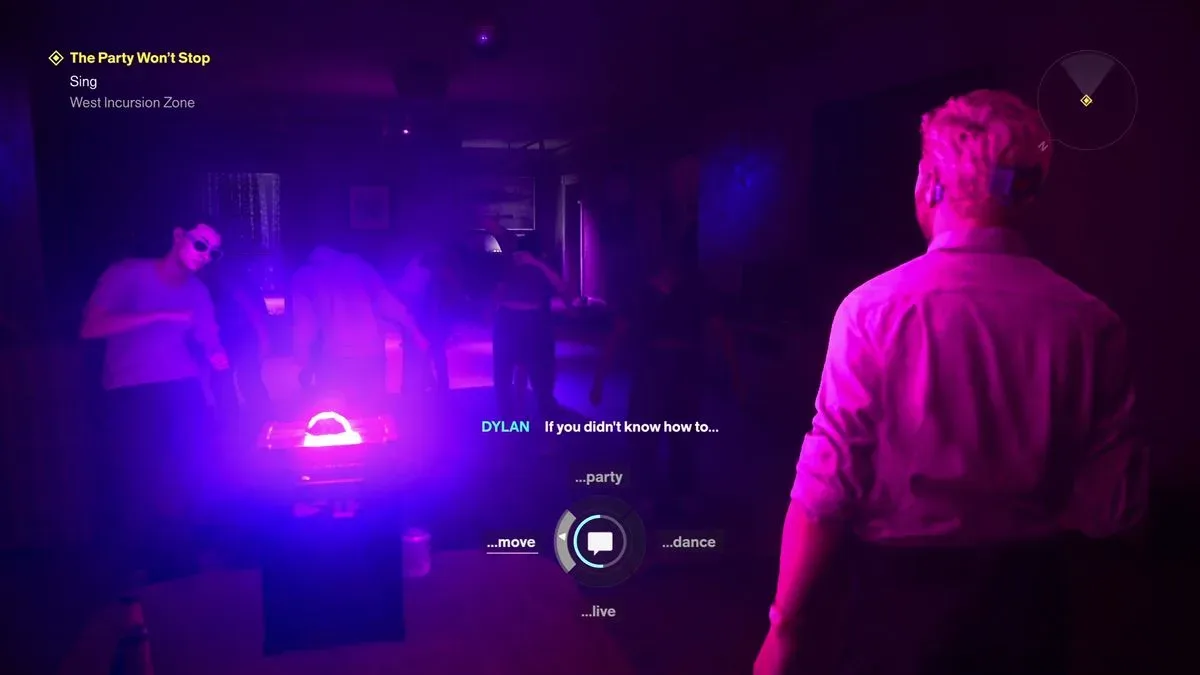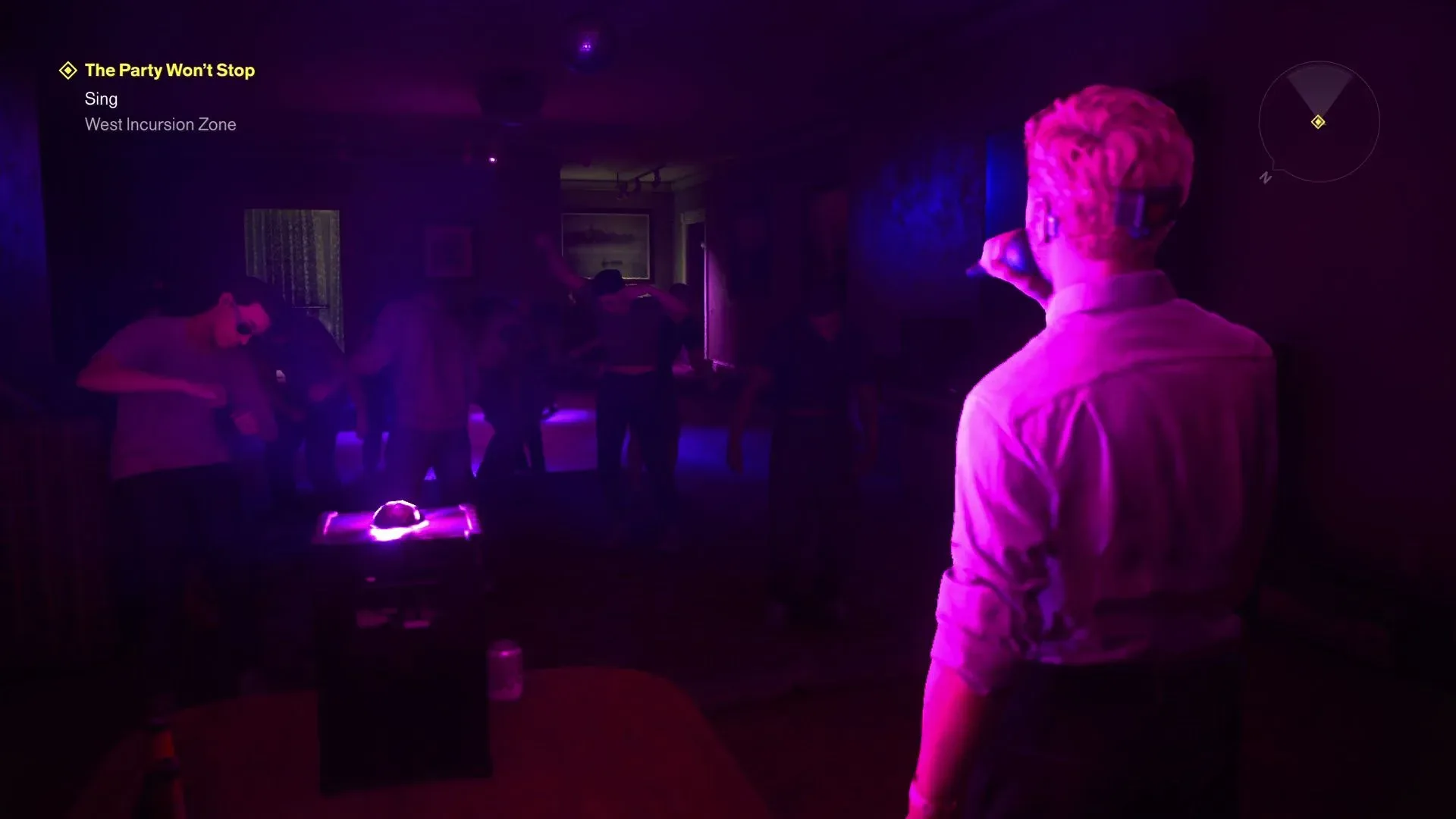
Control Resonant’s Karaoke machine is not the sort of cursed object that accepts a sheepish “I only know the chorus.” Found during the side quest The Party Won’t Stop, it compels the people around it to keep dancing while it tests whether somebody can complete its song from memory. A wrong response has immediate stakes: one of the partygoers is killed.
The good news is that the puzzle has a consistent core idea. The machine gives a line, then presents a choice for its continuation; the intended answer generally rhymes with the line it has just sung. The less-good news is that “generally” is a dangerous word when the venue’s entertainment equipment is cursed and the dancers are paying for a bad guess.
Below is the complete answer order for the Karaoke puzzle. Use the list in sequence during The Party Won’t Stop to provide every correct continuation. The guide also explains what the rhyme pattern is doing, why the full list remains more reliable than improvising, and what you receive once the scene is resolved.
All Control Resonant Karaoke puzzle answers
These are the correct selections for the Karaoke machine, in the order the prompts occur:
- Prompt: “It’s the greatest party you’ve ever seen…”
Answer: Gasoline - Prompt: “No end in sight, no end to happiness…”
Answer: Stress - Prompt: “When you move your feet, your heart starts beating…”
Answer: So fleeting - Prompt: “When you’re singing the sweetest song…”
Answer: Too long - Prompt: “What would you do without this groove?”
Answer: Move - Prompt: “When you move your dancing feet…”
Answer: Fear - Prompt: “Music gives you the power to sing…”
Answer: Everything - Prompt: “It keeps you going, fuels your fire…”
Answer: Higher and higher - Prompt: “So find your voice, just belt it out…”
Answer: Shout
How the Karaoke machine’s lyric puzzle works
The machine’s test is a rhyming puzzle: its selected phrase is meant to sound like the ending of the lyric that precedes it. In other words, do not read the prompt simply as a question about what would make the most literal sense. Listen for the sound at the end of the line.
Several answers show the intended relationship especially clearly. “Sweetest song” leads to “too long,” while “this groove” is answered with “move.” Likewise, “power to sing” leads into “everything,” and “belt it out” is followed by “shout.” They are rhyme-driven completions, not necessarily the most grammatically predictable next words in isolation.
A rhyme is a matching or closely matching sound, usually at the ends of words or phrases. The Karaoke machine applies that musical rule to its lyric fragments. The relevant feature is sound rather than spelling: “feet” and “fear,” for example, begin with similar letters but do not make the same ending sound. That distinction is why trying to solve every choice through text alone can be risky.
The pattern is useful as a first filter, but the answer list is the safer tool. The puzzle includes choices whose relationship may be less immediately obvious than a straightforward one-word rhyme, including “gasoline” after “seen” and the longer “higher and higher” after “fire.” More importantly, the machine’s threat means there is no practical upside to treating an answer sequence as a poetry experiment when the correct responses are known.
Related coverage includes Control Resonant Karaoke Puzzle Guide: Every Correct Lyric Answer.
A safe approach for ‘The Party Won’t Stop’
When you reach the cursed Karaoke machine, keep the answer order above handy and match each response to the exact prompt being sung. The key is to progress one line at a time. Do not skip ahead merely because a later pair is memorable; the answers are tied to a particular lyric fragment and sequence.
- Wait for the machine’s lyric prompt.
- Find the matching prompt in the ordered list.
- Select the response shown with that prompt.
- Repeat until all nine prompts have been answered.
This is deliberately a reference-based solution rather than a recommendation to guess from the rhyme scheme. The party scene establishes the cost of an incorrect lyric: the machine kills a dancing party member. That consequence gives the normally lighthearted format an unusually grim edge, and it makes exact completion preferable to a trial-and-error approach.
It is also worth separating two ideas that can otherwise get muddled: a wrong selection changes what happens to the people trapped in the party, while the listed quest rewards are not tied to perfect lyric accuracy. The rewards remain the same whether every answer is correct or some are missed. That does not erase the narrative consequence of a wrong answer, but it does mean players are not being locked out of the gear listed below by an imperfect performance.
Karaoke puzzle rewards
Completing the Karaoke encounter awards two items:
- Varsity Jacket: an outer-layer outfit item for Dylan.
- Bar Blade: an untapped artifact that passively regenerates health while a summoned ally is nearby.
The Varsity Jacket is a cosmetic wardrobe piece with a clearly specified slot: it is worn as Dylan’s outer layer. The Bar Blade has a gameplay effect, although its condition matters. Its health restoration is passive, meaning it happens without the player needing to actively trigger a healing action, but only while a summoned ally is close by.
A summoned ally is an ally brought into play through a summoning effect; for the Bar Blade’s benefit, proximity is the important requirement. The artifact is therefore most useful in situations where that companion is maintained nearby. If the ally is not close, the stated regeneration condition is not met. The item being described as an untapped artifact identifies its item type while distinguishing it from the clothing reward.
Why the puzzle’s reward rules matter
In many choice-based encounters, players assume that a perfect result is required for the full reward package. The Party Won’t Stop breaks that expectation. The Karaoke machine’s lyrics carry a severe in-scene consequence, yet the Varsity Jacket and Bar Blade are awarded even if some responses are wrong.
Practically, that means the decision to use the correct list is about safeguarding the party members rather than protecting the item drop. A player who only wants the jacket and artifact will still receive them, but the correct sequence is the route that avoids the machine’s stated penalty. It is an important distinction between narrative outcome—what happens in the encounter—and reward outcome—which items the quest grants.
The setup also turns a familiar karaoke convention on its head. Lyrics normally invite participation, memory, and a little imperfection. Here, recall is enforced by a cursed object, the dancers cannot simply leave the floor, and a missed line puts someone else at risk. That makes the rhyme mechanic more than a simple wordplay gate: it is the immediate language of the quest’s threat.
Quick answer checklist
If you need the shortest possible version before making a choice, use this sequence:
Gasoline → Stress → So fleeting → Too long → Move → Fear → Everything → Higher and higher → Shout.
For each entry, verify that the machine has reached the corresponding prompt rather than selecting based on the answer’s position alone. The sequence completes the song test, while the rhyme relationships explain why those responses fit the lyrics.
Control Resonant’s audio-focused puzzle is a very different sort of game mystery from the lost radio network explored in Radiotext, but both underline how much tension a game can get from listening closely. In this case, though, the solution is mercifully finite: nine prompts, nine answers, and no need to gamble with the dance floor.