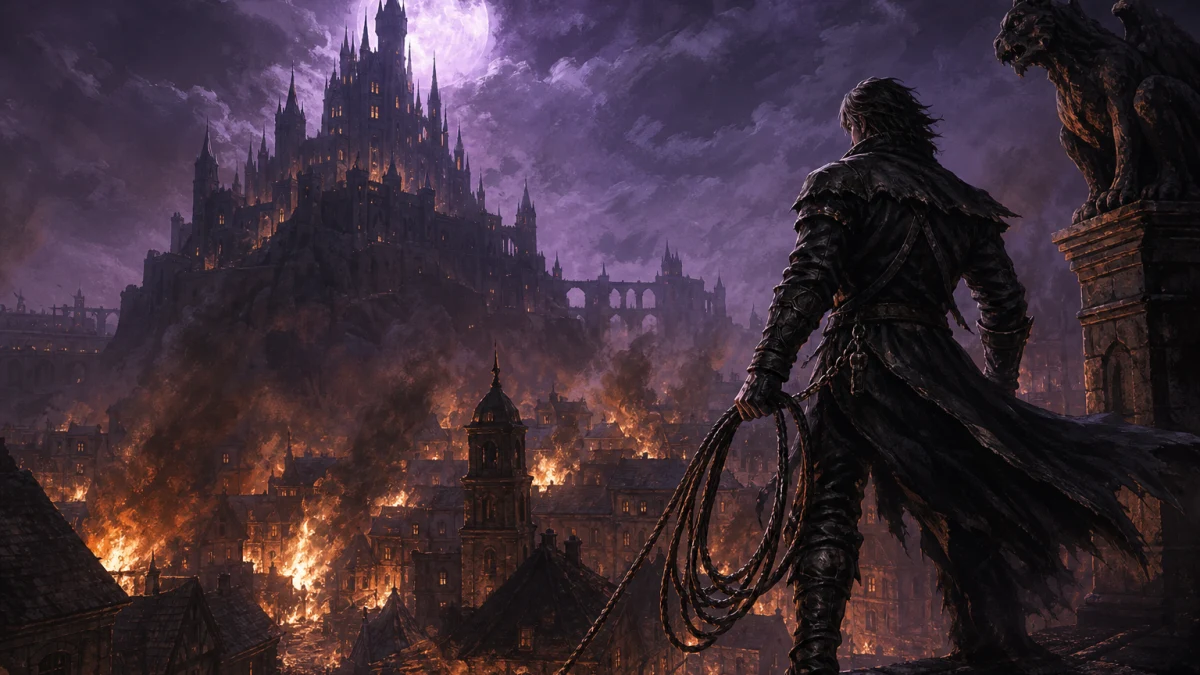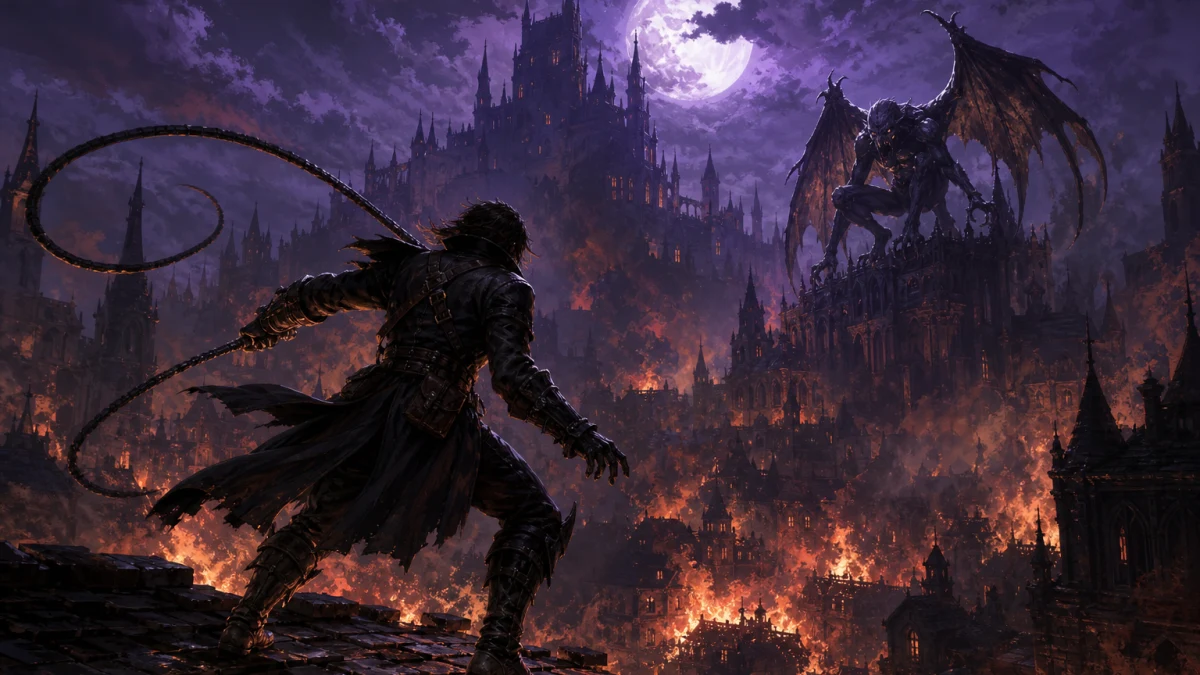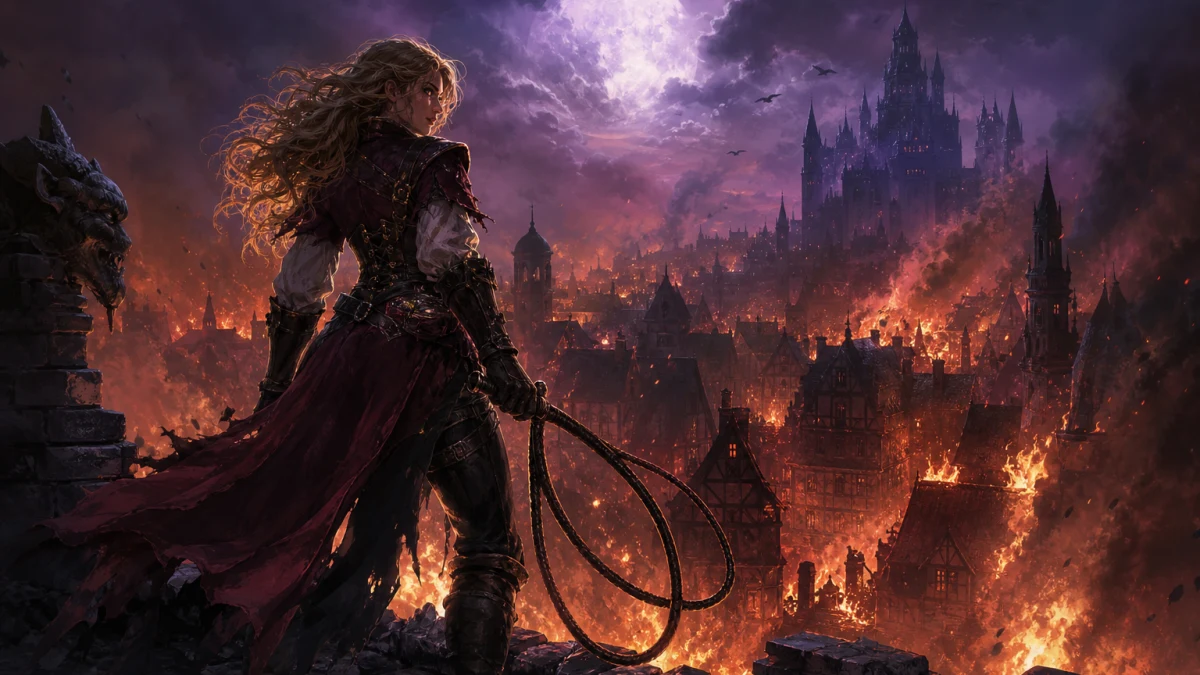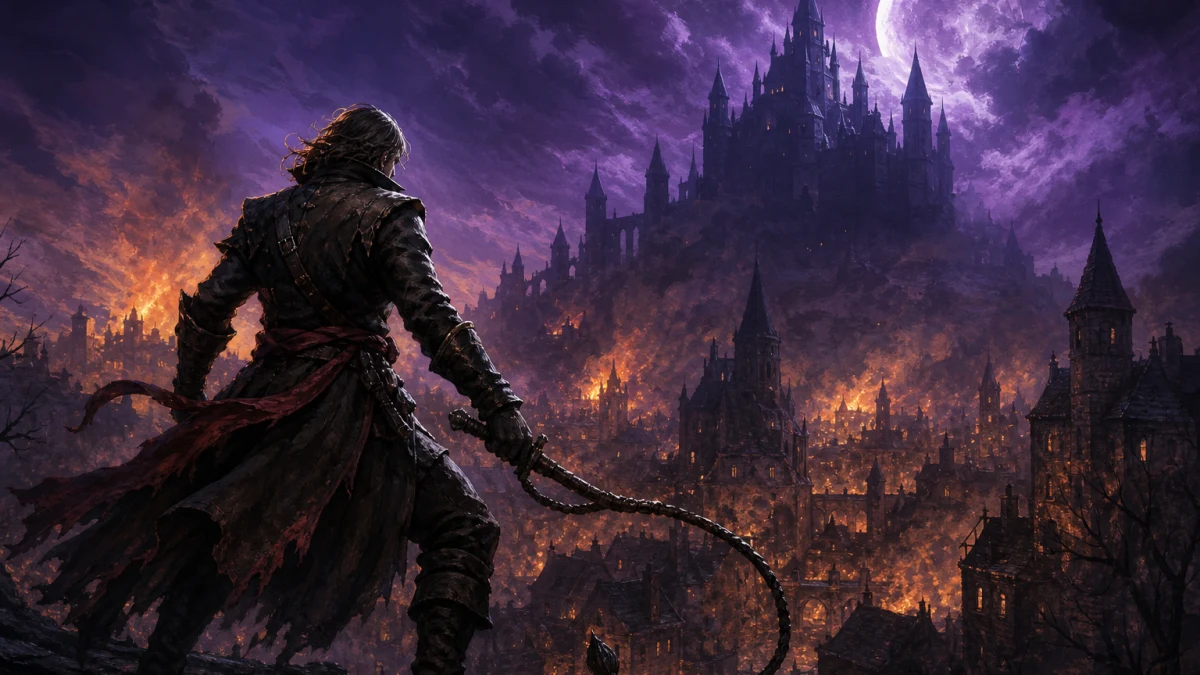
Castlevania can look forbidding from the outside. Its releases jump between centuries, several heroes share the Belmont name, Dracula rarely stays defeated forever, and familiar characters have substantially different histories in games and animation. Castlevania: Belmont’s Curse adds another historical chapter when it launches on October 15, 2026, but preparing for it does not require memorizing every resurrection, descendant or castle.
The useful background is much narrower. Belmont’s Curse takes place in Paris in 1499, 23 years after Castlevania III: Dracula’s Curse and approximately 20 years after Castlevania: Curse of Darkness. Those two games establish Trevor Belmont, Sypha Belnades, Isaac, Dracula’s lingering curse and the family history inherited by new protagonist Rose Belmont. Everything else is optional enrichment.
This is a spoiler-light continuity guide rather than a complete franchise timeline. It covers the premises and relationships Konami has made relevant to Belmont’s Curse while avoiding detailed endings, route solutions and unannounced plot turns. It also distinguishes confirmed information from reasonable interpretation, especially where Rose’s curse and Dracula’s precise condition remain deliberately unexplained before launch.
Evidence note: This pre-launch guide reflects official information and established reporting verified before Castlevania: Belmont’s Curse releases on October 15, 2026. The final narrative, the origin and complete effects of Rose’s curse, Dracula’s condition and possible appearances by Alucard, Grant or Hector were not fully disclosed. Interpretive connections are identified as possibilities rather than confirmed plot facts.
The No-Homework Answer
The shortest answer is reassuring: newcomers can begin with Belmont’s Curse. Rose Belmont is officially presented as a new protagonist, and her crisis starts in a new place at a clearly identified point in history. She travels into a burning Paris with her father, Trevor Belmont, after the city requests help. Monsters have appeared, an ominous castle looms over the disaster, and Rose is drawn into a conspiracy beneath the immediate invasion. That is a beginning designed to establish a problem rather than merely resume a scene that stopped in an older game.
Belmont’s Curse belongs to the established continuity of the Castlevania games. It is not a continuation of the animated adaptation, despite sharing names, imagery and some performers with versions audiences may recognize from television. It is also separate from the Lords of Shadow continuity, which rebuilds the Belmont and Dracula mythology around a different origin. Keeping those three lanes separate eliminates most of the apparent confusion before it starts.
Only two predecessors are essential to the historical setup. Castlevania III: Dracula’s Curse covers Trevor Belmont’s 1476 campaign against Dracula. Castlevania: Curse of Darkness explores the consequences three years later, primarily through Hector’s pursuit of Isaac. The developers have explicitly framed Belmont’s Curse as continuing after both games, and Konami required the new story to fit the official game canon. That makes the direct sequence Dracula’s Curse, Curse of Darkness and Belmont’s Curse—not every Castlevania release in publication order.
Here is the two-minute version. In 1476, Dracula raises an army against humanity. Trevor Belmont confronts him with help from allies who can include spellcaster Sypha Belnades, Dracula’s rebellious son Alucard and agile fighter Grant DaNasty. Dracula is defeated, but his death leaves Europe afflicted by a demonic curse associated with plague, famine and violence. Three years later, former Devil Forgemaster Hector hunts Isaac, another Forgemaster who remained loyal to Dracula and is implicated in the execution of Hector’s beloved Rosaly. Trevor is involved in that troubled period, and Dracula experiences a temporary resurrection.
By 1499, Trevor and Sypha’s daughter Rose is a young vampire hunter. Sypha died after being affected by Dracula’s curse, leaving Trevor and Rose with enduring grief. Rose carries a curse in her right arm and wields the Belmont family’s Vampire Killer holy whip. She and Trevor answer Paris’s plea for help, while Isaac resurfaces with a history linking him to Trevor two decades earlier. That is enough context to understand every relationship officially identified as central before release.
Knowing more can add resonance. Playing Dracula’s Curse demonstrates how Trevor’s alliance worked in its original branching format. Learning Curse of Darkness explains why Isaac is more than another castle monster. Neither step is mandatory, however. Belmont’s Curse does not ask a new player to recognize Simon, Richter or every later Belmont merely to understand that Rose has inherited a dangerous family vocation.
That distinction between useful context and mandatory homework matters because Castlevania’s publication history can create a false sense of prerequisite overload. Belmont’s Curse follows an entry released for the Nintendo Entertainment System era and a 2005 game originally sold for PlayStation 2 and Xbox, but narrative proximity is not the same as modern availability. A sequel can restate the relationships its new audience needs. Rose’s position as a new protagonist gives the story a natural reason to revisit events that occurred before her lifetime or infancy.
If only five names stay in memory, make them Rose, Trevor, Sypha, Isaac and Dracula. Rose is the new heroine. Trevor is her father and the Belmont who defeated Dracula. Sypha is her mother, Trevor’s magical ally and a victim of Dracula’s lingering curse. Isaac is a returning Devil Forgemaster connected to the 1479 aftermath. Dracula is the defeated but persistent source of the family’s historical conflict. Hector, Alucard and Grant add valuable context, but none has been confirmed as a 1499 participant.
The sensible pre-launch posture is therefore neither total ignorance nor exhaustive study. Learn the family relationship, the three dates and the continuity boundary. Leave the precise source of Rose’s condition, Isaac’s present objective and Dracula’s role in Paris for the game to reveal. That approach preserves the mysteries Belmont’s Curse is built to answer while preventing familiar names from becoming confusing.
- Remember three years: 1476, 1479 and 1499.
- Treat Dracula’s Curse and Curse of Darkness as the direct predecessors.
- Keep the game timeline separate from the animated series and Lords of Shadow.
- Know that Rose is Trevor and Sypha’s daughter, not an older heroine under a new name.
- Do not assume unannounced characters appear because related costumes are available.
Which Castlevania Continuity Is This?
Belmont’s Curse sits in the principal game continuity used by Dracula’s Curse and Curse of Darkness. That placement is not based merely on familiar names or fan reconstruction. The developers have said they had to make the story fit official Castlevania canon, and official material dates its predecessors and character relationships accordingly. Trevor defeated Dracula 23 years before the Paris crisis; Isaac has a history with Trevor extending back about 20 years; Rose is Trevor and Sypha’s daughter.
For this guide, “game continuity” means the connected historical setting in which those statements operate. It does not mean that every release ever carrying the Castlevania name must be forced onto one uncontested chart. The series contains remakes, reinterpretations, alternate continuities and older materials whose details do not always align neatly. None of those disputes needs to be settled to follow the explicit 1476-to-1479-to-1499 chain.
The animated Castlevania adaptation draws on several of the same games and uses Trevor, Sypha, Alucard, Isaac and Dracula. Its broad inspirations therefore overlap with the material behind Belmont’s Curse. Nevertheless, reporting based on developer comments says there is no explicit continuity connecting the new game to the animated series. Its visual and cinematic influence is intentional, but influence is not shared history. A shot can evoke the show without importing the show’s events.
Lords of Shadow is a clearer alternate branch. Its foundational story concerns Gabriel Belmont becoming Dracula. Belmont’s Curse instead follows a Trevor who previously fought an already established Count Dracula and later raised Rose. Those premises cannot be combined without replacing core identities and relationships. Lords of Shadow has its own Trevor and Simon, but their stories do not explain Rose’s family.
The safest newcomer rule is to identify the work before carrying information across. If a fact comes from Dracula’s Curse or Curse of Darkness, it may form part of the direct historical chain. If it comes only from the animated adaptation, treat it as that adaptation’s version unless Belmont’s Curse independently confirms it. If it comes from Lords of Shadow, keep it entirely within that continuity.
This approach avoids two opposite mistakes. One is assuming that all Castlevania stories contradict one another because details differ. The other is blending every recognizable character into a single biography. Belmont’s Curse supplies a precise frame: game-canon Trevor, the game history of Dracula’s defeat and curse, the Curse of Darkness version of Isaac, and a new daughter named Rose. That frame is all a newcomer needs.
Continuity is easiest to understand here as a set of relationships rather than an enormous ledger. Trevor fought Dracula. Sypha fought beside Trevor and later became Rose’s mother. Hector and Isaac were opposing Devil Forgemasters in the aftermath. Isaac and Trevor share history from that period. Those statements form a stable bridge between the three games even if a player has never studied the placement of every other Castlevania release.
Names alone cannot establish which version is present. Alucard is Dracula’s son in more than one interpretation, but details of his alliances and experiences differ by work. Isaac appears in both Curse of Darkness and animation, yet his design, history and character arc are not interchangeable. Trevor and Sypha may form a recognizable pairing across versions, but Belmont’s Curse supplies its own consequential addition: they are Rose’s parents, and Sypha died following an affliction attributed to Dracula’s curse.
The same caution applies to production connections. A returning actor can create welcome familiarity, while a visual homage can acknowledge an adaptation’s popularity. Neither device rewrites the underlying chronology. The evidence that matters for canon placement is the official historical framing: the dates, family ties, past conflicts and explicit developer commitment to fitting the game continuity.
There is therefore no need to master debates about titles outside this immediate chain. Belmont’s Curse is not being introduced as a universal answer to every disputed franchise placement. It is being introduced as a continuation of two identified games. Newcomers can accept that narrow bridge without adopting a fan-made timeline or deciding how every manual, remake and side story should be reconciled.
The Series Premise in One Page
Across much of Castlevania, the Belmonts are a lineage of vampire hunters who confront supernatural threats across generations. A Belmont is therefore not one permanently recurring hero. The family name passes from one era to another, allowing the series to move through centuries while preserving a recognizable mission. Trevor, Simon, Richter and Rose belong to different historical moments rather than one simultaneous adventuring party.
The family’s defining weapon is the Vampire Killer, a legendary holy whip. In Belmont’s Curse, official material associates it with Trevor’s history and confirms that Rose wields it. The weapon is more than a familiar silhouette: it makes Rose’s inheritance visible. She is carrying a family responsibility already marked by Trevor’s victory, Sypha’s death and her own unexplained curse.
Count Dracula is the recurring center of that struggle. Official material describes him as the immortal vampire king and lord of Dracula’s Castle. Castlevania stories repeatedly demonstrate that defeating Dracula in one period does not guarantee permanent safety. Resurrection, servants, curses and the aftereffects of his power allow the conflict to continue even when his immediate status is uncertain.
Dracula’s Castle is similarly more than ordinary real estate. It is the gothic stronghold around which monsters, traps and supernatural authority gather. Belmont’s Curse begins with a castle looming over Paris as creatures emerge and the city burns. Before release, it would be premature to explain exactly how this castle arrived, how it relates to the conspiracy or what Dracula is doing within the 1499 crisis. The important series convention is that a castle’s appearance signals a concentrated supernatural threat.
Different protagonists give those recurring elements different meanings. Trevor’s 1476 story is about answering Dracula’s army and restoring the Belmont name through action. Hector’s 1479 story is driven by revenge and his compromised relationship with Dracula’s forces. Rose enters the legacy as the child of two previous heroes, carrying both a holy weapon and a curse in her own body. Familiar iconography does not make her story a repetition.
This structure is also why later famous heroes are not prerequisites. Simon Belmont’s importance to the franchise does not insert him into 1499. Richter’s adventures occur in another period. A newcomer can understand the essential premise as a generational relay: Dracula’s darkness returns in changing forms, members of the Belmont line rise against it, and each age adds its own allies, losses and complications.
The word “lineage” should not suggest that Belmonts always operate alone. Trevor’s campaign is defined partly by the allies who can join him. Sypha contributes magic, Alucard turns Dracula’s own bloodline against him, and Grant supplies a human partner with abilities unlike Trevor’s. Curse of Darkness then changes perspective entirely by following Hector, a former servant of Dracula rather than a Belmont. The family is the historical spine, but Castlevania regularly widens its conflicts through outsiders, defectors and supernatural allies.
Nor does Dracula’s defeat always produce the same kind of sequel. Sometimes the danger is a direct return; at other times it is a servant, curse or social collapse enabled by his influence. Curse of Darkness is especially important because it presents aftermath as a threat in its own right. Plague, famine and violence continue after the apparent victory. Belmont’s Curse inherits that principle by placing Rose’s personal affliction and Sypha’s death alongside the visible invasion of Paris.
For Rose, the Vampire Killer and the cursed arm create an unusually direct summary of the larger premise. One side of her identity is the inherited means of resistance: a holy weapon associated with generations of hunters. The other is Dracula’s ability to leave damage inside the very family that opposes him. Official information does not yet explain how those forces interact, but their coexistence turns broad franchise history into an immediate character problem.
New players consequently need concepts more than encyclopedic detail. Belmont means a family tradition rather than one man. Vampire Killer means the family’s signature holy whip, not a separate character. Dracula can remain dangerous after defeat. His castle gathers supernatural threats. Allies and descendants change from century to century. Once those principles are clear, 1499 becomes an approachable new chapter rather than the far end of an unreadable chronology.
The Three Dates That Matter: 1476, 1479 and 1499
The cleanest way to organize the relevant history is around three dates. In 1476, Trevor Belmont confronts Dracula in Castlevania III: Dracula’s Curse. In 1479, Castlevania: Curse of Darkness explores the poisoned aftermath of that victory. In 1499, Rose and Trevor enter Paris at the beginning of Belmont’s Curse. Almost every confirmed returning relationship fits somewhere on that line.
The 1476 conflict establishes the heroic generation before Rose. Dracula assembles an army, Trevor accepts the task of opposing him, and allies join the campaign. The victory makes Trevor the Belmont who defeated Dracula, while Sypha’s participation establishes the magical side of Rose’s ancestry. Alucard and Grant also belong to this foundational struggle, although neither has been announced as part of the 1499 cast.
The year 1479 is not another arbitrary Dracula attack. Curse of Darkness begins from the premise that Dracula left a demonic curse over Europe as he died. Plague, famine and violence spread, creating a world in which fear and persecution can be manipulated. Hector pursues Isaac after Rosaly is falsely accused of witchcraft and executed. Trevor is no longer the primary playable hero, but his earlier victory and his encounters with the Forgemasters connect the games.
The 1499 opening occurs 23 years after Trevor’s 1476 victory. That interval is stated directly in the new game’s official framing. It gives Trevor time to move from legendary young hunter to Rose’s father and mentor. It also turns Sypha’s loss from a recent incident into a family wound that has shaped Rose’s upbringing.
The second interval is easiest to phrase approximately. The Paris crisis occurs about 20 years after the 1479 events, matching Isaac’s stated two-decade history with Trevor. It is also about 20 years after Dracula’s temporary resurrection associated with the Curse of Darkness period. The exact month-to-month arithmetic is less important than the narrative point: Isaac belongs to an unresolved generation of danger that Trevor remembers and Rose did not personally experience.
These gaps explain why Belmont’s Curse can be both a sequel and a new entry point. The old conflicts matter, but two decades have passed since the nearest predecessor. Rose represents a generation shaped by stories and consequences rather than a hero returning the next morning. Players need the chain of cause and relationship, not a scene-by-scene recollection of two old games.
Thinking in dates also prevents publication order from distorting the story. Dracula’s Curse was the third numbered game, yet it occurs earlier than the original adventures associated with Simon Belmont. Curse of Darkness arrived many years later as a release but takes place only three years after Trevor’s campaign. Belmont’s Curse then returns to that part of the chronology. Release sequence and fictional history are different organizing systems.
The 23-year gap is measured from 1476 to 1499. The roughly 20-year connection is measured from 1479 to 1499. Those statements are compatible; they simply use different starting points. Trevor’s defeat of Dracula belongs to the first interval, while his history with Isaac and Dracula’s temporary resurrection belong to the second. Keeping the two measurements attached to their events avoids the impression that official material is offering rival dates.
The gaps also establish differences in knowledge among the characters. Trevor can remember all three periods. Isaac shares the 1479 history and reappears in 1499. Rose may have inherited consequences from that era, but she was not one of its active combatants. Sypha fought in 1476 and survived long enough to become Rose’s mother, yet official history says Dracula’s curse eventually caused her death. Each character approaches Paris with a different relationship to the past.
No additional century is needed to understand that structure. Later Belmonts can illuminate how the family’s mission continues, and earlier material can broaden the mythology, but neither changes the immediate line. For practical preparation, write the sequence as victory, aftermath and inheritance: 1476 is the victory over Dracula, 1479 is the cursed aftermath, and 1499 is the crisis inherited by Rose.
- 1476: Trevor and his allies defeat Dracula.
- 1479: Dracula’s curse devastates Europe; Hector pursues Isaac.
- 1499: Trevor and Rose answer Paris’s request for help.
- The new game is 23 years after Dracula’s Curse and about 20 years after Curse of Darkness.
What Happened in Dracula’s Curse
Castlevania III: Dracula’s Curse is the earliest direct predecessor, despite being the third numbered Castlevania game. Its events take place before Simon Belmont’s adventures. That inversion between release order and story chronology is one reason newcomers sometimes assume more preparation is required than it is. For Belmont’s Curse, the relevant material begins with Trevor.
Dracula has assembled an army that threatens humanity. Trevor Belmont takes up the fight, entering a campaign that ultimately establishes him as the vampire hunter who defeated Dracula. The original game tells this through demanding stage-based action rather than lengthy modern exposition, so its historical importance is larger than its volume of dialogue might suggest.
Trevor can recruit Sypha Belnades, Alucard or Grant DaNasty. Sypha is a spellcaster, Alucard is Dracula’s son and can use supernatural abilities including transformation into a bat, and Grant possesses unusual mobility such as climbing walls and changing direction during a jump. Each ally changes how a player navigates and fights, but all belong to the broader historical image of companions who stood against Dracula.
The original design uses branching routes, and Trevor travels with one companion at a time. Consequently, individual playthroughs can present different routes and partnerships. Newcomers should not interpret that structure as proof that only one named ally can matter to later history. Official Belmont’s Curse material explicitly says Sypha fought beside Trevor, while its broader account refers to Trevor and his companions defeating Dracula.
The route system also creates a useful boundary. Belmont’s Curse may choose to clarify how it remembers the old alliance, but pre-release materials do not explain whether it will reconcile every route or ending presentation. It is enough to know that Trevor’s campaign drew together people with different relationships to Dracula: a Belmont hunter, a magician, Dracula’s rebellious son and an agile human ally.
What matters most is the outcome. Trevor becomes a legendary Belmont, Dracula is defeated in 1476, and Sypha’s connection to Trevor eventually produces Rose. Yet victory does not cleanse Europe immediately. Dracula’s Curse ends the immediate campaign while Curse of Darkness begins from its terrible residue. That distinction—defeated enemy versus surviving consequences—is the bridge to both 1479 and 1499.
Players approaching the older game should also adjust expectations about how it communicates. Its history is delivered through a comparatively lean framework, route choices, character abilities and the act of advancing on Dracula. It does not pause to provide the kind of family drama that Belmont’s Curse can build around Rose. Finishing it can make Trevor’s achievement tangible, but a plot synopsis captures the essential causal information for anyone who finds its format inaccessible.
Each companion represents a different way of reading the coalition. Sypha shows that magic can stand alongside the Belmont tradition. Alucard proves that Dracula’s family is not politically or morally unified behind him. Grant demonstrates that Trevor’s victory was not solely a duel between aristocratic supernatural bloodlines. Belmont’s Curse has only confirmed Sypha’s direct family importance so far, but the broader alliance explains why Trevor’s legend is not a story of complete isolation.
The branching presentation also explains why newcomers may encounter summaries that emphasize different companions. One player may remember relying on Sypha, while another may associate the campaign primarily with Alucard or Grant. Those differences arise from the game’s design and should not be treated as evidence that another player experienced the “wrong” history. The new game’s official material provides the facts it needs, including Sypha’s role beside Trevor.
A minimal Dracula’s Curse summary therefore needs only four lines. Dracula threatens humanity with an army. Trevor Belmont accepts the fight. Sypha, Alucard and Grant are the possible allies associated with his campaign. Trevor and his companions defeat Dracula in 1476. Everything beyond that—routes, stage order, companion technique and ending variation—is worthwhile game knowledge but not a prerequisite for following Rose.
Trevor Belmont: Hero, Father and Living Legacy
Trevor enters Belmont’s Curse with two identities that newcomers should hold together. He is the vampire hunter who defeated Dracula 23 years earlier, and he is Rose’s father. The first identity gives him public legend; the second gives the Paris journey personal stakes. He is not merely an old hero placed near a new protagonist for recognition.
His defining history is the 1476 campaign. With companions beside him, Trevor overcame Dracula’s army and defeated the vampire king. Official character material continues to associate Trevor with the Vampire Killer, the holy whip that defines the Belmont family’s vocation. By 1499, Rose also wields that inheritance, making the weapon a bond between generations rather than a disconnected piece of equipment.
Trevor and Rose travel down the River Seine after receiving a request for help from Paris. The city is burning as monsters emerge around the looming castle. That confirmed opening presents father and daughter already acting as hunters together. It does not require players to guess how they meet or whether Rose knows her heritage; she enters the crisis as a young vampire hunter raised within that legacy.
Fatherhood changes Trevor’s narrative function even before the plot reveals what happens next. In Dracula’s Curse, he is the central figure accepting an apparently impossible battle. In Belmont’s Curse, Rose is the new protagonist, while Trevor embodies experience, family memory and the cost of the previous victory. He knew Sypha as a fellow combatant and partner. He also knew Isaac during the 1479 period. Rose inherits consequences that Trevor remembers firsthand.
That difference should discourage premature assumptions about control, survival or succession. Official material establishes Trevor’s presence at the opening and Rose’s protagonist status, but it does not justify declaring Trevor permanently retired, doomed, fully playable or restricted to a supporting role. A family handoff can take many forms, and edition costumes do not answer narrative questions.
The most useful expectation is therefore relational. Trevor is a living bridge between all three important dates. He defeated Dracula in 1476, encountered the consequences and figures associated with 1479, and accompanies Rose into Paris in 1499. His knowledge can make the old games relevant inside the new story without requiring players to arrive with every detail memorized.
Trevor also bears a different form of inheritance from Rose. He carries the reputation and tools of the Belmont line, but he must now decide how to transmit that vocation to a daughter marked by Dracula’s curse. Official material does not disclose his choices or disagreements with Rose, so it would be wrong to invent a strained or harmonious relationship. The confirmed setup alone creates tension: a hunter who once defeated Dracula has been unable to shield his own family from the aftermath.
Sypha’s death deepens that burden. Trevor did not simply lose a former comrade; he lost Rose’s mother to the curse left by the enemy they defeated together. His famous victory can therefore be both genuine and incomplete. That complexity helps explain why a new crisis 23 years later need not diminish the original achievement. Trevor stopped Dracula’s army, but no single battle could erase every consequence of Dracula’s power.
Isaac gives Trevor another unresolved connection. The official 20-year history between them places Trevor close enough to the events of Curse of Darkness that Isaac’s appearance in Paris has personal meaning. Rose can meet Isaac as a present threat, while Trevor sees someone attached to a specific era of grief and supernatural disorder. What Isaac wants from either Belmont remains unrevealed, but the difference in their perspectives is already established.
For newcomers, Trevor should not be reduced to the gruff hero they may know from animation or replaced by his Lords of Shadow counterpart. This Trevor is the game hero of Dracula’s Curse, the Belmont connected to Curse of Darkness, Sypha’s widower and Rose’s father. Those four roles supply everything needed before launch. The rest—his behavior, capabilities and fate in Paris—belongs to Belmont’s Curse.
Sypha Belnades and the Cost of Dracula’s Curse
Sypha Belnades first matters here as one of Trevor’s allies in Dracula’s Curse. She is the spellcaster among the recruitable companions, bringing magical power to a campaign otherwise anchored by Trevor’s whip. Belmont’s Curse confirms that she fought beside Trevor against Dracula 23 years before the Paris crisis, fixing her firmly within the family history used by the new game.
More importantly, Sypha is Rose’s mother. That makes Rose the child of two heroes from the 1476 battle rather than an unrelated successor who happens to carry the Belmont name. Her heritage combines the Belmont line of vampire hunters with Sypha’s magical background. Official material has not yet explained exactly how that ancestry shapes Rose’s abilities or curse, so the connection should be understood as character history rather than a complete mechanical forecast.
The official character account adds a tragic development absent from a simple victory summary. Sypha was affected by Dracula’s curse and died soon after Rose’s birth. This is one of the clearest examples of why defeating Dracula did not end his impact. The curse reached beyond the battlefield, harmed a former victor and left Rose without her mother.
Sypha’s death is described as a lasting source of grief for Trevor and Rose. For Trevor, the loss connects his greatest victory to a personal cost that unfolded later. For Rose, Sypha is both an inherited legend and an absence. Depending on how soon after birth the death occurred, Rose may know her mother principally through Trevor’s memories and the family’s history, but official material has not detailed Rose’s recollections and should not be supplemented with guesses.
The phrase “Dracula’s curse” deserves care here. Official sources use it for Sypha’s fatal affliction, but they do not yet disclose its symptoms, duration or exact relationship to the curse in Rose’s right arm. Shared terminology creates a deliberate connection without proving that mother and daughter suffered an identical condition. Nor does a voice credit or costume establish that Sypha is physically alive in 1499.
For newcomers, Sypha’s role can be reduced to three essential truths. She fought beside Trevor in 1476, she became Rose’s mother, and Dracula’s lingering curse caused her death after Rose was born. Those facts explain Rose’s mixed inheritance and the grief within the Belmont household without requiring a route-by-route analysis of Dracula’s Curse or importing Sypha’s animated biography.
Sypha’s importance is therefore greater than her physical absence might suggest. She links Rose to the alliance that first defeated Dracula, supplies a magical family lineage beside the Belmont hunting tradition and demonstrates the curse’s capacity to invade private life. Every one of those functions can shape Rose’s story without requiring Sypha to return as a living character.
The timing should remain general because official material does not provide every family milestone. Sypha survived the 1476 battle, later had Rose and died soon after the birth. That sequence is confirmed. A precise date for Rose’s birth, a detailed account of Sypha’s illness and a chronology of the family’s movements have not been supplied. Filling those spaces with assumptions would turn a useful outline into invented biography.
It is also important not to derive abilities solely from parentage. Rose is the daughter of a spellcaster and is described as a hunter who uses multiple weapons, but official pre-release information does not authorize a complete catalogue of inherited magic. Her cursed arm may affect what she can do, and her maternal background may become relevant, yet those are areas for the game to define. Heritage creates narrative possibility, not an automatic mechanical specification.
Animation viewers should make a particularly clean reset here. The animated Sypha can provide a familiar visual and personality reference, but her experiences do not substitute for this game history. In Belmont’s Curse continuity, the preparation facts are stark and compact: Sypha fought Dracula, formed a family with Trevor, gave birth to Rose and died from Dracula’s curse. That loss is not a minor continuity note; it is one of the clearest personal costs behind the title.
Alucard and Grant: Important History, Not Confirmed Homework
Alucard and Grant DaNasty complete the group of potential allies surrounding Trevor’s 1476 campaign. They matter to Castlevania history, but neither is currently necessary to explain the announced 1499 premise. This distinction is especially useful for newcomers who recognize Alucard from another game or the animated adaptation and reasonably expect him to dominate any discussion of Dracula’s family.
In Dracula’s Curse, Alucard is Dracula’s son who opposes his father. He possesses vampiric abilities, including transformation into a bat, and can accompany Trevor along one branch of the campaign. His decision to fight Dracula establishes one of Castlevania’s recurring tensions: blood relationship does not guarantee loyalty to the vampire king.
Grant is Trevor’s especially mobile ally. His wall climbing and ability to redirect a jump distinguish him from Trevor’s more grounded movement. He is historically part of the coalition against Dracula, even though he is less visible than Trevor, Sypha or Alucard in many later adaptations and discussions.
As of the pre-launch material covered here, neither Alucard nor Grant appears on the official Belmont’s Curse character page. Their absence is not proof that they cannot appear; launch trailers and the final game may hold surprises. It does mean that a responsible preparation guide cannot list either one as a returning 1499 character.
The Alucard-style preorder costume is particularly easy to misread. A costume establishes that Rose can wear an appearance inspired by Alucard under the offer’s conditions. It does not establish that Alucard enters the story, becomes playable, lends Rose his powers or appears in a separate mode. Trevor- and Sypha-style edition costumes require the same restraint: cosmetic homage is not narrative confirmation.
Newcomers can therefore file both allies under “useful recognition, optional study.” If Alucard or Grant appears, Belmont’s Curse can reintroduce someone who once fought beside Trevor. If neither appears, their historical role still helps explain why official summaries speak of Trevor and his companions. There is no need to play an additional Alucard-centered game merely to prepare for Rose’s opening in Paris.
Alucard’s fame can otherwise distort the preparation list. He is a central figure in other celebrated Castlevania material, but popularity does not make every Alucard story a prerequisite for every entry. The direct reason to know him here is limited: he is Dracula’s son, he opposed his father, and he could accompany Trevor in 1476. Belmont’s Curse has not yet assigned him a confirmed role beyond the costume reference.
Grant presents the inverse problem. Because some audiences know little about him, they may assume he was never part of Trevor’s game history. Dracula’s Curse clearly establishes him as a potential ally with distinctive movement. His lower profile in adaptations does not erase that role, just as his historical involvement does not guarantee a return in 1499.
Both characters also illustrate why a branching old game cannot be translated into a simple modern ensemble without interpretation. Trevor can travel with one companion at a time, so the player does not experience a permanently assembled four-person party in ordinary play. Later official history can recognize multiple companions without reproducing every route literally. Whether Belmont’s Curse comments on those variations remains unknown.
The practical rule is to separate three evidence levels. Their 1476 association with Trevor is established. Their 1499 appearances are unconfirmed. A costume based on Alucard confirms only the costume. This rule preserves the value of their history without converting marketing extras or audience expectations into plot claims.
What Curse of Darkness Adds
Curse of Darkness is the less accessible but more directly revealing predecessor for Belmont’s Curse. It takes place three years after Dracula’s 1476 defeat, when the consequences of that victory have spread across Europe. Its importance lies less in another Belmont campaign than in showing how Dracula’s power survives through curses, human suffering and former servants.
The official prologue says Dracula left a demonic curse upon Europe as he died. Plague and famine spread, while violence and heresy consume the land. This is not merely atmospheric background. It creates conditions in which grief, suspicion and revenge can be exploited, showing that Dracula’s defeat did not restore ordinary life.
The playable protagonist is Hector, not Trevor. Hector is a Devil Forgemaster who had served Dracula but turned away. A Forgemaster can create and command demonic beings; Hector’s are called Innocent Devils. His personal story begins from the execution of Rosaly, who was falsely accused of witchcraft after a plot attributed to Isaac.
Isaac is another Devil Forgemaster, but one who remained loyal to Dracula’s side. Hector pursues him for revenge. Trevor also belongs to this period, which is why Belmont’s Curse can describe Isaac as having a history with Trevor dating back 20 years. The exact later turns of Hector’s pursuit are beyond what a spoiler-light primer needs to reveal.
Curse of Darkness matters even though Trevor is not its primary hero because it expands the meaning of the 1476 victory. Dracula’s servants retain agency, Europe remains spiritually and socially wounded, and Dracula temporarily returns three years after his defeat. The game establishes Isaac as a specific surviving link to that aftermath rather than a newly invented subordinate in Paris.
Availability makes this predecessor awkward. Curse of Darkness originally released for PlayStation 2 and Xbox in 2005. It is not listed in the current lineups of the Anniversary, Advance or Dominus collections examined for this guide. Readers without original hardware or another lawful copy can obtain the essential setup from Konami’s official historical synopsis and the new game’s character profiles. Watching or reading unofficial lore is not required to understand the confirmed connection.
The title’s value for Belmont’s Curse lies in cause and consequence, not merely character recognition. Dracula’s Curse shows the heroic act of defeating the vampire king. Curse of Darkness asks what happens when that victory leaves a continent sick, frightened and vulnerable to manipulation. Belmont’s Curse then makes those consequences familial through Sypha’s death and Rose’s condition. The three games form a thematic progression even before the new plot discloses all its connections.
Hector’s viewpoint is crucial to that expansion. A Belmont sees Dracula primarily as the enemy the family is sworn to oppose. A former Forgemaster has experienced Dracula’s power from within his forces. Hector’s break from that service and ability to create Innocent Devils complicate any easy division between human hunters and demonic power. Newcomers need not master the creatures or progression systems to understand why his perspective matters.
Isaac’s role makes the history actionable in 1499. Without Curse of Darkness, he might look like a newly introduced monster commander. With its premise in mind, he is a survivor of Dracula’s old order, an opposing Forgemaster and a figure linked to Rosaly’s death and Trevor’s past. His return tells players that the cursed aftermath has not been sealed away as ancient history.
A spoiler-light reader can stop before the older game’s late revelations. Know that Hector pursues Isaac, Dracula’s curse afflicts Europe, Trevor becomes involved and a temporary resurrection occurs in the 1479 period. Those facts establish the bridge. The details of confrontations, reversals and endings are not necessary unless a player wants to experience Curse of Darkness for its own sake.
That boundary is especially valuable because Belmont’s Curse may choose what to retell. It could summarize Isaac’s history for Rose, expect broad familiarity or draw on details beyond the official opening synopsis. Pre-release evidence does not show how much exposition it contains. Reading the official history is therefore the safest efficient route: it provides confirmed context without presenting fan interpretation as settled canon.
Hector: Relevant Even Without a Confirmed Return
Hector is essential to explaining Curse of Darkness but has not been announced for Belmont’s Curse. That may sound contradictory only if “important background” is treated as identical to “returning cast.” Hector provides the viewpoint through which players originally encountered Isaac’s 1479 actions and Dracula’s cursed aftermath. His relevance can remain historical.
Before the events of Curse of Darkness, Hector served as one of Dracula’s Devil Forgemasters. The role gives him power to create and command Innocent Devils. He eventually abandoned Dracula, setting him apart from Isaac’s continued loyalty. That shared discipline and opposing allegiance form the central contrast between the two men.
Hector’s immediate motivation is Rosaly’s death. She is falsely accused of witchcraft and executed following a plot attributed to Isaac. In a Europe already suffering beneath Dracula’s curse, the accusation demonstrates how supernatural devastation and human fear can reinforce each other. Hector’s resulting pursuit is personal revenge, not a standard Belmont assignment.
This context clarifies Isaac’s return in Belmont’s Curse. Calling Isaac a Devil Forgemaster is not merely assigning him a monster-summoning occupation. It reconnects him to a rivalry, a dead regime and the curse-ravaged society of 1479. Players who know Hector’s premise will understand why Isaac carries more historical weight than a newly encountered boss.
No official Belmont’s Curse character announcement covered by this guide confirms Hector’s presence. He should not be added to the cast by inference, even though Isaac returns and developers identify Curse of Darkness as a predecessor. A sequel can continue consequences without reassembling every participant. The same restraint applies to claims about Hector’s current condition or role after the older game.
For a newcomer, the concise Hector card is enough: former servant of Dracula, Devil Forgemaster, creator of Innocent Devils, partner of the executed Rosaly, and pursuer of Isaac in 1479. Learning the detailed ending of Curse of Darkness may add texture, but it risks spoilers and may not be knowledge Belmont’s Curse expects. The pre-launch evidence does not settle how extensively the new story will recap or reference it.
Hector also prevents a common identity mix-up. He and Isaac share the title of Devil Forgemaster, but they are not interchangeable. Hector is the playable protagonist of Curse of Darkness and has turned away from Dracula. Isaac is the loyal opposing figure whom Hector pursues. If a summary describes the protagonist seeking revenge for Rosaly, it means Hector; if it identifies the returning 1499 Forgemaster announced for Belmont’s Curse, it means Isaac.
Rosaly’s role should likewise remain within the confirmed premise. Her false accusation and execution motivate Hector and illustrate the social violence surrounding Dracula’s curse. This guide does not need to turn her death into a detailed plot recap or speculate about its relevance to Paris. Its importance is that Isaac’s actions carry human consequences beyond conventional loyalty to Dracula.
Hector’s absence from announced materials may ultimately mean little or much. He could remain unmentioned, be discussed historically or appear in a reveal withheld until release. None of those possibilities has enough evidence to become a claim. The useful preparation is to know why his name arises whenever Curse of Darkness is discussed, not to expect him at a particular point in Rose’s adventure.
If Belmont’s Curse does recount 1479, Hector supplies the natural center of that account. If it does not, Isaac’s official profile and history with Trevor are still sufficient to establish the surviving threat. In either case, Hector is optional homework rather than a required returning hero. That distinction keeps the guide informative without selling an unannounced reunion.
Isaac: The Returning Link to 1479
Isaac is the most important returning figure to learn after Trevor because his announcement makes Curse of Darkness materially relevant to the new game. Official Belmont’s Curse material again identifies him as a Devil Forgemaster who creates and commands demons. He is not simply borrowing a familiar name from the animated series; this profile explicitly links him to the game history.
In Curse of Darkness, Isaac remained loyal to Dracula’s forces. He stands opposite Hector, who abandoned that service. The predecessor’s opening premise attributes to Isaac the plot that led to Rosaly being falsely accused of witchcraft and executed. Hector consequently hunts him, turning the aftermath of Dracula’s defeat into a conflict between two former Forgemasters.
Belmont’s Curse adds that Isaac has a history with Trevor extending back 20 years. That statement points directly toward the 1479 period. Trevor was not the playable lead of Curse of Darkness, but he participated in its larger conflict and had reason to know Isaac. In 1499, their encounter is therefore a reunion between surviving figures of the cursed aftermath.
Twenty years also changes the dramatic balance. Rose was not one of the combatants in 1479, while Trevor carries firsthand knowledge of Isaac. Isaac may understand parts of the family’s suffering that Rose does not, especially given the links among Dracula’s curse, Sypha’s death and Rose’s arm. That is a plausible source of tension, not confirmation of Isaac’s precise knowledge or motives in Paris.
Liam O’Brien returns as Isaac’s English voice after first playing the role in Curse of Darkness. This is a valuable production connection and reinforces which game interpretation Konami is invoking. Voice casting alone, however, never determines continuity. The actual proof comes from the official biography, the Forgemaster identity and the stated history with Trevor.
Pre-release material still leaves major questions. It does not disclose whether Isaac remains straightforwardly loyal to Dracula, what he has done during the intervening decades, or how he fits the conspiracy beneath the Paris disaster. Nor does his presence confirm Hector’s return. The disciplined expectation is that Isaac embodies an unfinished thread from 1479; the shape of that thread belongs to Belmont’s Curse itself.
The term “Forgemaster” is more informative than a generic label such as sorcerer. Isaac can create and command demons, tying him directly to the kind of supernatural forces now overrunning Paris. Even so, that ability does not prove he created every creature shown, caused the castle to appear or designed Rose’s curse. Capability and culpability are different claims, and official material has not disclosed the conspiracy’s complete structure.
His relationship with Dracula should be described historically rather than projected unchanged into 1499. Isaac was loyal to Dracula’s forces in Curse of Darkness. Twenty years have passed, and the new game has not yet explained his present allegiance, priorities or understanding of Dracula’s condition. Assuming that every aspect of his older role remains static would erase the very reason to revisit him after such a long interval.
Isaac also demonstrates why animation knowledge must be reset rather than merely supplemented. Viewers may arrive with a detailed understanding of an Isaac who has his own distinctive journey. Belmont’s Curse invokes the game version connected to Hector, Rosaly and Trevor. Shared occupation or broad thematic resemblance cannot transfer events between those biographies.
For efficient preparation, remember four points. Isaac and Hector were both Devil Forgemasters. Isaac remained loyal to Dracula’s side while Hector left it. Isaac’s plot is connected to Rosaly’s execution and Hector’s revenge. Belmont’s Curse brings Isaac back with a two-decade history involving Trevor. Those facts explain his significance without revealing the ending of Curse of Darkness or predicting his fate in Paris.
Among all unannounced possibilities, Isaac is not one: his return is official. What remains uncertain is how the new story interprets that return. He may function as an antagonist, an intermediary in the conspiracy or something more complicated, but pre-launch evidence should not select among those outcomes. His confirmed value is as the living bridge between Dracula’s cursed aftermath and Rose’s present.
Dracula, Death and the Recurring Castle
Count Dracula stands behind the direct history even when his immediate condition is unclear. Official Belmont’s Curse material calls him the immortal vampire king and lord of Dracula’s Castle. Trevor and his companions defeated him in 1476, but that event never meant all of his power disappeared from the world.
Curse of Darkness supplies two reasons. First, Dracula’s death leaves a demonic curse over Europe, spreading plague, famine and violence. Second, the official history acknowledged for Belmont’s Curse says he temporarily resurrected three years after his initial defeat. By 1499, approximately 20 years have passed since that temporary return.
The word “temporarily” matters. It confirms a resurrection during the 1479 period without explaining Dracula’s exact 1499 condition. Official material shows darkness stirring again and presents a castle looming over burning Paris, but newcomers should not leap from those images to a detailed account of how, when or in what form Dracula returns. Those are central mysteries, not settled background.
Death is also officially listed among the Belmont’s Curse characters and identified as Dracula’s right-hand figure. Within the series’ iconography, Death’s presence reinforces the reach of Dracula’s faction. Yet even this does not reveal the complete hierarchy behind the Paris conspiracy. Death can serve Dracula without answering every question about Dracula’s physical state.
The castle itself functions as a warning and destination. Monsters emerge as Paris burns, and Rose’s path leads toward the supernatural stronghold. Castlevania veterans may recognize the pattern of a hostile castle filled with recurring creatures and servants, but familiarity should not become fabricated plot detail. Its origin, arrival and exact connection to the city remain unrevealed in the evidence used here.
Other announced figures deepen the monster lineage without supplying the final answer. Carmilla awaits Rose within Dracula’s Castle. Medusa appears with her petrifying gaze. The Fallen and a supernatural version of Joan of Arc are among the newly presented bosses. Their presence confirms a broad supernatural assault, not the precise mastermind, ending or status of Dracula in 1499.
Dracula’s recurrence is best understood as a series principle with case-specific rules. Knowing that he has returned before does not reveal the mechanism operating in Paris. A resurrection, a lingering curse, a servant’s scheme and the activity of the castle can all extend his influence, but official material has not declared which combination explains the 1499 disaster. The game’s mystery depends on that distinction.
Death’s title as Dracula’s right-hand figure similarly establishes allegiance without settling chronology. It identifies a powerful representative of Dracula’s side and makes the conflict feel connected to the vampire king’s established order. It does not tell newcomers whether Death is executing direct instructions, pursuing a restoration or acting within a broader conspiracy. Those would be plot conclusions rather than background facts.
Carmilla and Medusa carry recognizable names within Castlevania’s monster tradition, but this guide should not import biographies from every prior appearance. Their confirmed Belmont’s Curse descriptions are enough: Carmilla is a vampire awaiting Rose in the castle, and Medusa is a serpent-bodied monster with a petrifying gaze. Recurring names and archetypes do not guarantee that every version shares one uninterrupted personal history.
The supernatural Joan of Arc is particularly tied to the Paris and French setting, but official announcement of a boss figure is not a license to invent the story’s explanation. The same applies to the Fallen. Their inclusion suggests that Belmont’s Curse is using location and history to give the castle’s threats a distinct identity, yet their narrative origins and relationships remain material for the released game.
Newcomers can therefore approach the castle with informed uncertainty. Dracula was defeated in 1476 and temporarily resurrected in 1479. His curse continued to harm Europe and the Belmont family. Death and other monsters now appear around a castle threatening Paris. The exact way those facts combine is not missing homework; it is the plot Belmont’s Curse has yet to disclose.
Rose Belmont: What Is New and What Is Inherited
Rose Belmont is officially a new heroine and the protagonist of Belmont’s Curse. She is not Simon, Richter or another established Belmont moved into 1499. Nor is she Sonia Belmont, an older character some early speculation attempted to identify before Konami revealed Rose’s name. The official character material supersedes that theory.
Her closest inheritance is familial. Rose is Trevor Belmont and Sypha Belnades’s daughter, making her the child of two heroes from Dracula’s Curse. From Trevor comes the Belmont hunting tradition and direct tutelage implied by their shared journey. From Sypha comes a magical family background and the shadow of a mother lost to Dracula’s curse.
Rose wields the Vampire Killer, the Belmont family’s legendary holy whip. She is also described as using multiple weapons, so the whip does not exhaust her combat identity. For continuity purposes, however, it is the clearest emblem that she has taken up the family vocation rather than stumbling into Paris as an uninformed civilian.
What distinguishes Rose most sharply is the curse in her right arm. Its presence is confirmed; its origin, mechanics and ultimate consequences are not. Official descriptions do not yet establish whether it was inherited, transmitted, deliberately placed or acquired through an event outside the currently published backstory. Similarities to Sypha’s affliction invite questions but do not answer them.
Rose therefore embodies two kinds of inheritance at once. The Vampire Killer represents purposeful legacy: a holy weapon passed through a family of hunters. The cursed arm represents unwanted legacy or contamination, although even that wording remains interpretation until the story explains it. Her central tension may involve carrying the means to oppose Dracula alongside something connected to his curse, but the exact dramatic resolution is unknown.
This combination makes prior lore useful without making Rose derivative. Trevor’s triumph, Sypha’s magic, the European curse and Isaac’s survival all converge around her, yet she enters a crisis neither predecessor depicted. Paris, the conspiracy and Rose’s personal condition give Belmont’s Curse room to introduce its history through her perspective. New players and Rose can confront parts of the old story from a similar generational distance.
Calling Rose a successor requires precision. She follows Trevor as the new protagonist and carries the family weapon, but official material identifies her directly as his daughter. She is not an unnamed inheritor whose relationship must be guessed, and she is not evidence that Trevor has already died or disappeared. Father and daughter enter the Paris crisis together.
Her maternal heritage is equally important but less mechanically defined. Sypha was a spellcaster who fought beside Trevor, so Rose descends from two distinct traditions of opposing Dracula. That background may shape the story’s understanding of her, but it does not confirm a specific spell list, transformation or explanation for the cursed arm. Newcomers should allow the game to establish what Rose learned and what the curse enables.
The old Sonia theory is no longer a live identification problem. Early uncertainty around an unnamed or incompletely revealed heroine can generate speculation, but confirmed naming supersedes it. Rose Belmont is the official protagonist. Reintroducing Sonia as though the identity remained undecided would make the guide less accurate, not more comprehensive.
Rose’s newness also provides an audience function. Trevor knows what happened in 1476 and encountered Isaac’s era. Rose has grown up beneath those consequences but did not fight those battles. Questions about Sypha, Dracula’s curse and Isaac can therefore matter to her personally while still requiring explanation. A new player does not have to pretend to remember a history the protagonist herself experienced directly.
The most productive expectation is that Rose will be defined through choices and discoveries in 1499 rather than solely through genealogy. She carries famous names, a holy whip and a dangerous condition, but those are starting pressures. Official material has not revealed how she interprets the Belmont duty, responds to Trevor’s history or understands her mother’s fate. Belmont’s Curse exists to turn that inherited framework into Rose’s own story.
What Does “The Curse” Mean Before Release?
The title Belmont’s Curse encourages a single definitive explanation, but official material currently supports several connected uses of “curse.” The responsible pre-launch approach is to identify those layers without selecting one as the secret answer.
The broadest curse is the demonic affliction Dracula leaves over Europe after his 1476 defeat. Curse of Darkness associates it with plague, famine and escalating violence. This curse describes a societal aftermath: Dracula’s influence poisoning lands and people even while he is defeated.
A second use is personal. Belmont’s Curse says Sypha was affected by Dracula’s curse and died soon after Rose’s birth. The wording ties the family’s grief directly to Dracula’s surviving power. It does not disclose whether Sypha suffered the same manifestations seen elsewhere in Europe or a distinct supernatural affliction under the same umbrella.
The third and most visible use is Rose’s right arm. Official profiles say she bears Dracula’s curse there. That condition accompanies her into the 1499 crisis, but its abilities, costs and origin remain unrevealed. It may connect to Sypha, to the broad curse over Europe, to Isaac’s actions or to another event, yet none of those proposed mechanisms is confirmed merely because the terms overlap.
The possessive title adds another ambiguity. “Belmont’s Curse” could refer to Rose’s condition, the family’s recurring obligation to fight Dracula, the consequences Trevor brought home from victory, or a plot-specific meaning not yet shown. Titles often operate on several levels. Pre-release analysis can recognize the wordplay without declaring which interpretation the ending will validate.
Newcomers should therefore remember a hierarchy of certainty. Dracula cursed Europe after his defeat; Sypha was affected and died; Rose bears a curse in her arm. The relationships among those facts are part of the mystery. Treating a theory as established history would erase one of the new game’s central reasons to tell this story.
The word can also operate at different scales without contradiction. Europe’s curse concerns widespread misery. Sypha’s curse concerns an individual death within the aftermath. Rose’s curse concerns a visible bodily condition carried into a new crisis. One supernatural source may underlie all three, or the game may distinguish their mechanisms. Shared attribution to Dracula is confirmed; complete equivalence is not.
Isaac’s presence naturally invites another theory because Forgemasters create and command demons and because he belongs to the 1479 aftermath. Yet official material has not said that Isaac placed the curse on Rose, transmitted Sypha’s affliction or caused the Paris disaster. A returning antagonist can be relevant without being responsible for every unexplained event. Causal claims should wait for the story.
The title may also describe the Belmont legacy metaphorically, but this remains interpretation. The family repeatedly inherits the duty to confront Dracula, and Rose receives both a weapon and grief from the previous generation. That pattern resembles a burden passed through blood. It is thematically persuasive, but it should not be substituted for the literal curse already confirmed in Rose’s arm.
Pre-release trailers and images can show effects associated with the arm without necessarily explaining their origin or final cost. An animation demonstrates that something appears on screen; it does not establish a complete lore mechanism. The same evidence discipline that separates costumes from character appearances should separate visible powers from conclusions about the curse’s ultimate meaning.
The useful answer before launch is consequently plural. “The curse” refers at minimum to Dracula’s devastation of Europe, Sypha’s fatal affliction and Rose’s condition. The title may bind those layers together, but precisely how it does so remains unrevealed. Newcomers are not missing an answer buried in dozens of old games. Belmont’s Curse is positioned to supply that answer itself.
Animation Viewers: Familiar Faces, Different Histories
Viewers arriving from the animated Castlevania series already possess useful familiarity with the atmosphere and several names. Trevor, Sypha, Alucard, Isaac and Dracula all exist in the game material relevant to Belmont’s Curse. Their broad archetypes can also overlap: Trevor is a Belmont hunter, Sypha uses magic, Alucard is Dracula’s son, and Isaac is a Forgemaster.
That familiarity should be treated as orientation, not a transferred biography. Developer comments reported before launch state that Belmont’s Curse has no explicit continuity with the animated series. The game follows the official game canon after Dracula’s Curse and Curse of Darkness. Events created or substantially changed for animation should not be assumed to have happened here.
The visual relationship is real. The developers intentionally drew on the animation’s cinematic presentation and wanted viewers familiar only with the show to feel welcome. A scene’s composition, movement or dramatic energy may consequently feel recognizable. This is adaptation influence: one work learning from the visual language of another while telling a separate version of history.
Shared performers can make the boundary feel less obvious. Graham McTavish voices Dracula in Belmont’s Curse, and Liam O’Brien returns to the role of Isaac that he played in Curse of Darkness. Regardless of what audiences associate with individual voices, casting does not merge continuities. Character profiles and stated history determine which version is present.
Isaac requires particular care because his animated arc differs substantially from the concise game premise. The Isaac relevant here is the Devil Forgemaster loyal to Dracula’s forces in Curse of Darkness, implicated in Rosaly’s death and linked to Trevor 20 years ago. Knowledge of the animated Isaac may enrich a player’s interest, but it does not predict this Isaac’s relationships or development.
Animation-first players do not need to undertake corrective homework. They can enter Belmont’s Curse by replacing assumed backstory with four game-specific facts: Trevor and Sypha fought Dracula in 1476; they became Rose’s parents; Sypha died after Dracula’s curse affected her; and Isaac’s history comes through the 1479 conflict with Hector. Everything else can be learned as the new game presents it.
Alucard provides another useful test. Animation viewers know him as Dracula’s son who opposes his father, and that broad fact also applies to his role in Dracula’s Curse. The overlap stops short of proving that every relationship, conversation or later experience from animation occurred in game continuity. Belmont’s Curse has not even confirmed his presence in 1499.
The same reset applies to Trevor and Sypha as a couple. Their game alliance in 1476 and status as Rose’s parents are confirmed for Belmont’s Curse. The animation may offer a richer familiar courtship or partnership, but its specific events are not a hidden prequel to Rose’s story. The new game’s account of Sypha’s death alone establishes a major divergence that viewers must respect.
Visual influence should be welcomed rather than treated as suspicious. A game can use staging, expressive action and cinematic rhythm associated with a successful adaptation while preserving a separate canon. Developers’ desire to make show-first audiences comfortable explains why Belmont’s Curse may feel recognizable at a glance. It does not make continuity analysis dependent on resemblance.
The most practical viewing-to-game translation is selective. Carry over recognition of names, gothic imagery and broad roles. Set aside precise personal arcs, alliances and outcomes. Accept the dates and biographies provided by the game’s official material. This lets animation familiarity improve accessibility without allowing it to overwrite the historical chain Belmont’s Curse explicitly continues.
No one needs to watch the animated series before playing, and no viewer needs to finish a game marathon to be admitted. The two works can be enjoyed as related interpretations. For this entry, however, Dracula’s Curse and Curse of Darkness supply the applicable backstory, while the animation supplies aesthetic familiarity rather than canon events.
- Keep your familiarity with the names and gothic setting.
- Do not import television-only events or relationships.
- Use the game’s character profiles when versions conflict.
- Treat visual echoes and shared voices as production connections, not continuity proof.
Why Lords of Shadow Does Not Prepare You for This Timeline
The Lords of Shadow games are not a missing chapter between Trevor and Rose. They form a separate reimagining with a different foundational premise: Gabriel Belmont becomes Dracula. That origin reorganizes the identities and relationships around the Belmont family.
Belmont’s Curse uses an incompatible setup. Its Trevor defeated Count Dracula in 1476, later became Rose’s father and enters Paris with her in 1499. Dracula is an established vampire king whom Trevor opposed, not the identity of Gabriel Belmont within this history. Combining the two would make the central family conflict unintelligible.
Lords of Shadow also has its own versions of Trevor and Simon. Those names do not make their experiences transferable to Rose’s timeline. When Belmont’s Curse refers to Trevor, it means the hero of Dracula’s Curse and the figure connected to Curse of Darkness—not a composite assembled from every game bearing the name.
This separation does not diminish Lords of Shadow. Its games remain an optional way to explore how Castlevania concepts can be reinterpreted. They may help someone appreciate recurring imagery or alternative approaches to the Belmont-Dracula relationship. They simply do not function as historical preparation for 1499.
A practical test resolves most confusion: ask who Dracula originally was in the story being discussed. If the answer centers on Gabriel Belmont’s transformation, the material belongs to Lords of Shadow. If Trevor fought Count Dracula in 1476 and later raised Rose with Sypha’s legacy hanging over the family, it belongs to the continuity of Belmont’s Curse.
New players should not spend limited preparation time on Lords of Shadow unless they independently want to play it. Dracula’s Curse provides the relevant Trevor, Curse of Darkness provides the relevant Isaac, and the official Belmont’s Curse profiles supply Rose’s family history. That is the efficient path.
The alternate continuity label is more useful than calling one version false. Lords of Shadow deliberately reworks familiar names and relationships around its own premise. Belmont’s Curse returns to another established chain. Both can use Belmonts, vampires and recognizable imagery without describing the same sequence of historical events.
Importing the wrong Trevor causes especially large problems. A name shared across continuities can create a surface resemblance, but parentage, relationship to Dracula and place in the chronology define the character. Rose’s father is the Trevor associated with the 1476 defeat and the 1479 aftermath. Details belonging to the Lords of Shadow Trevor cannot explain his grief over Sypha or his history with Isaac.
Simon is similarly unnecessary here. His status as one of the franchise’s most famous Belmonts may lead newcomers to assume that every Castlevania plot begins with his story. It does not. In Rose’s direct chronology, Trevor’s campaign supplies the relevant Belmont victory. Lords of Shadow’s version of Simon adds no required information about Paris in 1499.
The preparation decision is therefore straightforward. Play Lords of Shadow if its alternate mythology and style appeal to you, not because Belmont’s Curse demands it. Treat it as comparative franchise exploration. When returning to Rose, reset the premise to Trevor and his companions defeating an already established Count Dracula in 1476.
Choose Your Preparation Route
There is no single correct preparation plan. Time, hardware, tolerance for older game design and interest in spoilers all matter. The best route is the one that delivers the relationships you want without turning entertainment into an assignment.
The zero-time route is to retain the three-date chronology and a few character cards. In 1476, Trevor, Sypha and their allies defeated Dracula. Dracula’s curse continued to damage Europe. In 1479, Hector pursued loyal Forgemaster Isaac while Trevor became involved in the aftermath and Dracula temporarily resurrected. In 1499, Trevor and his cursed daughter Rose answer Paris’s plea. Sypha is Rose’s late mother. This route is sufficient.
The one-game route is Castlevania III: Dracula’s Curse. It is included in the Castlevania Anniversary Collection, which has releases across PlayStation 4, Nintendo Switch, Steam and Xbox platforms. Playing it provides direct familiarity with Trevor, Sypha, Alucard, Grant, branching routes and the battle that defines the family’s reputation. Its age and stage-based difficulty are part of the experience, not an entrance exam; using the collection’s available conveniences does not invalidate the historical context.
The two-story route combines Dracula’s Curse with Konami’s official Curse of Darkness synopsis. This is likely the most efficient option. It preserves direct contact with Trevor’s foundational game while supplying the 1479 premise, Hector’s motive, Isaac’s role and the European curse without requiring discontinued hardware. It also avoids relying on unofficial summaries that may blend game and animation details.
The deep route is to play both direct predecessors. Curse of Darkness originally appeared on PlayStation 2 and Xbox in 2005, and no modern release was identified in the current Anniversary, Advance or Dominus collection lineups during this research. Anyone pursuing it should use original hardware or another lawful copy and recheck storefronts near launch in case Konami announces a new option. A complete playthrough may reveal material beyond this spoiler-light guide.
The animation-only route is equally valid. Continue directly to Belmont’s Curse, but treat the game’s opening as a fresh version of the mythology. Recognize Trevor, Sypha, Alucard, Isaac and Dracula without assuming their animated arcs occurred. The developers have indicated that show-first audiences were intended to feel welcome.
Completionists should resist expanding the route unnecessarily. Simon and Richter are major franchise figures, and numerous later games are excellent introductions to other parts of Castlevania, but they are not required to explain the 1476-to-1499 sequence. Preparation should clarify Rose’s story, not postpone it behind decades of releases.
A reader primarily interested in family context can use an even narrower variation: read the official character profiles for Rose, Trevor, Sypha, Isaac and Dracula, then retain the three dates. This route emphasizes relationships over play history. It is particularly appropriate for anyone who wants to avoid spoilers from Curse of Darkness while still understanding why Isaac’s return matters.
Players sensitive to older difficulty should not treat completion of Dracula’s Curse as a test of legitimacy. Its branching routes and companion system communicate valuable context even if someone samples rather than finishes it. An official synopsis can provide the outcome. The point of playing is to experience Trevor’s original form, not to earn permission to follow Rose.
Anyone seeking Curse of Darkness should verify lawful availability rather than assuming that its absence from the current collections authorizes unofficial copies. Original physical releases may require appropriate hardware and can carry practical costs. Konami’s own history page supplies the essential narrative premise for readers who cannot access the game. That is enough for this preparation purpose.
The spoiler-averse route should stop at the older games’ official premises. Dracula is defeated in 1476, Europe suffers his curse, Hector pursues Isaac in 1479, and a temporary resurrection occurs. Detailed late-game outcomes are unnecessary to understand the announced cast. This leaves Belmont’s Curse room to recap, reinterpret or build upon the aftermath in its own way.
The best route for most newcomers is consequently modest: play Dracula’s Curse if its style appeals, read the official Curse of Darkness synopsis, and avoid importing animation or Lords of Shadow biographies. That plan supplies the direct history with minimal expense and no franchise-wide marathon.
- No time: learn the three dates and five central names.
- One game: play Dracula’s Curse in the Anniversary Collection.
- Efficient context: play Dracula’s Curse and read Konami’s Curse of Darkness synopsis.
- Deep context: lawfully play both predecessors if accessible.
- Show-first: begin the game, but reset character histories to the game continuity.
What Remains Unknown Before Launch
The largest boundary is simple: the full released narrative was unavailable for this pre-launch guide. Official pages and interviews establish the historical framework, but they do not reveal every return, motive or outcome. A newcomer should know which gaps are intentional rather than trying to fill them with rumors.
Alucard, Grant and Hector have not been listed on the official Belmont’s Curse character page used for this research. All three are historically relevant: Alucard and Grant fought in Trevor’s generation, while Hector drove the 1479 story. None can currently be promised as a story character. An Alucard-style costume is not evidence to the contrary.
The origin and operation of Rose’s arm curse remain unknown. Official material confirms that it is Dracula’s curse and locates it in her right arm, but it does not explain when she received it, whether Sypha transmitted anything to her, what powers or risks it carries, or whether it can be removed. Those questions should survive into the game rather than be answered by speculation.
Dracula’s precise role in Paris is also unrevealed. He was defeated in 1476 and temporarily resurrected three years later. Darkness, monsters and a castle now threaten Paris, while Death and other familiar enemies appear. This evidence confirms a Dracula-linked crisis without establishing his physical condition, command structure or place in the underlying conspiracy.
Isaac’s return does not reveal how much of Curse of Darkness the new game expects players to know. Belmont’s Curse may summarize the relevant events, assume only the broad premise or draw on late details not discussed here. It may also refine how the series remembers the branching companion structure of Dracula’s Curse. Pre-release sources do not settle either issue.
Finally, family history can acquire nuance when characters speak for themselves. The official profiles say Sypha died after Dracula’s curse affected her, Rose is her daughter, and grief has remained with Trevor and Rose. The final game may add circumstances, memories or supernatural complications without invalidating that starting point. Until release, those additions are unknown.
The right mindset is not suspicion but discipline. Enter Belmont’s Curse knowing its confirmed lineage, then let the game disclose its conspiracy. If launch-week material adds characters or revises availability, those practical facts should be rechecked. The historical core—1476, 1479, 1499; Trevor, Sypha, Rose, Isaac and Dracula—remains the stable foundation.
The extent of Trevor’s playable or supporting role is also not established by family prominence alone. Official material confirms that he travels with Rose toward Paris and identifies Rose as the new protagonist. It does not support a full roster, control scheme or prediction about how long Trevor remains beside her. Those matters belong to the released game and other dedicated coverage.
Sypha’s announced history leaves open whether she appears through memories, supernatural means or not at all. Her death is the confirmed starting fact. A performer credit, costume or depiction of past events would not make her alive in 1499. Any appearance would need to be interpreted according to its actual context rather than used to overturn the profile in advance.
The castle’s relationship to Paris remains another major unknown. Its looming presence and the outbreak of monsters are official, but the mechanism of its appearance and the conspiracy beneath the disaster have not been explained. Familiar franchise patterns can suggest possibilities, yet prior castles do not confirm this one’s origin or rules.
The final game may also add precision to family chronology. It could disclose when Rose was born, how long Sypha survived afterward, when Rose’s arm became cursed and what Trevor told his daughter about 1479. None of those missing details undermines the confirmed relationships. They are narrative spaces deliberately left for Belmont’s Curse to fill.
Pre-launch preparation is successful when it clarifies what not to decide. Do not decide that Alucard must return because of a costume. Do not decide Isaac caused every curse because he commands demons. Do not decide Dracula’s visible status from the existence of his castle. Do not decide Rose inherited her condition from Sypha merely because both are linked to Dracula’s curse.
After release, some of these boundaries will naturally change. Story appearances, motives and mechanisms can then be described from the public game with suitable spoiler warnings. For a guide published one day before launch, preserving uncertainty is more useful than presenting theories that readers must later unlearn.
- Unconfirmed: story appearances by Alucard, Grant or Hector.
- Unexplained: the origin and full effects of Rose’s curse.
- Unrevealed: Dracula’s exact condition and role in the conspiracy.
- Uncertain: how extensively Curse of Darkness will be recapped.
- Not evidence: character-inspired costumes, voice casting or animation similarities.
Belmont’s Curse does not require a complete Castlevania education. Its direct history is a compact family tragedy spread across three dates: Trevor and Sypha help defeat Dracula in 1476; Dracula’s curse, Hector and Isaac define the troubled aftermath in 1479; and Rose enters burning Paris with Trevor in 1499. She carries both the Vampire Killer and a curse whose meaning has not yet been disclosed.
The most important preparation is keeping versions separate. The animated series can provide visual and thematic familiarity, but not game-canon biography. Lords of Shadow is an alternate mythology built around Gabriel Belmont becoming Dracula. For this story, follow the game versions established by Dracula’s Curse and Curse of Darkness.
Players with time can experience Dracula’s Curse through the Anniversary Collection and consult Konami’s official Curse of Darkness history. Everyone else can start with Rose. She is a new protagonist positioned to inherit the past, question it and reveal what “Belmont’s Curse” means on her own terms.
Sources
- Castlevania: Belmont's Curse Official Website
- Castlevania: Belmont's Curse Official Character Profiles
- Castlevania: Belmont's Curse Product Information
- Castlevania III: Dracula's Curse — Castlevania Portal History
- Castlevania: Curse of Darkness — Castlevania Portal History
- Graham McTavish Reprises Role of Dracula in Castlevania: Belmont's Curse
- How Konami and Evil Empire Reimagined Castlevania's Return
- Belmont's Curse and the Animated Series Continuity Interview
- Castlevania Anniversary Collection Game-by-Game Guide
- What Is the Story of the Castlevania: Lords of Shadow Series?
- Castlevania Collections Bundle — Steam